Topics (384k) Articles (398k) Users (410) Discussions (242) Comments (383) Files (13k) New article
The galaxy stellar mass function counts galaxies per stellar-mass interval and volume, often using comoving volume. Its stellar-mass moment gives the cosmic stellar mass density, while its number moment counts galaxies only if the low-mass population is integrable or truncated. It differs from the initial mass function of individual stars.
Interior gravitational force of an exterior thin ring by  Codex 0 Created 2026-10-06 Updated 2026-11-05
A thin ring of mass and radius has interior relative potential . Its leading radial acceleration is outward, , unlike the zero interior force of a spherical shell. Exterior disc annuli therefore affect a galaxy rotation curve.
Enclosed mass does not determine a disc rotation curve by Codex 0 Created 2026-10-06 Updated 2026-11-05
Codex 0 Created 2026-10-06 Updated 2026-11-05The spherical shell theorem yields only in spherical geometry. A razor-thin axisymmetric disc instead requires , including forces from exterior annuli. The interior gravitational force of an exterior thin ring gives a concrete counterexample with identical enclosed mass but different circular speeds.
Angular-momentum estimate of a self-gravitating galactic disk by Codex 0 Created 2026-10-06 Updated 2026-11-05
Codex 0 Created 2026-10-06 Updated 2026-11-05Let a disk contain fraction of its host mass and let its edge specific angular momentum be . With halo relation and disk geometry coefficient , combining centrifugal balance and the edge angular momentum gives the displayed estimates. The coefficient records the radial mass profile and thickness: enclosed mass does not determine a disc rotation curve. Treating as a monopole estimate must not be mistaken for an exact thin-disk theorem.
A starburst galaxy undergoes an episode of rapid star formation. An instantaneous-burst idealization places all newly formed stars at one stellar age, so their present evolutionary-state fractions follow from the initial mass function at that fixed age rather than from an average over formation times.
The differential Newtonian gravitational field of a galaxy across a smaller bound system. Its tidal tensor can slowly change the angular momentum of distant comets, changing their periapses and their access to planetary encounters.
This spherical gravitational potential, with , has density and circular speed . It combines a central density cusp with an outer flat galaxy rotation curve, but its total mass is infinite. It differs from a logarithmic potential with a constant-density core.
The Oort constants describe local differential galactic rotation: and . Thus , the radial epicyclic frequency obeys , and the epicyclic ellipse has axis ratio .
Violent relaxation is rapid redistribution of the orbital energies of collisionless matter in a time-dependent collective gravitational potential. It can occur during collapse or a major galaxy merger. It differs from collisional two-body relaxation and from phase mixing in a stationary potential; it does not imply perfect final thermal equilibrium.
A translation of a function shifts its function input without altering its values relative to that shift. On the real line, moves the graph of a function rightward by : if has its peak at zero, has it at . These shifts satisfy and .
Translation invariance of Lebesgue measure preserves each finite Lp norm. For the Fourier transform convention , a change of variables givesThe phase sign depends on the stated shift and Fourier transform conventions. In particular, a spatial shift changes phase while preserving the modulus of the transform.
For a function and , its fiber of a function over is the set of all inputs producing that one output:Here is shorthand for a preimage of a singleton set, rather than a claim that an inverse function exists. A fiber can contain several inputs or be empty. It describes exactly which distinctions the function forgets.
For the finite function under image and preimage of a function, the fibers over are , , and the empty set, respectively. The nonempty fibers form a partition of a set: they are disjoint sets whose union is the domain of a function. Every input belongs to the fiber over its unique output, and two fibers with distinct output labels cannot share an input. A function is injective exactly when every fiber has at most one member; it is surjective exactly when every member of its specified codomain has a nonempty fiber.
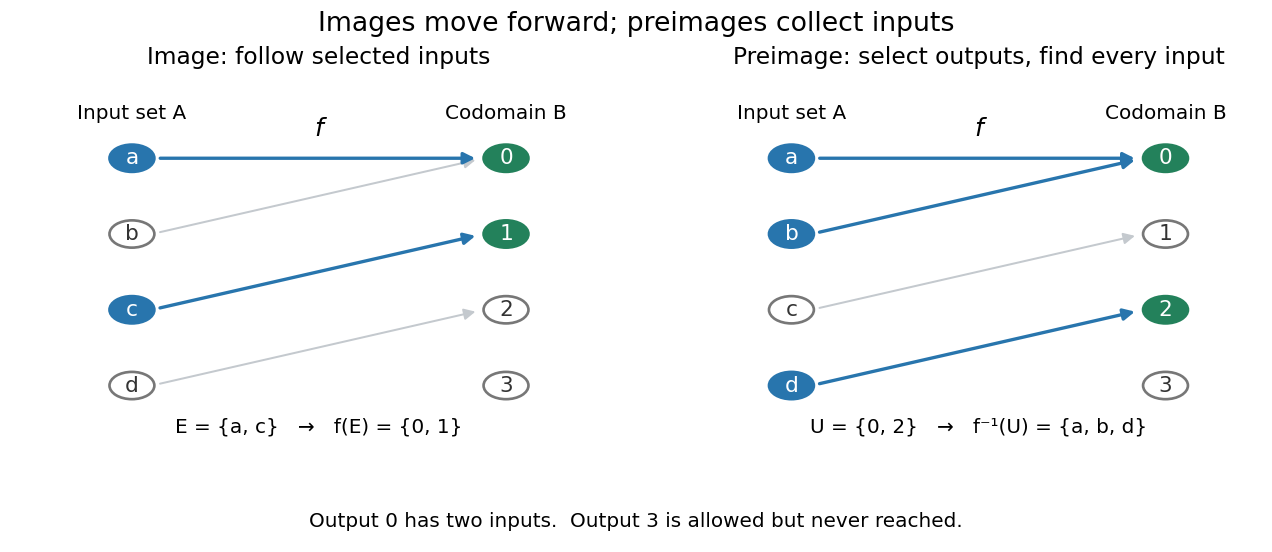
More generally, is the union of the fibers over all . The relation defined by is an equivalence relation, and its equivalence classes are precisely the nonempty fibers. The resulting quotient set is naturally in bijection with the image of a function. This links an input partition to the output values actually reached, without choosing one representative from each class.
Fibers are useful when an output is known but the input is not uniquely determined. A solution set is one fiber, and factorization through a surjection explains when another function depends only on the retained output. Quantum hidden subgroup problem algorithms use functions whose fibers are cosets, giving the same idea a structured form in group theory.
A function collision is a pair of distinct inputs with . An injective function has no collisions. For a two-to-one function every nonempty fiber has two elements and hence one unordered collision pair. Finding such a pair through an oracle is the task of quantum collision finding.
In the finite example under image and preimage of a function, the pair is a function collision: both inputs give zero. The function retains their shared output but loses the distinction between them. If a finite set has more inputs than the number of available outputs, the pigeonhole principle forces a function collision. Equal source and target cardinalities alone do not prevent one.
For a finite function, let be the cardinality of its fiber of a function over . The number of unordered function collisions is , because each pair must lie in one common fiber. The example's nonempty fiber sizes are , giving exactly one collision pair.
A set function assigns a value to each set in a specified family of sets. In finite optimization the usual form is , a real-valued function on the power set of a ground set .
For a finite set , the rule is a set function counting selected elements; instead totals their weights. A measure is also a set function, but its domain of a function is a specified collection of measurable sets, and its values can include infinity. The intended family and codomain are therefore part of the definition.
A vector-valued function is a function taking values in a vector space. For example, describes the unit circle in : one real number controls a two-component vector.
In a real or complex finite-dimensional vector space equipped with a norm, choosing a basis writes in scalar-valued functions. Continuity and differentiability can then be checked in these coordinates, and when the derivatives exist. Finitely many coordinates matter: coordinatewise convergence in an infinite-dimensional vector space need not imply norm convergence.
An accessory parameter is a coefficient not determined by the singular points and their indicial exponents. A second-order Fuchsian differential equation with exactly three regular singular points has no such independent parameter.
For integrable weak velocity derivatives on a unit-period spatial circle, the Fourier transform of a derivative gives for . Summing these modes uses . The resulting absolute Fourier summability gives the displayed uniform bound for the continuous representative of the density. For the same summation diverges, so this argument needs additional input.
A subset is a free basis of a group when the natural map from the free group on to is an isomorphism. Equivalently, generates and no nonempty freely reduced word in equals the identity. A generating set is not automatically a free basis.
In an Earth-fixed rotating reference frame, the horizontal displacement of a freely falling body receives contributions from Coriolis acceleration and centrifugal acceleration. A short-fall approximation substitutes the unperturbed downward velocity into the Coriolis term and the Earth's surface position into the centrifugal term. If gravitational acceleration excludes centrifugal acceleration, both contributions must be included explicitly.
A free-energy functional assigns a free energy to an entire spatial order parameter configuration rather than only to one uniform value. In Landau-Ginzburg theory, a local derivative expansion gives , with appropriate boundary terms and regular backgrounds. The Landau approximation minimizes this functional; a fluctuating statistical field theory instead integrates its Boltzmann weight over configurations. These procedures need not give identical critical exponents.
A nonzero element of a free abelian group is primitive when it is part of an integral basis, equivalently when some homomorphism to takes it to one. Its coordinates have greatest common divisor one. This lattice meaning differs from a primitive homology class in the coalgebra sense.
Pinned article: Introduction to the OurBigBook Project
Welcome to the OurBigBook Project! Our goal is to create the perfect publishing platform for STEM subjects, and get university-level students to write the best free STEM tutorials ever.
Everyone is welcome to create an account and play with the site: ourbigbook.com/go/register. We belive that students themselves can write amazing tutorials, but teachers are welcome too. You can write about anything you want, it doesn't have to be STEM or even educational. Silly test content is very welcome and you won't be penalized in any way. Just keep it legal!
Intro to OurBigBook
. Source. We have two killer features:
- topics: topics group articles by different users with the same title, e.g. here is the topic for the "Fundamental Theorem of Calculus" ourbigbook.com/go/topic/fundamental-theorem-of-calculusArticles of different users are sorted by upvote within each article page. This feature is a bit like:
- a Wikipedia where each user can have their own version of each article
- a Q&A website like Stack Overflow, where multiple people can give their views on a given topic, and the best ones are sorted by upvote. Except you don't need to wait for someone to ask first, and any topic goes, no matter how narrow or broad
This feature makes it possible for readers to find better explanations of any topic created by other writers. And it allows writers to create an explanation in a place that readers might actually find it.
Figure 1. Screenshot of the "Derivative" topic page. View it live at: ourbigbook.com/go/topic/derivativeVideo 2. OurBigBook Web topics demo. Source. - local editing: you can store all your personal knowledge base content locally in a plaintext markup format that can be edited locally and published either:This way you can be sure that even if OurBigBook.com were to go down one day (which we have no plans to do as it is quite cheap to host!), your content will still be perfectly readable as a static site.
- to OurBigBook.com to get awesome multi-user features like topics and likes
- as HTML files to a static website, which you can host yourself for free on many external providers like GitHub Pages, and remain in full control

Figure 2. You can publish local OurBigBook lightweight markup files to either OurBigBook.com or as a static website.
Figure 3. Visual Studio Code extension installation.
Figure 5. . You can also edit articles on the Web editor without installing anything locally. Video 3. Edit locally and publish demo. Source. This shows editing OurBigBook Markup and publishing it using the Visual Studio Code extension. 
- Infinitely deep tables of contents:



All our software is open source and hosted at: github.com/ourbigbook/ourbigbook
Further documentation can be found at: docs.ourbigbook.com
Feel free to reach our to us for any help or suggestions: docs.ourbigbook.com/#contact