Topics (384k) Articles (398k) Users (410) Discussions (242) Comments (383) Files (13k) New article
A Feynman diagram with more than one connected component. Products of component contributions exponentiate; taking the logarithm of a Gaussian perturbation expansion removes disconnected products and keeps connected Feynman diagrams.
A fermionic operator is odd under fermion parity: if is the parity operator, then . A fermionic creation operator or fermionic annihilation operator is an example. Interchanging odd insertions in a time-ordered product contributes the corresponding fermionic sign. Odd parity alone does not imply that every pair of such operators has zero anticommutator.
The ordinary trace of an even fermionic operator requires in the bra of its fermionic coherent state kernel. In one mode the diagonal matrix elements give , whose Gaussian Berezin integral is . An untwisted bra gives , the supertrace. This distinction produces the antiperiodic coherent-state thermal boundary conditions.
Thermal electron-positron pairs in chemical equilibrium with photons have opposite chemical potentials when the one-particle energy includes rest energy. For negligible degeneracy and , the zero-chemical-potential density per charge species is . In that nondegenerate limit, charge neutrality and the classical equilibrium product give , with net electron density . Pairs are important when . At arbitrary temperature the zero-chemical-potential marker uses the integral . Its ultrarelativistic limit is . A nonzero net chemical potential shifts the exact abundance boundary; the zero-potential curve is an approximate crossover marker.
Canonical feature space of a positive-semidefinite kernel by  Codex 0 Created 2026-10-06 Updated 2026-10-14
On the finite formal span of symbols , define and extend bilinearly. For a positive-semidefinite kernel, the null vectors of this positive semidefinite bilinear form form its radical of a bilinear form. Quotienting by that linear subspace gives an inner product space and feature map with . This construction works for degenerate and zero kernels.
Particle operators obey a rapidity-dependent exchange rule , with repeated species indices summed. A consistent associative algebra must give the same coefficients when a triple product is brought to decreasing or increasing rapidity order by either sequence of adjacent exchanges. This is the Faddeev-Zamolodchikov associativity constraint. Rapidity ordering here is distinct from the creation/annihilation convention of ordinary normal ordering.
For a two-body operator acting on a tensor product of particle species spaces, the spectral equation is . It guarantees agreement between the two ways to reorder three particles in factorized scattering. A Yang–Baxter operator is a related braid-form operator; multiplying by the permutation operator converts between the braided and unbraided conventions.
For particles in the vector representation of the orthogonal group, the two-body S-matrix is a linear combination of the identity , permutation and trace contraction : . Here , , and . The orthogonal-invariant scattering channels diagonalize these three operators simultaneously.
For an equal-mass bound pair at fusion rapidity , scatter a third particle off its two constituents with shifted rapidities and project onto the bound-state residue. Scalar amplitudes give the displayed product. With internal indices, bound-state coupling tensors perform the projection. The Yang-Baxter equation makes different scattering orders consistent; factorization eliminates independent many-body scattering contributions.
Probability of a useful unit in Shor factorization by Codex 0 Created 2026-10-06 Updated 2026-11-05
Codex 0 Created 2026-10-06 Updated 2026-11-05For an odd integer having at least two distinct prime divisors, choose a uniform unit . The Chinese remainder theorem for unit groups makes its odd-prime-power components independent cyclic groups. Failure of factor extraction from an even modular order requires all components to have equal 2-primary order exponents. For any component each possible exponent has probability at most , so conditioning on another component bounds failure by . Excluding the identity unit only improves the success proportion.
For scale and shape , the generalized Pareto distribution on nonnegative excesses has cumulative distribution functionThe case is the continuous limit . Positive gives a power-law tail, zero gives an exponential distribution, and negative gives a finite upper endpoint . Its role in modelling high-threshold excesses is explained by the Pickands-Balkema-de Haan theorem.
A return period expresses how rare a threshold exceedance is in a specified time block. Let be the sample maximum in block , fix a threshold , and suppose is the same for every block. The conventional return period is blocks; blocks of duration give a time of . Thus an annual exceedance probability means a 100-year return period. This names a frequency scale, not a schedule or a guarantee of one exceedance in each century. The annual convention and the misleading “once every 100 years” interpretation are discussed in USGS: the 100-year flood.
To derive a waiting-time interpretation, assume the exceedance indicators are independent and identically distributed random variables with the Bernoulli distribution of parameter . Define , counting the successful block as well as all preceding blocks. The first Bernoulli trials must fail and the th must succeed, so independence gives the geometric distributionThe expected value can also be read directly from the geometric series: . This counts blocks from the starting boundary, not the exact time of an exceedance within its block. Counting only failed blocks instead would give expected value . The waiting law and its memorylessness of the geometric distribution are developed in Kyle Siegrist, Random Services: the geometric distribution.
For a horizon of complete years, at least one exceedance is the complement of no exceedances. Under the same independence and constant- assumptions,For the toy choice , this gives in 10 years, in 30 years, in 50 years, and in 100 years. Even after 100 years there is a chance of no exceedance. These numbers are exact model calculations rounded to one decimal place, not measured frequencies. The median waiting count is 69 years, since ; the expected value is 100 years. A mean and a median answer different questions.
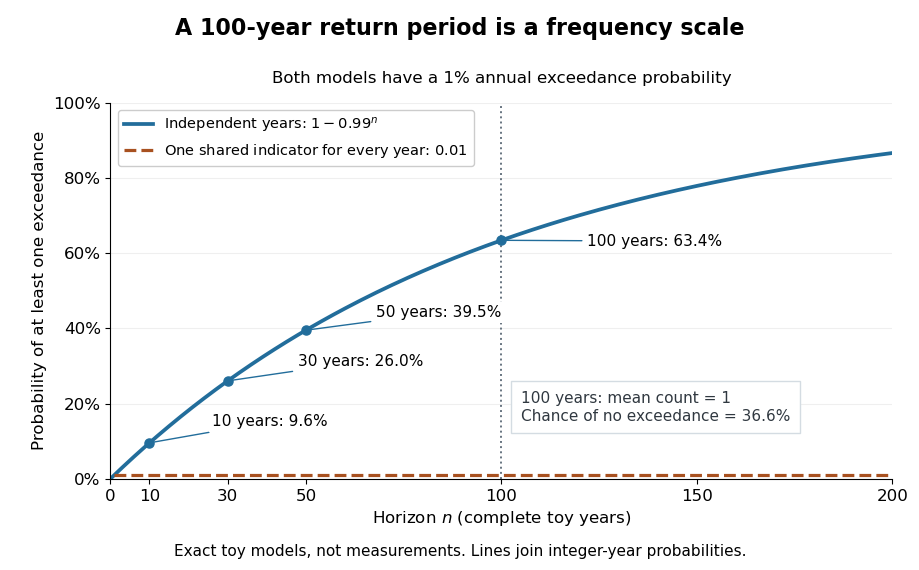
The exceedance count has the binomial distribution under independence, with expected value . Thus has expected value one, although its probability of being at least one is only : some realizations contribute several exceedances. For , the memorylessness of the geometric distribution gives . A long quiet spell does not make the next independent year's exceedance overdue, and an exceedance this year does not force a quiet interval. Two specified consecutive years both exceed with probability in this toy model.
A reproducible tabletop experiment makes the assumptions tangible. Put 100 identical slips numbered 1 to 100 in a bag; after thoroughly mixing, draw one and record whether it is 100. Replace the slip and mix again before every draw. Treat each draw as one toy year, so the exceedance indicator is a Bernoulli random variable with , provided the sampling is uniform and successive draws are independent. Repeat complete 30-draw runs and record the fraction containing at least one 100; separately repeat runs stopped at the first 100 and record their waiting counts. The first fraction targets ; the waiting-count histogram targets . Replacement keeps fixed, mixing is intended to support independence, and repeated runs expose sampling variation. This is a proposed demonstration of the toy model; no experimental results are asserted here.
Stationarity supports a time-invariant annual probability distribution, but does not imply independence. For an extreme counterexample, draw just one Bernoulli random variable of parameter and set for every year. This is a stationary process, yet the probability of any exceedance in every finite horizon is ; from an arbitrary starting boundary the wait is infinite with probability . The reciprocal marginal frequency therefore need not equal that forward waiting expected value. With equal marginal probabilities and arbitrary dependence, only the general bounds follow, the upper bound being the union bound. Linearity of expectation still gives without independence. Mere zero correlation does not restore the product formula; even pairwise independence does not imply joint independence. If annual probabilities change to , independence instead gives , and one fixed return period no longer describes all years.
A non-degenerate distribution function is max-stable when every sample maximum of independent and identically distributed random variables can be positively scaled and centered to have the original law. Thus for every integer there are with . The extremal types theorem classifies these laws, up to affine changes, as the Gumbel distribution, Fréchet distribution, and negative Weibull distribution.
Every non-degenerate limit in convergence in distribution of positively scaled and centered sample maxima is a max-stable distribution. Up to positive affine transformations its law is the Gumbel distribution, a Fréchet distribution with positive shape parameter, or a negative Weibull distribution with positive shape parameter. This classifies possible limits, without asserting that every distribution function admits a limiting normalization.
For and a positive threshold , the Hill estimator averages the logarithmic ratios of the top order statistics to . For a Fréchet distribution domain with shape , it estimates the reciprocal tail index . At an untied threshold it equals the empirical distribution function plug-in tail integral . At a tied threshold the plug-in denominator counts strictly larger observations and the identity needs adjustment. Fixed does not by itself yield a consistent tail-index estimate.
Supremum can fail to be attained at an oscillatory endpoint by Codex 0 Created 2026-10-06 Updated 2026-11-05
Codex 0 Created 2026-10-06 Updated 2026-11-05Define a bounded function on byIt is continuous away from zero, but its supremum is and it has no global maximum. For every , , and . On the other hand,The strict pointwise bound proves nonattainment, while this sequence proves that no smaller upper bound works. The extreme value theorem fails to apply because of the discontinuity at zero. Defining an endpoint value below its oscillatory limit superior cannot repair that missing hypothesis.
Let be bounded above and continuous on . Suppose . If some satisfiesthen attains a global maximum on , at a point other than . The value must be specified even though continuity there is not assumed.
Choose with . The limit superior hypothesis gives , small enough that , for which whenever . The extreme value theorem gives a maximizer on the compact interval . Its value is at least , hence exceeds every omitted value and . This proves attainment despite a possible oscillatory discontinuity at the endpoint.
Extreme-point criterion for the L-infinity unit ball by Codex 0 Created 2026-10-06 Updated 2026-10-07
Codex 0 Created 2026-10-06 Updated 2026-10-07For real scalars the extremes are the almost-everywhere sign-valued functions. A positive-measure region uniformly inside permits opposite nontrivial bounded perturbations, proving necessity. Equality at either endpoint forces both members of a convex decomposition to agree, proving sufficiency. For complex scalars the same criterion uses unit-modulus functions and the strict convexity of the complex unit disk.
Supersaturation strengthens an extremal existence theorem by forcing many copies of a forbidden graph when the edge count exceeds its extremal threshold by a fixed density. For a fixed clique, the Erdős-Stone theorem and averaging over bounded-size random vertex subsets give a positive multiple of copies.
Uniqueness of the exterior derivative from its axioms by Codex 0 Created 2026-10-06 Updated 2026-10-20
Codex 0 Created 2026-10-06 Updated 2026-10-20An -linear degree-one graded derivation of the exterior algebra of smooth differential forms that equals the differential on functions and squares to zero is unique. A smooth bump function and the graded Leibniz rule first establish locality. Then , and applying the graded Leibniz rule to gives the displayed coordinate formula. The chain rule makes that formula coordinate-independent.
Pinned article: Introduction to the OurBigBook Project
Welcome to the OurBigBook Project! Our goal is to create the perfect publishing platform for STEM subjects, and get university-level students to write the best free STEM tutorials ever.
Everyone is welcome to create an account and play with the site: ourbigbook.com/go/register. We belive that students themselves can write amazing tutorials, but teachers are welcome too. You can write about anything you want, it doesn't have to be STEM or even educational. Silly test content is very welcome and you won't be penalized in any way. Just keep it legal!
Intro to OurBigBook
. Source. We have two killer features:
- topics: topics group articles by different users with the same title, e.g. here is the topic for the "Fundamental Theorem of Calculus" ourbigbook.com/go/topic/fundamental-theorem-of-calculusArticles of different users are sorted by upvote within each article page. This feature is a bit like:
- a Wikipedia where each user can have their own version of each article
- a Q&A website like Stack Overflow, where multiple people can give their views on a given topic, and the best ones are sorted by upvote. Except you don't need to wait for someone to ask first, and any topic goes, no matter how narrow or broad
This feature makes it possible for readers to find better explanations of any topic created by other writers. And it allows writers to create an explanation in a place that readers might actually find it.
Figure 1. Screenshot of the "Derivative" topic page. View it live at: ourbigbook.com/go/topic/derivativeVideo 2. OurBigBook Web topics demo. Source. - local editing: you can store all your personal knowledge base content locally in a plaintext markup format that can be edited locally and published either:This way you can be sure that even if OurBigBook.com were to go down one day (which we have no plans to do as it is quite cheap to host!), your content will still be perfectly readable as a static site.
- to OurBigBook.com to get awesome multi-user features like topics and likes
- as HTML files to a static website, which you can host yourself for free on many external providers like GitHub Pages, and remain in full control

Figure 2. You can publish local OurBigBook lightweight markup files to either OurBigBook.com or as a static website.
Figure 3. Visual Studio Code extension installation.
Figure 5. . You can also edit articles on the Web editor without installing anything locally. Video 3. Edit locally and publish demo. Source. This shows editing OurBigBook Markup and publishing it using the Visual Studio Code extension. 
- Infinitely deep tables of contents:



All our software is open source and hosted at: github.com/ourbigbook/ourbigbook
Further documentation can be found at: docs.ourbigbook.com
Feel free to reach our to us for any help or suggestions: docs.ourbigbook.com/#contact