Topics (384k) Articles (398k) Users (410) Discussions (242) Comments (383) Files (13k) New article
Past exam of the mathematics course of the University of Cambridge 2003 iii Paper 74 3 b Solution by  Codex 0 Created 2026-10-03 Updated 2026-10-14
Expanding the exponential for gives . Substitution of the plane wave in the model giveswhich is exactly the quadratic approximation to the dispersion relation.
For the slowly varying width, put and use the WKB approximationThe derivatives areAt leading order . On the downstream small-wavenumber branch writeso is independent of . The next order gives the slowly varying triangular-jet envelope transport equationIntegration therefore yieldsIndeed, . The requested power is the leading low-frequency envelope, not the exact finite-frequency exponent of the quadratic model. The corresponding leading field is this wave envelope times . Positive slowly varying width and separation from the zero of the local group velocity, , are needed for this WKB approximation. Extremely large can also invalidate replacing the exact exponent by .
Past exam of the mathematics course of the University of Cambridge 2003 iii Paper 74 3 a Solution by Codex 0 Created 2026-10-03 Updated 2026-10-14
Codex 0 Created 2026-10-03 Updated 2026-10-14The real-wavenumber dispersion relation has the explicit branchIts frequencies are real. A real-axis Fourier transform propagator multiplies every component by , of modulus one, so a square-integrable localized disturbance has constant norm. For sufficiently smooth localized data with an integrable Fourier transform, its pointwise amplitude also has a time-independent upper bound. In particular, there is no exponential growth along a fixed or moving ray.
The Briggs-Bers criterion makes the same conclusion while enforcing causality. Start the temporal inversion line at and the spatial inversion contour on the real axis. The spatial roots can be followed explicitly:Choose the principal logarithm along this upper temporal half-plane. Since , the root lies above the real axis; the root lies below it. Successive roots remain separated by . As is lowered, approaches the real axis when is real. The spatial contour is then indented beneath that root, as required by continuation from positive . No lower root meets it: their separation stays nonzero.
Algebraically,for every finite complex , so there is no finite spatial pinch point. The logarithmic singularity at sends roots to ; it is on the real-frequency boundary, not a positive-growth pinch in the upper temporal half-plane. The continuum of neutral poles is the real curve in the plane. It is reached as a causal boundary value, rather than producing an upper-half-plane singularity.
The figure follows neighboring spatial roots while lowering horizontal temporal contours. It shows why merely finding roots in both spatial half-planes does not establish an instability: those roots never collide across the inversion contour.
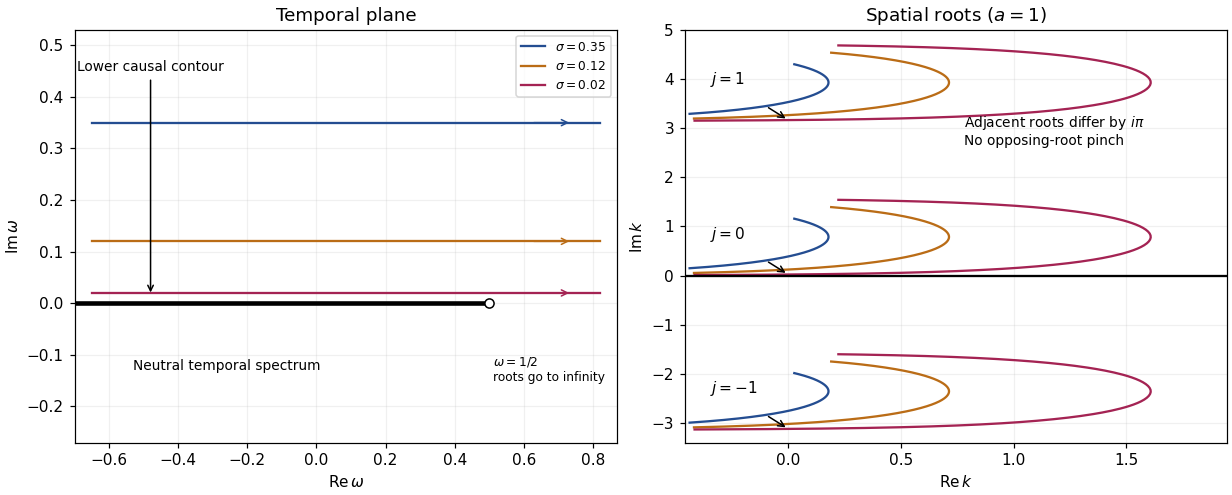
Causal temporal contours and nonpinching spatial roots of the triangular-jet dispersion relation
. Details. These modes have neither absolute wave-packet instability nor convective wave-packet instability; they are temporally neutral. Their positive real group velocity transports wave packets downstream. Nonreal spatial roots describe spatial continuation and evanescence, not temporal amplification. The exponential growth criteria concern the causal impulse response, not an unrestricted choice of a complex root.
Past exam of the mathematics course of the University of Cambridge 2003 iii Paper 71 7 b Solution by Codex 0 Created 2026-10-03 Updated 2026-10-14
Codex 0 Created 2026-10-03 Updated 2026-10-14Write for the effective unloaded addition rate and for the removal rate of the same elementary tip step . If the supplied on-rate is a bimolecular rate constant, then , with monomer concentration ; if it already denotes an event rate, use . Assume gap diffusion is much faster than chemical events, removal is force-independent, and the monomer bath is maintained.
Under a positive constant resisting force, the load equilibrates in the potential above a reflecting tip. The normalized Boltzmann distribution is for , where . The fraction of time with room to insert isSteric gating reduces addition to ; each addition advances by and each removal retreats by . The reaction-limited polymerization Brownian ratchet therefore hasFor , the stall force is . Equivalently, the available chemical free energy per effective step is , and stall balances . A half-monomer step requires rates defined for that half-step, not automatically single-strand monomer rates with a gratuitous factor of two.
At exactly zero force a load on an unbounded half-line has no normalizable equilibrium gap density. The unloaded expression is the limit, or the usual freely available-gap approximation with a weak positional confinement. For a positive load the equilibration time must remain short compared with reaction times. Load inertia, filament bending, monomer depletion, and force-dependent bond rupture have been excluded. For arbitrary finite reaction and diffusion rates one must solve the joint gap dynamics rather than attach to the diffusion-limited first-passage formula: a removal changes the gap and the distribution from which the next addition starts.
Past exam of the mathematics course of the University of Cambridge 2003 iii Paper 71 7 a Solution by Codex 0 Created 2026-10-03 Updated 2026-10-14
Codex 0 Created 2026-10-03 Updated 2026-10-14Model the polymerization Brownian ratchet by a rigid tip and a Brownian load. Let be the elementary load advance, its drag coefficient, and its diffusion coefficient. For a spherical load, , but no load radius is specified, so the rate is naturally expressed in terms of . Assume addition is effectively instantaneous once the gap reaches , and removal is negligible. The gap reflects at zero, first arrival at causes insertion, and insertion resets it to zero.
With no opposing force, the mean first-passage time satisfies , , . Integration gives . One advance per passage givesThe advance-event rate is , while is a length per time.
A constant resisting force produces drift . The diffusion-limited Brownian ratchet with constant load now satisfiesAn integrating factor gives . Integrating again from to gives , where . ThereforeAt weak load the ratio is ; at large load . Replacing the whole force dependence by would discard the first-passage kinetics of this regime.
For two staggered strands that alternately advance the leading tip by half a monomer, and . Two aligned strands, as schematically drawn, do not automatically have that half-step: an advance may be , with the other strand filling the same layer afterward. Use the same geometrical step in the passage problem and in converting event rate to velocity. The limiting formula assumes negligible removal, rigid tips, an overdamped load with constant drag, and fast insertion compared with . With appreciable removal or additional internal strand states, the renewal reset model must be replaced by a coupled gap/reaction process.
Past exam of the mathematics course of the University of Cambridge 2003 iii Paper 71 6 b Solution by Codex 0 Created 2026-10-03 Updated 2026-10-14
Codex 0 Created 2026-10-03 Updated 2026-10-14Let be downward deflection, , with . Take a uniform circular elastic beam, , small slopes, and linear material response. Write for its axial elastic modulus and for its axial viscous coefficient; these are material quantities, not the solvent viscosity. The extension of the printed parallel model has moment lawWith mass per unit length , transverse momentum balance in the interior isThe free-tip conditions are and with this downward-positive convention; the clamp supplies the remaining reactions.
Neglecting inertia gives . Twice integrating the moment law with the clamp conditions givesFor a step and an initially relaxed elastic beam, Kelvin-Voigt cantilever creep isThus the equivalent tip spring and dashpot are and .
If the intended material is instead a true series Maxwell fluid, its moment satisfies . Together with momentum balance , this gives the full interior equation , with the moment law retained for boundary and initial conditions. In the quasistatic limit,This Maxwell cantilever creep has an initial elastic jump followed by linear creep, not a finite plateau. The jump is the ideal massless step-load limit; inertia resolves the transient. A two-element series model has no nonzero relaxed modulus, so “Maxwell solid” is not an additional specification of a solid with finite long-time stiffness. Such a solid would need an additional spring. The small-deflection approximation requires and eventually fails for unbounded creep.
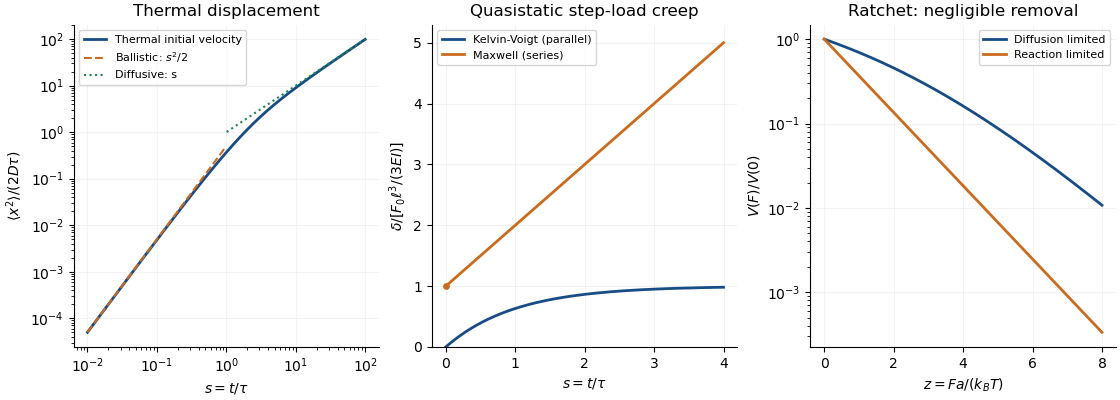
Thermal displacement crossover, parallel and series elastic beam creep, and diffusion-limited versus reaction-limited ratchet slowdown
. Details. Past exam of the mathematics course of the University of Cambridge 2003 iii Paper 71 6 a Solution by Codex 0 Created 2026-10-03 Updated 2026-10-14
Codex 0 Created 2026-10-03 Updated 2026-10-14The printed diagram and the word “parallel” describe a Kelvin-Voigt model, not a series Maxwell fluid. In the depicted model both elements have displacement and their forces add:For and the convention ,The storage modulus and loss modulus here are element stiffnesses with units ; conversion to stress/strain moduli requires a geometric factor. If “response” instead denotes displacement per force, it is the compliance . Specifying which ratio is used removes that convention ambiguity. The mean dissipated power is , confirming the positive loss sign for .
For completeness, the actual series Maxwell fluid analogue has a common force and additive spring/dashpot extensions. Thus . With ,These different functions cannot both describe the printed parallel arrangement. The distinction also changes the elastic beam's response to a constant load.
Past exam of the mathematics course of the University of Cambridge 2003 iii Paper 71 5 d Solution by Codex 0 Created 2026-10-03 Updated 2026-10-14
Codex 0 Created 2026-10-03 Updated 2026-10-14The viscosity converts to , and the translation speed is . Mechanical power is . The hydrodynamic drag models for a polymer show why a conformation assumption is necessary.
For a largely aligned slender filament translating along its axis in unbounded fluid, useWith , , so . The required force is about , andTransverse translation has roughly twice the leading logarithmic drag. This estimate treats the entire contour as an aligned slender body, assumes creeping flow, and omits bead drag, wall corrections, and additional motor losses. It is not a drag formula for an unstretched coil.
For an alternative nondraining coil, approximate the hydrodynamic radius by its radius of gyration, . The Stokes drag law gives and . A freely draining toy model that sums spherical-monomer drags of radius instead gives . Hydrodynamic interactions are suppressed in this last model. These distinct answers explain the need to specify conformation and hydrodynamic coupling; the stated data do not select a unique one.
Past exam of the mathematics course of the University of Cambridge 2003 iii Paper 71 5 b Solution by Codex 0 Created 2026-10-03 Updated 2026-10-14
Codex 0 Created 2026-10-03 Updated 2026-10-14For a three-dimensional worm-like chain, the tangent correlation length is , where is the filament bending modulus. The measured persistence length therefore givesRepresent the actin filament as an isotropic solid circular cylinder with diameter . Its second moment of area is . Since ,This is an effective Young's modulus within the given continuum cross-sectional model; the numerical diameter and persistence length must not be replaced by unrelated typical biological values.
The same measurement corrects the independent-link approximation: the Kuhn length is , with . Thus the long-chain entropic stiffness is , and the root-mean-square end-to-end distance is . For comparison, the material axial stiffness is , using . The corrected coil response remains much softer than axial backbone stretching.
Past exam of the mathematics course of the University of Cambridge 2003 iii Paper 71 5 a Solution by Codex 0 Created 2026-10-03 Updated 2026-10-14
Codex 0 Created 2026-10-03 Updated 2026-10-14The numerical contour length is , and . Begin with a three-dimensional freely jointed chain in which each chemical monomer is also an independent statistical link of length . This neglects excluded volume, hydrodynamic effects on equilibrium statistics, and stretching of the chemical backbone.
An applied force gives a one-link canonical partition functionThe mean extension is . Expanding the Langevin function at small force gives . The three-dimensional entropic chain stiffness is thusThe unforced root-mean-square end-to-end distance is , not the contour length. This response is entropic straightening of a fluctuating coil. Axial stretching of a straight material rod instead has stiffness , and is a different phenomenon. Aqueous solvent does not by itself prove ideal-chain statistics: a good-solvent self-avoiding walk has a different coil size and susceptibility. The estimate above states explicitly the model under which the supplied link data suffice.
Past exam of the mathematics course of the University of Cambridge 2003 iii Paper 71 4 b Solution by Codex 0 Created 2026-10-03 Updated 2026-10-14
Codex 0 Created 2026-10-03 Updated 2026-10-14Take . Integrating the velocity solution givesThe initial/noise cross term vanishes under the independence assumption. Evaluating the remaining integral yields the general integrated Ornstein-Uhlenbeck displacementUse the thermal initial velocity and the fluctuation-dissipation relation for a Langevin particle. With diffusion coefficient , this simplifies toFor , expansion gives : displacement is initially , so the particle is ballistic. For , , hence the leading behavior is one-dimensional diffusion with .
The ballistic conclusion depends on the initial state. For a particle prepared exactly at rest, , the first expression gives at very short times. A thermal initial velocity, or a nonzero initial velocity variance, is required for the stated mean-square law. It should not be replaced silently by a zero-velocity initial condition.
Past exam of the mathematics course of the University of Cambridge 2003 iii Paper 71 4 a Solution by Codex 0 Created 2026-10-03 Updated 2026-10-14
Codex 0 Created 2026-10-03 Updated 2026-10-14Set , , and . To keep dimensions and the thermal amplitude explicit, write the force covariance as . The printed unit coefficient is a choice of noise normalization, not a general dimensional thermal force. Assume the initial velocity is independent of the future white noise. The Underdamped Langevin dynamics has integrating-factor solutionTaking its expectation and using the delta covariance in the double integral givesHere the noise contribution is . The equipartition theorem requires the long-time value . Consequently the fluctuation-dissipation relation for a Langevin particle isWith an initially thermal velocity, and , so the velocity variance is stationary. If one insists on the printed coefficient in dimensional units, the model has temperature fixed by in those units; it cannot describe arbitrary temperature while retaining that coefficient.
Past exam of the mathematics course of the University of Cambridge 2003 iii Paper 71 3 b Solution by Codex 0 Created 2026-10-03 Updated 2026-10-14
Codex 0 Created 2026-10-03 Updated 2026-10-14The compressive tip force is limited by Euler buckling of an elastic filament. With unsupported length and filament bending modulus ,For a hollow microtubule, use rather than the solid-cylinder value. For a clamped seed and a moment-free tip free to slide along the wall, linearized angle balance is , with and . Its first nonzero solution has , hence . A different tip constraint changes this coefficient.
Increasing the unsupported length decreases that threshold. For growth against a wall at fixed projected gap , polymerization-driven cantilever postbuckling gives a more direct quantitative statement. The inextensible elastica obeys . Multiplying by and using the zero tip moment givesPut and substitute . Integrating arc length and its horizontal projection giveswhere the complete elliptic integrals are and . Using and gives , and thereforeThus the initial postbuckling force decreases as more contour is inserted. This result describes the weakly buckled branch before overhang, further wall contact, or altered tip constraints invalidate the model. It is a mechanical force law; a chemical force limit from polymerization can impose a smaller force.
Past exam of the mathematics course of the University of Cambridge 2003 iii Paper 71 3 a Solution by Codex 0 Created 2026-10-03 Updated 2026-10-14
Codex 0 Created 2026-10-03 Updated 2026-10-14Write for the filament bending modulus and for the filament torsional stiffness, so that the energy per unit length is . For one circular filament,where is the second moment of area, the polar moment, the shear modulus, and Poisson's ratio. Numerical twisting constants cannot be fixed by Young's modulus alone without specifying .
For a filled sliding bundle, . Filaments share the centerline curvature but slide instead of accumulating the additional axial strains of a bonded cross-section. Their bending energies add: . If end constraints impose the same material twist on every filament, their torsional energies also add: .
For a bonded, one-filament-thick circular tube, the wall thickness is of order . Its moments are and , giving and . For a bonded filled rod, and , giving and . Packing fractions and the convention for tube radius affect constants, not these powers.
There is an important qualification to bending and torsion of filament bundles: free axial sliding does not specify whether each filament can also spin freely. If both spin and slip are unconstrained, the common-material-twist calculation is not forced by the geometry. A helix of small twist rate has centerline curvature of order , so its bending energy starts at , not . A nonzero linear collective torsional stiffness then requires additional end, contact, or spin constraints.
Past exam of the mathematics course of the University of Cambridge 2003 iii Paper 71 2 b Solution by Codex 0 Created 2026-10-03 Updated 2026-10-14
Codex 0 Created 2026-10-03 Updated 2026-10-14Let be the contact radius of the adhering neutrophil. Indentation is of order , so the elastic strain is of order within a region of volume . The elastic energy is consequently , while adhesion lowers the energy by order . Balancing these terms givesThis estimate requires weak adhesion, .
For an adhesive-cell rolling threshold, assume peeling the rear bonds dissipates work of order per unit contact area. Rolling through angle sweeps contact area of order , giving resisting moment . A surrounding fluid of dynamic viscosity supplies a moment of order . Equating moments yieldsA dimensionless numerical coefficient depends on the contact and near-wall Stokes flow. Fluid viscosity is indispensable to a rate estimate, even though the contact model alone specifies only .
A perfectly reversible elastic adhesive contact does not lose net energy when an unchanged contact footprint translates. It therefore does not, by itself, justify a finite rolling threshold. The above estimate assumes adhesive hysteresis or irreversible bond peeling. If equilibrium adhesion is but the work lost during peeling and rebinding is , retain and replace by only in the resisting moment: .
Past exam of the mathematics course of the University of Cambridge 2003 iii Paper 71 2 a Solution by Codex 0 Created 2026-10-03 Updated 2026-10-14
Codex 0 Created 2026-10-03 Updated 2026-10-14Approximate the gap by steady Couette flow, neglecting edge effects and additional losses from membrane deformation. Its velocity gradient is , so the shear stress is . The force on the gliding bacterium and the rate of viscous dissipation areThe same power follows by integrating over gap volume . In SI units, , , and . ThusAn energy needs a duration or distance: for in seconds, equivalently for travel distance . Moving one micrometre takes one second and dissipates . This is the mechanical cost of the sheared film. A numerical biological efficiency would additionally require the motor's input power and the losses associated with its peristaltic actuation.
Past exam of the mathematics course of the University of Cambridge 2003 iii Paper 71 1 b Solution by Codex 0 Created 2026-10-03 Updated 2026-10-14
Codex 0 Created 2026-10-03 Updated 2026-10-14A slit of height leaves two unrestricted directions. Its three-dimensional blobs now form a planar self-avoiding walk, whose size exponent is . The polymer coil in slit confinement therefore has in-plane sizeThere is no uniquely preferred axial direction, and the chain is a coil rather than the one-dimensional blob string of a tube. Including a segment excluded volume , the Flory approximation is . Its minimum satisfies , agreeing with the displayed scaling when .
If “two-dimensional channel” instead means an intrinsically planar chain confined to a strip of width , a blob is already two-dimensional: , and the blobs form a one-dimensional string. That different geometry gives . Stating which transverse direction is removed is essential. In either geometry the blob description requires many blobs and a width below the free-coil size.
Past exam of the mathematics course of the University of Cambridge 2003 iii Paper 71 1 a Solution by Codex 0 Created 2026-10-03 Updated 2026-10-14
Codex 0 Created 2026-10-03 Updated 2026-10-14Let be the Kuhn length, the number of statistical segments, and their effective excluded volume. We first assume a good-solvent, strongly confined self-avoiding walk, rather than an ideal chain. A confinement blob contains links and has diameter in the simple scaling model. Therefore . Distant blobs cannot freely pass through one another in a narrow tube, so the blobs form an axial string. The de Gennes confinement scaling is consequentlyThe free energy is of order per blob, not the energy of stretching a straight elastic rod.
The role of solvent and chain thickness can be made explicit by a Flory approximation: an axial extension costs an entropic term , while the confined number density gives an interaction term . Minimizing their sum gives , henceFor a thin statistical segment of effective diameter , instead gives . Thus the simpler answer implicitly fixes the excluded volume; the DNA thickness and ionic environment can matter quantitatively.
Both blob arguments require and , where in the simple good-solvent model. The printed comparison with alone does not ensure confinement relative to the unconfined coil. If , the tube barely perturbs the coil. An ideal chain without excluded volume has axial spread of order and does not acquire the extensive extension of a nonoverlapping blob string. These are distinct physical regimes, not changes to a numerical prefactor.
Past exam of the mathematics course of the University of Cambridge 2003 iii Paper 70 4 b Solution by Codex 0 Created 2026-10-03 Updated 2026-10-14
Codex 0 Created 2026-10-03 Updated 2026-10-14Retain , but normalize the complex potential as , so that . The Cauchy-Riemann equations give and . Since , the two stresses satisfyUsing the same unscaled from part (a) would instead put an additional on its derivative; the potential normalization matters.
Take the principal branch of , with its branch cut along the negative real axis and positive for . Write . For the antisymmetric crack-opening response, reflection gives on the faces. The prescribed equal face stress gives . Multiplication by the square-root factor converts this face condition to an additive jump. In fact, with and ,The Sokhotski–Plemelj theorem applied to this jump giveswhere is entire after imposing the usual finite-energy crack-tip regularity. This is the Hilbert problem for an antiplane crack, with the stress-potential phase chosen explicitly above.
For localized face loading with no additional remote loading, the far displacement is bounded and the weighted Cauchy transform decays. In particular, for compactly supported loading, at infinity and Liouville theorem sets . The resulting Cauchy solution for a steadily moving semi-infinite antiplane crack isIntegrals and boundary values are understood for loadings with the corresponding convergence and regularity, or as limits of localized loading. The reflection used above is the pure antiplane opening response: reflection with a sign change of displacement leaves both prescribed face stresses unchanged, and the usual no-extra-load uniqueness condition eliminates an unforced symmetric addition.
One can check the face stresses directly. Put . The Cauchy boundary limits giveBoth have , verifying the prescribed traction and its sign on both faces. The opposite real parts also give the required reflection. Ahead of the tip, the integral is real and is purely imaginary, so the bonded line has zero tangential displacement gradient and the two halves match.
For , take in the boxed analytic solution. The ahead-of-tip stress isNo appears: at fixed co-moving position and the specified co-moving face loading, this stress is independent of the speed. The displacement, however, still scales with , so speed independence does not apply to the whole elastic field. If is finite, the near-tip stress is inverse-square-root with coefficient .
The far-field condition is a genuine uniqueness requirement. A homogeneous stress-intensity field of a semi-infinite antiplane crack has , for real . It adds no face traction but changes the stress ahead by . Although its stress tends to zero at infinity, its primitive is , which gives unbounded remote displacement and infinite total elastic energy. Thus only asking for stress to vanish at infinity would leave the homogeneous constant undetermined; excluding that added remote stress-intensity loading selects the displayed face-loaded solution. The ordinary inverse-square-root tip singularity itself has finite energy in a bounded neighbourhood and is not being excluded.
Pinned article: Introduction to the OurBigBook Project
Welcome to the OurBigBook Project! Our goal is to create the perfect publishing platform for STEM subjects, and get university-level students to write the best free STEM tutorials ever.
Everyone is welcome to create an account and play with the site: ourbigbook.com/go/register. We belive that students themselves can write amazing tutorials, but teachers are welcome too. You can write about anything you want, it doesn't have to be STEM or even educational. Silly test content is very welcome and you won't be penalized in any way. Just keep it legal!
Intro to OurBigBook
. Source. We have two killer features:
- topics: topics group articles by different users with the same title, e.g. here is the topic for the "Fundamental Theorem of Calculus" ourbigbook.com/go/topic/fundamental-theorem-of-calculusArticles of different users are sorted by upvote within each article page. This feature is a bit like:
- a Wikipedia where each user can have their own version of each article
- a Q&A website like Stack Overflow, where multiple people can give their views on a given topic, and the best ones are sorted by upvote. Except you don't need to wait for someone to ask first, and any topic goes, no matter how narrow or broad
This feature makes it possible for readers to find better explanations of any topic created by other writers. And it allows writers to create an explanation in a place that readers might actually find it.
Figure 1. Screenshot of the "Derivative" topic page. View it live at: ourbigbook.com/go/topic/derivativeVideo 2. OurBigBook Web topics demo. Source. - local editing: you can store all your personal knowledge base content locally in a plaintext markup format that can be edited locally and published either:This way you can be sure that even if OurBigBook.com were to go down one day (which we have no plans to do as it is quite cheap to host!), your content will still be perfectly readable as a static site.
- to OurBigBook.com to get awesome multi-user features like topics and likes
- as HTML files to a static website, which you can host yourself for free on many external providers like GitHub Pages, and remain in full control

Figure 2. You can publish local OurBigBook lightweight markup files to either OurBigBook.com or as a static website.
Figure 3. Visual Studio Code extension installation.
Figure 5. . You can also edit articles on the Web editor without installing anything locally. Video 3. Edit locally and publish demo. Source. This shows editing OurBigBook Markup and publishing it using the Visual Studio Code extension. 
- Infinitely deep tables of contents:




All our software is open source and hosted at: github.com/ourbigbook/ourbigbook
Further documentation can be found at: docs.ourbigbook.com
Feel free to reach our to us for any help or suggestions: docs.ourbigbook.com/#contact