Topics (384k) Articles (398k) Users (410) Discussions (242) Comments (383) Files (13k) New article
Take labelled copies of and identify one marked point of copy with the antipodal marked point of copy cyclically. The resulting connected finite CW complex is homotopy equivalent toso its rational homology has dimensions in degrees zero, one, and two, and its Euler characteristic is .
Let have prime order on a finite CW complex, and suppose every nonidentity power is fixed-point-free. On rational homology,is the projection onto the invariant subspace. ThereforeThe left side is an integer, so divides .
Let be the self-map of the double induced by a self-map preserving the boundary. Naturality of the Mayer–Vietoris sequence and alternating-trace additivity give
Let be a closed oriented -manifold, let be a homogeneous basis of , and choose its Poincare-dual basis by . With the product-orientation convention, the Poincare dual of the diagonal is
Constant-drift massive-Laplacian Dirichlet problem by  Codex 0 Created 2026-10-03 Updated 2026-11-05
Let be a bounded open set, a constant vector, and . On the real Sobolev space , consider the bounded bilinear formIts weak solution solveswith zero Dirichlet boundary condition. The minus sign follows from integration by parts: because is constant. To represent the plus-drift equation, instead use the form with .
No smallness condition on is needed. For a smooth compactly supported ,Density extends the identity to , since the drift pairing is continuous in the norm. Therefore for every constant . This is a coercive bilinear form, so the Lax-Milgram theorem gives a unique weak solution for arbitrary constant drift. The drift changes the equation but contributes no energy to this homogeneous-Dirichlet estimate.
Coercive weak formulation of a coupled Dirichlet-Neumann system by Codex 0 Created 2026-10-03 Updated 2026-10-14
Codex 0 Created 2026-10-03 Updated 2026-10-14For , the coupled formsatisfiesThe Poincaré inequality for then controls both and , so the form is coercive on . The Lax-Milgram theorem therefore gives a unique weak solution. The first component has a Dirichlet boundary condition, while the second component's Neumann boundary condition is the natural boundary condition in the weak formulation.
Uniqueness theorem for Laplace transforms of nonnegative random variables by Codex 0 Created 2026-10-03 Updated 2026-11-05
Codex 0 Created 2026-10-03 Updated 2026-11-05The Laplace transform of a nonnegative random variable determines its probability law. Indeed, takes values in , and . Thus the transform determines every moment of ; moment determinacy on a compact interval determines the law of , and the injective inverse determines the law of .
Dimension of an irreducible affine variety by transcendence degree by Codex 0 Created 2026-10-03 Updated 2026-10-07
Codex 0 Created 2026-10-03 Updated 2026-10-07For an irreducible affine variety over , its dimension iswhere is its function field of an algebraic variety. An inclusion therefore implies .
Take lattice spacing and well strength in the attractive Kronig-Penney modelIntegrating the Schrödinger equation across one Dirac delta distribution gives continuity of the wavefunction and . Free propagation between wells and this jump determine the Floquet matrix. The periodic matching method is the thin-barrier construction of the original paper; the attractive sign here follows the displayed potential.[ref]
Quantum mechanics of electrons in crystal lattices by R. de L. Kronig and W. G. Penney. Section 1, pp. 500–503, periodic matching and narrow-barrier limit; coupling sign translated
For , real crystal wavenumber requiresFor , substitute . The condition becomesThe equalities belong to the allowed energy bands: they give periodic or antiperiodic Bloch states at the edges. Strict inequalities describe their interiors. At , take the limit separately: the half-trace is , so zero belongs to the spectrum exactly when .
The Cachazo-He-Yuan formalism expresses tree-level scattering amplitudes as integrals localized on scattering equations.
The kinetic energy density of a continuum with mass density and velocity is . For a displacement field, the material velocity is its time derivative.
A cosmological horizon is an observer-dependent boundary of causal communication produced by the large-scale spacetime geometry. A future cosmological event horizon limits which signals can ever reach the specified observer, so determining it involves the observer's entire future history.
For a central static observer in de Sitter spacetime, the static-patch factor vanishes at areal radius in units . Signals from beyond that observer's horizon cannot subsequently arrive, even though the full spacetime extends regularly across the patch boundary. In a general expanding universe, an instantaneous expansion scale alone does not determine whether a future event horizon exists.[ref]
Suppose the predicted state has normal distribution and the new observation is , where the measurement noise is independent of the state and previous observations. Gaussian conditional expectation givesThe coefficient is the scalar Kalman gain. The posterior mean is a weighted mean of the predicted state and the new observation, with the more precise quantity receiving more weight. For , the same equations can be expressed in precision parametersThe two precision parameters add because the measurement noise is independent of the state and past observations. Completing the square in the product of the prior density and the likelihood function gives this form directly. This is a Gaussian conditional expectation for a fixed unknown state; a moving state additionally requires a Kalman prediction step.
Transfer matrix for the one-dimensional Ising model by Codex 0 Created 2026-10-03 Updated 2026-11-05
Codex 0 Created 2026-10-03 Updated 2026-11-05For nearest-neighbour interactions, a two-by-two transfer matrix assigns one Boltzmann factor to every adjacent spin pair. With periodic boundary conditions, summing all spin configurations gives the partition function as the trace of a power of this matrix.
The logistic map repeatedly applies a quadratic function:The closed interval is a positively invariant set: . An orbit is the entire resulting sequence , not just one application of the formula. For example, with and , the first states are , approaching the fixed point .
As a simple model of population dynamics, is a scaled abundance in generation . When abundance is small, is close to ; increasing abundance reduces this per-capita multiplier. The falling side of the quadratic function represents sufficiently severe crowding reducing the next generation. The scale is not generally the carrying capacity: the positive fixed point is . The logistic map is a discrete-generation model; the continuous-time logistic growth equation has a different evolution rule and does not produce its period-doubling cascade.
The practical question is how abundance behaves after the initial adjustment: does it settle, alternate, or continue varying? The same formula permits all these possibilities. The following figure shows three orbits, their cobweb plots, and a bifurcation diagram. In a cobweb plot, moving vertically to calculates the next state, and moving horizontally to makes that value the input for the next step.
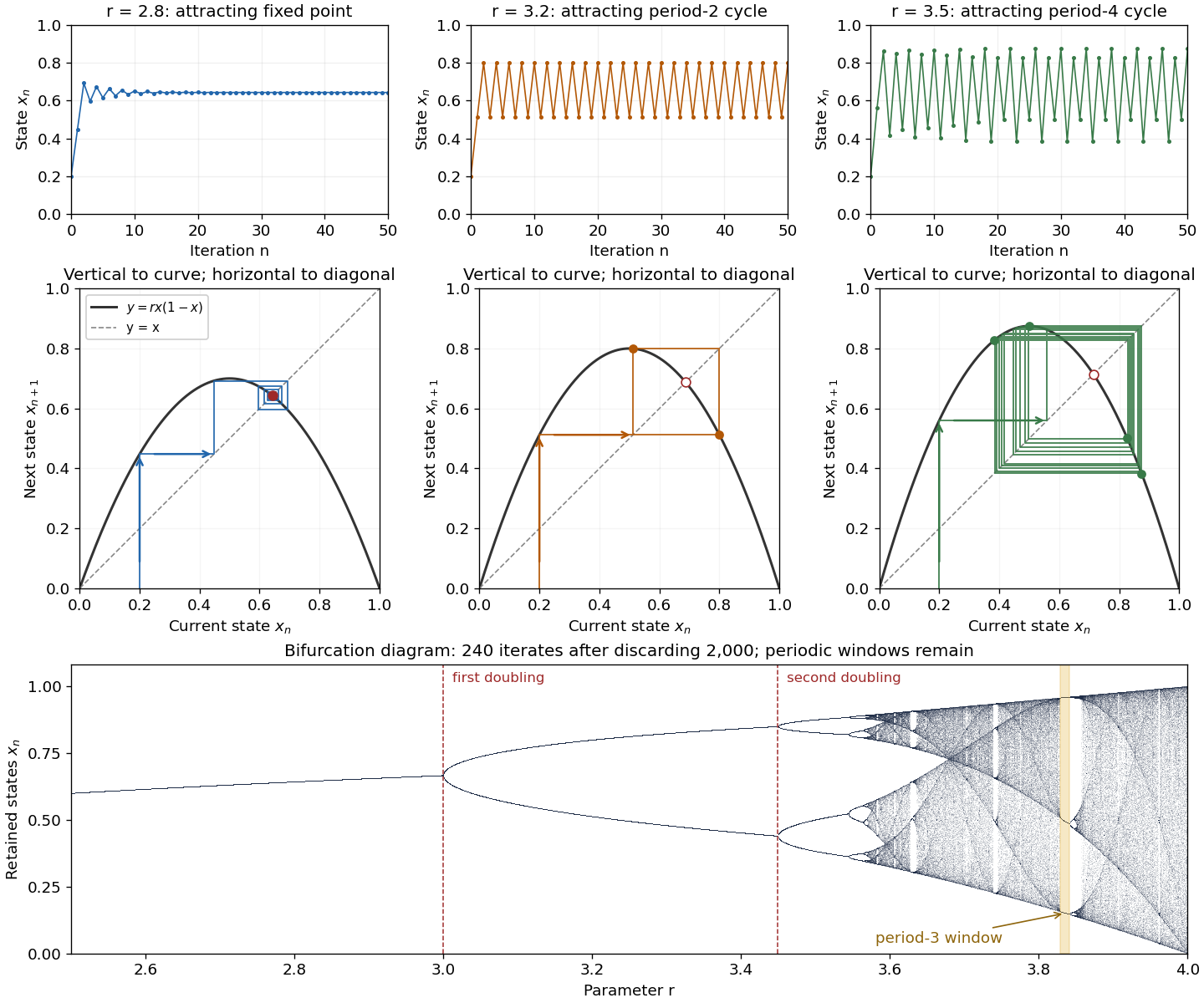
The fixed points solve :The second fixed point is in for and coincides with zero at . The derivative is , so the fixed-point multipliers are at zero and at . The fixed point stability for an iteration test gives an attracting zero for , and a locally asymptotically stable positive fixed point for . A multiplier of modulus one needs a nonlinear argument; the strict derivative test alone settles neither nor .
This derivative test has a direct interpretation. A small error obeysAt , the leading multiplier is : the error changes sign, explaining the alternating approach, while its magnitude eventually shrinks by approximately a factor per step. At , the multiplier is , and the positive fixed point repels nearby states. However, a different outcome has asymptotic stability: the logistic map two-cycle attracts nearby orbits.
For , the attracting period-two orbit has the two valuesAt they are approximately and , with and . Their periodic-orbit multiplier is , so a small displacement shrinks over two steps even though the fixed point is unstable. The brief algebraic justification is to factor , remove the fixed point factors, and multiply the two derivatives using the chain rule.
At , the positive fixed-point multiplier passes through and a period-doubling bifurcation creates the period-two orbit. At , its periodic-orbit multiplier passes through and an attracting period-four periodic orbit emerges. At , the period-four values are approximately in that order. Further period-doubling bifurcations accumulate near . Beyond that value there are also parameter windows with attracting periodic orbits, including a period-three window near . Neither a crowded numerical plot nor a parameter beyond the accumulation value proves sensitive dependence on initial conditions on the attracting set.
The endpoint supplies an analytically transparent example. The homeomorphism satisfieswhere is the full tent map. Thus these maps have topological conjugacy; stretching and folding in the tent map explain sensitive dependence on initial conditions and Devaney chaos for on . This does not make every individual orbit nonperiodic: stays fixed, and follows . Sensitivity means that these exceptional orbits also have arbitrarily close initial states that eventually depart substantially.
Robert M. May's "Simple mathematical models with very complicated dynamics" (1976), Nature 261, pp. 459–467, reviewed how simple deterministic recurrence relations can pass from stable abundances through period-doubling cascades to irregular behaviour. May presented the logistic map as an especially accessible example and discussed the relevance of such models to population dynamics. The paper explicitly describes itself as a review of results found by several researchers, bringing their findings together for a broad scientific audience.[ref]
For a real number , the beta transformation is the interval mapon . Each interval of continuity is expanding with slope .
A conserved quantity is a quantity that remains constant along the time evolution of a system. In Hamiltonian mechanics, a possibly time-dependent phase-space function is conserved exactly when .
An atomic domain is an integral domain in which every nonzero nonunit is a finite product of irreducible elements. Every unique factorization domain is atomic, but atomicity alone does not imply uniqueness.
Pinned article: Introduction to the OurBigBook Project
Welcome to the OurBigBook Project! Our goal is to create the perfect publishing platform for STEM subjects, and get university-level students to write the best free STEM tutorials ever.
Everyone is welcome to create an account and play with the site: ourbigbook.com/go/register. We belive that students themselves can write amazing tutorials, but teachers are welcome too. You can write about anything you want, it doesn't have to be STEM or even educational. Silly test content is very welcome and you won't be penalized in any way. Just keep it legal!
Intro to OurBigBook
. Source. We have two killer features:
- topics: topics group articles by different users with the same title, e.g. here is the topic for the "Fundamental Theorem of Calculus" ourbigbook.com/go/topic/fundamental-theorem-of-calculusArticles of different users are sorted by upvote within each article page. This feature is a bit like:
- a Wikipedia where each user can have their own version of each article
- a Q&A website like Stack Overflow, where multiple people can give their views on a given topic, and the best ones are sorted by upvote. Except you don't need to wait for someone to ask first, and any topic goes, no matter how narrow or broad
This feature makes it possible for readers to find better explanations of any topic created by other writers. And it allows writers to create an explanation in a place that readers might actually find it.
Figure 1. Screenshot of the "Derivative" topic page. View it live at: ourbigbook.com/go/topic/derivativeVideo 2. OurBigBook Web topics demo. Source. - local editing: you can store all your personal knowledge base content locally in a plaintext markup format that can be edited locally and published either:This way you can be sure that even if OurBigBook.com were to go down one day (which we have no plans to do as it is quite cheap to host!), your content will still be perfectly readable as a static site.
- to OurBigBook.com to get awesome multi-user features like topics and likes
- as HTML files to a static website, which you can host yourself for free on many external providers like GitHub Pages, and remain in full control

Figure 2. You can publish local OurBigBook lightweight markup files to either OurBigBook.com or as a static website.
Figure 3. Visual Studio Code extension installation.
Figure 5. . You can also edit articles on the Web editor without installing anything locally. Video 3. Edit locally and publish demo. Source. This shows editing OurBigBook Markup and publishing it using the Visual Studio Code extension. 
- Infinitely deep tables of contents:



All our software is open source and hosted at: github.com/ourbigbook/ourbigbook
Further documentation can be found at: docs.ourbigbook.com
Feel free to reach our to us for any help or suggestions: docs.ourbigbook.com/#contact