Topics (384k) Articles (398k) Users (410) Discussions (242) Comments (383) Files (13k) New article
If acts on a vector space , it acts on by conjugation:Under , this is the tensor product of group representations .
For representations and of a group , the tensor product representation is the tensor product with diagonal action
A group action on a nonempty set is transitive when every two points lie in the same orbit of a group action, equivalently when for all there is a group element with . There is exactly one group orbit: every position is reachable from every other. Requiring avoids calling the group action on the empty set transitive merely because the quantified statement has no points to test.[ref]
Transitive Group Actions by Keith Conrad. Definition 1.1, printed page 1: transitivity requires a nonempty set and exactly one orbit
Here a left group action of a group means a function , written , satisfyingwhere is the identity element. Products move the point by first, then by . Transitivity says that an orbit map , , is surjective for every ; it suffices to check one chosen point.[ref][ref]
For example, the symmetric group acts on by . This is a transitive group action, but it is not a free group action: the stabilizer subgroup of is . Both the transposition and the cyclic permutation send to . In contrast, the cyclic group acts on itself by , using modular arithmetic. The group element sending to is uniquely . These two group actions reach the same number of points, but only the second has unique transport between them.
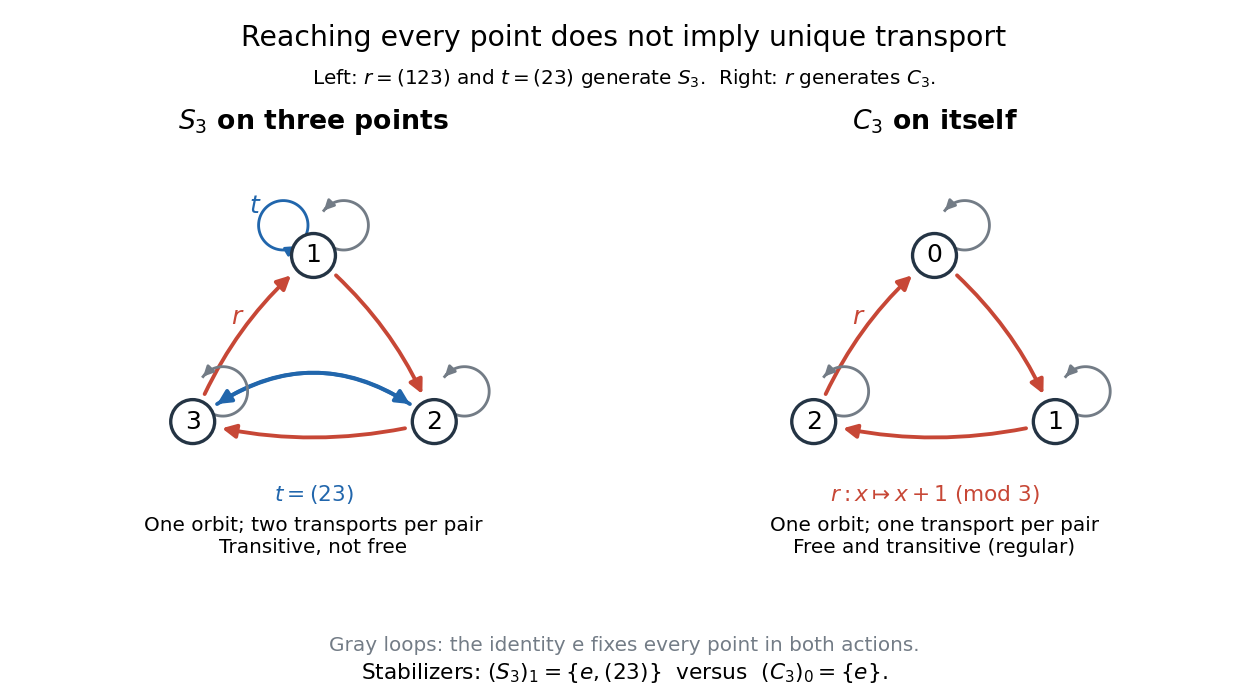
Transitive group actions with and without unique transport
. The symmetric group on three labels has a stabilizer subgroup of group order two at each point, hence two group elements sending any chosen point to any other. The cyclic group acting on itself has trivial stabilizer subgroups and one transport per pair. Red arrows show a generating cyclic permutation; blue arrows show the extra transposition in . Gray loops show the identity element in both group actions. Details.The stabilizer subgroup measures the ambiguity of transport. If , thenThe first set is a left coset, and the second identity says that stabilizer subgroups in one group orbit are conjugate subgroups. Briefly, exactly when . Thus, for a finite group in a transitive group action, the orbit-stabilizer theorem gives , and there are exactly transports for each pair of points. The example counts are for and for . This separates the number of reachable positions from the number of ways to reach each one.[ref]
A divisible group is an abelian group in which, for every positive integer and every , some satisfies .
A torsion-free group is a group in which the identity element is the only element of finite order of a group element.
The quantum variational principle estimates the lowest energy by choosing a trial wavefunction and computing its expectation value, without solving the Schrödinger equation exactly. Minimizing over a manageable family of trial wavefunctions gives an upper bound; enlarging that family can improve the estimate.
Let be a self-adjoint operator bounded below, and put . For in its operator domain ,Trial states may also lie in the form domain , where . Then use the quadratic form of a positive quantum Hamiltonian shifted by :This extends the expectation value beyond without requiring to exist. Equality for a normalized state holds exactly in the energy eigenspace at , if that eigenvalue exists. [ref]
https://www.mat.univie.ac.at/~gerald/ftp/book-schroe/schroe.pdf. Gerald Teschl, Mathematical Methods in Quantum Mechanics, Theorem 2.19 and equations (3.50)–(3.51)
.A short proof makes the direction of the bound memorable. If has a complete orthonormal basis of energy eigenstates , writeThe expectation value is a weighted average of allowed energies:Equality requires every occupied energy eigenstate to have energy . [ref]
https://live.ocw.mit.edu/courses/8-05-quantum-physics-ii-fall-2013/61bc31b8d8bf0680c322733910a71aa0_MIT8_05F13_Chap_01.pdf. Barton Zwiebach, MIT 8.05 Wave Mechanics, section 5, Variational Principle
. With continuous spectrum, the spectral theorem replaces the sum by an integral against the scalar spectral measure; the same nonnegative-difference argument works.For an unnormalized trial wavefunction, divide by its squared norm: is the form version of the Rayleigh quotient. The quantum variational principle supplies an upper bound on ; it supplies neither a lower bound on nor, by itself, a guarantee that a bound state exists.
To see the method at work, choose the real Gaussian wave packetThe Gaussian integral gives wavefunction normalization and the two useful position averages:Thus its position probability density is a normal distribution with standard deviation : large means narrow confinement. In units , integration by parts and give the kinetic energyThese smooth, rapidly decaying trial wavefunctions belong to the operator domains of both polynomial Quantum Hamiltonians below. Narrowing the Gaussian wave packet increases its kinetic energy; widening it increases the potential energy in either confining potential.
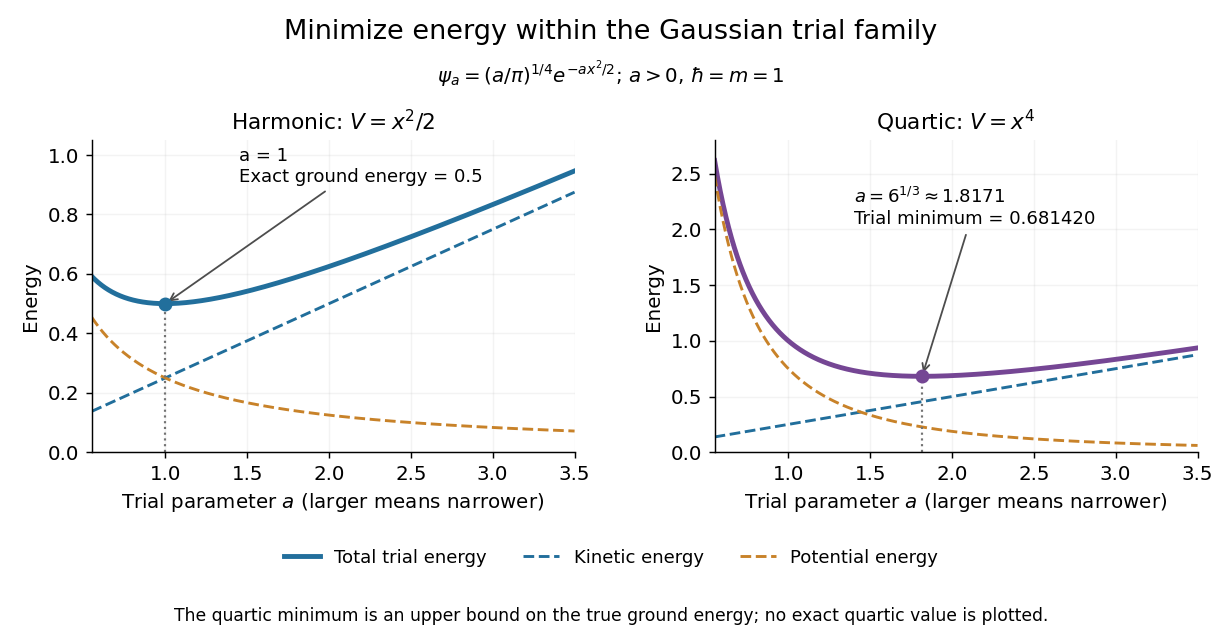
For the quantum harmonic oscillator, take :The trial values at are respectively . The derivative changes sign at , where kinetic energy and potential energy are both . Here the trial family contains an exact ground state:The zero-point energy remains positive even at the best width. For comparison, removing the potential leaves as : the free Quantum Hamiltonian on the line has spectral bottom zero but no normalizable zero-energy energy eigenstate. A sequence of ever broader trial wavefunctions need not approach an actual bound state.
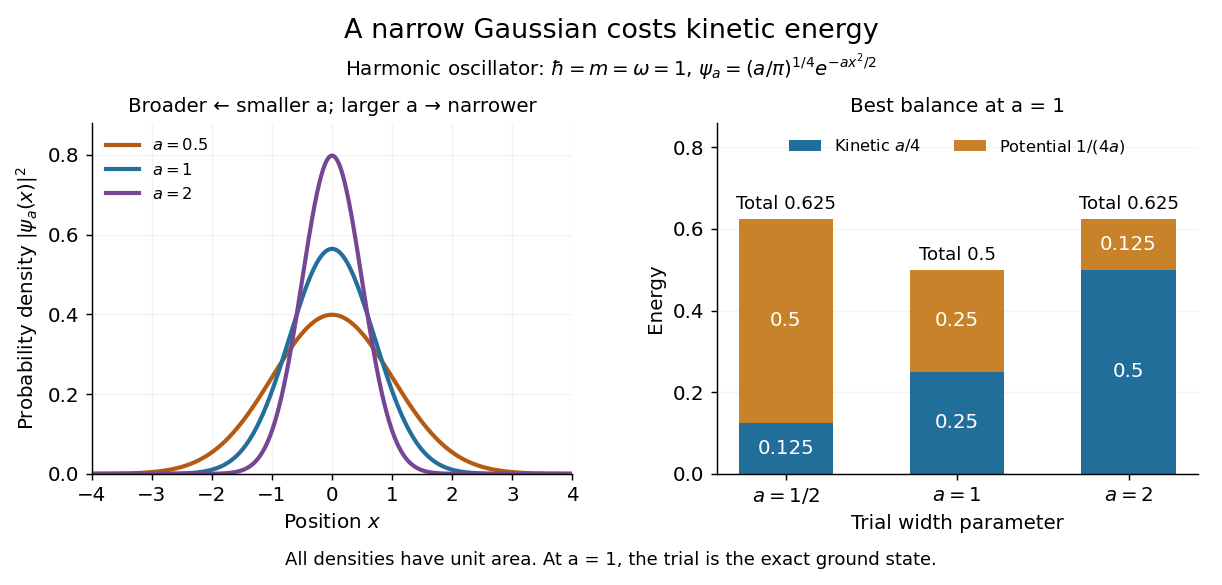
Gaussian trial widths and the kinetic–potential energy tradeoff
. Normalized Gaussian wave packets with have different position probability densities. The bars show the competing kinetic energy and harmonic potential energy ; their sum is smallest at . Details.For a pure quartic oscillator, keep and set the quartic coefficient to one:The trial values at are respectively . Setting the derivative to zero givesThe sign of this derivative changes from negative to positive at the optimum, giving the smallest energy within this Gaussian wave packet family:At this width, and , so , as expected from the power-law quantum virial theorem for a scale-optimized trial wavefunction. The number is an upper estimate of the ground-state energy, not an asserted exact energy eigenvalue. Indeed,depends on for every , so no member of this trial family is an energy eigenstate. Nevertheless, a single width parameter already turns a difficult Schrödinger equation into a useful, explicit energy estimate.
The external vertex boundary of a vertex set isFor comparisons at fixed , minimizing is equivalent to minimizing .
An edge colouring assigns a label called a colour to every edge of a graph: it is a function . Here this definition allows arbitrary assignments. Two edges sharing a vertex may receive the same colour. A proper edge colouring imposes the additional condition that such edges receive different colours. Some textbooks use "edge colouring" as shorthand for this proper version; check the convention before applying a theorem.[ref]
Line graphs and edge coloring. Line graphs and edge coloring, slide 1: arbitrary labeling versus proper edge coloring
The distinction matters in Ramsey theory. In a red-blue edge colouring of a complete graph, a triangle in a graph is monochromatic when its three edges have the same colour. These are arbitrary edge colourings: forbidding equal colours on edges sharing a vertex would forbid the very monochromatic triangles in a graph being sought. For example, assigning red to every edge of is a valid arbitrary edge colouring, although it is not a proper edge colouring. Colour labels can also stand for time slots: then proper edge colouring turns incompatible jobs into separate rounds.
A graph automorphism is a bijection of the vertex set that preserves and reflects adjacency. It preserves graph distances and transports simple random-walk hitting problems between vertices.
A coset progression is a sumset , where is a finite subgroup of an abelian group and is a generalized arithmetic progression.
An abelian progression is a generalized arithmetic progression inside an abelian group. It is the image of an integer box under a group homomorphism.
An Abelian gauge theory has a commutative gauge group. Its gauge field strength has no commutator term, so the pure gauge Lagrangian has no cubic or quartic gauge-boson self-interactions.
A Wilson line is the path-ordered parallel transporterUnder a gauge transformation , it transforms as .
A gauge coupling is the constant multiplying the gauge potential in the gauge covariant derivative. Its normalization depends on that of the Lie-algebra generators; each simple or Abelian factor of a gauge algebra may have an independent coupling.
The gauge group is the group of local internal symmetries. Its Lie algebra labels the gauge-boson species, while a matter field carries a representation of the group.
A gauge boson is a spin-one quantum excitation of a gauge field. Each generator of the gauge group supplies one gauge-boson species before symmetry breaking.
Klein-four criterion for an irreducible even quartic by  Codex 0 Created 2026-10-03 Updated 2026-11-05
For irreducible , the Galois group is exactly when is a square in . In the transitive Klein-four action on the roots , all three nonidentity double transpositions fix , forcing it into the fixed field .
Pinned article: Introduction to the OurBigBook Project
Welcome to the OurBigBook Project! Our goal is to create the perfect publishing platform for STEM subjects, and get university-level students to write the best free STEM tutorials ever.
Everyone is welcome to create an account and play with the site: ourbigbook.com/go/register. We belive that students themselves can write amazing tutorials, but teachers are welcome too. You can write about anything you want, it doesn't have to be STEM or even educational. Silly test content is very welcome and you won't be penalized in any way. Just keep it legal!
Intro to OurBigBook
. Source. We have two killer features:
- topics: topics group articles by different users with the same title, e.g. here is the topic for the "Fundamental Theorem of Calculus" ourbigbook.com/go/topic/fundamental-theorem-of-calculusArticles of different users are sorted by upvote within each article page. This feature is a bit like:
- a Wikipedia where each user can have their own version of each article
- a Q&A website like Stack Overflow, where multiple people can give their views on a given topic, and the best ones are sorted by upvote. Except you don't need to wait for someone to ask first, and any topic goes, no matter how narrow or broad
This feature makes it possible for readers to find better explanations of any topic created by other writers. And it allows writers to create an explanation in a place that readers might actually find it.
Figure 1. Screenshot of the "Derivative" topic page. View it live at: ourbigbook.com/go/topic/derivativeVideo 2. OurBigBook Web topics demo. Source. - local editing: you can store all your personal knowledge base content locally in a plaintext markup format that can be edited locally and published either:This way you can be sure that even if OurBigBook.com were to go down one day (which we have no plans to do as it is quite cheap to host!), your content will still be perfectly readable as a static site.
- to OurBigBook.com to get awesome multi-user features like topics and likes
- as HTML files to a static website, which you can host yourself for free on many external providers like GitHub Pages, and remain in full control

Figure 2. You can publish local OurBigBook lightweight markup files to either OurBigBook.com or as a static website.
Figure 3. Visual Studio Code extension installation.
Figure 5. . You can also edit articles on the Web editor without installing anything locally. Video 3. Edit locally and publish demo. Source. This shows editing OurBigBook Markup and publishing it using the Visual Studio Code extension. 
- Infinitely deep tables of contents:




All our software is open source and hosted at: github.com/ourbigbook/ourbigbook
Further documentation can be found at: docs.ourbigbook.com
Feel free to reach our to us for any help or suggestions: docs.ourbigbook.com/#contact