
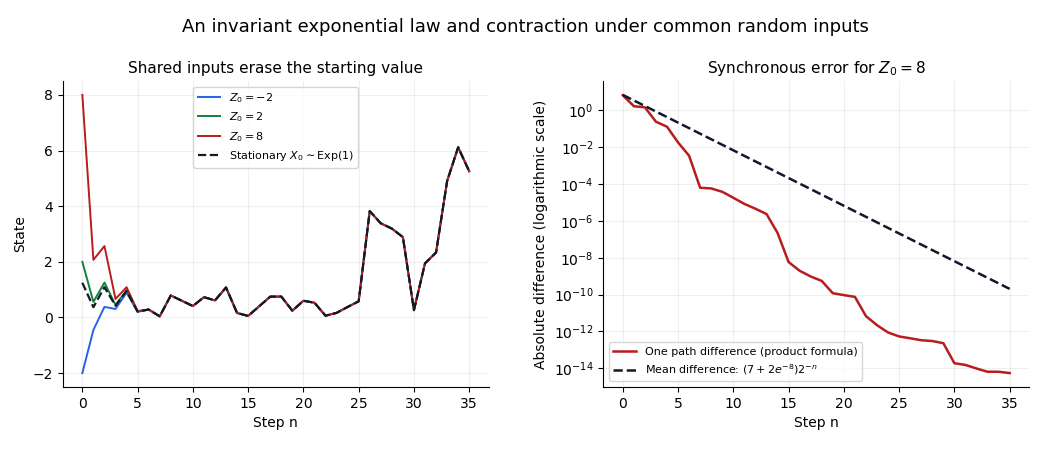
Drive two copies of a random affine recursion with the same coefficient pairs, independent of their initial coupling. Then . If and , independence of random variables givesThis proves convergence in L1 and hence convergence in probability of the difference. If one copy starts in a stationary distribution, Slutsky's theorem shows that the other copy converges to that distribution. The argument compares paths before taking their one-time probability distributions; it does not require the paths ever to become exactly equal.
Let have the uniform distribution on and let have an exponential distribution of rate , with all these inputs independent. The random affine recursion has an invariant exponential law of the same rate. Indeed, for independent exponential , beta-gamma independence says that is uniform and independent of . Thus an independent uniform gives the same law as .
For any deterministic real initial value , couple the recursion to a stationary copy. Synchronous contraction of a random affine recursion gives an expected difference . Hence the one-time laws converge to , independently of . An invariant initialization keeps every one-time law unchanged while the chain continues to fluctuate.

Mixed radix 2026-10-31
A positional representation in which each digit has its own positive integer base. Least-significant-first digits satisfy , and digit has weight . For positions, assume . Repeated Euclidean division by the successive bases converts that integer to digits; a backwards version of Horner's method converts the digits back.
Chest radiograph Created 2026-10-31 Updated 2026-11-05
A chest radiograph is an X-ray transmission image through the chest. Different paths encounter different compositions and thicknesses, producing different detected intensities through attenuation. The detector records a projection through the body rather than a physically isolated slice.
For a narrow monochromatic beam, a spatially varying linear attenuation coefficient gives . Real sources emit an electromagnetic spectrum of photon energies, and scattered radiation contributes additional signal. Overlapping structures can therefore be ambiguous in a single projection; detector display brightness also depends on processing and must not be confused directly with one local material density.
Radial sine-power kernel integrability 2026-10-31
Assign an arbitrary finite value at the origin. Polar integration and the substitution rule reduce the joint L1 norm exactly to . Near zero, gives ; at infinity, gives . These are integrable when and , respectively. Their explicit integrals give the displayed bound. This is a planar version of sine power kernel integrability, with the radial area element determining the exponents.
Radial zero-energy rigidity 2026-10-31
Consider an orientation-preserving classical radial deformation of an elastic solid on a connected spherical annulus. If its nonnegative energy is zero everywhere and the material is isotropic with strict Baker-Ericksen inequalities, every gradient is a natural state, so . Thus and .
A separate rigidity argument applies when the zero wells are , with finitely many positive definite symmetric . The radial gradient is positive symmetric; if , then , so uniqueness of the positive square root gives . The rotation well similarly gives . Hence the continuous ratio takes values in a finite set of eigenvalues and must be constant on the connected radial interval. Differentiating finishes the proof. This version needs neither material isotropy nor Baker-Ericksen inequalities and does not require an assumed continuity of beyond the radial-map regularity used for the ratio.
For a radial deformation with positive radial derivative, put and . The principal nominal stresses are and . Radial equilibrium reads . Since , substitution cancels the terms proportional to , leaving . Strict convexity of and positivity of force a constant positive determinant .
Integration of gives . Two spherical boundary radii fix uniquely. A positive increasing cube-radius interpolation verifies positivity of and , so the algebraic solution is an admissible smooth radial equilibrium. The result is restricted to this energy family and radial class; strict convexity of its determinant term alone does not imply uniqueness among arbitrary three-dimensional deformations.
Let be a compact Hausdorff space and a closed equivalence relation. The quotient space is compact and Hausdorff. Indeed, the saturation of any closed is the projection of the compact set , so is closed. Thus the quotient map is a closed map.
Two different equivalence classes are disjoint compact subsets of and have disjoint open neighbourhoods . To see the latter assertion, separate each pair of points by disjoint neighbourhoods and use compactness twice to extract finite covers. Now and are open saturated subsets containing the respective classes, and lie inside . Their quotient images are disjoint open neighbourhoods, proving the Hausdorff condition. Compactness follows from the continuous quotient map. This applies to finite gluing along closed boundary pieces when the generated equivalence relation is closed; that last condition must be checked.
Sphere with its equator collapsed 2026-10-31
Collapse the equator of a sphere to a single equivalence class and leave every other point in its own class. The two closed hemispheres are disks sharing that equator. A disk with its boundary collapsed is a sphere, so the two hemisphere quotients are spheres sharing just one point: their wedge sum. An explicit map sends height and longitude on the upper hemisphere to , and sends the lower hemisphere to the sphere centred at by reversing the first coordinate. The equator goes to the common origin and the poles go to . This map is continuous and has precisely the collapsed equator as its only nonsingleton fibre. Its induced map is a homeomorphism by the compact-to-Hausdorff continuous bijection theorem.
Quinine sulfate 2026-10-31
Thalleioquin test 2026-10-31
Tinctura Quiniae Composita 2026-10-31
Historical pharmaceutical preparation; its composition and clinical use must be identified by edition. [ref]
The Essentials of Materia Medica and Therapeutics by Alfred Baring Garrod (1865). corresponding monograph and British preparation
Šura-Bura component lemma 2026-10-31
In a compact Hausdorff space, the quasicomponent is connected and equals the connected component of . If were a nontrivial separation, disjoint open neighborhoods of its compact pieces leave a compact complement missing . Finitely many clopen neighborhoods of intersect to a clopen containing inside . The piece is then clopen in the whole space, contains , and misses the nonempty other piece, contradicting the definition of . This also proves that any neighborhood of a component contains a clopen neighborhood of that component, by compactness of its complement.
Šura-Bura lemma 2026-10-31
In a compact Hausdorff space, each connected component is its quasi-component and has a neighborhood basis of clopen sets. Let be the intersection of clopen neighborhoods of . It is compact. If it splits into two nonempty compact sets, normality separates them by disjoint open neighborhoods. The finite intersection characterization of compactness gives a finite intersection of clopen neighborhoods lying in their union. Its intersection with the neighborhood containing is then clopen and excludes part of , a contradiction. Thus is connected and equals the component. Applying the same finite-intersection argument to any neighborhood of proves the neighborhood-basis assertion. [ref]
https://www.cl.cam.ac.uk/research/hvg/Isabelle/dist/Isabelle/browser_info/HOL/HOL-Analysis/Homotopy.html. Formalized Šura-Bura results, including the compact Euclidean case
. Pending infections at quarantine in a delayed epidemic model Created 2026-10-31 Updated 2026-11-05
Suppose that newly infected members of a biological population pass through a noninfectious stage of fixed duration before becoming infectious. This delay is a latent period, whereas the incubation period ends at symptom onset. The two endpoints need not coincide.[ref]
Household Transmission Investigation (HHTI) template protocol for respiratory pathogens with pandemic potential by World Health Organization. Section 1.3, printed p. 8, definitions and Figure 1: infection-to-infectiousness versus infection-to-symptoms
Let be the rate of new infections in the specified compartmental model. Assume no death or other removal during the noninfectious stage. At an intervention time , all infections acquired during the preceding time units are still pending entry into the infectious class, soFor a smooth recent incidence history, a Taylor expansion about givesThus the leading pipeline correction is proportional to the recent infection rate, rather than simply to the number currently infectious. A rapidly varying incidence history requires the integral instead of this short-delay expansion.
An ideal intervention stopping all new transmission at does not reverse these already acquired infections. Under the assumptions above, exactly additional entries into the infectious class occur after , over the next time units. They must be added when the reported cumulative count at records infectious-class entries. If that count already records infections at acquisition, the pending individuals are already included and must not be counted twice.
The definition of the susceptible individual compartment also matters: a genuinely uninfected susceptible class loses an individual at infection, while a model grouping not-yet-infectious individuals with susceptible ones postpones that recorded class transfer. The same biological delay therefore appears at different places in the bookkeeping. The assumption of perfect transmission removal is a model idealization rather than a clinical intervention rule.
For and the radial exponential trial state , , put . Direct radial integration gives the Rayleigh quotientThe kinetic expectation is ; the potential expectation follows by splitting its radial integral at . The common prefactor cancels from the stationary condition, giving . Its positive solution is unique, since the left side increases and the right side decreases. For , it satisfies .
Quantile expectation formula Created 2026-10-31 Updated 2026-11-05
For an integrable real random variable with distribution function , the generalized inverse sends a uniform random variable on to the distribution . This follows from if and only if . Equality of laws proves both the expectation formula and absolute integrability of the quantile. Atoms and flat pieces of cause no problem.
Interpolatory quadrature 2026-10-31
An interpolatory quadrature approximates a definite integral by exactly integrating the interpolation polynomial through prescribed sampled values. For distinct quadrature nodes , its quadrature weights are , where are the Lagrange cardinal polynomials. It is exact for all polynomials of polynomial degree at most , because polynomial interpolation reproduces them. Newton-Cotes quadrature adds equal spacing of the quadrature nodes.
Impose zero Dirichlet boundary conditions on an interval. The isoperimetric constraint is regular because . The Lagrange multiplier rule applied to gives the Sturm-Liouville equationMultiplying by and using integration by parts gives . Thus the multiplier is the stationary value of the original functional, or its Rayleigh quotient. This calculation does not require to have one sign; positive-weight spectral conclusions require additional hypotheses.
If two stationary functions have different multipliers, multiplying their equations crosswise and subtracting gives . The endpoint terms vanish. This proves the weighted orthogonality of Sturm-Liouville eigenfunctions. Higher stationary values need not be local minima of the constrained functional.
The Euler-Lagrange equation is . For positive a nonzero stationary function exists exactly when is a positive integer , and all such functions are . These values are the Dirichlet eigenvalues of on the interval. At the solutions are affine and the endpoint conditions leave only zero; negative likewise leaves only zero. Stationarity alone does not assert minimization of the quadratic functional.
There are unlisted articles, also show them or only show them.