
Work by Saul Perlmutter 2026-10-18
Work by Saul Dushman 2026-10-18
Saponification of triglycerides 2026-10-18
A triglyceride contains three ester linkages joining glycerol to fatty acid-derived acyl groups. Complete saponification therefore consumes three hydroxide equivalents per triglyceride, yielding one glycerol and three fatty acid carboxylates.[ref]
27.2 Soap. Organic Chemistry by John McMurry; §27.2, opening chemical definition and fat hydrolysis equation
Writing the three hydrocarbon groups separately allows their compositions to differ:This is the preceding ester chemical equation applied three times: each linkage supplies one carboxylate, and each formerly esterified oxygen on the glycerol scaffold gains one hydrogen. The two sides retain the same three groups and have net electric charge .
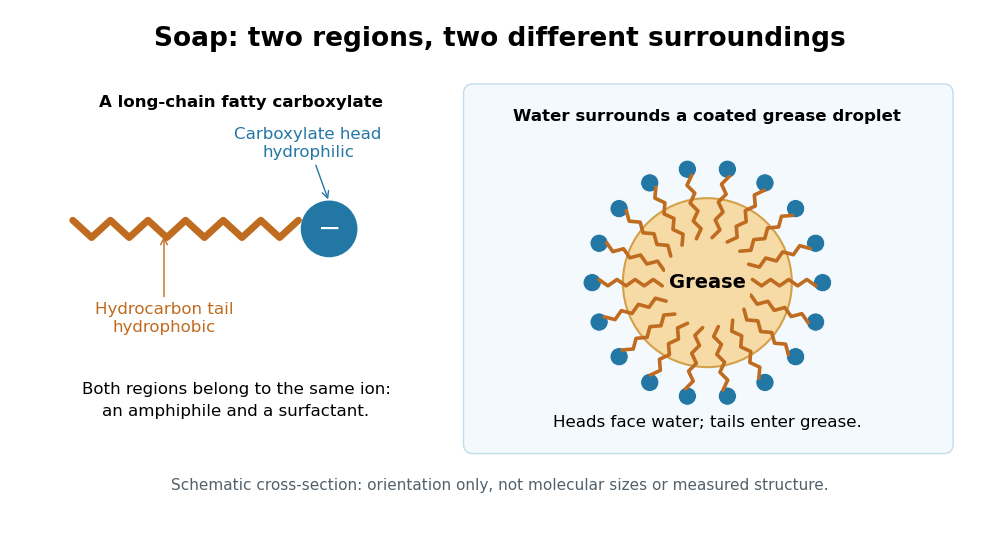
Soap consists of sodium or potassium salts of long-chain fatty acids. Its carboxylate head is hydrophilic, while its long hydrocarbon tail is hydrophobic. This makes it an amphiphile and a surfactant: the tails can associate with grease while the heads remain exposed to water, helping disperse grease for rinsing. An acetate ion is also a carboxylate, but lacks the long hydrophobic tail that gives soap this cleaning role.[ref]
27.2 Soap. Organic Chemistry by John McMurry; §27.2, chemical definition and paragraphs on the ionic head, hydrocarbon tail and removal of grease

Saponification with limiting hydroxide 2026-10-18
Consider a hypothetical closed, well mixed chemical solution initially containing of ethyl acetate, of hydroxide, and no acetate ions or ethanol. One millimole is mole. Assume complete conversion as far as the one-to-one chemical equation allows, with no competing chemical reactions. This is an ideal stoichiometry calculation, not a measured yield.
Let the extent of reaction be , expressed in millimoles. The four values of amount of substance, in the order ethyl acetate, hydroxide, acetate ion, ethanol, areThe upper bound follows because both reactant quantities must be nonnegative. Thus hydroxide is the limiting reagent, and the ideal endpoint leavesThe carboxylate formed equals the hydroxide consumed, while unreacted ester remains. Adding more hydroxide raises the stoichiometry bound; merely waiting longer does not change that bound. To convert these values of amount of substance into concentrations, a volume is also required. The endpoint does not specify the reaction rate or time needed to approach it.
Work by Sandip Pakvasa 2026-10-18
Work by Sander Konijnenberg 2026-10-18
Work by Samuel Jackson Barnett 2026-10-18
Work by Samuel Chao Chung Ting Created 2026-10-18 Updated 2026-10-25
Work by Sam Edwards 2026-10-18
Work by Salvador Luria 2026-10-18
Magnesium chloride Created 2026-10-18 Updated 2026-10-31
Magnesium chloride is an ionic compound with two chloride anions per magnesium cation. Complete dissolution supplies one divalent magnesium ion and two monovalent chloride ions per formula unit. At analytical salt concentration , these species contribute molar ionic strength , provided additional dissolved ions are absent.
Relativistic Sagnac delay on a circular ring 2026-10-18
Consider an ideal circular vacuum path of laboratory radius , a limit of closely spaced mirrors constraining light around the circle at laboratory speed . The source and detector rotate uniformly together with signed angular velocity , where , in flat spacetime. Let be the laboratory circumference and the positive area. The pulse travels counterclockwise and the pulse clockwise, independently of the sign of . Both depart from the detector at .
Unwrap the circle into a laboratory arc coordinate. The two first-return conditions areConsequently the exact laboratory arrival times and their difference areThe denominators are closing rates in these laboratory equations; they are not local speed of light measurements by a rotating observer. The two arrival spacetime events lie on the same detector world line. Its constant speed is , so proper time along that world line givesThus laboratory coordinate-time and rotating-detector proper time delays agree only to leading order at small . The radius and circumference here are laboratory quantities, not lengths obtained by laying comoving rods around the rim. Finite mirror polygons, transparent media, and optical dispersion require their own path and propagation assumptions before using an exact formula.
An exact dimensionless check takes . Relative to , the laboratory arrival times are and , giving . The detector instead records . The leading Sagnac area law would give . These are model values chosen to make the relativistic distinction visible, not attainable parameters of the historical apparatus.
The rotating loop does not constitute a universal measurement of the one-way speed of light. It compares completed circuits at a single readout; assigning a velocity to each remote leg additionally requires a clock synchronization convention. Local Einstein synchronisation around a rotating rim does not close into a single globally synchronized clock network: the accumulated mismatch is another expression of the rotating-path asymmetry. Local comoving vacuum measurements still give in both directions. Special relativity predicts a nonzero closed-loop delay because the receiver moves during propagation, while no single comoving inertial frame covers the whole circuit.
Sagnac area law 2026-10-18
For a rigidly rotating prescribed vacuum path, use spatial coordinates attached to the apparatus and laboratory time . At a path point , the local apparatus velocity is . A light displacement has instantaneous laboratory displacement , up to the common rotation of the spatial axes. The null condition is thereforeWrite . To first order in , the positive root isReversing the path reverses the dot product term but leaves the leading path-length term unchanged. Subtract the two return times and use the scalar triple product identity:This is a line integral version of the Sagnac area law; the vector area identity also follows from Stokes theorem. For a mirror-defined polygon the actual ray paths move slightly as the mirrors rotate; the stationary optical path at zero rotation gives the same first-order result. The prescribed-path calculation is an idealization, not an exact finite-speed formula for every moving-mirror layout.
The dot product explains the geometry: only the projection of the oriented vector area along the angular velocity contributes. A planar loop whose normal vector is perpendicular to has zero leading delay. For repeated traversals with the same orientation, the signed vector areas add; oppositely oriented lobes can cancel even when the total unsigned area is large. Equal perimeter alone does not imply equal response. A constant translational velocity contributes nothing to this leading closed-path line integral, since .
Sagnac interferometer 2026-10-18
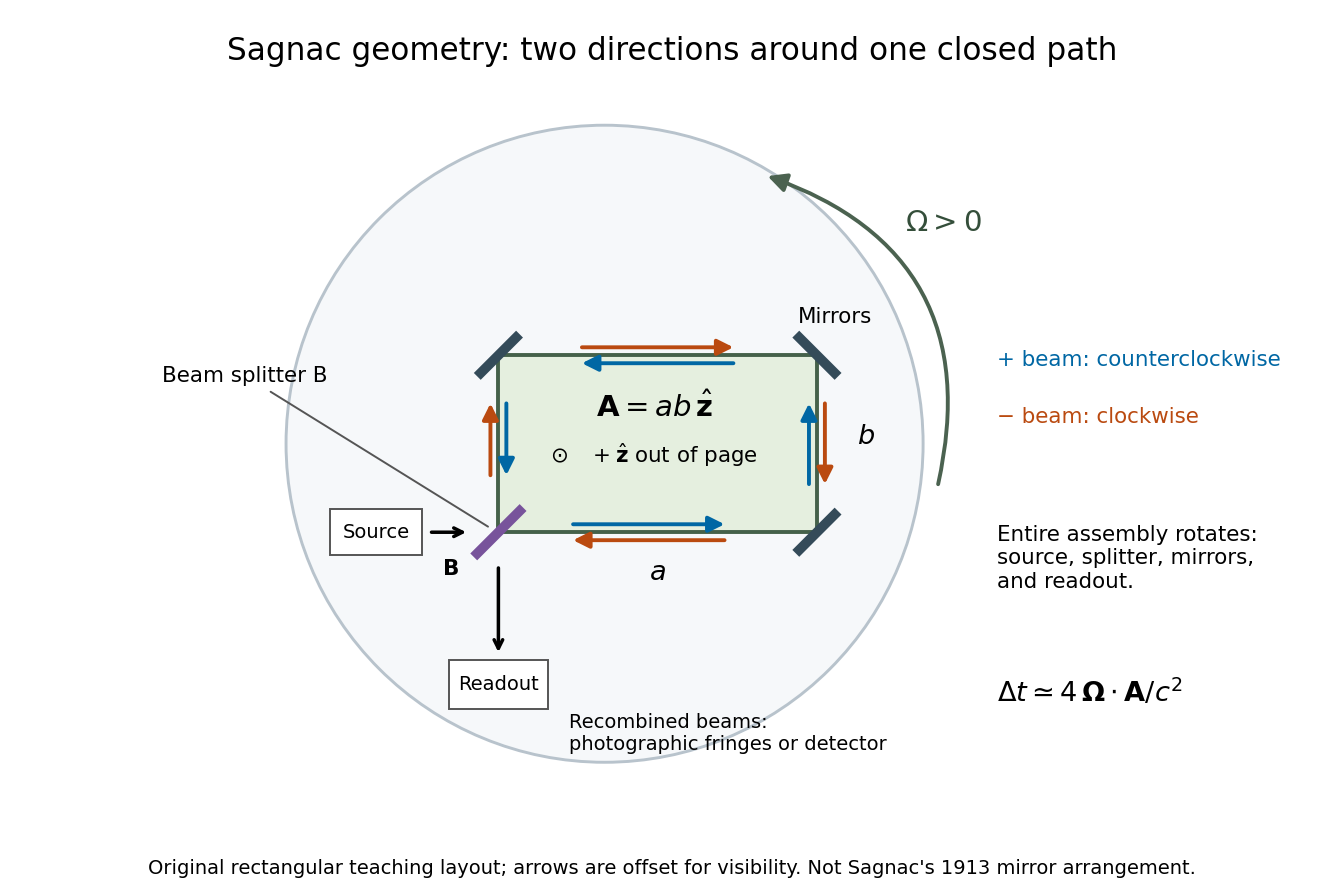
A Sagnac interferometer uses a beam splitter to send light with optical coherence around a common closed optical path in opposite directions, then recombines the beams to read their phase difference. Mirrors or a guiding path define the loop; the source, beam splitter, loop and readout rotate together in the basic experiment. A small relative beam tilt makes spatial interference fringes whose displacement reveals a change of phase difference. At one fixed output, a photodetector can instead record the corresponding change in light intensity.

Work by S. V. Sharnick 2026-10-18
At fixed incident flux, projectile energy and detector geometry, the Rutherford differential cross-section gives count rate , where is the target nuclei per unit area. Equal gives a rate ratio. Equal foil mass per area instead gives , with the atomic mass number, while equal physical thickness also requires the material mass density. An empirical log-log plot with slope supplies a different, experimentally normalized relation . These normalizations must be specified before comparing different target elements.
Work by Russell Alan Hulse 2026-10-18
Work by Rudolf Ludwig Mössbauer Created 2026-10-18 Updated 2026-10-25
Cross-link density inferred from rubber elasticity Created 2026-10-18 Updated 2026-10-20
The ideal rubber elasticity relation infers active strand number density from the shear modulus. If a quoted modulus is instead Young's modulus, nearly incompressible behavior gives . This is not automatically the junction density: for junction functionality and no dangling ends or loops, counting strand ends gives . Network fluctuations and inactive strands modify the modulus, so converting it into a chemical cross-link count requires a network model.
Work by Roy Jay Glauber Created 2026-10-18 Updated 2026-10-25
There are unlisted articles, also show them or only show them.