
Finite-aperture stabilization of an inverted liquid surface Created 2026-10-18 Updated 2026-10-20
For a deep inviscid liquid above a gas of negligible inertia, an inverted free surface has dispersion relation , . The Rayleigh-Taylor instability affects . A bounded aperture can suppress it if its smallest allowed wavenumber is at least . The capillary length is and the marginal wavelength is . A pinned one-dimensional span of width with a half-sine lowest mode instead has , giving . A numerical maximum container size therefore also requires aperture geometry and contact-line boundary conditions; the marginal wavelength alone is not a universal diameter.
Work by Randall G. Hulet Created 2026-10-18 Updated 2026-10-31
Work by Ramamurti Shankar 2026-10-18
Work by Ralph Percy Hudson 2026-10-18
Work by Rainer Weiss 2026-10-18
Work by Rainer Schödel 2026-10-18
Radix sort key encoding 2026-10-18
An encoding for radix sort must make the intended total order of sort keys agree with the lexicographic order of its fixed-width numerical digit tuples. The positional notation for bounded nonnegative integers has this property. At the most significant differing position , a one-unit numerical digit difference contributes , while all lower positions together contribute at mostThis geometric series shows why lower numerical digits cannot reverse that comparison. Leading zero padding works here because it preserves place values and the represented integer.
For signed integers in a known integer interval , encode and choose with . This order-preserving function is also injective: exactly when . For , the four-bit encodings of are after adding eight. Restore the original signed sort keys when displaying the complete sorting records; the encoding need not replace their data. Sorting the unsigned values of raw two's complement bit patterns would put nonnegative integers before negative ones, so their representation alone is not this ordered encoding.
For variable-length strings, first specify the alphabet order and whether a proper prefix precedes its extensions. As an original construction, use , let every string have length at most three, encode as one and as two, and append zeros to width three. Zero is reserved for an end marker strictly below every real symbol. The strings encode as in radix three, which preserves their lexicographic order. A differing real symbol decides the comparison; at a prefix boundary, the shorter string's zero comes before the extension's one or two. Left padding would instead encode as and as , reversing . Padding raw bytes with zero also fails if zero is an allowed data symbol: distinct strings can then receive the same encoding. A reserved end marker and an explicit symbol ordering are essential; byte order alone does not establish a desired human text order.
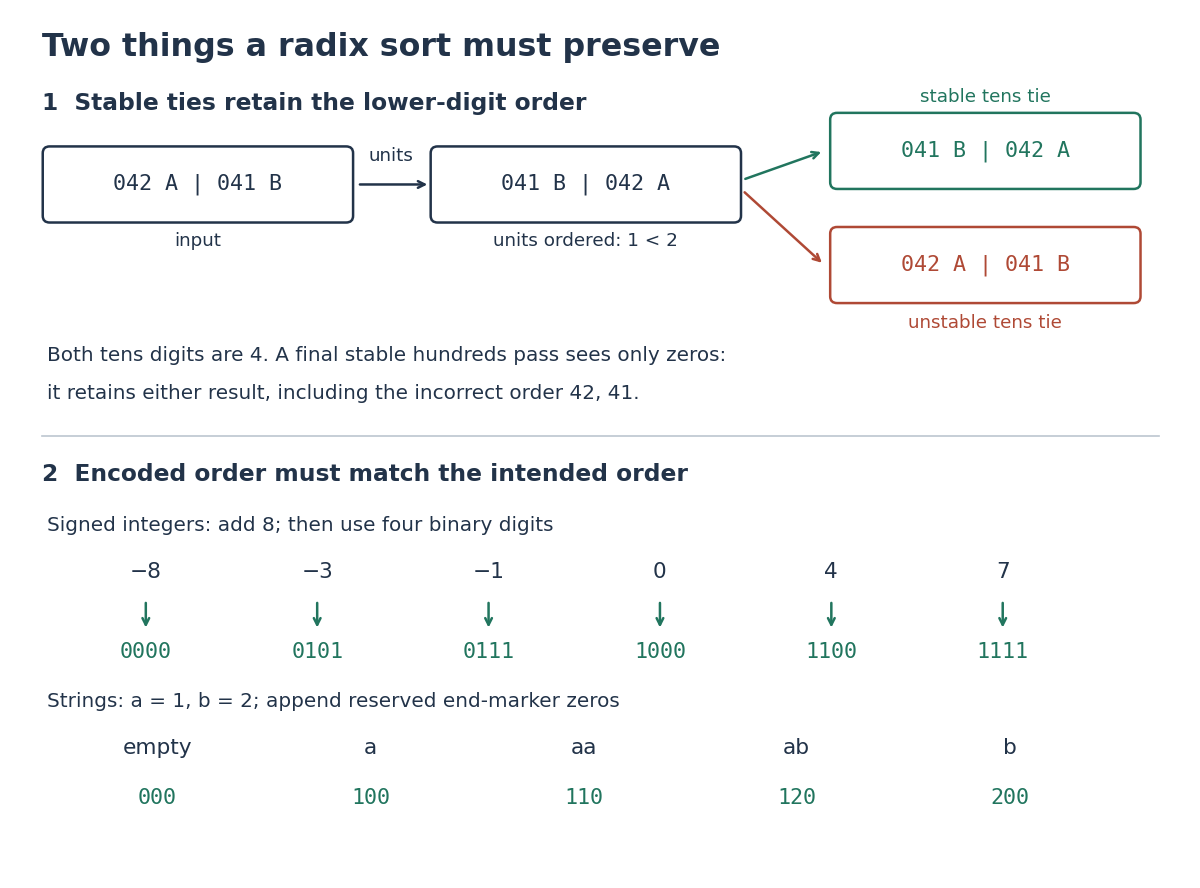
Stable ties preserve lower digits; suitable encodings preserve the intended order
. Original counterexample above: reversing a tens tie destroys the units order and a later stable hundreds pass cannot repair it. Below: signed integer offsets and a reserved end marker for bounded strings produce increasing fixed-width encodings. All entries are exact constructed examples. Details.
Stable digit sort 2026-10-18
A stable digit sort applies stable sorting to complete sorting records using one specified numerical digit of their encoded sort keys. Counting sort can supply it; stable record placement in counting sort moves records without discarding their associated data. Stability concerns equal current numerical digits, even when the full sort keys differ. This is the information-preservation step in least-significant-digit radix sort.[ref]
11.2 Counting Sort and Radix Sort. Open Data Structures: An Introduction by Pat Morin; §11.2.1, associated-data and stability paragraphs; §11.2.2, least-significant passes and correctness paragraph after Figure 11.8
An original two-record counterexample exposes the need for the tie rule. Start with at width three. A units pass gives . Both tens numerical digits are four. A deliberately unstable tens pass may reverse their tie and return : it is sorted by the tens numerical digit, yet its two-position suffixes are decreasing. The final stable hundreds pass sees two zeros and keeps this wrong order. Sorting permutation preservation still holds, but sortedness fails. Stability in the tens pass would have retained the units information.
With counting sort as the stable digit sort, each pass initializes counters, counts current numerical digits, constructs their prefix sums, and places complete sorting records. Thus each pass costs , and passes cost in Big O notation. Reuse the counters and two arrays of record references between passes: auxiliary space complexity is , rather than . Assume constant-cost numerical digit extraction, counter arithmetic, array indexing and record-reference movement; the bound counts these operations, not the cost of copying arbitrarily large payloads or performing arbitrary-precision integer arithmetic.
The benefit is avoiding a counter for every possible whole sort key: width has possibilities, while each pass needs only counters. A larger radix reduces the number of passes for a fixed key range but enlarges the counter array. The comparison sorting lower bound does not apply to these direct array indices; they reveal more than a two-way comparison. Nor does fixing make disappear: growing key width still increases work.
Least-significant-digit radix sort 2026-10-18
A least-significant-digit radix sort processes numerical digits from smallest to largest place value. Fix integers and , and take complete sorting records whose sort keys satisfy . Use exactly positions in positional notation with radix , including leading zeros. At pass , apply a stable digit sort to the current array usingThe floor function selects the integer quotient, and the remainder selects the current numerical digit. Move the complete sorting record, including its associated data. There are exactly passes, so this procedure terminates even for an empty array. The radix sort suffix invariant supplies its algorithm correctness argument.
For an original input, let the letters identify the attached data:Here , , and leading zeros only align place values; represents the integer five. The exact pass ledger is:After the units pass, the numerical digits are . The ties retain before and before before . This array is not yet ordered by its whole integer sort keys: still precedes . After the tens pass, the two-position suffixes are . In particular, now precedes : their tens numerical digits differ, so stable sorting does not require retaining their previous order. The hundreds pass produces the final sorted array, with all attached letters preserved.
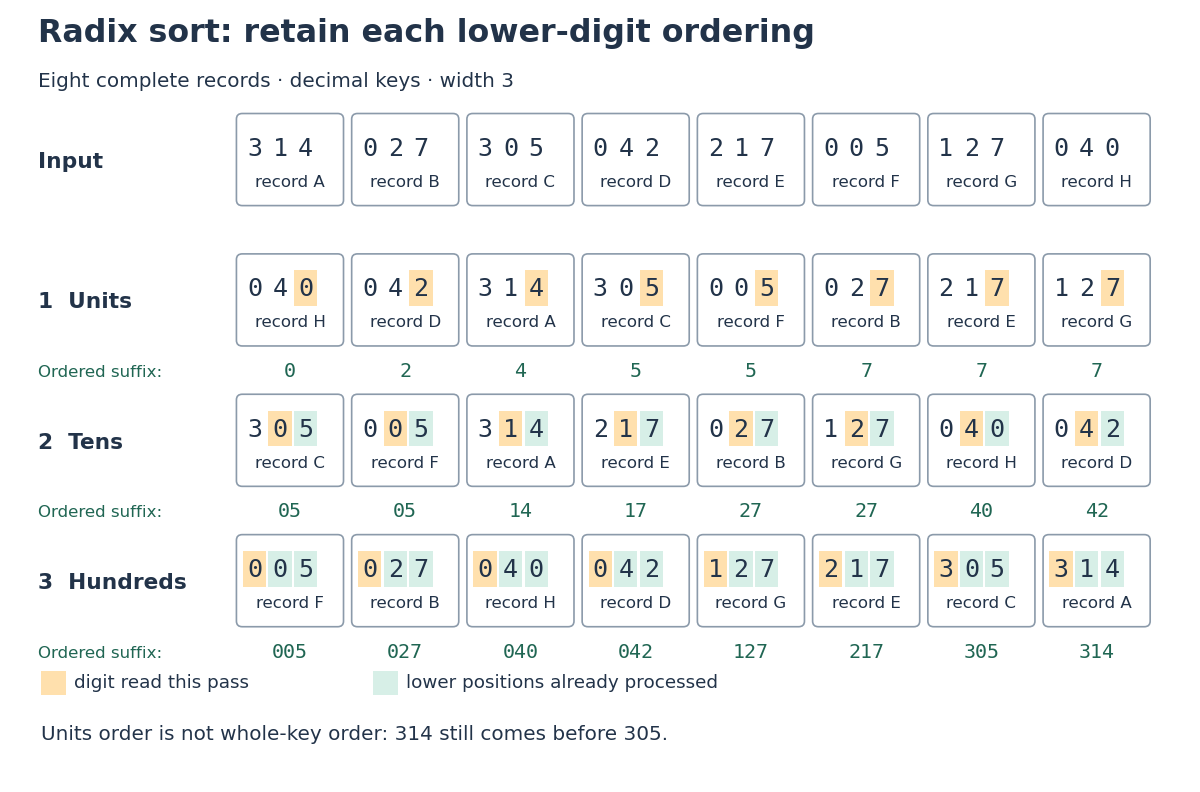
Three stable digit passes order successively longer suffixes
. Original decimal radix sort ledger. Each card carries an unchanged record label. Orange marks the numerical digit read in the current pass; green marks lower positions already processed. The suffix row beneath each pass shows precisely what is ordered, rather than claiming whole-key sortedness early. Details.
Absorption (electromagnetic radiation) Created 2026-10-18 Updated 2026-11-05
The transfer of energy from electromagnetic radiation to matter. Optical reflection redirects the incident electromagnetic radiation, and transmission lets it pass through; absorption transfers some of its energy to the material instead.
Radiometer 2026-10-18
A radiometer measures electromagnetic radiation through its received power. A radio radiometer can express that power as a noise temperature, allowing an unknown source to be compared with calibrated reference temperatures.
Fluence Created 2026-10-18 Updated 2026-11-05
For a beam at a specified surface, fluence is the time-integrated incident light intensity: , with units of energy per area. It records how much energy arrived during an exposure rather than the instantaneous rate of delivery.
For a constant rectangular pulse, . Two pulses can therefore have equal fluence and different peak intensities if their durations differ. This matters in nonlinear optics, where the response can depend strongly on instantaneous intensity, and in comparing exposure protocols. Photon fluence instead counts incident photons per area; converting it to energy fluence requires the photon energies.
Radiocarbon dating 2026-10-18
Radiocarbon dating uses the loss of carbon-14 relative to stable carbon after carbon exchange stops. It can measure either an isotope ratio by accelerator mass spectrometry or radioactive activity per fixed carbon content. Interpreting an age requires radiocarbon calibration and control of contamination and reservoir differences.
Potassium-argon dating Created 2026-10-18 Updated 2026-10-25
With no initial radiogenic argon-40 and complete daughter retention, the surviving potassium-40 population is and the accumulated daughter population is . Here is the total nuclear decay constant and is the argon-producing branching fraction. Their ratio gives the displayed age. The result measures closure of the mineral's isotope system under those assumptions.
Detection efficiency 2026-10-18
The probability that an event of a specified kind produces a registered count in a specified arrangement. For a radiation detector, geometry, intervening material and the detector response can all affect detection efficiency.
Becquerel Created 2026-10-18 Updated 2026-11-05
The becquerel, symbol , is the SI unit of radioactive activity, with . An radioactive activity of one becquerel means one expected nuclear transformation per second under the stated conditions, not a guarantee of one event in every individual second.
Measured count rate need not equal radioactive activity. A particle detector registers only some decays because of geometry and detection efficiency, and one transformation can emit several particles or none detectable by that instrument. Activity also differs from deposited energy or absorbed dose: those depend on the emitted particles, their energies and where their interactions occur.
Gell-Mann and Zweig quark models 2026-10-18
In his 1964 paper, Murray Gell-Mann proposed fractional-charge quarks, constructing baryons and mesons from them. He also distinguished a mathematical constituent model from the hypothesis of finite-mass physical particles. The successful bookkeeping did not itself settle that distinction.[ref]
A Schematic Model of Baryons and Mesons by Murray Gell-Mann. pp.214–215: triplet construction and discussion of physical versus mathematical quarks
George Zweig's 1964 CERN model used three constituents called aces, with fractional electric charge and baryon number . Its abstract also proposed an experimental search.[ref]
An SU3 Model for Strong Interaction Symmetry and Its Breaking (Version 2) by George Zweig. Version2 title page and abstract, dated21February1964
The theoretical construction and the experiment that might discriminate between interpretations are separate parts of the argument. The Omega baryon discovery experiment illustrates the power of testing an incomplete particle pattern against new observations. Quark-model constituent bookkeeping 2026-10-18
For a three-light-flavor example, take up quarks, down quarks and strange quarks with the following additive quantum numbers. Here denotes electric charge in units of the positive elementary charge , is baryon number, is strangeness, is the third component of isospin, and is flavor hypercharge. An antiquark reverses all five displayed values. These are flavor coordinates, not spatial coordinates or electroweak hypercharge.
Adding these columns immediately explains familiar hadrons. A proton with valence quarks has and ; a neutron with has and . A positive kaon with has , and . Thus the same constituent rules describe both baryons and mesons.
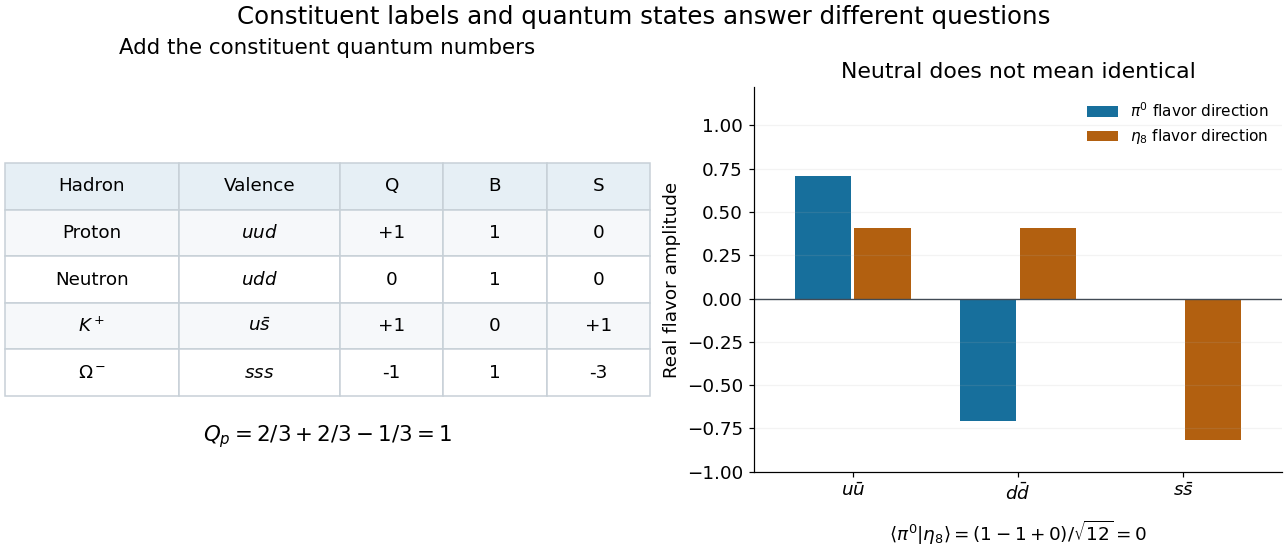
Adding constituent quantum numbers distinguishes charged and neutral hadrons
. Original arithmetic examples for the three-light-flavor quark model. The lower panel contrasts two orthogonal neutral flavor combinations: identical total electric charge does not make two states identical. These are ideal flavor basis states, not a mass fit or a reconstruction of an experimental event. Details.
Two hadrons can have identical additive labels while differing in their internal state. The Lambda baryon and neutral Sigma baryon both have valence content , yet their total isospin differs. Likewise, the neutral pion flavor direction and the Eta octet state both have , but their inner product vanishes. Expanding that inner product gives . Constituent counting must therefore be supplemented by quantum superposition and the symmetry of the state.
Constituent-quark model 2026-10-18
The constituent-quark model describes a low-energy hadron using effective massive quarks and phenomenological interactions. Its constituent quark masses include strong-interaction dressing and differ from short-distance running quark masses.
Spin-flavour symmetry Created 2026-10-18 Updated 2026-10-25
For three light flavours and two spin states, an approximate spin-flavour symmetry acts on the six-dimensional single-quark spin-flavour space. A spatial ground-state three-quark colour singlet requires the symmetric representation of dimension . Under flavour symmetry and ordinary spin rotations, it decomposes as : the baryon decuplet has spin and the baryon octet spin . The product of spin and flavour factors can require a correlated sum, rather than a single unentangled product.
There are unlisted articles, also show them or only show them.