
Thermodynamics of a liquid film Created 2026-10-18 Updated 2026-10-20
For a film described by , with material content fixed, its Helmholtz free energy obeys . Equality of mixed partial derivatives gives the Maxwell relation . If depends only on temperature, write ; thenHere is the heat capacity at constant area. For and , reversible adiabatic stretching cools the film, since , although positive mechanical input can increase its total internal energy. If with constant positive and constant , the isentropic process satisfies , where is an arbitrary fixed reference temperature. The work convention uses the total area conjugate to ; a two-surface film described by projected area requires the corresponding factor of two consistently throughout.
Lossless planar surface-plasmon dispersion 2026-10-18
For a vacuum-material interface at , write the magnetic phasor as , with in vacuum and in the material. The Ampere-Maxwell law gives and . Tangential field continuity gives . Together with , this gives the displayed relation and requires for real propagating and decay on both sides. For , the branch has and approaches that upper frequency only as . At low frequency, .
Helium-3 superfluidity 2026-10-18
Helium-3 superfluidity involves Cooper pairs of fermions; helium-4 atoms are bosons. Individual helium-3 atoms do not undergo Bose-Einstein condensation. [ref]
The Extraordinary Phases of Liquid 3He by David Morris Lee. Lee, 1996 lecture; 1997 reprint pp.645–647
The helium-3 superfluid discovery experiment connects an unexpected pressure feature to a change in the state of a liquid. Its lesson is unusually instructive: finding a reproducible anomaly and identifying the material that changed are separate experimental achievements. Pomeranchuk cooling explains how the experiment reached its operating regime; an independent nuclear magnetic resonance channel distinguishes the phases.
Helium slit-flow experiment 2026-10-18
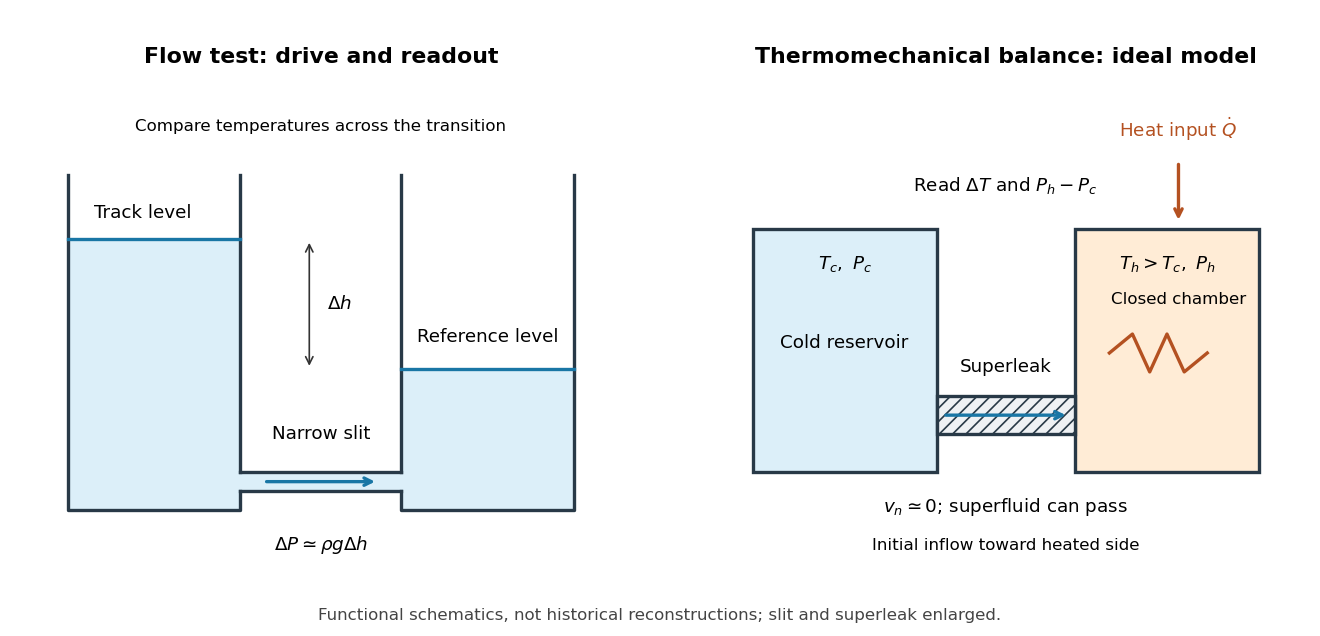
Pyotr Leonidovich Kapitza's 1938 test compared helium flow through optically flat glass disks. Suspension set the tube-to-bath level difference; a cathetometer read levels. The gap was estimated as . Levels barely moved over minutes above the transition, but equalized in seconds below. A laminar flow viscosity calculation gave only an upper bound.[ref]
Viscosity of Liquid Helium below the λ-Point by Pyotr Leonidovich Kapitza. Kapitza, 1938 viscosity paper, reprint chapter 34, pp.506–507
The essential control is to compare the same restriction and level readout at different temperatures. A changed pressure head is not itself evidence for a changed material response: the driving head must be included when interpreting the flow. For an idealized comparison at equal vapor pressure, negligible surface tension corrections and nearly constant mass density , hydrostatic equilibrium givesHere is the difference in free-surface heights and is gravitational acceleration. This explains why following a liquid level provides both a driving pressure and a transported volume; it does not turn a finite-resolution observation into proof of zero viscosity.

Superfluid number density 2026-10-18
The particle-number density associated with the superfluid response. In two dimensions it is a number per unit area and gives the phase stiffness for particles of mass . It differs from total density and need not equal condensate density.
Lambda point Created 2026-10-18 Updated 2026-10-20
The lambda point is the temperature of the transition between ordinary liquid helium-4 and its superfluid phase, named after the sharp lambda-shaped heat capacity feature. At saturated vapor pressure it lies near . Its value varies with pressure.
High-temperature superconductivity 2026-10-18
High-temperature superconductivity is a historical name for superconductivity above earlier metallic benchmarks. The original Bednorz-Müller experiment operated at tens of kelvins, requiring deep cooling; cuprate superconductors opened a new materials family.[ref]
Perovskite-type oxides: The new approach to high-Tc superconductivity by Johannes Georg Bednorz and Karl Alexander Müller. Part 1, p.426, historical comparison
A higher superconducting transition temperature enlarges the available operating range, but useful transport also needs a sufficient superconducting critical current at the operating temperature and magnetic field. In a ceramic, connections between grains can limit the whole specimen even when individual grains support superconductivity. This connects the materials problem to superconducting weak links and the Josephson effect. The parallel-path model of a superconducting ceramic below isolates why connectivity matters.
Superconductor Created 2026-10-18 Updated 2026-11-05
A superconductor is a material in a state of superconductivity, characterized by dissipationless steady bulk charge transport in the appropriate regime and the equilibrium magnetic screening of the Meissner effect. The state exists only within limits on temperature, magnetic field and electric current.
A zero measured electrical resistance is an important transport signature, but magnetic measurements distinguish superconductivity from the idealized perfect conductor. Type-I superconductors and type-II superconductors differ in their equilibrium response to increasing magnetic field; a type-II material can remain superconducting while containing Abrikosov vortices. Superconducting magnets exploit persistent electric currents, while superconducting circuits exploit the Josephson effect. A material's useful operating range also depends on processing, geometry and flux pinning, not solely on its transition temperature.
Single-electron superconducting tunneling Created 2026-10-18 Updated 2026-10-20
Single-electron superconducting tunneling transfers individual electrons across a barrier into or out of quasiparticle states of a material with superconductivity. In a normal-metal–insulator–superconductor junction, abbreviated NIS, only one electrode has superconductivity. Such a junction can reveal a superconducting energy gap without supporting a DC Josephson effect between two superconducting reservoirs.
For an elementary interpretation, assume an opaque barrier, approximately constant normal-electrode density of states, and an energy-independent tunneling matrix element over the range probed. Write the superconducting density of states divided by its normal-state value as , with measured from its chemical potential. A signed voltage convention chosen for positive normal-electrode injection giveswhere is the Fermi-Dirac distribution at a common temperature and is the normal-state junction electrical resistance. This current convention is local to the NIS measurement. The expression counts occupied initial and empty final states; it is a quasiparticle transport model, not a current-phase relation of a superconducting weak link.
An original analytic illustration uses the ideal fully gapped BCS theory spectrum at zero temperature, with positive gap edge :For positive , the occupation difference restricts the integral to . Since , integration and odd extension giveThe threshold is for this NIS model. In the corresponding zero-temperature single-electron process between two fully gapped superconductors, creating excitations on both sides instead requires . That quasiparticle threshold does not forbid coherent pair electric current below it. At finite temperature, thermally populated quasiparticles soften the simple threshold argument.
At zero temperature in the NIS approximation, away from the singular gap edge. Thus a voltage sweep probes the excitation density of states. The ideal divergence is rounded in real measurements, and at nonzero temperature the derivative samples a thermally broadened range of energies. For , the model has : electrical work creates excitations and is dissipated on relaxation. This distinguishes its steady transport from the conservative Josephson coupling energy.
Josephson junction 2026-10-18
A Josephson junction couples two regions with superconductivity through a weak link. A tunnel barrier is one implementation.
The remarkable possibility is a steady electric current across an insulating barrier at zero electric potential difference. This is the DC Josephson effect, carried by coherent transfer of Cooper pairs. It differs from single-electron superconducting tunneling, which probes the quasiparticle excitation spectrum and produces a dissipative current-voltage characteristic. Both contributions can occur in the same superconducting tunnel device. Brian D. Josephson predicted the pair contribution in 1962; his paper treats transfer that leaves the quasiparticle distribution unchanged. [ref]
Possible new effects in superconductive tunnelling by Brian D. Josephson. Josephson (1962), pp. 251–252, opening paragraph and equation (3)
The Josephson effect turns a difference of quantum phases into a measurable electric current, and an applied electric potential difference into a rate of phase advance. The Giaever gap experiment instead turns an electric potential difference into an excitation energy scale. These complementary measurements expose two aspects of superconductivity: its coherent order parameter and its gapped quasiparticle spectrum. The microscopic pairing calculation belongs to BCS theory and the BCS gap equation. A tunnel diode uses a different device, a semiconductor p-n junction.
Adding capacitance and an external bias makes the Gauge-invariant Josephson phase dynamical. Current-biased Josephson phase dynamics explains how its trapped energy levels and escape can be measured electrically.
Ginzburg-Landau theory of superconductivity 2026-10-18
Vitaly Lazarevich Ginzburg and Lev Landau applied an order parameter description to superconductivity in 1950. A spatially varying complex amplitude extends the fixed-amplitude description of the London equations. Their initial charge assumption preceded the later identification of the universal pair charge.[ref]
Consider the following isotropic, local SI Helmholtz free energy model near a continuous superconducting transition temperature:Here , is a phenomenological mass parameter, and fixes the electron-pair convention. The uniform superconducting minimum for has . The gradient term penalizes changes of the amplitude and the gauge-invariant quantum phase; the magnetic term penalizes magnetic field penetration. The gauge-coupling sign in Ginzburg-Landau superconductivity keeps the electric current and field equation consistent. This model omits material anisotropy, microscopic nonlocality and critical fluctuations.
Superconducting critical current 2026-10-18
A superconducting critical current is the limiting electric current, for a specified sample, temperature, external magnetic field and measurement criterion, beyond which the chosen state of superconductivity no longer sustains dissipation-free transport. A weak connection can limit a loop before the rest of its material does. A magnetic field generated by the electric current itself also contributes to the sample's conditions. A limit on the initial superconducting persistent current and a bound on its subsequent electrical resistance answer different experimental questions.
The persistent current in a superconducting loop experiment prepares a closed cold path, changes the externally linked magnetic flux, and follows the resulting superconducting persistent current through its magnetic field. The essential measurement starts after the inducing magnetic field has stopped changing.
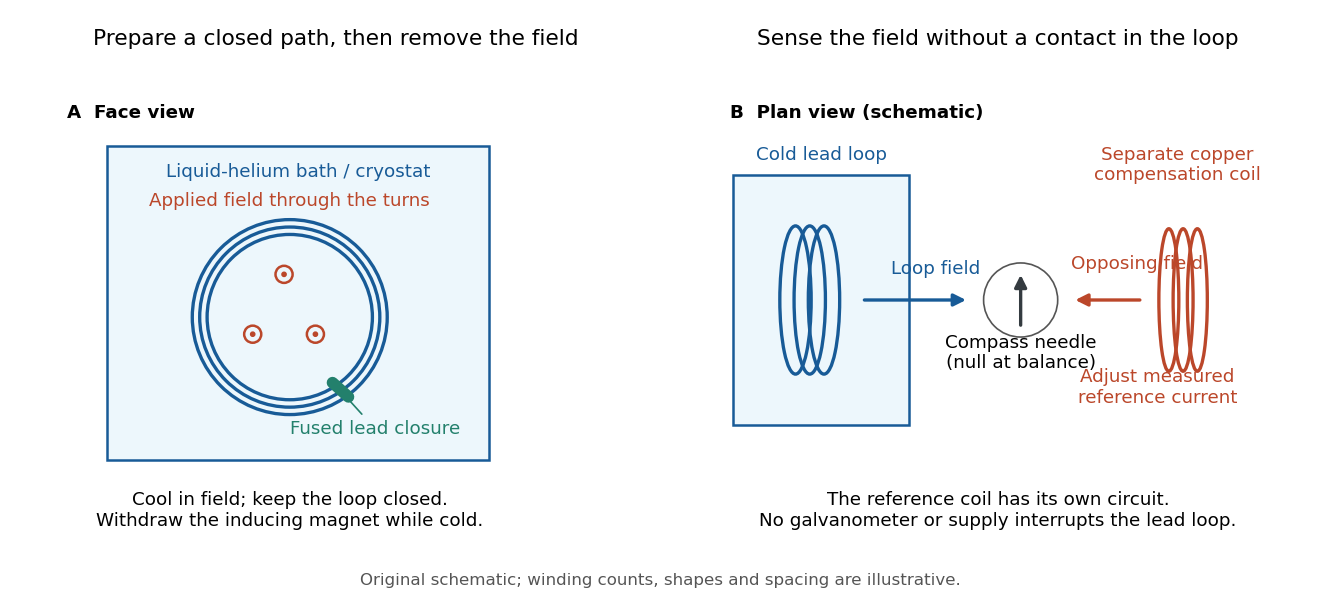

Heike Kamerlingh Onnes's 1914 Communication 140c describes a lead coil closed by fused lead connections. Cooling in a magnetic field and removing the inducing magnet prepared the circulation. A magnetic compass sensed it without contacts; a separate copper coil, cooled in liquid air, supplied a measured balancing magnetic field. Reversing orientation and compensation reduced offsets. [ref]
Further Experiments with Liquid Helium, J (Continued) by Heike Kamerlingh Onnes. Communication 140c (1914), §5, pp. 278–280; §7, pp. 280–281
The liquid-helium cryostat maintained low temperature, but refilling temporarily warmed the apparatus and changed the inferred electric current. A later run used a smaller initial electric current. Apparatus deformation and needle-zero drift limited comparison; cutting the closure still left a smaller magnetic signal, warning against assigning every signal to circulation around the whole loop. The report consequently gave an upper bound under a residual Ohm's law hypothesis. [ref]
Further Experiments with Liquid Helium, J (Continued) by Heike Kamerlingh Onnes. Communication 140c, §5, pp. 279–280; §6, p. 280; §8, pp. 281–283
For interpreting such a measurement, write a locally calibrated magnetic signal asHere is the coupling and gain, while contains the background magnetic field and readout offset. Only after establishing stable and correcting does a ratio of signals determine a ratio of electric currents. A gradual change in geometry, a drifting background magnetic field, or a change of temperature can imitate or conceal a decay. A pickup coil connected only to a voltage meter obeys Faraday's law of induction and detects a changing linked magnetic flux; its zero steady output cannot demonstrate that the underlying static magnetic field has disappeared. A magnetic compass can respond to that static magnetic field.
Opening the path, reversing the preparation, and repeating with smaller initial electric current are useful controls for separating whole-loop circulation, magnetic background and a superconducting critical current. Keep the temperature and external magnetic field stable during the interval used to infer electrical resistance. A sudden reduction near a superconducting critical current is not evidence for the constant- exponential decay model at smaller electric current. Persistence also does not replace the Field-cooled Meissner experiment: transport around a hole and magnetic expulsion from the material test different properties.
Persistent current (superconductivity) 2026-10-18
A superconducting persistent current is an electric current circulating in a closed path with superconductivity after the external driving electromotive force has ceased. Its associated magnetic field makes the circulation observable without inserting a measuring instrument into the path. This article concerns macroscopic circulation in superconductivity. A finite experiment establishes persistence over its observation window with a stated measurement error, rather than directly observing an infinite lifetime.
The ideal circuit connection is flux conservation in a superconducting loop. In a fixed loop with self-inductance , a single circulating electric current , and externally imposed linked magnetic flux , the lumped circuit approximation givesWhen the electrical resistance vanishes, integrating gives . Removing the external linked magnetic flux therefore changes the circulating electric current; holding it fixed afterwards preserves that electric current. This is a circuit approximation with a specified self-inductance, not a derivation of the microscopic state of superconductivity. For thin paths where the carrier contribution matters, fluxoid and flux quantization in a superconductor supplies the more careful description.
For constant , constant effective electrical resistance , and no changing external linked magnetic flux, the RL circuit instead predictsThis exponential decay follows by separating . A long relaxation time tests extremely small electrical resistance without trying to resolve an equally tiny steady electric potential difference. The stored magnetic energy is , so the same model gives , exactly the Joule heating loss. The finite energy stored in the loop supplies the magnetic readout; the circulating electric current is not a continuously powered source of useful work.
Superconducting device Created 2026-10-18 Updated 2026-11-05
A superconducting device uses superconducting behavior to perform a function such as generating a strong magnetic field, detecting flux, switching or manipulating quantum states. Examples include superconducting magnets, SQUIDs and Josephson junction circuits.
Its performance depends on the full operating environment: temperature, magnetic field, applied current, losses and thermal coupling. A superconducting component does not make every part of a device lossless. Junction interfaces, quasiparticles and vortices can produce measurable dissipation or noise even when the intended circuit element has a superconducting state.
Testing a differential thermal actuator 2026-10-18
A proposed bench test can isolate the mechanism without a gas burner. Illuminate a blackened and a polished sample of matched material and geometry, record both temperatures and their relative displacement, then block the beam. Measure incident irradiance separately. Swap the surface treatments, hold the ambient temperature fixed for the illumination test, and change it with the beam blocked for a common-heating control. This is a model-based experiment proposal, not a report of measurements.
A larger response of the dark sample would support a difference in absorbed power; the displacement and cooling curves test the assumed linear thermal expansion coefficient and time constant. A stable illumination step that never reaches the switching gap challenges the chosen parameter model rather than the existence of thermal expansion. Nonuniform sample temperature, unequal losses and mechanical friction can separate the physical device from the ideal equations.
Differential thermal model of a sun valve Created 2026-10-18 Updated 2026-11-05
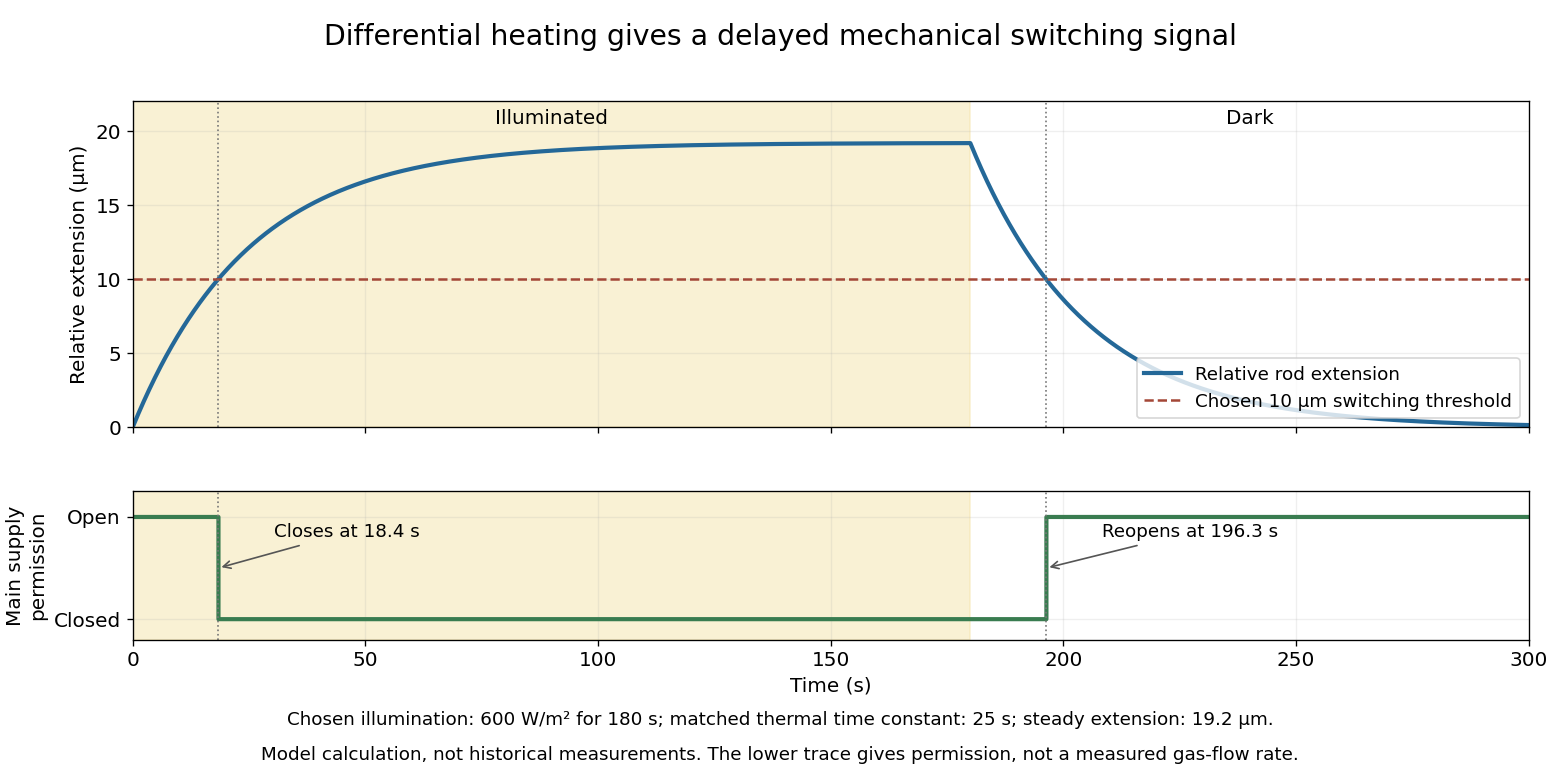
Take a stipulated pair of effective rods with common length , linear thermal expansion coefficient , heat capacity , projected illuminated area , and thermal conductance to an environment at constant temperature . One reference represents the symmetric polished-rod assembly. Write and . Let their effective radiometric absorptances be for a fixed incident optical spectrum, and let be the common irradiance. A spatially uniform, linear heat-balance model givesHere includes a linear approximation to the relevant losses; changing the surface treatment can also change those losses in a real device. We stipulate equal and to isolate the response to absorbed illumination, with thermal coupling from the burner neglected. Small, mechanically unconstrained extensions then give a differential displacementThe time constant describes thermal memory. A common imposed temperature shift cancels from the extension difference under the matched-coefficient assumptions; mismatched materials, geometry or thermal coupling can spoil that cancellation.
For a step from darkness to constant irradiance , with initially equal rod temperatures, the first-order linear differential equation givesChoose , , , , , , and . The calculated difference of absorbed powers is , givingFor an illustrative ideal valve that closes at , the closing time isThis threshold is crossed only when . These are chosen model parameters, not a fit to a historical valve.

Fructose Created 2026-10-18 Updated 2026-11-05
Fructose is a six-carbon ketose monosaccharide with the same molecular formula as glucose, but different connectivity in the open-chain form. In aqueous chemical solution, fructose occurs mainly in cyclic forms.
Fructose supplies one of the two sugar units in sucrose and is the repeating building block of many fructans. These examples distinguish a free monosaccharide from its residues inside larger carbohydrates.[ref]
25.1 Classification of Carbohydrates. Classification of monosaccharides
Sudden hydrogenic charge change Created 2026-10-18 Updated 2026-10-20
In the sudden approximation, changing the nuclear charge of a one-electron hydrogen atom from to leaves its electronic state unchanged during the change. Its subsequent probability to occupy a final state is the squared overlap with that state. Using normalized wavefunctions , , givesThis follows by integrating over positive . A spherically symmetric initial state has zero overlap with every final state of nonzero orbital angular momentum, by the orthogonality of the spherical harmonics. Nuclear recoil and interactions with emitted particles can invalidate the perfectly spherical sudden-change model.
Work by Subrahmanyan Chandrasekhar 2026-10-18
There are unlisted articles, also show them or only show them.