
Thomson effect Created 2026-10-18 Updated 2026-10-20
The Thomson effect is distributed reversible heating or cooling when an electric current flows through a homogeneous material with a temperature gradient. It is distinct from junction Peltier effect heating and even-in-current Joule heating.
Dilution refrigerator Created 2026-10-18 Updated 2026-11-05
A dilution refrigerator removes heat at very low temperatures by transferring helium-3 from a concentrated phase into a dilute phase rich in helium-4. The enthalpy per circulating helium-3 atom is higher in the dilute phase, so crossing the phase boundary absorbs energy from the mixing chamber of a dilution refrigerator. This is the useful cooling process.
Continuous operation requires a circulation loop. A dilution refrigerator still preferentially evaporates helium-3 from the returning mixture; pumps return it through a condensing and precooling path. Heat exchangers let the outgoing cold stream cool the incoming stream before it reaches the mixing region.[ref]
How Does a Dilution Refrigerator Work? by Bluefors. Phase Separation of Helium Isotopes and Operation of the Dilution Unit: enthalpy difference, mixing chamber, still and return heat exchangers
A heater attached to the cold stage can impose a known test load, allowing a measurement of cooling power versus temperature. Unwanted heat conduction through supports and wiring, and absorbed thermal radiation, enter that same load budget. The refrigerator therefore needs both the microscopic mixing mechanism and careful thermal coupling to the experiment. Maxwell's demon Created 2026-10-18 Updated 2026-11-05
Maxwell's demon is a thought experiment in which a controller measures microscopic motion and selectively operates a barrier, apparently driving a system away from thermal equilibrium without the usual thermodynamic cost. For example, admitting fast gas particles preferentially to one side seems to create a temperature difference that a heat engine could exploit.
The controller must be included in the physical accounting. Its measurement record becomes correlated with the gas, and a repeatable cyclic device must deal with that record rather than treating information storage as an unlimited free resource. Landauer's principle connects logically irreversible memory erasure with a thermodynamic cost under its stated conditions. This does not mean that every measurement automatically dissipates exactly one bit's erasure cost. The point is to track the complete cycle, correlations and resources. A controller that reduces one subsystem's entropy can still respect the Second law of thermodynamics by increasing entropy elsewhere.
Richardson hot-wire emission experiment 2026-10-18
In his Nobel lecture, delivered on 12 December 1929 for the 1928 prize, Owen Willans Richardson recalled heating wires for weeks while hand-pumping away gas released by the apparatus. With platinum, he found a finite emission per unit area that rose rapidly with temperature. His initial 1901 formula used ; he preferred the form in 1911.[ref]
Thermionic Phenomena and the Laws which Govern Them by Owen Willans Richardson. Nobel Lectures, Physics 1922–1941; pp. 224–225 and 229, preparation and chronology
The early apparatus surrounded a heated platinum wire with a metal cylinder connected to earth through a galvanometer. Wire electrical resistance supplied the temperature readout. After checking collection saturation, Richardson measured at a wire potential of , over roughly –; reversing polarity suppressed the negative discharge.[ref]
O. W. Richardson and the Electron Theory of Matter, 1901–1916 by Ole Knudsen. Histories of the Electron: The Birth of Microphysics edited by Jed Z. Buchwald and Andrew Warwick; pp. 229–231, resistance thermometry and Fig. 7.2, reproducing the 1903 apparatus
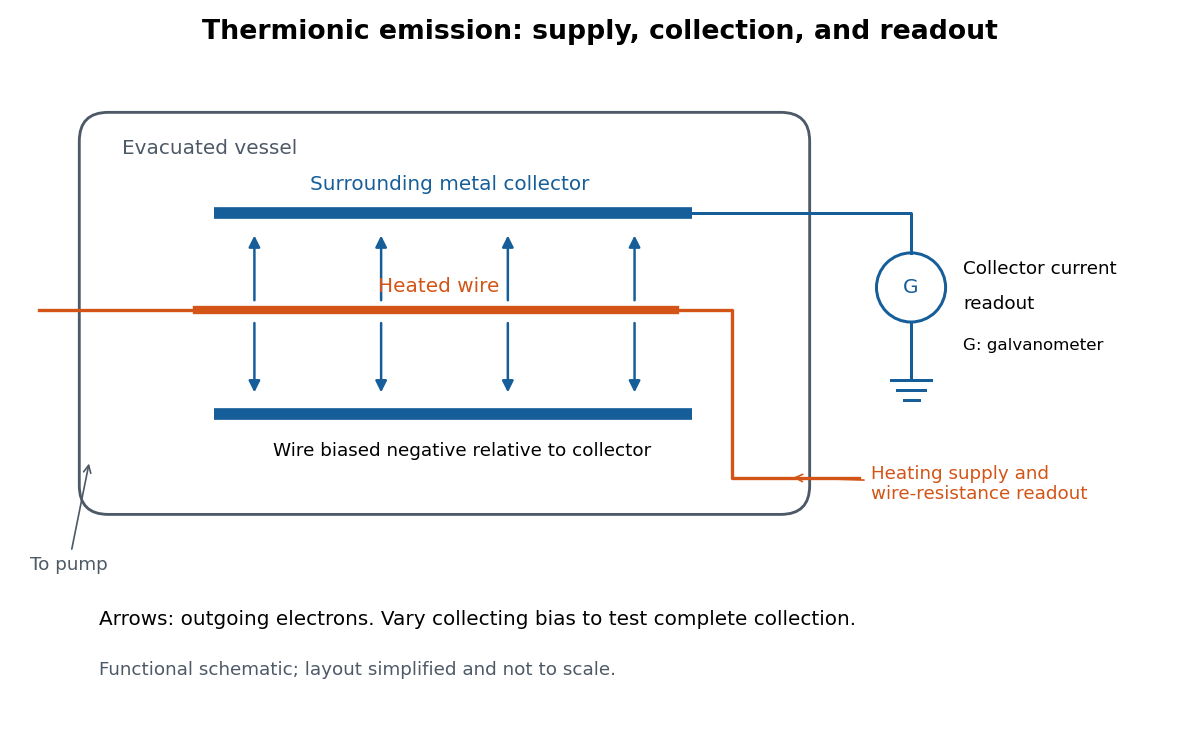
Heated-wire emission and separate collection and temperature measurements
. Original functional schematic of the measurement principle, with a wire and surrounding collector shown in section. The layout is simplified; no dimensions or instrument performance are asserted. Details.
The inference rests on several controls. A temperature sweep probes thermal escape; reversing the collecting electric field tests the sign of the mobile electric charge; varying collection voltage tests whether transport is limiting. Prolonged pumping and heating test whether a transient gas release is responsible. These controls address different alternatives, and none by itself establishes a clean, uniform surface.
For a modern repetition, stabilize each temperature, measure the collector electric current against collecting electric potential difference, and record the pressure and surface preparation. Repeat selected temperatures after cooling to reveal drift. Use the collection plateau and the actual emitting area to construct a Richardson plot. The resulting slope estimates the work function only within the stated surface and transport assumptions; it does not turn an uncontrolled wire into a reference material.
Space-charge-limited thermionic current Created 2026-10-18 Updated 2026-10-20
A space-charge-limited thermionic current occurs when the negative space charge of emitted electrons creates an electric field that obstructs further transport across the gap. Raising the emitter temperature may then increase the surface supply without producing the corresponding collector electric current. The gap geometry and collecting electric potential difference matter even when the surface is stable.
To distinguish this from an emission-limited thermionic current, vary the collecting electric potential difference at fixed emitter temperature, then repeat at another temperature. A voltage-dependent transport region followed by a collection plateau separates a gap constraint from a supply constraint. A weak collector electric current alone cannot establish a high work function. Nor does simply choosing a very large collecting electric potential difference guarantee a valid zero-field measurement: the surface barrier may then change.
Emission-limited thermionic current Created 2026-10-18 Updated 2026-10-20
An emission-limited thermionic current is set by the rate at which the heated surface supplies electrons, with nearly complete collection. At fixed temperature, increasing the attracting electric potential difference then produces an approximate collection plateau. That plateau is the useful regime for fitting the Richardson-Dushman law, provided the electric field has not significantly lowered the surface barrier.
The emitting surface still matters in this regime. Adsorption changes the work function; different crystal faces can have different barriers. Heating may desorb contaminants or change a coating, so repeated measurements at the same temperature need not agree unless the surface preparation is controlled. For fixed , a barrier change multiplies by . In the chosen model at , raising the barrier by reduces to about 0.313 of its previous value.
Richardson-Dushman law Created 2026-10-18 Updated 2026-10-20
The Richardson-Dushman law models the magnitude of emitted electric current density asHere is absolute thermodynamic temperature, is the work function, is the Boltzmann constant, and is the Thermionic Richardson constant. The signed electric current density points opposite to the outgoing electron motion; here is positive. For uniform emission over area , the emitted electric current magnitude is .
The Richardson-Dushman law assumes an emitter close to thermal equilibrium, a surface with a well-defined and approximately constant work function over the fitted temperature range, and predominantly thermal escape over the barrier. Interpreting a measured collector electric current with this law additionally requires an emission-limited thermionic current, known emitting area, and negligible return emission from the collector. Strong electric fields can lower the surface barrier or enable quantum tunnelling; then this zero-field expression is insufficient.
For a deliberately chosen teaching model, take and , expressing the barrier in electronvolts. These are illustrative parameters, not measured properties of a named material. Using , at the Boltzmann factor is about , yetA 20 percent increase in temperature raises the predicted electric current density by about 69 times. For a chosen emitting area , these correspond to approximately and if collection is complete. The small escaping fraction is replenished by the external electrical circuit.
The sensitivity is especially clear from the logarithmic derivative at fixed :In the chosen model at , a rise changes by about 2.5 percent to first order. Accurate temperature measurement matters even when electric current measurement is easy.
Volume fluctuations of a closed gas bubble 2026-10-18
For fixed particle number and temperature, a bubble with surface tension and area has effective availability . Its stationary condition is . Its curvature is . Positive curvature is required for stable Gaussian fluctuation approximation. The variance follows from availability curvature and equilibrium fluctuations. For an ideal gas, the restoring denominator becomes for positive . Treating the internal pressure as externally fixed instead of fixing the gas particle number changes the stability problem.
Heat-capacity activation estimate 2026-10-18
For gapped excitations with and approximately constant prefactor, two heat capacity measurements at give the displayed activation-energy estimate. A more general prefactor changes its numerator to . The two-point estimate measures an effective exponential scale; it does not independently determine the prefactor or establish a detailed excitation density of states.
Work by Theodore Lyman 2026-10-18
Work by Theodore Harold Maiman Created 2026-10-18 Updated 2026-10-25
Work by Theodor Wulf 2026-10-18
Michelson-Morley experiment Created 2026-10-18 Updated 2026-10-31
An interferometer compares round-trip light travel times along perpendicular arms as its orientation changes. The absence of the classical stationary-aether fringe shift at the expected scale constrains orientation dependence of the round-trip speed of light. The result is consistent with special relativity, but alone does not select it uniquely from every alternative theory.[ref]
On the Relative Motion of the Earth and the Luminiferous Ether by Albert Abraham Michelson and Edward W. Morley. 1887 report, interferometer arrangement and comparison of predicted and observed orientation-dependent shifts

The 1887 Michelson-Morley experiment apparatus
. Historical photograph credited by Wikimedia Commons to Case Western Reserve University; public domain in the United States. The stone support floated in a trough of mercury so that the interferometer could turn. Source.
The instrument's stone support and floating mounting allowed the experimenters to change its orientation while limiting mechanical disturbance. The measured quantity was the fringe shift produced as the apparatus rotated, rather than a direct timing of a single light pulse.[ref]
On the Relative Motion of the Earth and the Luminiferous Ether by Albert Abraham Michelson and Edward W. Morley. 1887 report, apparatus description and observation procedure


Spin-boson model Created 2026-10-18 Updated 2026-11-05
A spin-boson model couples a two-state quantum system to a collection of quantum harmonic oscillators. The oscillator modes provide environmental degrees of freedom that can exchange energy with the spin and change its reduced density matrix. One transverse-coupling convention isThe choice of coupling axis matters: here the Pauli matrix flips the energy-basis spin states. Coupling only through has a different effect, since it commutes with the free spin Hamiltonian operator.
Work by Takashi Mukai 2026-10-18
Work by Takaaki Kajita 2026-10-18
Alternating Gradient Synchrotron Created 2026-10-18 Updated 2026-10-25
The Brookhaven proton synchrotron used for the Lederman-Schwartz-Steinberger two-neutrino beam experiment.
Monodisperse 2026-10-18
A monodisperse particle suspension has a narrow distribution of particle sizes. Treating its particles as having a single radius simplifies the Perrin sedimentation experiment model; residual size variation can still affect the inferred Avogadro constant.
Sedimentation 2026-10-18
Sedimentation is separation of suspended particles through a body-force-driven relative motion. In the Perrin sedimentation experiment, diffusion balances gravitational settling to produce a stationary height profile.
Capillary action Created 2026-10-18 Updated 2026-11-05
Motion of a liquid through a narrow space due to surface tension and contact with the walls; it draws the chromatographic mobile phase through a thin-layer chromatography coating.
There are unlisted articles, also show them or only show them.