
Work by Robert Andrews Millikan 2026-10-18
Rigid body orientation 2026-10-18
The rotational configuration of a rigid body relative to a reference frame. In three dimensions, one marked direction leaves rotation about that direction undetermined.
Vehicle rollover threshold Created 2026-10-18 Updated 2026-10-20
For a rigid vehicle turning on a level road, with centre of mass height , half track width and turn radius , sufficient static friction supplies centripetal acceleration . The inner and outer wheel normal forces obey and . The inner contact force first vanishes at the displayed speed. The approximation neglects suspension movement and extra torques; inadequate static friction can cause sliding before rollover.
Work by Richard Quentin Twiss 2026-10-18
Work by Richard N. Watts 2026-10-18
Work by Richard Edward Taylor 2026-10-18
Work by Richard A. Forman 2026-10-18
Work by Riccardo Giacconi 2026-10-18
Polyuridylic acid 2026-10-18
Extensional flow Created 2026-10-18 Updated 2026-10-20
An extensional flow stretches material along one or more directions while contracting it along others. A local ideal model of planar extension has velocity : its rate-of-strain tensor is and it is an incompressible flow. Uniaxial extensional flow instead contracts both transverse directions. These geometries probe extensional viscosity and can stretch polymers.
Uncompetitive inhibition 2026-10-18
The complementary limit of the branching model permits inhibitor binding only to the enzyme-substrate complex: set , hence , with finite . Then both and decrease by , while their ratio stays fixed. This limit helps distinguish preferential binding to in mixed inhibition from exclusive binding to in uncompetitive inhibition.
Mixed inhibition 2026-10-18
In the branching model, mixed inhibition retains inhibitor binding to both free enzyme and the enzyme-substrate complex. Unequal and shift both apparent parameters; their equality gives pure noncompetitive inhibition. For the chosen unequal case, gives and , hence and . Because , binding favours free enzyme, and the apparent Michaelis constant increases. Reversing that inequality decreases it.
The limiting behaviour provides a useful diagnostic within this model:Low substrate concentration isolates through the initial slope; high substrate concentration isolates through the plateau. At , the chosen competitive inhibition and unequal mixed inhibition examples have the same low- slope, , but different plateaus, and . Measuring only low substrate concentrations would miss that distinction.
Competitive inhibition 2026-10-18
In the model of reversible enzyme inhibition, competitive inhibition makes substrate binding and inhibitor binding mutually exclusive: is allowed but is absent. Set , equivalently take . ThenFor the chosen , : the half-limiting substrate concentration rises from to , while the limiting reaction rate remains . At the inhibited reaction rate is , compared with the uninhibited . “Overcome by substrate” means that their ratio tends to one as , not that any finite addition removes the difference.
Inhibition constant 2026-10-18
An inhibition constant sets an inhibitor concentration scale in an enzyme kinetics model. In the rapid-binding construction under reversible enzyme inhibition, and are dissociation constants. Smaller values favour the corresponding bound population at fixed free inhibitor concentration. More generally, fitted inhibition constants need not be true binding dissociation constants; a mechanism must justify that interpretation.[ref]
Symbolism and Terminology in Enzyme Kinetics (Recommendation 1981) by Nomenclature Committee of the International Union of Biochemistry. Symbolism and Terminology in Enzyme Kinetics, section 6.4, final paragraphs: operational inhibition constants versus explicitly defined dissociation constants
For example, choosing makes in this model, but does not imply that half of all enzyme is : and also contribute to the total population.
Resonant frequency 2026-10-18
A frequency at which a specified driven response is resonant. The value can depend on the observable and damping: the electric current amplitude of a driven series RLC circuit peaks at , while a different circuit readout need not peak at the same frequency.
Resonator Created 2026-10-18 Updated 2026-11-05
A resonator stores oscillatory energy in one or more normal modes. Driving near a mode's frequency can produce resonance. Losses limit the response and determine its quality factor. After the drive is removed, an isolated weakly damped mode decays approximately exponentially; an observed room response may combine many modes.
Logarithmic beta integral from a sector contour Created 2026-10-18 Updated 2026-10-20
For real , choose a branch of the complex logarithm whose argument interval contains strictly, and integrate over an annular sector of angle . The one enclosed simple pole is , with residue . The circular arcs tend to zero, with bounds and .
Writing for the title integral and , the two radial segments and the residue theorem giveDivide by and equate real and imaginary parts. This gives and the title formula. When , the sector extends below the negative real axis; the principal complex logarithm therefore cannot be used throughout that sector. A cut along a ray just below the positive axis avoids this issue for every .
Indirect selection of bacterial mutants 2026-10-18
Indirect selection of bacterial mutants recovers a source using a related sample's tested phenotype, rather than directly challenging the retained lineage. A positive example uses a surviving replica biological colony to locate its unexposed source. A negative example uses failure to grow in one condition to locate a source that does grow elsewhere. The second is particularly useful for finding auxotrophy: dependence on an externally supplied nutrient.
Construct a four-by-four teaching layout with rows A–D and columns 1–4. The master has 13 biological colonies; A4, D1 and D4 are empty. A growth-supporting control replica grows at every occupied master site except B2 and C3. A replica lacking an assumed nutrient X grows at those same control sites except A2 and C1. All other requirements are stipulated equal. These are invented readouts, not observations from the Lederberg replica plating experiment.
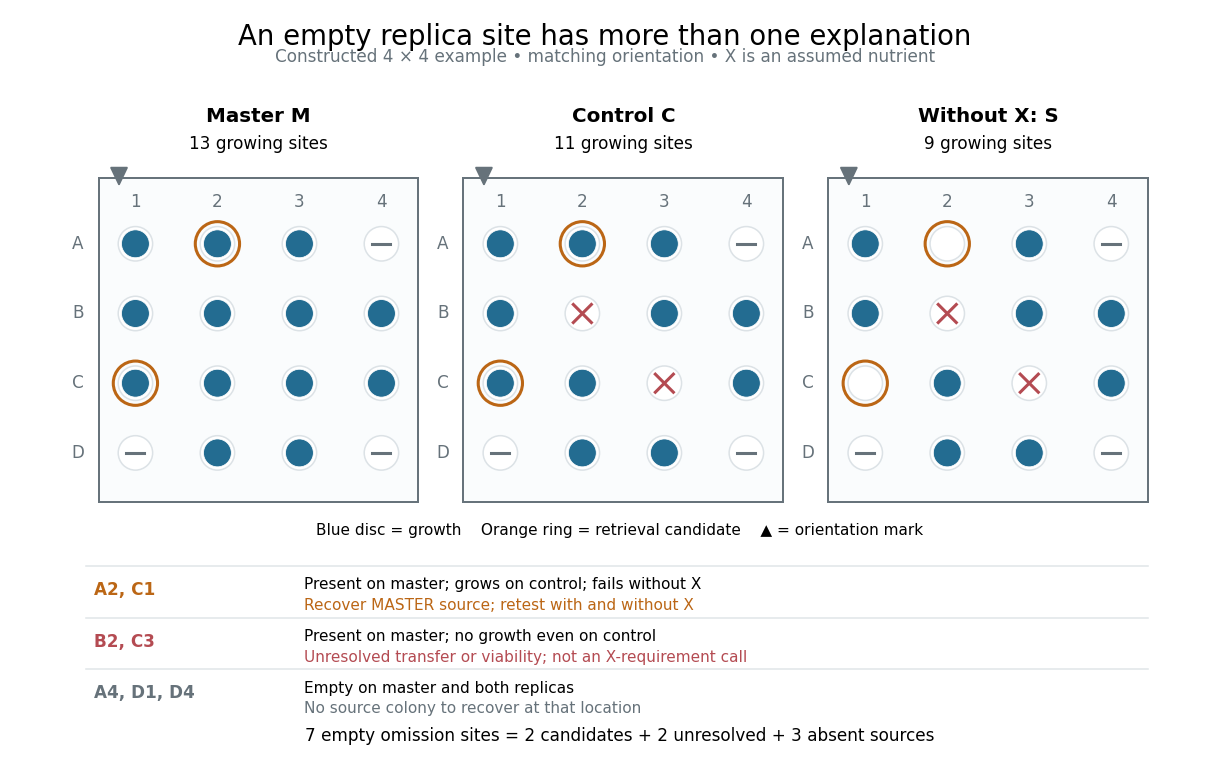
An original replica plating map separates retrieval candidates, unresolved transfer and absent sources
. Constructed four-by-four master, control and nutrient-X-omission readouts, viewed in the same orientation. Blue discs mean growth. Orange rings identify A2 and C1 for recovery from the master. Red crosses mark B2 and C3, which lack growth even on the control; gray dashes mark positions empty on the master. The lower comparison distinguishes these three explanations of an empty restrictive-replica site. No measured data or published plate illustration is reproduced. Details.
Let , and be the finite sets of sites with growth on the master, control and X-omission replica respectively. In this construction , with cardinalitiesThe set differencecontains the two condition-dependent candidates. Pick from A2 and C1 on the master, then compare fresh samples of each recovered source with and without X. Restoration of growth when X is supplied supports an X-requirement phenotype, subject to the scientific controls; growth alone does not identify a particular gene or mutation.
By contrast,is unresolved sampling or viability in this first comparison. Neither site should be counted as an X-requirement candidate. The three sites outside have no master source to recover at all. The short logical argument is membership testing: a candidate must belong to , establishing control growth, and not belong to , establishing the contrasting readout. Being outside alone supplies only the second condition. Among the seven empty X-omission sites, two are candidates, two are unresolved and three have no master source. The beauty of the method is that a shared location turns this logical distinction into a practical retrieval route.
Replica plating controls 2026-10-18
Replica plating controls distinguish a growth phenotype from failure of the copying process. A replica on a cell culture medium that supports the starting biological colonies is a touch-transfer scientific control: growth at a site demonstrates that viable biological cells reached that control site. If a source is visible on the master but absent on both control and restrictive replicas, the restrictive readout is unresolved. If it grows on the control but fails on the restrictive replica, the difference is a candidate condition-dependent phenotype.
The touch-transfer scientific control still cannot guarantee transfer to every other replica. A known growing comparison on the restrictive cell culture medium, repeat sampling, and retesting a recovered source address different possible failures. Likewise, an orientation mark checks which source a site represents; it cannot check whether any biological cells arrived. Gentle, aligned contact helps preserve the map. In Investigations in Molecular Cell Biology by Clare M. O’Connor, section 12.6: Exercise 2 - Replica plating and complementation, the instructions align master and carrier marks and call for light, even contact.[ref]
12.6: Exercise 2 - Replica plating and complementation. Investigations in Molecular Cell Biology by Clare M. O’Connor; Introductory light-touch instruction and steps 1–2: orientation marks, aligned inversion and gentle even contact
For indirect selection of bacterial mutants, keep the recovery route on the unexposed master. Returning a carrier that has touched a challenged replica to that master would introduce a possible exposure route. The original experiment's stray-bacteriophage check addresses contamination of the retained lineage, while the orientation and touch-transfer scientific controls address spatial identity and successful sampling. These questions must be checked separately.
Lederberg replica plating experiment 2026-10-18
Joshua Lederberg and Esther Lederberg reported replica plating in 1952. They autoclave-sterilized velveteen and secured it pile-up on a wood or cork cylinder with a metal hoop. Inverted agar plates touched the fabric lightly. Pencil marks or pin indentations fixed orientation. Complete-medium and minimal-medium replicas compared growth of biological colonies.[ref]
Replica plating and indirect selection of bacterial mutants by Joshua Lederberg and Esther Lederberg. pp. 399–402, Methods: Replica plating; Figure 1 caption; Results: plate orientation
Escherichia coli W-1 grew on plain agar; serial T-1 bacteriophage replicas showed resistant biological colonies at matching sites. Corresponding unexposed master regions seeded repeated broth-and-plain-agar enrichment, yielding resistant isolates. Stray-bacteriophage checks were negative; resistance persisted without challenge. This supported preexisting heritable resistance. The authors noted variable transfer and moisture-dependent resolution.[ref]
Replica plating and indirect selection of bacterial mutants by Joshua Lederberg and Esther Lederberg. pp. 401–403: transfer variability, Clonal occurrence of phage resistant mutants, Indirect selection and stray-phage checks; p. 404, Discussion
The Luria-Delbrück experiment uses variation between independently grown cell cultures to investigate the timing of resistant mutations. The Lederberg replica plating experiment adds a spatial route to a recoverable source: the tested samples identify an unexposed lineage. These are complementary arguments about mutation and natural selection. Growth readouts establish a tested phenotype; identifying the responsible nucleotide sequence requires other evidence, such as DNA sequencing.
There are unlisted articles, also show them or only show them.