
Cell culture passage accounting 2026-10-18
In an original constructed example, seed biological cells in of cell culture medium. Suppose the recoverable count becomes before the next subculture. Transfer a well-mixed quarter of that harvest into a new vessel and bring its final volume to . Assume complete recovery, no loss during transfer and no division during handling. The selected portion containsThe other biological cells remain outside the tracked vessel. The lower count after transfer is selection of a portion, not evidence of death. Adding fresh cell culture medium lowers the number density further without changing the selected count.
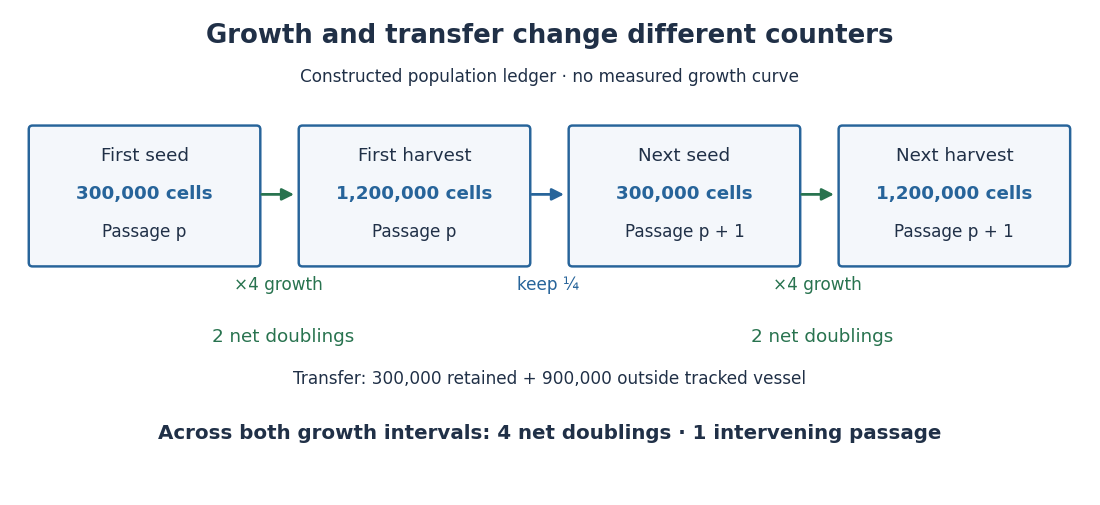
One subculture transfer can follow two cell line population doublings
. Original constructed count ledger, not an observed HeLa growth curve. Each growth interval multiplies the recoverable count by four; each transfer retains one quarter. The tracked lineage gains four net cell line population doublings across two intervals although both seed counts are . Boxes describe whole cultured populations, not persistent individual biological cells. Details.
If the next interval again changes to , the two growth intervals contribute net cell line population doublings. At the second harvest there has been just one intervening passage. Another quarter-transfer would add another passage without adding a growth interval. Thus neither passage number nor the logarithm of the final count divided by the very first seed count records all growth when portions are removed.
Work by Stuart Jay Freedman Created 2026-10-18 Updated 2026-10-25
Work by Stig Lundquist 2026-10-18
Work by Steven Weinberg 2026-10-18
Work by Steven T. Cundiff 2026-10-18
Work by Steve Williamson 2026-10-18
Work by Stephen M. Seltzer 2026-10-18
Work by Stephen F. Mason 2026-10-18
Work by Stephen A. Cook Created 2026-10-18 Updated 2026-10-25
Neutrino astronomy 2026-10-18
Neutrino astronomy infers properties of astronomical sources from detected neutrino reactions. Solar neutrino detection probes ongoing stellar nuclear fusion; the SN 1987A neutrino burst probes a brief episode of core-collapse supernova evolution. A detector observes reaction products, so source inference depends on cross sections, neutrino flavor, thresholds and detection efficiency.
Stellar activity Created 2026-10-18 Updated 2026-11-05
Stellar activity is variable magnetic behaviour in a star's outer layers, including starspots, atmospheric heating and eruptive phenomena. Rotation carries regions of different brightness and line shape across the visible disc. Their changing contribution alters both the stellar light curve and the apparent Doppler shift, even when the star's centre of mass has no corresponding orbital motion.
This makes stellar activity both a subject of study and a source of stellar noise in exoplanet searches. A changing stellar spectral-line bisector tests whether a line is deforming rather than simply translating in wavelength. Simultaneous brightness measurements supply another diagnostic. Actual observing times matter because an activity-period alias in radial-velocity sampling can place an activity-related signal at a misleading period.
Work by Stefano Zapperi 2026-10-18
Frequency estimation Created 2026-10-18 Updated 2026-10-20
Frequency estimation infers a periodic signal's frequency from observed samples. It may use a peak of the discrete Fourier transform, or fit a sinusoidal model with amplitude, phase, and frequency as unknown parameters. Its attainable precision depends on noise, observation duration, sampling rate, and the estimator. Fourier frequency resolution alone does not specify that precision.
Spin degeneracy 2026-10-18
When a single-particle energy is independent of its spin projection and all projections are available, the state degeneracy due to spin is . A spin-half gas has if both projections are available, while a fully polarized gas can have one populated spin species. A magnetic field that resolves Zeeman splitting requires counting the separate energies instead of multiplying one common occupancy by .
Work by Stanley Block 2026-10-18
Nambu superconductivity and chiral symmetry analogy Created 2026-10-18 Updated 2026-11-05
Yoichiro Nambu's superconductivity work led to the spontaneous symmetry breaking ideas recognized by his share of the 2008 Nobel Prize in Physics.[ref]
Guide to the Yoichiro Nambu Papers 1917-2009 by University of Chicago Library. Biographical Note, superconductivity origins and 2008 award
His 1960 treatment made the Meissner effect response consistent with gauge invariance by including collective pair contributions alongside the quasiparticles. The resulting Ward identity relates the interaction correction to the current and the self-energy; retaining the quasiparticles alone omits part of the response.[ref]Quasi-Particles and Gauge Invariance in the Theory of Superconductivity by Yoichiro Nambu. Abstract, paragraphs 2–4: current corrections, Ward identity, Meissner response and collective pair excitations
The individual Nobel lecture explains the bridge to particle: the superconductivity gap suggested a dynamically generated fermion mass, and the accompanying collective excitation suggested a light pion. It also notes that the long-range Coulomb interaction turns the charged phase response into a plasmon. A neutral global phase mode and a charged material therefore need different low-momentum descriptions.[ref]
Nobel Lecture: Spontaneous symmetry breaking in particle physics: A case of cross fertilization by Yoichiro Nambu. p. 1016, Eqs. (1)–(7): quasiparticles, collective current, plasma frequency and pion analogy
In 1961, Yoichiro Nambu and Giovanni Jona-Lasinio supplied a four-fermion model with a self-consistent mass and a massless pseudoscalar bound state: an idealized pion. Their original constituents were nucleon fields. Their introduction explicitly distinguishes the zero-mass neutral collective excitation from its charged plasma counterpart and allows approximate chiral symmetry as the explanation of a nonzero pion mass. This is a model of dynamical symmetry breaking, rather than a microscopic derivation of quantum chromodynamics.[ref]
Dynamical Model of Elementary Particles Based on an Analogy with Superconductivity. I by Yoichiro Nambu and Giovanni Jona-Lasinio. §I, pp. 345–346: gap analogy, collective pairs, idealized pion, Coulomb interaction and approximate chirality
In the modern two-light-quark account, chiral symmetry breaking leaves isospin intact and produces three Goldstone bosons in the exact non-anomalous chiral limit. Small quark masses explicitly break that chiral symmetry, so the observed pions are pseudo-Goldstone bosons. The chiral protection of a fermion mass identifies the distinct obstruction to inserting an explicit fermion mass into a chirally symmetric equation. The useful lesson is that massive individual excitations and much lighter collective excitations can coexist because they describe different motions of an interacting state.
A concrete experimental motivation for treating the electromagnetic response carefully is the Field-cooled Meissner experiment. MIT's realization cools lead in a solenoid field using helium gas. A nearby thermometer follows the cooling; a test coil feeds an integrator and oscilloscope. Expulsion gives a pulse, warming reverses it, and switching off the field while the sample is normal checks its sign. A change in alternating-field response alone can reflect normal electrical conductivity. This readout tests magnetic flux expulsion, not the spectrum or existence of a neutral Goldstone boson.[ref]
For a global symmetry in field theory, different orientations can be physically distinct states. A local gauge symmetry instead includes redundant descriptions of the same physical state. A gauge-dependent field expectation alone is consequently insufficient as a physical criterion for spontaneous symmetry breaking. The Higgs mechanism changes the physical mode content when the gauge field is dynamical; the global Goldstone theorem alone does not prove that mechanism. In particular, the massless direction of a gauge-fixed scalar potential need not appear as a separately observable massless particle.
Finite-volume angular source selection 2026-10-18
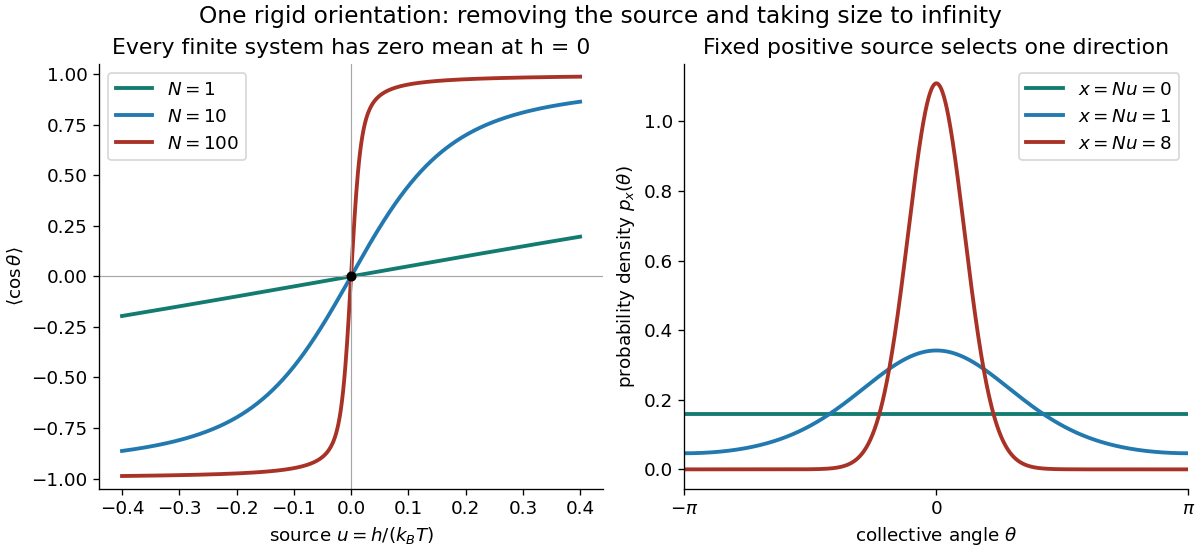
Freeze the magnitude of an order parameter and retain just one common orientation for rigidly aligned cells. Give this collective coordinate energy at positive temperature . The Boltzmann distribution is the displayed normalized probability density function, where is the Boltzmann constant. Here is energy per cell, a different normalization from the source density in continuous vacuum selection by an external source. This is a deliberately restricted model of selection among already ordered orientations: it does not derive alignment or an ordering critical temperature from a spatial interaction.
Its mean orientation is an elementary ratio of integrals:At every angle has equal probability, and the numerator vanishes exactly. For small , expansion of the exponential gives because the angular mean of is . For and the means are approximately and . At fixed , increasing concentrates the probability density function near ; expanding gives angular variance approximately . ConsequentlyThe uniform angular average remains a symmetric mixture if one sets first. The other order selects a definite direction. This is the continuous-orientation version of the symmetry-breaking order of limits; it illustrates selection without replacing the separate problem of stability against spatial fluctuations.

Consider two real scalar fields with positive , standard kinetic terms, and the displayed scalar potential. At , the circle group rotates one field into the other: this is a global symmetry in field theory, with the same rotation at every point in space. The vacuum manifold is the circle . Choose and differentiate the scalar potential twice:The scalar mass matrix assigns a restoring force to the radial displacement, whereas its tangent is one of the Goldstone directions in the scalar mass matrix. Moving around the circle costs no potential energy; moving between neighbouring points in space can still cost gradient energy. Flat angular potential energy therefore means a soft collective excitation, not that every spatial pattern is free.
A positive source explicitly selects the positive direction. The minimum is , where is the positive solution of . The two eigenvalues of the scalar mass matrix there areFor example, and give , and . The light angular excitation becomes a Goldstone boson as , while the radial mass stays finite. The source changes both the preferred direction and the radius; expanding about the old point at nonzero would miss that shift.
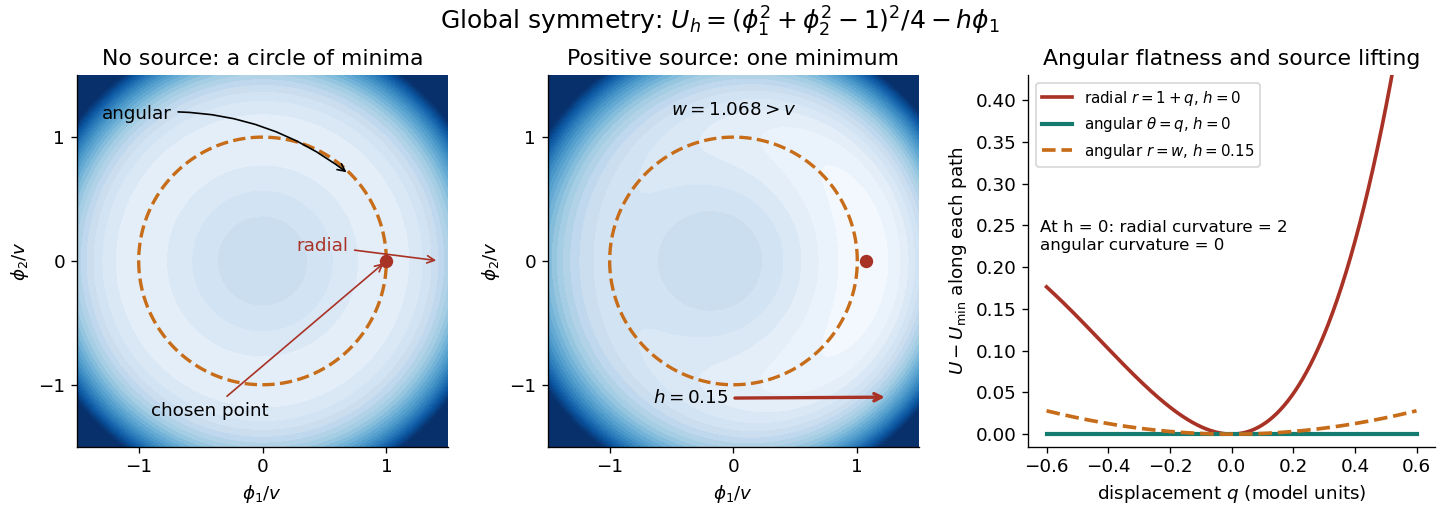
An external source selects an orientation and lifts the angular flat direction
. Original dimensionless scalar potential example with . Dashed circles mark the zero-source vacuum manifold. The right panel follows a radial line or a circular angular path, with potential energy measured from the minimum appropriate to that path. A circular path has zero angular potential energy at ; a straight tangent displacement agrees only to quadratic order. Details.
Explicit twofold anisotropy of a complex scalar field Created 2026-10-18 Updated 2026-11-05
Adding to the exponential complex-scalar potential gives , where . Phase rotations retain only ; the full real-field internal symmetry also permits , giving two independent sign reflections. For the minima are , . Around either minimum, gives squared masses and . For the unique minimum is zero. Explicit anisotropy removes the continuous vacuum circle, so discrete symmetry breaking supplies no mandatory Goldstone boson.
Mitotic aster Created 2026-10-18 Updated 2026-10-20
There are unlisted articles, also show them or only show them.