
Resistor 2026-10-14
A resistor is an electrical circuit component whose intended behavior is electrical resistance. An ideal ohmic resistor obeys Ohm's law, , and converts electrical energy into heat at power through Joule heating. It provides the dissipative term in a series RLC circuit.
Ohm 2026-10-14
The ohm is the SI unit of electrical resistance, one volt per ampere. A component of electrical resistance needs an electric potential difference of to carry electric current under Ohm's law. [ref]
https://openstax.org/books/university-physics-volume-2/pages/9-3-resistivity-and-resistance. Ling, Sanny and Moebs, §9.3: the ohm
. Strain gauge Created 2026-10-14 Updated 2026-10-18
A strain gauge changes its electrical resistance with mechanical deformation, enabling calibrated deformation measurements and force probe readout.
Point-moment elastodynamic displacement 2026-10-14
Integrating the equivalent dipole body force against the elastodynamic Green tensor by parts gives the displayed time convolution. For a fixed seismic moment tensor shape , its terms are . Derivatives of the angular projectors and the retarded near-field integral additionally produce and coefficients, yielding the final static field after the source stops.
Elastodynamic surface-jump representation 2026-10-14
Choose a surface normal from its minus to its plus side and jumps , . The equivalent force density is and the dipole density is . This follows by applying the elastic wave operator to a piecewise smooth displacement field: its distributional source is . Integration by parts against the elastodynamic Green tensor gives the displayed signs. At a material interface the dipole term is interpreted through the continuous reciprocal Green traction, rather than an undefined product of a discontinuous stiffness with a surface delta.
In a homogeneous isotropic solid, the far-field P wave is the radial projection of the force and the S wave is its transverse projection. For a unit force axis , the magnitudes are and . The approximation requires distance large compared with both reduced wavelengths; angular nodes can still be controlled by a smaller near-field contribution.
Elastic energy velocity 2026-10-14
For a real branch polarization and complex displacement amplitude , the cycle averages are and . Differentiating the acoustic tensor eigenvalue equation with respect to gives their ratio as the group velocity. This identifies the energy flux direction with the normal to the elastic slowness surface in a lossless nondispersive elastic medium.
Elastic wave surface 2026-10-14
The unit-time elastic wave surface is the locus of group velocities on the three branches of a homogeneous elastic wave. At time , its scaled sheets describe the propagating wavefronts from an impulsive point source when that source excites the corresponding modes. Homogeneity of the dispersion relation gives , so each regular sheet is the envelope of planes . It is generally different from the radial reciprocal of the elastic slowness surface.
Fix horizontal slowness and define , and . Under strong ellipticity in elasticity, is positive definite, so the vertical-slowness determinant has degree six with real coefficients. Real roots are intersections of a vertical line with the elastic slowness surface; complex-conjugate pairs give evanescent waves.
Bragg's law Created 2026-10-14 Updated 2026-10-18
Bragg's law selects directions of constructive interference in coherent elastic scattering from equally spaced lattice planes:Here is the perpendicular interplanar spacing, the incident wavelength, the positive integer diffraction order, and the Bragg angle, measured between the incoming beam and the lattice planes. The scattering deflection, between incoming and outgoing propagation directions, is . Thus a plotted detector angle must be halved before insertion into Bragg's law. The in the parent elastic Bragg scattering condition denotes the full deflection; the present denotes half of it. [ref]
Bragg's law. Online Dictionary of Crystallography, Bragg's law, Definition: spacing, wavelength, glancing angle and reflection order
The lattice planes organize wave interference throughout a crystal structure; they are not literal metal mirrors or separate reflecting surfaces. The picture assumes elastic scattering, hence an unchanged wavelength, and sufficiently stable relative wave phases across the contributing lattice planes. X-ray wavelengths comparable with atomic interplanar spacings make these directions experimentally accessible. The sine cannot exceed one: an order exists geometrically only if . For , even the first diffraction order is inaccessible. A geometrically possible direction need not have nonzero wave intensity; the crystal lattice structure factor and crystal basis structure factor also matter. [ref]
Structure factor. Online Dictionary of Crystallography by International Union of Crystallography; Definition and Derivation: coherent addition of the atoms within the unit cell
The logarithmic derivative of the modular discriminant gives . Differentiating its weight-twelve transformation yields the anomalous term . Subtracting the displayed inverse-height term cancels that anomaly. The result transforms with weight two under the modular group but is not holomorphic, so it is not a holomorphic modular form.
Zero mode Created 2026-10-14 Updated 2026-11-05
A zero mode is a nonzero eigenvector of an operator with eigenvalue zero. For a differential fluctuation operator it must also satisfy the specified boundary conditions. A zero mode prevents ordinary inversion of the operator and makes its unmodified functional determinant vanish. Gauge directions can produce zero modes of a kinetic operator, while stationary-path focusing can produce them in a semiclassical boundary-value problem. Removing, separately integrating or otherwise treating these directions is necessary before using a Gaussian determinant formula.
Involution exponential formula Created 2026-10-14 Updated 2026-11-05
For a linear operator on a finite-dimensional complex vector space with , every even power is and every odd power is . Separating the absolutely convergent matrix exponential series into those powers proves the displayed identity without a Hermiticity assumption. If is also a Hermitian operator, the exponential is a unitary operator.
Laplacian eigenspace 2026-10-14
The vector space of functions satisfying for a specified Laplace-Beltrami operator. On a closed manifold its dimension is finite and is the spectral multiplicity of . A finite isometric group action preserves this space; invariant elements are the Laplacian eigenfunctions on the corresponding smooth quotient.
Real square roots of operators with simple real spectrum Created 2026-10-14 Updated 2026-11-05
If a real linear operator on an -dimensional vector space has distinct real eigenvalues, any real square root commutes with and preserves each one-dimensional eigenspace. There is multiplication by a real , hence . Conversely, if all the eigenvalues are nonnegative, choosing on an eigenbasis supplies a real square root. Without simple spectrum the necessity fails: a real quarter-turn squares to .
Eigenline Created 2026-10-14 Updated 2026-10-25
An eigenline is a one-dimensional vector subspace spanned by an eigenvector. If with , then for every scalar , so the line is an invariant subspace. It can be contained in an eigenspace of larger dimension; an eigenline need not be the whole eigenspace.
Dirichlet eigenfunction 2026-10-14
A Dirichlet eigenfunction is an eigenfunction of a differential operator satisfying a homogeneous Dirichlet boundary condition. The term applies to more general boundary-value operators as well as the Dirichlet Laplacian.
Nodeless eigenfunction 2026-10-14
A nodeless real eigenfunction has no zero in the interior of the domain. For a one-dimensional confining Schrödinger operator, the nodeless theorem for a one-dimensional ground state identifies the ground state as the eigenfunction that can be chosen strictly positive. Normalizable excited states have nodes.
At small areal number density , identical aligned cracks contribute independently the fixed-throughflow dissipation reduction of a conductive crack. Equating the mean dissipation density to gives the displayed first-order enhancement. Writing is an algebraic noninteraction estimate, not a claim of accuracy at higher density. The enhancement saturates as crack conductance becomes large compared with transport through the surrounding porous matrix.
Layered porous permeability 2026-10-14
Consider planar horizontal layers with positive scalar intrinsic intrinsic permeabilities , thicknesses , and fractions . Assume each layer is uniform and isotropic, fully saturated by the same Newtonian fluid of constant mass density and dynamic viscosity, with perfect hydraulic contact and steady incompressible flow. Use boundaries that impose pure flow normal to the layers or a common gradient of hydraulic head along them; additional interface resistance and finite-edge effects are excluded.
For vertical flow normal to the layers, every layer carries the same normal Darcy flux by mass conservation. The hydraulic head drops add. Writing and taking positive as the drop along the flow direction givesThis is the thickness-weighted harmonic mean. It is hydraulic head, rather than fluid pressure alone, that accounts correctly for gravity in the vertical calculation. A thin layer of very small permeability of a porous medium can control the whole discharge because all flow must pass through it.
For horizontal flow parallel to the layers, each layer experiences the same gradient of hydraulic head. For width , each area is , and the individual volume fluxes add:This is the thickness-weighted arithmetic mean. A highly permeable layer can carry most of the horizontal flow because it supplies a continuous route from inlet to outlet. Woessner and Poeter derive both cases for hydraulic conductivity; identical fluid properties allow the common factor to cancel.[ref]
For two equally thick layers, take and , where . The values 1 and 9 are therefore permeabilities in units of , rather than dimensionless intrinsic intrinsic permeabilities. ThenAcross the layers, the less permeable half takes of the total hydraulic head drop and the more permeable half only . Along the layers, the more permeable half carries of the total volume flux. At the same magnitude of imposed gradient of hydraulic head, horizontal Darcy flux is times the vertical Darcy flux.
The arrangement thus creates physical anisotropy from locally isotropic ingredients. In coordinates with along the layers and normal to them, the effective permeability of a porous medium tensor is . A driving gradient of hydraulic head with both horizontal and vertical components generally produces a discharge in a different direction. This distinction matters when deciding whether a geological bed conducts aquifer flow along itself or acts as a barrier to flow across it.
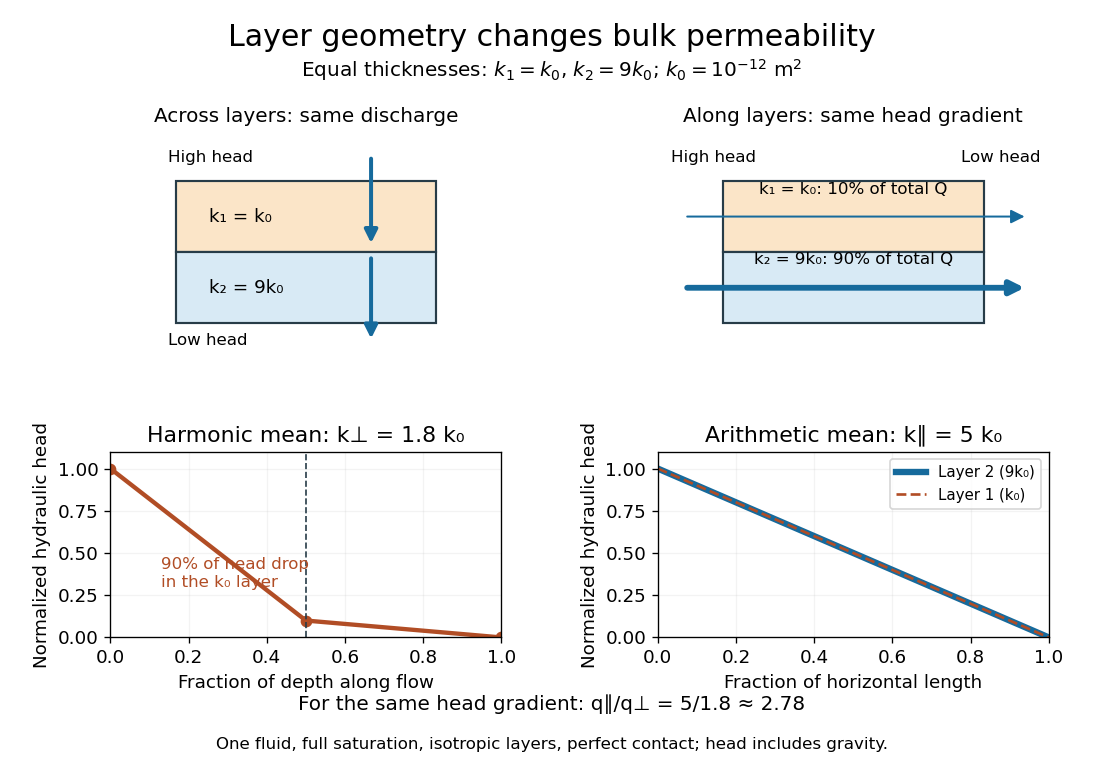

Regenerate the diagram by running
python ../layered-porous-permeability.py from _media; it writes its PNG into the current directory. There are unlisted articles, also show them or only show them.