
EM expectation step 2026-10-14
Hold the old statistical parameters fixed when taking the conditional expectation, while keeping the candidate statistical parameters variable:For independent observations in a finite mixture model, is a hidden component label. Bayes' theorem gives its mixture responsibilities:These posterior probabilities are the conditional expectations of the mixture allocation indicators; they turn hidden counts into fractional counts.[ref]
Maximum Likelihood from Incomplete Data via the EM Algorithm by Arthur Pentland Dempster and others. Section 4.3, printed pp. 15-16, especially the paragraph following equation (4.3.3): conditional indicator probabilities and weighted counts
They condition on a current fixed fit, rather than averaging over a posterior distribution of the statistical parameters. Taking the conditional expectation of the complete-data log-likelihood is essential: substituting a single guessed label, or merely substituting the conditional mean into a nonlinear complete-data expression, generally gives a different algorithm. Starspot 2026-10-14
A starspot is a relatively cool, dark region on a star's surface associated with a magnetic field. Starspots change the light curve as the star rotates. A planet crossing a starspot blocks less light than it would from an unspotted region, producing a local upward anomaly during an exoplanet transit; unocculted starspots can instead deepen the normalized exoplanet transit depth. They can also distort spectral lines and imitate a Doppler spectroscopy signal.
Exoplanet transit depth Created 2026-10-14 Updated 2026-11-05
The fractional decrease in observed radiative flux during an exoplanet transit, relative to the out-of-transit baseline. For a uniform star, a dark planet, full disc overlap, and no transit dilution, the exoplanet transit depth is . For a nonuniform star it depends on the blocked specific intensity as well as the radius ratio.
Existential formula Created 2026-10-14 Updated 2026-10-25
An existential formula is an existential block followed by a quantifier-free formula, with remaining free variables serving as parameters. Truth is preserved by structure embeddings. Reflection of truth for every such formula defines an existential embedding.
Symmetric simple exclusion process Created 2026-10-14 Updated 2026-11-05
On , put independent rate- Poisson processes on unoriented nearest-neighbour edges, and exchange their endpoint occupations at each mark. Its generator on cylinder functions is . Equal occupations do not change the state, and a particle next to a vacancy jumps across at rate . The stirring representation of symmetric exclusion constructs it for arbitrary initial configurations. The simple occupation-product product self-duality of symmetric exclusion requires symmetry and is not the ordinary duality of an asymmetric process.
Copper(I) oxide Created 2026-10-14 Updated 2026-11-05
Copper(I) oxide, , is a copper oxide semiconductor in which copper has oxidation state . The name distinguishes it from copper(II) oxide, ; the chemical formula matters when identifying the material in an optical experiment.
Its importance here is the resolved Exciton Rydberg series observed in the exciton absorption experiment in copper(I) oxide. An optical absorption resonance can occur below the unbound electron–hole threshold because an electron and an electron hole bind as an exciton. Resolving many resonances approaching that threshold tests the internal bound-state model rather than directly imaging electron–hole orbits. Sample temperature, strain, illumination and line resolution affect how far the series can be followed; the linked experiment describes those controls.
Invariant sigma-algebra of an exchangeable sequence Created 2026-10-14 Updated 2026-11-05
On the coordinate product space of a sequence, the invariant sigma-algebra consists of measurable events unchanged by every finite permutation of coordinates. Its definition is pointwise and does not depend on the probability law. An exchangeable law makes each such permutation measure preserving. events in the tail sigma-algebra are invariant because any finite permutation fixes every sufficiently late coordinate. Conversely, exchangeable invariant events are tail events modulo null sets.
De Finetti theorem 2026-10-14
For an infinite sequence of real exchangeable random variables, conditional on its invariant sigma-algebra of an exchangeable sequence, the coordinates are independent and identically distributed. In particular, for Borel sets ,Here is the core proof. Let denote invariance under permutations of coordinates . Symmetrization as conditional expectation identifies the empirical average of each indicator with its conditional expectation on . The reverse martingale convergence theorem gives its limit conditional on . Multiplying the averages sums over all ordered coordinate tuples, including repetitions. Symmetrization of the product itself sums over the distinct tuples. The fraction of repeated tuples is at most , so these bounded averages have the same limit. This proves the displayed factorization. Permutation invariance also makes the individual conditional laws identical. A regular conditional distribution on the real line packages that common law as a random probability measure, giving the equivalent mixture-of-iid formulation.
For a module homomorphism over a commutative ring , is injective if and only if every is injective, with ranging over maximal ideals. In a localization of a module, maps to zero exactly when some denominator satisfies . If is injective this gives , so the original fraction is zero. In general it identifies with . A nonzero element of has a proper annihilator, contained in some maximal ideal; it remains nonzero in that localization. Thus vanishing of all localized kernels forces . No finiteness or Noetherian assumption is required.
Exact rank-sum tail one above the minimum Created 2026-10-14 Updated 2026-11-05
For two independent continuous samples of positive sizes under a common-distribution null, each -subset of ranks is equally likely. The smallest rank sum is , attained only by . The only subset with rank sum one larger is . Hence the exact lower tail at that threshold is . This follows directly by observing that any other change increases the sum by at least two.
For a degree-zero rational function regular on an open subset of projective space, each derivative is a regular homogeneous rational function of degree . These derivatives define a derivation with values in , hence a map from the Kähler differential sheaf. The last map is . On , put and use frame . The derivative of has coordinate vector with at , at and zero elsewhere. Those vectors form a free basis of the kernel of , proving exactness directly in every characteristic.
Prime reciprocal lower bound 2026-10-14
For , the harmonic number exceeds . The finite Euler product over the primes at most contains every summand of this harmonic number. Taking logarithms and applying the geometric-series bound for the logarithmic remainder bounds the total remainder by , proving the displayed bound.
For directions spaced in the same rotational sense, Euler formula for normal curvature gives . The sum of the equally spaced complex exponentials is zero when , proving the formula. Consecutive unsigned angles alone do not imply this arrangement: they permit directions to double back.
A finite set of distinct great circles not all passing through a common antipodal pair has a vertex lying on exactly two circles. Its cells are spherical polygons with at least three edges: a digon would have antipodal endpoints, and every circle's defining hemisphere would then have to contain both endpoints, forcing a common axis. With and , the graph has a vertex of valence less than six. Valences are even and at least four, so one is exactly four. Central projection identifies this with an ordinary intersection in a real projective line arrangement. If affine line intersections are counted only at finite points, parallel-line configurations require a separate qualification.
Poincare duality gives the displayed formula for connected closed oriented four-manifolds. Every integer occurs. A connected sum of copies of the Complex projective plane and copies of has Euler characteristic , because the summand characteristics are three and zero. Given any integer , choose large enough that ; when both counts are zero use . If simple connectivity is additionally required, the possible values instead begin at two, since ; connected sums of projective planes realize every such value.
Use Poincare duality with coefficients in , valid also without orientability. The ranks in complementary degrees agree, and their signs in the alternating sum are opposite. They therefore cancel in pairs. Euler characteristic is independent of the coefficient field, giving the stated integer equality.
Euler characteristic and holes 2026-10-14
For a finite CW complex, counts connected components: its connected components are its path components, as recorded by the zeroth homology group. For a finite graph regarded as a one-dimensional CW complex, no higher homology groups occur, so counts independent graph cycles, and . For a connected planar surface obtained by removing disjoint open disks from the interior of a closed disk, and ; the annulus is .
The word "hole" needs its dimension. A two-sphere encloses a cavity but has and . A closed orientable surface of genus instead has and : increasing the genus by one adds two independent one-dimensional homology classes. In higher dimensions, further homology groups enter with alternating signs; there is no universal "components minus handles" rule.
A homeomorphism preserves every homology group, hence the Euler characteristic wherever the finite rational Betti number sum is defined. In fact, homotopy invariance of homology makes Euler characteristic invariant under homotopy equivalence. Thus different finite CW complex structures on the same space have equal alternating cell counts.[ref]
Algebraic Topology by Allen Hatcher. Algebraic Topology, §2.2, p. 146, homotopy-type independence immediately before Theorem 2.44
In the illustrated simplicial subdivision, inserting the three edge midpoints turns one filled triangle into four. The counts change from to , but . Splitting a single edge adds one vertex and one edge, so its net contribution is . Adding a diagonal inside a polygonal face adds one edge and one face, giving .
These local accounts explain common refinements. For arbitrary finite simplicial subdivisions, including barycentric subdivision in any dimension, the underlying geometric realization is unchanged. The topological invariance of Euler characteristic therefore guarantees the same alternating count, even when the individual counts change substantially.
Euler characteristic of a torus 2026-10-14
Identify opposite sides of a square by translations to obtain a torus. All four corners become one vertex; the horizontal sides give one topological cell and the vertical sides one topological cell . The open square supplies one two-dimensional topological cell. Thus and . The cellular boundary of each one-dimensional topological cell is zero because its endpoints agree. Traversing the face boundary gives the group commutator , whose signed counts of both and vanish. Hence its cellular boundary is also zero, and .[ref]
A Concise Course in Algebraic Topology by J. P. May. A Concise Course in Algebraic Topology, Chapter 13, §5, p. 103, Example (i), the torus cellular chains and integral homology
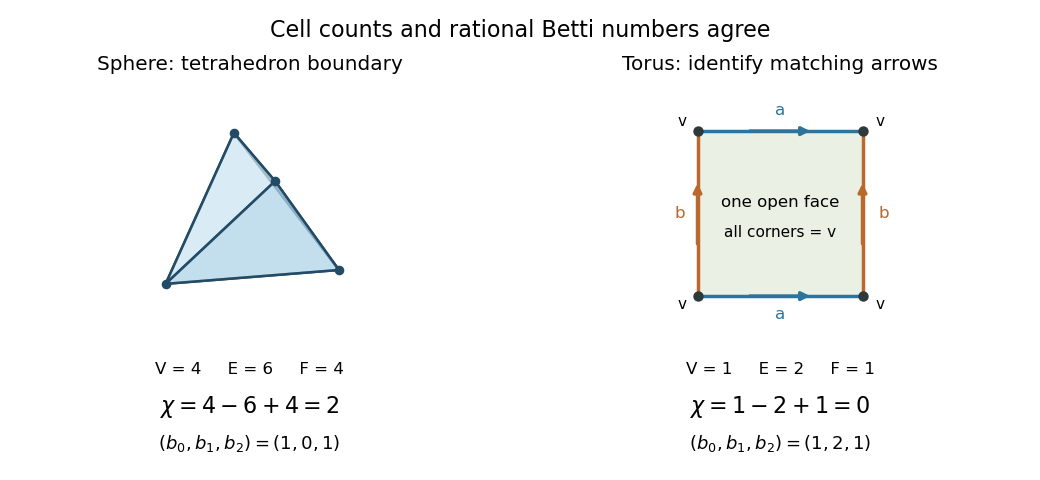
The tetrahedral sphere and the square presentation of a torus have different alternating cell counts
. Details. 
The boundary of a tetrahedron is a two-sphere, with four vertices, six edges and four triangular topological cells: . Its rational Betti numbers are by homology of a sphere. The torus's two independent one-dimensional homology classes cancel its degree-zero and degree-two contributions. The torus and annulus both have Euler characteristic zero, yet different homology groups; one integer cannot recover all of homology.
There are unlisted articles, also show them or only show them.