
Filter (mathematics) 2026-10-14
A filter is a nonempty upward-closed subset of a partial order such that every two members have a common lower bound in . With standard notation for forcing, lower means stronger, so these are exactly the directed filters used to define a generic filter. The projection of a product-generic filter uses these properties before genericity of its factor filters is proved.
Chain-poset nonembedding lemma 2026-10-14
If is the inclusion-ordered collection of every chain in a partial order, including the empty chain, it has no order-preserving injection into . Supposing exists, recursively set for . By induction the earlier values form a chain; its proper initial chains are distinct, so monotonicity and injectivity make strictly greater than every earlier value. This would inject the Hartogs ordinal into .
Strict partial order 2026-10-14
A strict partial order is an irreflexive transitive relation. In a classical set, it corresponds to a partial order through reflexification, but recovering the strict relation from the weak one requires inequality. In an arbitrary topos, this reverse operation need not be geometric or define an inverse interpretation.
Product order 2026-10-14
The product order on a Cartesian product of partially ordered sets compares every coordinate separately. Points that improve one coordinate and worsen another are incomparable. It is generally a partial order, not a total order.
Complete partial order 2026-10-14
A family of order-completeness notions used in semantics: in particular, a directed-complete partial order has every directed join, while a pointed one additionally has a least element. The precise completeness condition should be specified, since this terminology is not synonymous with complete lattice.
Chain-complete partially ordered set 2026-10-14
A chain-complete partially ordered set has a supremum for every chain, with the empty-chain condition requiring a least element if empty chains are included. This implies the weaker upper-bound hypothesis of Zorn lemma, which requires only that each chain have some upper bound, not necessarily a least one. Some treatments use “chain-complete” for that weaker condition, so the convention should be specified. In the inclusion order on lattice ideals avoiding a specified element, the union of a nonempty chain is an ideal and is its supremum. This union observation is the step needed to apply Zorn in prime-ideal separation arguments.
Lower bound in a partially ordered set 2026-10-14
A lower bound of a subset of a partially ordered set is an element no greater than every member of . For minimization, a number below every feasible objective value is therefore a lower bound on the optimum; a relaxation often provides such a certificate.
// Target: mathematical-optimization.bigb
Dilworth's theorem 2026-10-14
Every finite partially ordered set can be partitioned into as many chains in a partial order as its largest antichain. Reachability in an acyclic directed graph is a partial order, so the theorem supplies chains which can be expanded into directed paths, possibly overlapping at intervening vertices.
Szpilrajn extension theorem 2026-10-14
Every partial order has a total order extension. Apply Zorn's lemma to extensions ordered by inclusion: the union of a chain is a partial order. If a maximal extension leaves two elements incomparable, adjoining one comparison and taking its transitive closure of a relation creates no cycle, contradicting maximality. Quotienting a preorder by its indifference relation and lifting a total order gives a complete weak-order extension preserving its strict part.
A real-valued function on a partially ordered set is increasing when it preserves its order. Indicators of increasing events are examples. In spin or edge configuration spaces the order is coordinatewise, so increasing observables grow when a zero coordinate is replaced by one. Positive association of random variables concerns pairs of such observables, and stochastic domination compares their expectations.
Upper and lower bounds 2026-10-14
An upper bound of a subset is an element above every member, and a lower bound is below every member. They need not lie in the subset or be unique. Infimum and supremum are the greatest lower and least upper bounds when those exist.
Maximal and minimal elements 2026-10-14
A maximal element has no strictly greater element; a minimal element has no strictly smaller one. Either can be nonunique, unlike a greatest or least element. These notions are defined for arbitrary partially ordered sets.
Greatest element and least element 2026-10-14
A greatest element lies above every member of an ordered set, and a least element lies below every member. Antisymmetry makes either unique if it exists. A greatest element is maximal, but a maximal element need not be greatest.
Upper and lower sets Created 2026-10-14 Updated 2026-10-20
In a partially ordered set , an upper set satisfies and ; a lower set satisfies and . The complement of a set exchanges the two conditions: if and , then would force , so is lower. In a Boolean lattice ordered by inclusion, these are the up-set and down-set conditions.
Lattice-ordered group 2026-10-14
An ordered group whose partial order is a lattice. Each pair has a join and a meet . Translations preserve these operations, for example . Pointwise maximum and minimum make the order automorphisms of a chain into a lattice-ordered group.
Convex subgroup of an ordered group Created 2026-10-14 Updated 2026-11-05
Positive cone of an ordered group 2026-10-14
The nonnegative cone determines the partial order by . It contains the identity element, is closed under products and conjugation, and intersects its inverse only in the identity. Conversely these conditions define a two-sided invariant partial order. Its strictly positive part omits the identity; conventions for differ, so specify which is intended.
Ancillary conditioning that eliminates a nuisance parameter Created 2026-10-14 Updated 2026-11-05
For a sufficient statistic and parameter , a useful strong reduction requires the law of to be free of and the conditional distribution of given to be free of the nuisance parameter . In the discrete case it giveswhere sums to one on each fiber, sums to one over , and sums to one over separately for every fixed . Ordinary ancillarity, or just the law of being free of , does not by itself guarantee that conditioning removes .
Noisy parity total correlation 2026-10-14
Keep as independent fair bits, introduce an independent Bernoulli random variable with , and set . The extra bit flips the integer parity rule with probability . For each even-integer parity triple the probability is ; for each odd-integer parity triple it is .
Every coordinate remains fair, and every pair remains independent for every . For example, after fixing , the fair independent makes fair regardless of . A pair's joint probability distribution therefore does not change as noise destroys the three-way relation.
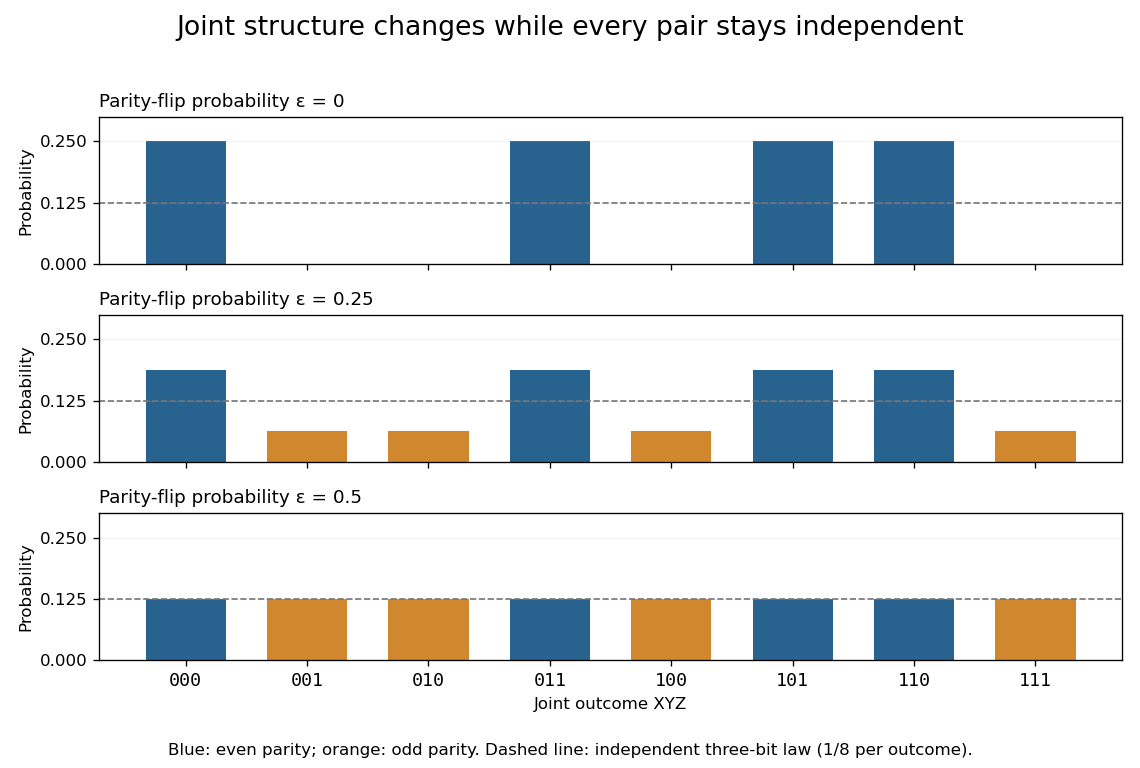

Knowing , uncertainty in is exactly the uncertainty in . The chain rule for information entropy giveswhere is binary entropy. HenceAt , the result is approximately bits, although all three pairwise mutual informations are zero. At , all eight triples have probability , giving joint independence and zero total correlation. At , the complementary integer parity rule is deterministic again, so total correlation returns to one bit.
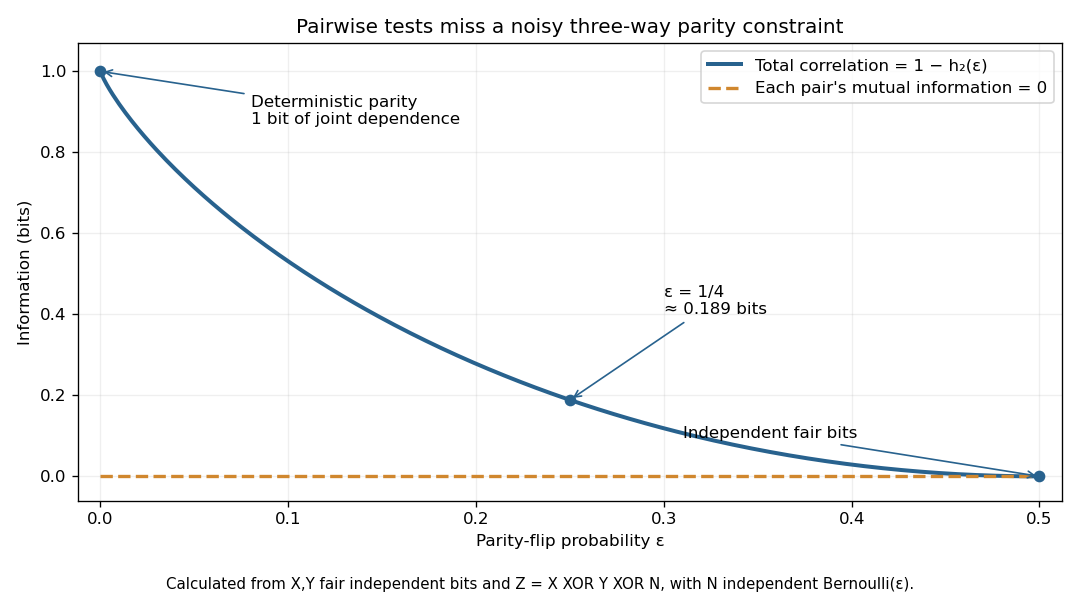

The example distinguishes "there is a dependence" from "a pair reveals it." Once are known together, is predictable at zero noise; knowing either one alone leaves a fair bit. Total correlation detects the joint departure from independence, but does not by itself specify which variables cause which others.
Reciprocal-polynomial parity-check matrix Created 2026-10-14 Updated 2026-11-05
If a binary length- cyclic code has generator of degree and check polynomial of degree , use the coefficient vectors of as the rows of a parity-check matrix. They have distinct leading positions and are independent. Their scalar products with a word are the coefficients of in its product with , which vanish for codewords.
// Target: algebra.bigb
There are unlisted articles, also show them or only show them.