
Finite groups of planar rotations are cyclic Created 2026-10-14 Updated 2026-11-05
A finite group of planar rotations about one point is a cyclic group. For a nontrivial group, choose its smallest positive rotation angle . Subtracting multiples of from any other group angle leaves a group angle in , hence zero. Applying the same argument to shows that for a positive integer . The identity-only group is cyclic as well.
Active planar rotation 2026-10-14
For column coordinate vectors in the fixed Cartesian basis, an active planar rotation sends to . For radians,The endpoint travels counterclockwise through along a circle of radius . Its Euclidean norm stays . The second Cartesian basis direction becomes , whose dot product with is still zero.
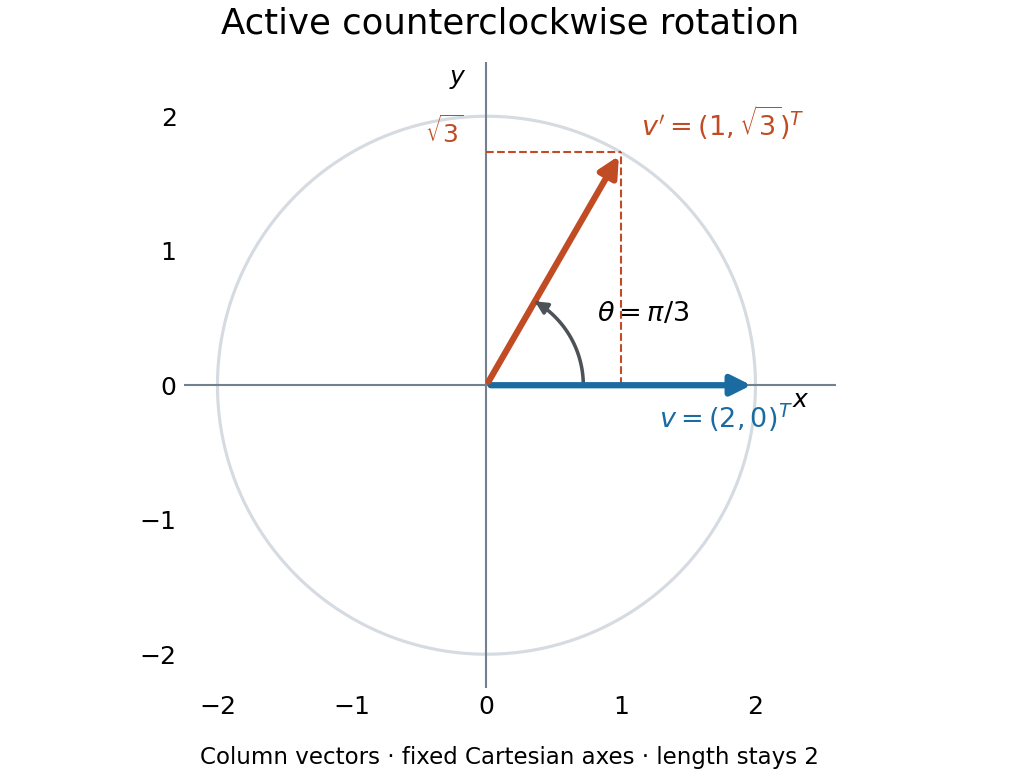
An active counterclockwise planar rotation by : the vector moves while the Cartesian basis stays fixed
. Details. 
A quick sign check is to look at the first column: must point above the horizontal axis for . The columns have unit Euclidean norm and zero dot product, so ; the determinant is . Finally, the transpose negates the off-diagonal entries, giving : turning back reverses the action. This is the same matrix used for passive rotation of coordinates, though that interpretation keeps the vector fixed.
Pitot-static tube 2026-10-14
First Piola-Kirchhoff stress tensor Created 2026-10-14 Updated 2026-11-05
The first Piola-Kirchhoff stress tensor expresses the current force transmitted through a material surface per unit reference area. In the spatial-first index convention used here,where is the deformation gradient, , the Cauchy stress tensor, and the reference and current unit normal vectors. Nanson's formula supplies the transformation of oriented surface area.
Its first index refers to current force direction and its second to reference surface orientation, so it is generally nonsymmetric even when is symmetric. The mechanical power per reference volume is . In a uniform uniaxial test the relevant component is the axial force divided by original area, connecting this tensor to engineering stress. The material-first nominal stress tensor in this repository is ; keeping this convention explicit prevents misplaced transposes.
Second Piola-Kirchhoff stress tensor 2026-10-14
The second tensor has two material indices and is symmetric when the Cauchy stress tensor is symmetric. The displayed relation uses the material-first nominal stress tensor convention. In particular, is generally not this tensor. These conventions agree with A. F. Bower's definitions of stress measures.
Gluing three-balls along a boundary disk 2026-10-14
Two piecewise linear balls of dimension three glued along a common boundary disk form another piecewise linear ball. The Schoenflies theorem identifies each boundary pair with a sphere and a hemisphere. Coning the resulting boundary homeomorphisms extends them over the balls, which then become the two halves of a standard ball. The same argument shows that removing a ball attached along one boundary disk leaves a ball.
Picard iteration Created 2026-10-14 Updated 2026-10-31
Picard iteration replaces a tentative trajectory by the accumulated integral of its proposed rate. For an initial value problem , , define the Picard map and its starting function byHere is the constant starting trajectory; the same symbol without its argument denotes the initial state. A fixed point of solves this integral equation, and the fundamental theorem of calculus gives the original ordinary differential equation.
For , , successive integrals giveAt , the first five values are , while . The fourth polynomial misses by about . On , every omitted term of the exponential series is nonnegative and increasing, so the largest error occurs at . The tail tends to zero, giving uniform convergence to the exponential function on this interval.
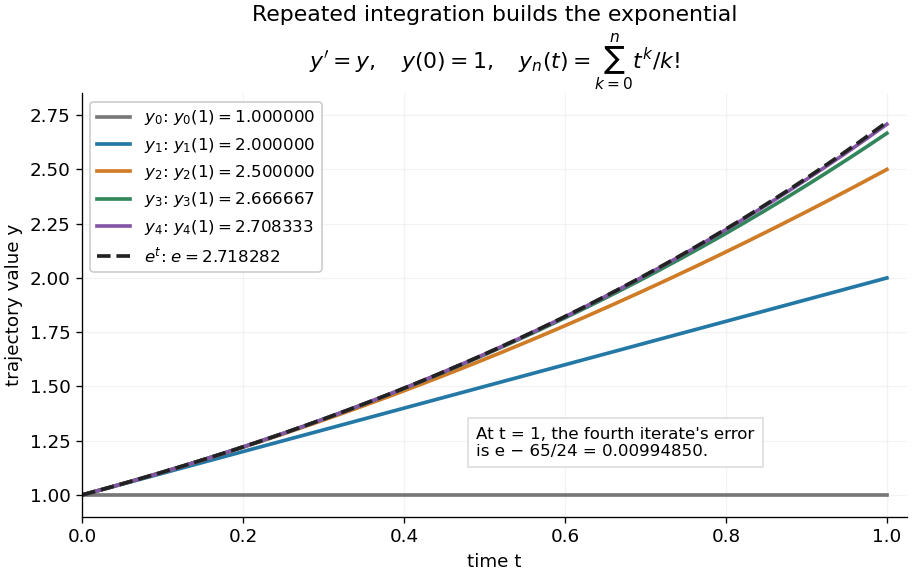
Picard iteration builds the exponential solution by repeated integration
. The first five polynomials approach the exponential function on . Endpoint values are listed in the legend; the last error is approximately . Details.
The beauty of Picard iteration is that each proposed trajectory supplies a better rate history for the next one. For this example, one integration adds exactly the next term of the exponential series. In general, the integrals may be difficult to compute, but the construction still explains local existence and uniqueness.
The short contraction mapping argument needs two independent controls. Choose a time-state cylinder on whichThe second bound is the uniform local Lipschitz condition. Set with , and . In the function space of continuous functions , use the supremum norm . On its closed ball , direct integral estimates giveThus the map preserves the closed ball and is a contraction mapping there. This closed ball is a complete metric space, so the contraction mapping theorem gives convergence to exactly one fixed point. Any other local solution of a differential equation stays in the same ball after shortening its interval, and hence agrees there.
For , take , so in the state ball and , . Choosing gives and , with the actual solution satisfying . The plotted interval is longer than this simple guarantee: the explicitly computed exponential series converges there anyway. The condition is sufficient for this one-step contraction mapping argument, rather than a necessary lifespan bound.
Small-vorticity phototactic orientation response Created 2026-10-14 Updated 2026-11-05
For light along , vorticity along and , spherical coordinates give a first orientation-density correction proportional to . The linearized alignment-diffusion operator preserves azimuthal harmonics and the rotation of the axisymmetric equilibrium forces only this sine harmonic. Angular integration makes the first correction to the mean purely vertical. Uniqueness follows from the weighted identity : integration by parts shows the only homogeneous smooth solution is a multiple of , removed by normalization.
Zero-flux pressure gradient in a cell-driven channel Created 2026-10-14 Updated 2026-11-05
In the Boussinesq approximation, downward excess cell weight gives . The no-slip boundary condition at both walls and zero total fluid flux determine the excess axial pressure gradient , with . In particular, , . For large , writing and gives the outer profile . A thin layer restores no slip at the illuminated wall. Cells descend there and fluid returns upward on the other side. At the limiting solution is , .
Transverse and longitudinal momentum projectors Created 2026-10-14 Updated 2026-11-05
At non-null four-momentum, these complementary projectors satisfy , and . The gauge-fixed Maxwell kinetic operator is ; its inverse gives propagator . Transversality here removes one four-dimensional longitudinal direction, leaving rank three; it does not by itself project onto the two physical photon polarizations. The pole requires the Feynman i-epsilon prescription.
Spectral mismatch correction 2026-10-14
For collected spectral radiant flux and a linear photodiode with spectral responsivity , the dark-subtracted electric current is . A reference optical spectrum sets the conversion from electric current to collected luminous flux. Applying it to another optical spectrum givesAssume nonzero calibration and test signals. Then is the corrected luminous flux. Multiplying either optical spectrum by an overall positive scale leaves unchanged. If is proportional to , for every optical spectrum. Uniformly overfilled aperture measurements use wavelength-resolved irradiance instead, multiplying the electric current expression by aperture area; the same ratio cancellation gives the illuminance correction. This is the algebra behind source-dependent calibration, rather than a new measured correction curve. [ref]
Photodetachment threshold Created 2026-10-14 Updated 2026-10-20
In the published chlorine experiment, negative ions were accelerated and mass-selected, then overlapped with a tunable laser beam. A downstream electric field deflected charged ions; neutral chemical atoms continued to a plate, whose secondary electrons were counted. Scanning the laser frequency produced an onset in this neutral-atom signal. The apparatus therefore inferred an electron affinity from a threshold, rather than measuring the heat of attachment.[ref]
Isotope shift in the electron affinity of chlorine by U. Berzinsh and others. §2, printed pp. 2–4, Figure 1: ion preparation, deflectors, neutral-atom secondary-emission detector and threshold fitting
Reversing the laser direction and averaging the two thresholds corrected the first-order Doppler shift. A Fabry–Pérot interferometer and reference spectral lines calibrated the frequency. Finite laser bandwidth, unresolved quantum state splitting and shifts of the calibration lines limited the inference; the authors included these effects in fitting and the error estimate. The level diagram shows only the extracted gap, not a measured signal curve.[ref]
Relativistic energy and momentum of a phi-four kink Created 2026-10-14 Updated 2026-11-05
For the real scalar field with metric and potential , the static phi-four kink is and satisfies . Its mass is . A Lorentz boost gives . The stress-energy tensor gives . Similarly, , proving the energy–momentum relation .
For and sufficiently smooth real phase, expand free paraxial propagation as . Taking the squared modulus gives the displayed intensity. Negative phase curvature initially focuses the field. With , , with transverse length scaled so the modulation wavenumber is one. Period-averaged intensity stays one.
Zigzag instability Created 2026-10-14 Updated 2026-11-05
A zigzag instability is a long-wave transverse phase modulation of parallel rolls. In the modela small Fourier mode has growth rate . Thus the straight pattern is linearly stable for and unstable to sufficiently long transverse waves for .
When , the unstable band is . Differentiating with respect to gives the fastest growing scale and maximum growth . The fourth derivative stabilizes short waves rather than allowing arbitrarily fine structure to grow fastest.
Translation-covariant phase expansion 2026-10-14
Let , and . Two applications of the chain rule give . In a Fredholm solvability condition, the fourth term generally contributes to the coefficient of . It cannot be omitted merely because the fast-coordinate correction functions have been denoted by .
Insert Hadamard gates on every data qubit immediately after encoding by a bit-flip repetition code and immediately before its bit-flip detection and recovery. The intervening physical error is thereby conjugated by , and turns a single Pauli Z gate error into a single bit flip for the original correction circuit. The encoded logical codewords are now and . The syndrome ancillas and the final inverse encoding stay unchanged. This protects against phase flips in the new basis; it does not simultaneously correct arbitrary bit flips in the physical basis.
Logical failure of the three-qubit phase-flip repetition code Created 2026-10-14 Updated 2026-11-05
The phase-flip repetition code with codewords corrects any one physical Pauli Z gate error. Its two adjacent-pair error syndromes cannot distinguish an error pattern from its three-bit complement. Minimum-weight recovery therefore leaves no residual error at weight zero or one, and leaves at weight two or three. This residual operator exchanges the codewords, so inverse encoding gives a logical Pauli X gate. For independent physical phase errors of probability , the decoded quantum channel is , where . For , .
The codewords have residual logical Pauli X gate after an uncorrectable two- or three-site phase error. Precede their encoding by a logical Hadamard gate and follow decoding by its inverse. Since , the same error now acts as a logical Pauli Z gate. Explicitly the encoded coefficients are and for an input . This convention matters when translating physical phase errors into a claimed decoded phase-error channel.
Phase-contrast microscope Created 2026-10-14 Updated 2026-11-05
A phase-contrast microscope makes small specimen-induced wave phase changes visible through wave interference. An illumination annulus is imaged onto a phase ring in the microscope objective's rear focal plane. The ring changes the relative phase and amplitude of largely undeviated illumination compared with specimen-diffracted light, producing intensity differences in the image.[ref]
Introduction to Phase Contrast Microscopy by Nikon Instruments Inc.. Figure 1 and optical-train description: condenser annulus and objective phase plate
Correctly matching and centering the annulus and ring is an apparatus requirement. A transparent unstained specimen can then acquire strong image contrast, but halos and image contrast reversals can occur. Comparing ordinary illumination with the aligned phase system demonstrates that image brightness is not simply a map of optical absorption.
There are unlisted articles, also show them or only show them.