
Digit agreement and p-adic distance Created 2026-10-14 Updated 2026-11-05
Two p-adic integers agree in their first low-order p-adic digits precisely when their difference is divisible by . Equivalently,If the first differing digit has index , the remaining leading coefficient is nonzero modulo , giving exact p-adic valuation and p-adic metric . If no digit differs, the two elements are equal and their distance is zero. Truncating at therefore gives , with a stricter bound possible when further digits are zero.
Ostrowski's theorem 2026-10-14
Every nontrivial absolute value on is equivalent either to the usual absolute value or to one -adic absolute value.
2-adic absolute value 2026-10-14
The 2-adic absolute value is the p-adic absolute value for the prime number . It is defined on the rational numbers by for and , and extends to their P-adic number completion . For a nonzero integer, count factors of two until the remaining factor is odd; for a rational number, subtract the denominator's count from the numerator's count.
The associated metric reverses a familiar comparison:Although is eight units from on the ordinary number line, it agrees with modulo , whereas already disagrees modulo . The 2-adic absolute value measures that agreement. The value also shows why this Non-Archimedean absolute value must be distinguished from the ordinary absolute value .
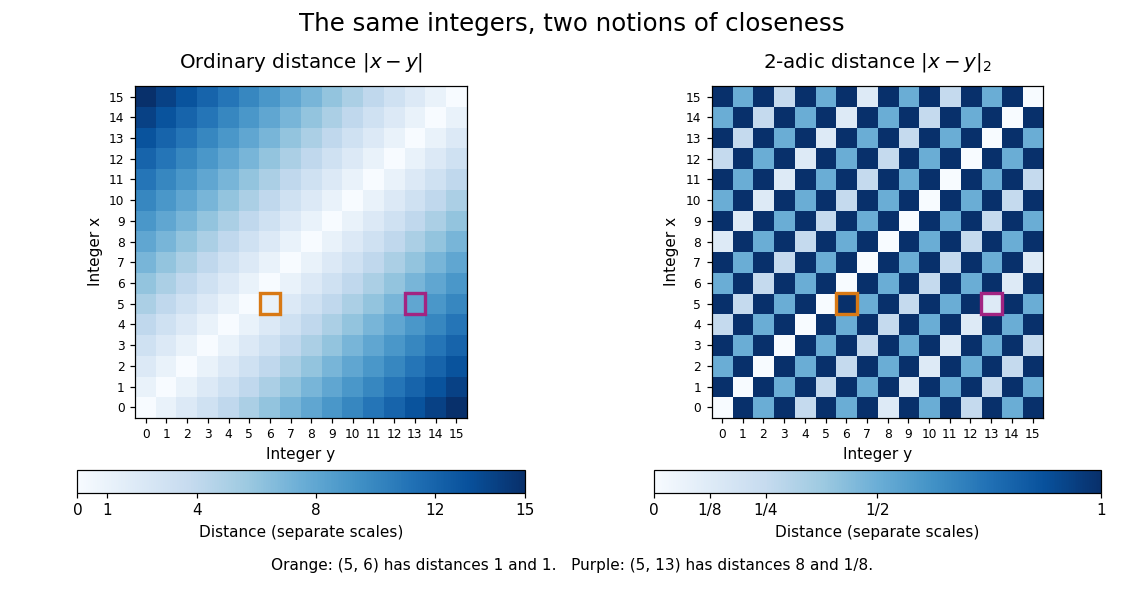
Ordinary absolute value and 2-adic absolute value give different distance patterns for the same sixteen integers
. Details. 
In the left panel, differences farther from the diagonal grow in ordinary absolute value. In the right panel, nonzero even differences are closer than odd differences, and each further factor of two halves the 2-adic absolute value. The highlighted pairs have opposite distance rankings. The repeated pattern is the nested congruence class structure of an ultrametric space, visible without adding any new points.
p-adic metric 2026-10-14
The p-adic metric on the P-adic numbers is induced by the p-adic absolute value. Its ultrametric inequality is . On p-adic integers, digit agreement and p-adic distance expresses metric precision as shared low-order digits.
Weyl plane-wave representation Created 2026-10-14 Updated 2026-10-18
Here has nonnegative imaginary part. This representation of the outgoing Helmholtz equation kernel separates propagating plane waves from evanescent waves. The absolute vertical separation is required for fields on either side of a source; choosing its sign fixes the upward or downward angular spectrum.
Carathéodory's criterion Created 2026-10-14 Updated 2026-10-31
A set is measurable for an outer measure when every set is split additively by :The measurable sets form a sigma-algebra, and the restriction of to it is a complete measure.
Outer automorphism of a group Created 2026-10-14 Updated 2026-11-05
An outer group automorphism is not conjugation by any element of the group. Its nonidentity class belongs to . A permutation-group example is the exceptional automorphism of that swaps its natural and transitive copies of ; it sends a transposition to a product of three disjoint transpositions and hence cannot be inner.
Cytolysis 2026-10-14
Osmotic lysis is rupture after excessive water entry and swelling. It is an outcome for susceptible biological cells, not an inevitable response of every biological cell to a hypotonic solution. Cell walls can bear the resulting load, and cellular mechanisms can regulate water balance. A protoplast challenge tests a particular preparation under particular conditions.
Tonicity 2026-10-14
Tonicity describes how a surrounding chemical solution changes cellular volume through osmosis. It depends on which solutes remain effectively excluded on the timescale of interest, not simply on the amount of dissolved material. The following comparisons take a functional cell membrane, an initially unpressurized biological cell, and effectively excluded solutes as the reference; rising turgor pressure can oppose entry in a walled biological cell.
Operationally, hypotonic solutions cause sustained swelling, hypertonic solutions sustained shrinking, and isotonic solutions no sustained volume change in the specified passive comparison. State the reference biological cell, membrane properties and observation interval. A permeating solute can transiently change water potential while crossing; after its chemical potential equilibrates, its initial unequal concentrations cannot be treated as a permanently retained osmotic load. Thus equal osmolarities need not imply isotonic solutions. Conversely, a stationary walled biological cell may have unequal osmolarities balanced by turgor pressure.[ref]
Osmosis, Cell Membranes-Structure and Transport, BYU-Idaho. Cell Membranes—Structure and Transport, Osmosis: paragraphs beginning Here is another way and final Note; permeating solutes and transient effects
Osmotic concentration 2026-10-14
In the dilute ideal particle-count description, osmolarity is the total amount of substance of independently dissolved solute particles per volume of chemical solution: . It includes both membrane-permeating and retained solutes; specifying a particular membrane is unnecessary to count particles. A neutral undissociated solute contributes one particle per molecule, whereas separated ions are counted individually. Common units are or , with one osmole denoting one mole of the counted particles. Osmolality uses mass of solvent instead of volume of chemical solution; the two numerical values should not be identified without the appropriate mass-to-volume conversion.[ref]
Osmosis, Cell Membranes-Structure and Transport, BYU-Idaho. Cell Membranes—Structure and Transport, Osmosis: paragraphs beginning Earlier this semester and Osmolarity is a useful term; total particle counting
This ideal counting definition states its scope: interactions can require a thermodynamic activity description of osmotic pressure. Tonicity asks a different question, namely how that surrounding chemical solution changes a specified biological cell's volume through its particular cell membrane.
Membrane osmometer 2026-10-14
A membrane osmometer connects osmosis to a visible liquid level or a measured balancing pressure. In a teaching version, a solute-containing pouch is joined to a narrow vertical tube and submerged in external water. Entry increases the enclosed volume and raises the meniscus. Both the column and any stretched pouch can contribute an opposing pressure.
The University of Toronto's Osmosis (Brine) by University of Toronto Department of Physics demonstration (activity Me-012b, Description, steps 1–14) specifies soaking a dialysis membrane tube, tying one end closed and fastening the other around a thistle tube's narrow end. A stand holds the tube. Colored brine is cooled to room temperature and injected using a syringe to reduce bubbles; the pouch is completely immersed in a or beaker of distilled water. A taped marker records the initial level; subsequent meniscus height is the readout. The protocol proposes another pouch containing distilled water as a comparison, and its older instructions explicitly check seals for leaks.[ref]
Osmosis (Brine) by University of Toronto Department of Physics. Osmosis (Brine), Description steps 1–14, water-filled comparison and Old Description A.2: apparatus, readout and leak check
A rise is consistent with net water entry. To infer osmotic pressure quantitatively, use a retained solute and establish a stable equilibrium after accounting for dilution. If both free surfaces are at the same atmospheric pressure, the liquids have approximately equal mass densities , and the pouch adds negligible mechanical load, the hydrostatic pressure difference at membrane height is approximately , where is the meniscus height above the external surface and is gravitational acceleration. This is the liquid-column inference, not a pressure calibration supplied by the Toronto demonstration. For unequal mass densities, compare the two column pressures separately.
Useful additional controls are matched initial levels and geometry, constant temperature, replicate runs, and monitoring external solute to test retention. These are proposed checks, not reported Toronto results. Leaks, trapped bubbles, surface tension in the narrow tube, evaporation and membrane stretching can alter the level. In particular, a dialysis membrane may pass dissolved salt: the brine setup illustrates transient movement but cannot be assumed to retain every dissolved ion. Color improves visibility without proving salt retention. A stationary level can reflect weakening concentration differences or leakage rather than osmotic thermodynamic equilibrium; a rising level alone supplies neither nor a verified value of .
Osmotic pressure 2026-10-14
Osmotic pressure is the excess pressure needed on a chemical solution to maintain osmotic thermodynamic equilibrium with pure solvent across a semipermeable membrane. For a nearly incompressible solvent, equality of chemical potential gives . It is an equilibrium property; an observed initial swelling rate is a different measurement.[ref]
osmotic pressure. Gold Book, osmotic pressure: equilibrium definition, solvent activity formula and dilute ideal limit
For a dilute ideal chemical solution of retained particles,Here is the amount of substance of independently dissolved solute particles, measured in moles; is the final volume of chemical solution, not the starting volume of pure solvent. Count the resulting ions separately if a solute dissociates; do not multiply twice if already counts them. With in and in , has units . This resembles the ideal gas law, although the particles here are dissolved in a liquid.
The assumptions are uniform temperature, a dilute ideal chemical solution, a nearly incompressible solvent, and a semipermeable membrane that retains the counted solutes while passing solvent. Association, incomplete dissociation and interactions change the relation between added material and independent particles; nonideal thermodynamic activities invalidate simple particle counting. The formula does not describe a concentrated brine merely because the apparatus contains a membrane.
Water potential 2026-10-14
Water potential expresses the chemical potential of water relative to a stated pure-water reference in units of pressure. For a nearly incompressible liquid at fixed temperature, use a constant reference molar volume and writeThe reference is pure water at the same temperature and a chosen pressure . Both sides must use the same reference. Neglecting height differences and interactions with solid surfaces, the approximation isHere is the dimensionless thermodynamic activity of water, the molar gas constant, and the absolute temperature. The natural logarithm is therefore applied to a dimensionless quantity. The pressure contribution increases with pressure; the solute potential is negative when . Across an available passive water route, net water transfer favors higher to lower water potential. The familiar plant description adds effects of height and interactions with solid surfaces when they matter; they are omitted in the two liquid compartments here.[ref]
30.5 Transport of Water and Solutes in Plants. Biology 2e, §30.5, Water Potential, Solute Potential, Pressure Potential and Figure 30.32: component balance and direction of transfer
Adding solute and raising pressure can thus cancel in water potential while each contribution remains nonzero. Equality of water potential does not imply equality of pressure or of every solute concentration. In a supported plant cell, the cell wall permits a positive turgor pressure to balance a negative solute potential; plasmolysis illustrates the opposite loss of support after water leaves.
Let , , and . A decaying outer disturbance matched to the leading translating sphere in Stokes flow isHere and away from zero. The substitution reduces the latter equation to , whose decaying radial solution is proportional to . In the inner overlap, cancellation of the potential monopole gives . The potential source's volume flux is , and its mass flux is . Downstream, the fluid wake width grows as ; its mass deficit balances this source, while its momentum deficit is , the Stokes drag law.
Bessel's inequality 2026-10-14
Orthogonal projection residual Created 2026-10-14 Updated 2026-10-31
An orthogonal projection residual is the difference between a vector and its orthogonal projection onto a linear subspace . It is orthogonal to every vector in , so for all . The Gram-Schmidt process uses such residuals to remove directions already represented by earlier basis vectors.
This is an optimality condition as well as a geometric description. No permitted change within can remove a further orthogonal component of . In the preceding dot product example, is perpendicular to the line spanned by .
The selected inner product matters. Keep and the same line, but use the weighted Euclidean inner product with . The projection coefficient and residual becomeNow , although . The orthogonality is with respect to , so it need not look perpendicular in the ordinary drawing. The squared weighted error isThe weighted optimum reduces the first-coordinate error from to , at the cost of increasing the magnitude of the second-coordinate error from to . The weights express which errors are more costly.
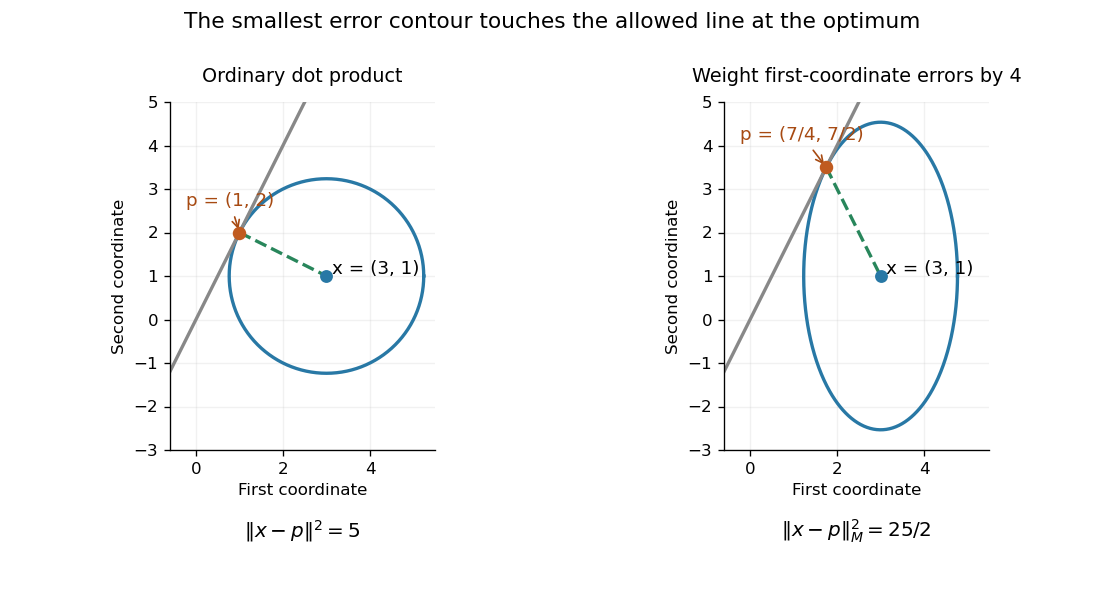
Changing the inner product changes the closest point: a circle and a weighted error ellipse touch the same permitted line at different points
. Details. 
In linear least squares, residual orthogonality to the column space is expressed by the normal equations for linear least squares. With a weighted Euclidean inner product, the corresponding real-matrix equation is . This makes the choice of error measurement part of the mathematical model, rather than merely a plotting convention.
At in the orientation double cover, use the derivative of the covering projection to transport the chosen orientation to the tangent space of the cover. In local oriented sheets this prescription is smooth, so it defines a global orientation. The involution reverses it.
For a connected smooth manifold, every component of the orientation double cover maps onto the base by the path lifting theorem. There can therefore be at most two components. A global orientation splits the cover into two copies of the base. Conversely, if there are two components, each meets every fibre once, so its inverse projection gives a smooth global choice of orientation.
Outward conormal of a surface boundary 2026-10-14
On the smooth boundary of an orientable surface, let be the chosen unit normal vector and the positively oriented unit tangent vector used by Stokes theorem. The outward conormal is . It is a unit vector, tangent to the surface and orthogonal to its boundary. This convention turns into by cyclic invariance of the scalar triple product.
Oriented atlas 2026-10-14
An oriented atlas is a smooth atlas whose smooth transition maps have positive Jacobian determinants on every overlap. The coordinate bases then give compatible choices of orientation of a vector space on all tangent spaces. A nowhere-vanishing top-degree differential form gives such an atlas: restrict each chart until its coefficient has constant sign, reverse one coordinate if necessary to make that sign positive, and compare the positive coefficients on overlaps. Conversely, a partition of unity glues positive local coordinate top forms to a global volume form.
There are unlisted articles, also show them or only show them.