
Scalar polarization reduction at a conducting corrugation Created 2026-10-14 Updated 2026-11-05
If a metal surface is and the incident field is independent of , Maxwell's equations separate into TE polarization and TM polarization. The metal condition that the tangential electric field vanish sets in the TE sector. In the TM sector , so the same condition gives . This explains why the TE problem agrees with scalar Dirichlet acoustics while the TM problem has different rough-surface boundary forcing.
A bundle trivial on a twistor line has a global holomorphic bundle frame there. Comparing it with the given two patch bundle frames produces invertible matrices , holomorphic on their respective affine patches, with . The obstruction to varying such a bundle frame locally with space-time is , so the splitting factors can be chosen holomorphically in a neighbourhood. If two splittings differ by and , then is holomorphic on the compact complex projective line and hence independent of its projective coordinate. It is the space-time gauge freedom.
On a twistor domain containing the lines for in a space-time domain , the Ward construction uses a holomorphic vector bundle with for every . A degree-zero restriction is not sufficient: has degree zero but is not holomorphically trivial. A trivial restriction has independent global holomorphic sections; their evaluations give a linewise bundle frame and hence a factorization of its patching matrix. Nearby factors can be chosen holomorphically because . Lines on which the splitting type is nontrivial are called jumping lines and obstruct this regular reconstruction there. For a globally regular field on affine complexified Minkowski space the condition is needed on all its incidence lines; on a smaller domain only those lines are required.
Abelian Ward splitting by Laurent series 2026-10-14
On a twistor line use and . For a degree-zero holomorphic patching logarithm, its Laurent series splits as , . The twistor incidence relation implies . Hence on both patches. The gauge potential is , . Exponentiating the two additive factors produces the linewise holomorphic splitting of .
Radial peculiar velocity in spherical harmonics Created 2026-10-14 Updated 2026-10-18
With and logarithmic growing-mode rate , the linearized cosmological continuity equation gives . Apply the Rayleigh plane-wave expansion to its velocity potential and differentiate radially to obtain the displayed expression. The factor supplies the velocity dimensions. At the present epoch has the same formula with removed; the commonly used is an approximation, not an exact general growth law.
For on , quadratic polynomials are annihilated. Taylor's formula with integral remainder gives with . This Peano kernel is nonnegative throughout the interval and integrates to , giving the sharp bound; attains equality. The derivative is at an interior point, so this is distinct from an endpoint differentiation formula.
Centered second-derivative Peano kernel Created 2026-10-14 Updated 2026-10-31
For on , quadratic polynomials are annihilated. The Peano kernel theorem gives , with the displayed kernel; its value at zero does not affect the integral. Its absolute integral is , proving . The kernel changes sign, consistent with exactness also on cubic polynomials despite the estimate using only three derivatives.
Delayed solutions of a square-root differential equation Created 2026-10-14 Updated 2026-10-20
This initial value problem uses a square root and absolute value to define a continuous function on all of . For every finite waiting time , a forward solution of a differential equation on isThe constant solution of a differential equation is another choice. For example, at , waits give values . These are dimensionless mathematical trajectories; no measured physical waiting time is being supplied.
Verification uses the original ordinary differential equation, including the join. Before departure, both and vanish. For , their common value is . For , the difference quotient at the join isThus the derivative exists at , equals the rate law there, and is continuous across the join. For the same computation gives the right derivative at the starting endpoint. For , the left and right second derivatives at departure are and : these forward solutions of a differential equation are continuously differentiable functions, without being twice differentiable at departure. The local two-sided statement of the Peano existence theorem is separate from this explicitly forward family.
The rate law tends to zero as , but its secant slopes from zero are unbounded:No finite local Lipschitz constant exists at zero. At the quotient is , even though the rates are shrinking to zero. Continuity controls the rate itself; Lipschitz continuity would control its change relative to the state displacement.
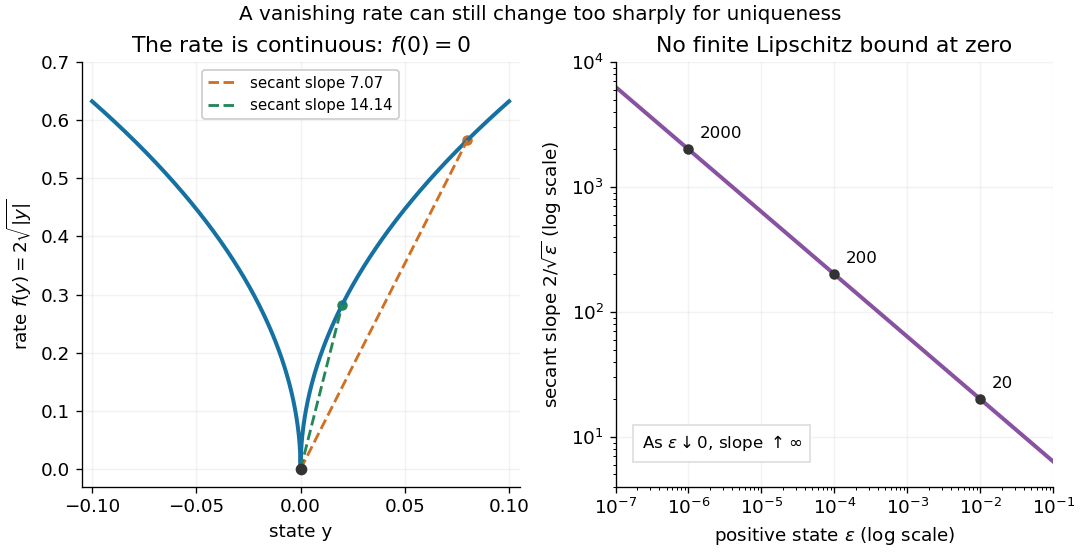

There is also a numerical lesson. The forward Euler method starting exactly at zero gives at every step. It reproduces the constant solution of a differential equation for every positive step size, while the moving trajectories remain equally valid. A computation producing one trajectory cannot establish uniqueness. Likewise, the separable differential equation calculation that divides by only describes the moving pieces: checking the original equation recovers the zero pieces and their joins.
Pauli expansion of a quantum error 2026-10-14
The tensor products of single-qubit Pauli matrices form an orthogonal basis of the operator space on qubits, so every linear error operator has a Pauli expansion. Using , with scalar phases absorbed into the coefficients, its computational basis action is , with binary arithmetic. This describes coherent errors as well as individual Pauli errors; it does not assume that the noise is a probabilistic Pauli channel. A physical noise map has Kraus operators of this form when the usual quantum channel description applies, for instance when the initial system and environment are uncorrelated.
Weight of a Pauli operator Created 2026-10-14 Updated 2026-11-05
The weight of a tensor-product Pauli operator is the number of nonidentity local factors; its global phase is ignored. Products satisfy because their support is contained in the union of the two supports. The quantum code distance uses this weight to measure the smallest undetectable nontrivial action on logical information.
Pauli decomposition of a qubit-environment isometry Created 2026-10-14 Updated 2026-10-25
Every linear map from a qubit into the tensor product of that qubit and an environment can be expanded in the Pauli matrix orthonormal basis of operators. If and , then the four coefficient vectors areThese environment vectors need not be orthogonal, so this is an operator expansion rather than a claim that the quantum channel is a classical Pauli channel. Physical isometries additionally preserve the inner products of the two input basis states.
Irradiation grazing angle of a disk 2026-10-14
For a thin illuminated surface and a central point source, the radial light ray has slope whereas the surface tangent has slope . Their angle difference is the grazing angle. The incident flux is to leading order. This requires a positive grazing angle and an unobstructed ray; a negative formal flux instead signals failure of direct illumination, not negative heating.
With and , real and , eliminate the internal fields to obtain , where and . The internal output transfer is ; the external output transfer is . The loop is asymptotically stable in this nondegenerate range. At the cavity mode is undamped and decoupled; at the instantaneous algebraic feedback connection is singular.
Young's lattice Created 2026-10-14 Updated 2026-11-05
The Young lattice is a partially ordered set whose elements are integer partitions, including the empty partition. Each partition of an integer is identified with its diagram, and the order is inclusion of Young diagrams. A cover adds exactly one box. A saturated path from the empty diagram to is equivalent to a standard Young tableau of shape .
Glaisher partition bijection Created 2026-10-14 Updated 2026-11-05
Fix a prime . Replace each part , with , by copies of . This is a size-preserving bijection from regular partitions to partitions of an integer whose parts are not divisible by . To invert it, write each multiplicity of a part not divisible by in base and use its digit in position as the multiplicity of . Every resulting multiplicity is below . The bijection explains why the number of simple symmetric-group modules equals the number of p-regular elements' conjugacy classes.
Reverse lexicographic order on partitions Created 2026-10-14 Updated 2026-10-31
Pad partitions with trailing zeros. In the descending-dictionary convention used for symmetric-function reverse lexicographic ordering, the partition with the larger first differing part precedes the other. This is the reverse of increasing dictionary order on integer partitions, and is a total order. It is distinct from comparing the last differing part in a monomial reverse-lexicographic order.
Colouring of a set 2026-10-14
A colouring assigns to each member of a set a colour in another set . Its nonempty fibres form a partition of a set. The colour set may be infinite; a finite colouring is the special case with finitely many colours. A homogeneous set for a colouring of finite subsets has all its subsets of the specified size assigned one colour.
Pad a partition in a rectangle with zero rows until it has entries, and put . The complementary rotated diagram has row lengths . This is again a partition in a rectangle, and its size is . Repeating the operation recovers the original integer partition, so it gives a bijection between diagrams of size and diagrams of size . Consequently the coefficients of the Gaussian polynomial read the same in either direction. The displayed identity can be interpreted as an identity of Laurent polynomials; it does not require substituting at .
For the two-by-two rectangle, the empty diagram pairs with , and pairs with ; and each map to themselves. This establishes symmetry, while unimodality of Gaussian binomial coefficients is a stronger statement about the growth and decrease of successive coefficients.
Indistinguishable particles Created 2026-10-14 Updated 2026-11-05
Indistinguishable particles have the same intrinsic particle properties, so exchanging their particle labels does not identify a different observable arrangement. Two electrons are an example; an electron and a proton belong to different species. Labels used as slots in a wavefunction are mathematical coordinates, not permanent identity tags.
For ordinary identical particles in three spatial dimensions, the symmetrization postulate takes the total quantum state to be symmetric for bosons or antisymmetric for fermions. In the antisymmetric case, exchanging all one-particle variables changes the sign of the wavefunction while leaving detection probabilities unchanged. The symmetry includes spin and other internal coordinates, not just position.
Spatial modes can nevertheless be addressed separately. Measuring the spin in one localized mode differs from measuring an imagined permanently labelled electron. Conditional spin measurement of identical fermions makes that distinction explicit. In two spatial dimensions, anyons allow more general exchange behavior; the boson/fermion alternative is not an unrestricted statement about every dimension.
Linear extension 2026-10-14
A linear extension is a total ordering of the elements of a partially ordered set that preserves all its comparisons. For a finite set it can be recorded as a list. If two adjacent elements in that list are incomparable, their interchange is again a linear extension.
There are unlisted articles, also show them or only show them.