
Poisson structure 2026-10-14
A Poisson structure is an antisymmetric smooth bivector field whose induced function bracket satisfies the Jacobi identity. In coordinates its condition is the vanishing cyclic sum of . Applying Jacobi to coordinate functions proves necessity; expanding arbitrary brackets cancels the second derivatives and proves sufficiency. A function bracket-commuting with every function is a Casimir function of a Poisson manifold.
Poisson tensor 2026-10-14
A Poisson tensor is a smooth bivector field defining whose bracket obeys the Jacobi identity. In coordinates, . Its Hamiltonian distribution integrates into symplectic leaves, even though its rank can vary across the manifold. The tensor specifies a bracket without requiring a globally nondegenerate symplectic form.
Poisson map 2026-10-14
A smooth map between Poisson manifolds is a Poisson map when for all smooth functions on . When a Lie group acts by Poisson automorphisms and the quotient is smooth, brackets of invariant functions descend and make the quotient projection Poisson. The quotient can be Poisson without being symplectic.
Symplectic foliation 2026-10-14
The symplectic foliation of a Poisson manifold consists of maximal connected integral manifolds of its Hamiltonian distribution. Each leaf has a nondegenerate closed two-form inverse to the restricted Poisson structure, with compatible sign conventions. Ranks can differ between leaves, making this a singular foliation. Hamiltonian flows remain within a leaf, and Casimir functions of a Poisson manifold are constant along every leaf; a Casimir level set need not be a single leaf.
A uniform magnetic field defines a constant Poisson bivector on momentum space by the displayed components. For the Hamiltonian and convention , it gives . Constancy makes every term in the coordinate Jacobi identity vanish. If , the symplectic leaves are the planes , and energy is conserved along the flow. The whole three-dimensional momentum space is not symplectic, and an energy surface need not itself be a Poisson submanifold.
For an isotropic Poisson line process of intensity , its pair intersections form a locally finite point process. Coincident intersections and parallel pairs have probability zero. Its intensity measure is times area. Indeed the Poisson factorial moment measure and the change of variables from signed distances to intersection location giveThe factor counts unordered line pairs. Shared lines create dependence between intersections; this process is not a Poisson point process.
Poisson kernel on the circle 2026-10-14
For , the geometric series gives . Hence this positive even kernel has normalized integral one, and normalized convolution with it multiplies the th Fourier coefficient by . Its mass outside any fixed neighbourhood of zero tends to zero as . If an integrable function has finite one-sided limits at zero, evenness gives half the mass to each side and the convolution tends to .
For and a Lebesgue point , its Poisson integral tends to through every fixed Stolz region. If , the Poisson kernel there is at most , where is shorter angular distance. Dyadic annuli about bound the near contribution by small local averages of times a summable sequence . The contribution outside a fixed small arc is and vanishes. This is the local kernel argument underlying the Fatou theorem for bounded holomorphic functions.
For drops with intensity , impact time and nonnegative volume , let their radius at time be . The dry probability at isThe exponent is the intensity of drops whose patch covers the point by that time. An infinite exponent means zero dry probability. No spatial-homogeneity assumption is needed.
Suppose the shell has mass density . Its mass is , by integrating . Summing the geometric series gives total mass . At the enclosed shells have indices , so the enclosed mass is the total mass times . The magnitude of the Newtonian gravitational field at every such boundary is therefore the same, . This does not assert that the field is constant throughout each shell.
One-parameter Poisson-Dirichlet distribution 2026-10-14
Take a Poisson random measure on with intensity and arrange its atoms as . The sum is finite and positive almost surely, has Gamma distribution with shape and rate one, and the law of is . The order is decreasing, so the first component is the largest; a size-biased selection of a component has a different law.
For , these continuous functions on have maximum one and integral . Their supports shrink towards zero while their value at zero remains zero. They converge pointwise to zero and their integrals converge to zero, but their convergence is not uniform convergence. Thus convergence of integrals and continuity of the pointwise limit do not imply uniform convergence.
Factorial cosine iterated limit detects rationality Created 2026-10-14 Updated 2026-10-25
For fixed , the inner limit is one precisely when is an integer, and zero otherwise, because exactly at integers and powers of a number with modulus below one tend to zero. If is a rational number, divides for every , making the inner limit eventually one. If is an irrational number, multiplication by a nonzero integer cannot make it integral, making every inner limit zero. The order of the two limits is essential to this argument.
Spectral decomposition of a quantum-plane point Created 2026-10-14 Updated 2026-11-05
For finite matrices satisfying , with not a root of unity, sends the generalized eigenspace of at into the one at . Finiteness of the spectrum makes nilpotent on the sum of the nonzero generalized eigenspaces. Exchanging gives the corresponding statement for . Splitting the zero generalized eigenspace of by that of gives the displayed invariant direct sum; both operators are nilpotent on .
Point-mass lens deflection and focusing 2026-10-14
Deflection changes one light ray's direction; focusing concerns relative directions of neighboring light rays and their bundle's cross section. To see the difference for a point-mass gravitational lens, send parallel incident light rays past the lens. A ray at impact parameter meets the optical axis approximately beyond the lens. Doubling quadruples this crossing distance. Thus the lens does not have a common focal length for all rays, although it can produce lensing magnification and an Einstein ring for a specified source-observer geometry.
The point-mass gravitational lens also illustrates why focusing must not be identified just with positive lensing convergence. Away from the central mass, differentiate the reduced deflection : its two-dimensional divergence is zero, so there. Nevertheless its radial and tangential derivatives differ, giving lensing shear of magnitude and . A vacuum ray bundle can be distorted and magnified. In the same ideal transparent geometrical optics model, surface brightness is preserved; the larger apparent solid angle supplies the increased received light.
Two images of a point-mass lens 2026-10-14
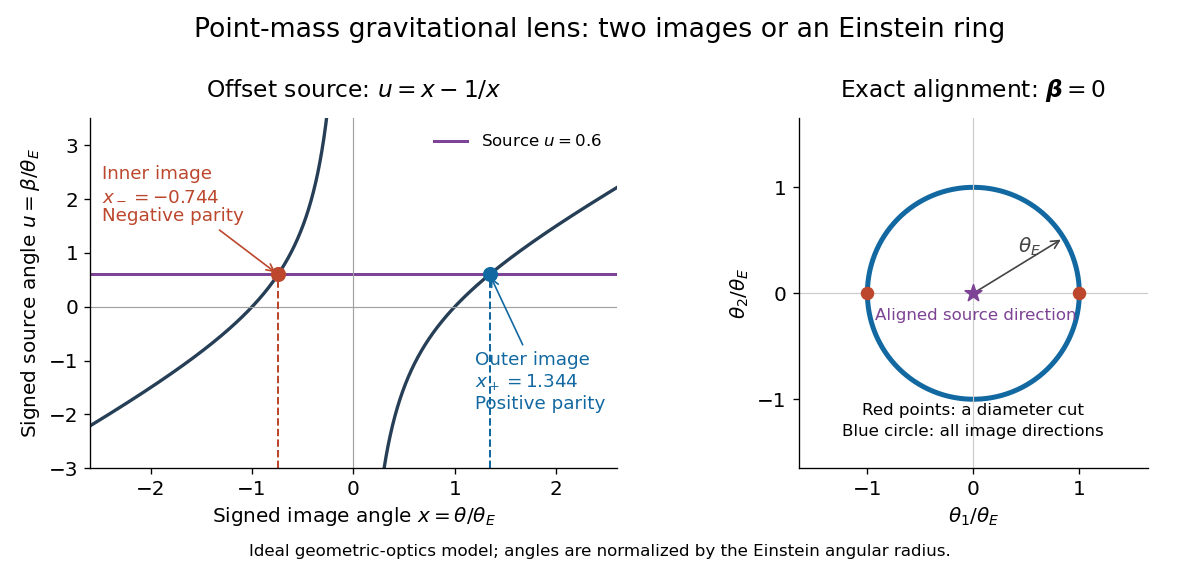
Choose a signed angular coordinate along the source-lens line. The point-mass gravitational lens becomesFor , multiplication by gives the quadratic equation . Its positive discriminant yields the two displayed roots. Their product is , so they lie on opposite sides of the lens. With , and : the outer image lies on the source side. For , the outer image is instead the minus root. These are image directions seen by the observer, not two emitting objects.[ref]
Gravitational Lensing by Matthias Bartelmann. Section 2.2, printed pp. 15-16, equations (100)-(110): point-mass model, two roots, critical circle and magnification
For a dimensionless example, set and . Solving gives and , with separation . The lensing magnification follows from image parity in gravitational lensing: , , and total amplification . Changing or the distances rescales the angles through the Einstein angular radius, while these dimensionless values remain the same.
For , the quadratic equation gives and . Using , the outer image tends to unit lensing magnification and the inner image has . Two mathematical images can therefore look like one at finite sensitivity or angular resolution. Furthermore, the inner impact parameter eventually becomes too small for the stated weak-field approximation or passes through the opaque lens: the ideal formula must then be replaced by an appropriate physical model.

Hyperbolic derivative density 2026-10-14
For a nonconstant holomorphic map into the unit disc, the displayed density pulls the target hyperbolic metric back to the source Euclidean coordinate. It is not the operator norm between two hyperbolic tangent spaces, which additionally divides by the source metric density. Away from ramification points ; a ramification point of multiplicity adds times its point mass to the distributional Laplacian.
Hyperbolic tube around a radial segment 2026-10-14
Under the Cayley transform between the half-plane and disk, a radial segment ending at a boundary point becomes a vertical half-ray. If a point is within hyperbolic distance of that half-ray, it lies in a fixed angular sector. Indeed, in the complex upper half-plane, . This converts bounded hyperbolic approach to a boundary point into nontangential approach, allowing normal-family proof of angular boundary convergence to transfer radial limits of bounded holomorphic functions.
Poincare inequality with a positive-measure zero set Created 2026-10-14 Updated 2026-10-31
Suppose vanishes on a measurable subset of measure at least , with . Writing for its mean, the zero set gives . Thus , and the Poincare-Wirtinger inequality supplies the displayed estimate. An elementary proof of that inequality on a ball bounds differences along line segments and splits the segment parameter at , giving the valid explicit constant . The change of scale from the unit ball multiplies the constant by .
Finite-index invariance of Poincare duality for torsion-free groups Created 2026-10-14 Updated 2026-11-05
For a torsion-free group and finite-index subgroup , is a Poincare duality group of dimension if and only if is. Finite-index induction and coinduction of coincide and give , so Shapiro's lemma identifies their group-ring cohomology as abelian groups. The finite-index finiteness and cohomological-dimension lemmas supply finite projective resolutions. Without torsion-freeness of the converse fails: contains the index-two subgroup but has infinite integral cohomological dimension.
There are unlisted articles, also show them or only show them.