
Characteristic and minimal polynomials of right multiplication Created 2026-10-14 Updated 2026-11-05
On two-by-two complex matrices let . In row-entry coordinates, its matrix is , so its characteristic polynomial is the square of that of . For every polynomial , . Thus implies , and the reverse implication follows by taking . The operators have exactly the same annihilating polynomials and hence the same minimal polynomial. In general, right multiplication on -by- matrices has characteristic polynomial and the same minimal polynomial.
Socle of a finite group 2026-10-14
The socle is generated by all minimal nontrivial normal subgroups. Distinct minimal normal subgroups commute and meet trivially, although in the abelian case not every collection of them is an independent direct-product decomposition. It is a direct product of simple groups. In a faithful primitive permutation group each nontrivial normal subgroup is transitive; its minimal normal subgroups are either elementary abelian and regular, or direct powers of a nonabelian simple group. This is the starting point of the O'Nan–Scott theorem.
Choose a minimal nontrivial normal subgroup of . Its conjugates under the ambient group are minimal normal subgroups of ; distinct ones intersect trivially and commute. Choose a maximal family whose product is direct. Any omitted conjugate either lies in that product or meets it trivially and could be adjoined, so all conjugates lie in it. Their product is ambient-normal and therefore is . A normal subgroup of one factor is then normal in , since the other factors commute with it; minimality makes each factor simple. All factors are isomorphic because they are conjugates of . In the abelian case they are cyclic of one common prime order.
A nontrivial minimal normal subgroup of a finite solvable group is abelian: its commutator subgroup is characteristic, and minimality plus solvability excludes . A nontrivial Sylow subgroup of this abelian group is characteristic, so minimality makes a p-group. The characteristic subgroup of pth powers is proper, hence trivial by minimality. Therefore is an elementary abelian group.
Michaelis constant 2026-10-14
The substrate concentration giving half the limiting reaction rate in the Michaelis-Menten equation. In the elementary mechanism , it is under the quasi-steady-state approximation, whereas the binding dissociation constant is .
If the relative weak topology on the unit ball of a normed vector space is first countable at zero, choose a countable collection of finite families of continuous linear functionals defining a local base. For any and , one family has common kernel on which . Extend that restriction to with using the Hahn-Banach theorem. Then vanishes on , so it belongs to by finite-dimensional factorization. Consequently the countable union of these families has norm-dense linear span in . The converse is the metrization of the weak topology on a bounded set construction from a norm-dense sequence in . In particular, separability of alone does not suffice: has nonseparable dual .
Metric entropy 2026-10-14
For a subset of a metric space, its metric entropy at resolution is the logarithm of the least number of radius- balls covering , with value infinity when no finite cover exists. It quantifies how many choices are needed to approximate an element at that resolution. If points are pairwise more than apart, each covering ball contains at most one, giving a lower bound by their logarithmic cardinality. The logarithm base changes only a constant factor. This approximation entropy differs from Kolmogorov-Sinai entropy of a dynamical system.
Chebyshev distance 2026-10-14
The metric induced by the maximum norm measures the largest difference in Cartesian coordinates. Simultaneous changes of Cartesian coordinates cost only as much as the slowest coordinate requires.
Manhattan distance 2026-10-14
The metric induced by the L1 norm gives taxicab geometry. Each difference in Cartesian coordinates contributes its absolute value independently, so an axis-aligned route with no backtracking realizes the endpoint distance.
Bounded metric transform 2026-10-14
Development of the method of types 2026-10-14
In his 1998 retrospective, Imre Csiszár describes the method of types as a 1970s refinement of the typical set approach, with older counting ingredients. He credits his research group with turning those ingredients into a general tool, while explicitly declining to give a complete discovery history.[ref]
The Method of Types by Imre Csiszár. §I, printed pp. 2505–2506: the refinement in the 1970s and the author's qualified historical account
The useful shift is from an approximately typical collection to exact frequency classes: the latter retain enough structure to study how fast error probabilities decay. Probability of a type class 2026-10-14
For a string of empirical distribution , independence givesMultiplying this by the size of a type class gives its exact probability. The entropy bounds for a type class then implyThese bounds apply to one attainable empirical distribution, not automatically to a tail event containing many classes.[ref]
The Method of Types by Imre Csiszár. §II, equation (II.1) and Lemma II.2, equation (II.5), printed pp. 2506–2507
If but , every string in that class is impossible and .As an exact example, take an independent and identically distributed binary source with . Each balanced four-symbol string has probability . There are six such strings, soThe relative entropy is . The exponential upper bound is , visibly larger than the exact probability. It captures the cost of an atypical frequency without supplying the exact finite-length prefactor.
For , the exact probability of twenty ones iswhile the exponential upper bound is approximately . At the source frequency , relative entropy is zero and the upper bound is one; the exact probability of ten ones is only about . A likely neighborhood of frequencies need not give a large probability to a single exact profile.
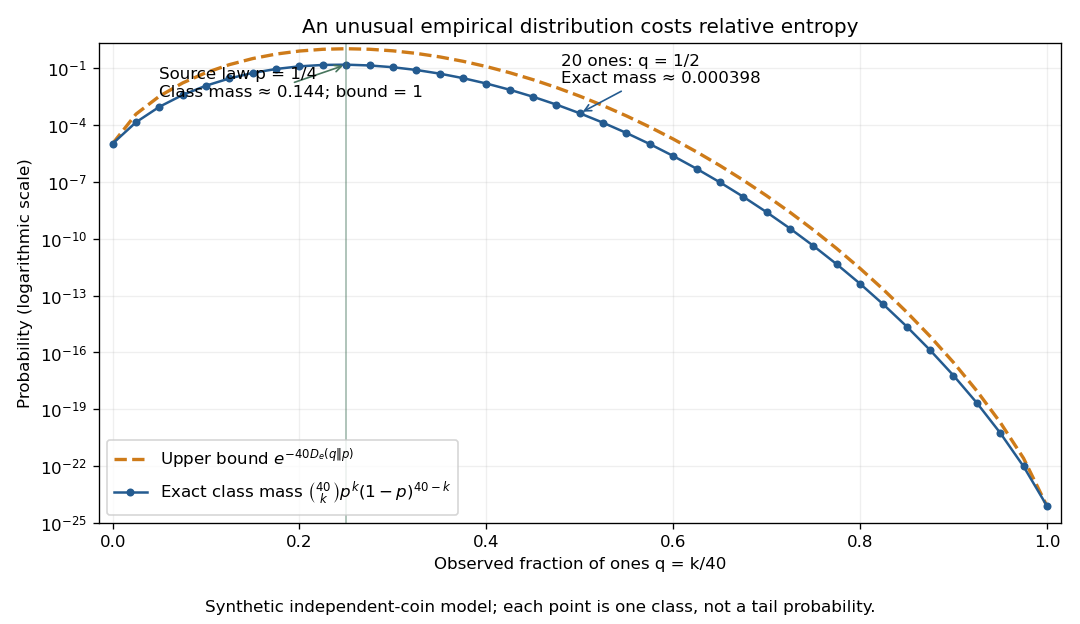

The striking cancellation is that there are about strings in a class, but each costs about . The information entropy terms cancel, leaving relative entropy as the rarity exponent. Summing over polynomially many classes preserves that leading exponential scale. This is the elementary counting mechanism behind finite-alphabet versions of Sanov theorem and many error exponents in hypothesis testing.
Entropy bounds for a type class 2026-10-14
For an attainable empirical distribution on a fixed finite alphabet of size ,Thus differs from by at most , uniformly over attainable profiles. Information entropy is the leading logarithmic count; the polynomial factor matters at short lengths.[ref]
The Method of Types by Imre Csiszár. §II, Lemma II.2, equation (II.4), printed pp. 2506–2507: type-class cardinality bounds
The upper bound has a short explanation. Under an independent and identically distributed source whose law is itself, each string in has probability . Multiplying by the number of such strings cannot give a probability above one. A corresponding polynomial lower bound follows from the multinomial coefficient; the Stirling's approximation gives sharper prefactors when needed.
For the balanced four-symbol class, , so the upper bound is , while the exact size is six. Information entropy is not an exact count for a short string. On the leading scale it becomes precise: the difference divided by tends to zero as grows with the alphabet fixed.
Number of empirical types 2026-10-14
A possible empirical distribution corresponds to nonnegative integer counts with sum . Stars and bars therefore givesThe bound also follows by letting each count independently range from zero to , which overcounts tuples whose sum is wrong. With the alphabet fixed, the count grows polynomially in , whereas there are strings when . For binary symbols there are exactly profiles: the number of ones can be any integer from zero through .
This reduces a rare-event calculation to a sum over profiles when the event depends only on counts. An event that depends on order may instead require counting the relevant subset inside each type class. A source with statistical dependence need not make strings of the same empirical distribution equiprobable; the memoryless assumption cannot simply be dropped.
For a smooth noncontact pair encounter in deterministic zero-inertia Stokes flow, streamwise reflection changes the sign of simple shear and time reversal changes it back. Uniqueness then pairs incoming and outgoing trajectory branches, with equal transverse separation at infinity. Hydrodynamic transverse motion during the encounter need not vanish; its net scattering displacement does. Contact, Brownian forcing and inertia can break this argument.
For two well-separated spheres with isolated downward speeds and radii , let , , , and let point upwards. Their leading Stokeslet interactions giveEach sphere's Stokes drag law supplies force on the fluid. Evaluate the other's Stokeslet at its centre and subtract the two velocities to obtain the equation. Corrections from finite size and potential dipoles are higher order in radius divided by separation. The approximation must remain well separated throughout the segment of trajectory to which it is applied.
For equal distant spheres, a force on the second generates a Stokeslet velocity at the held first sphere. The first sphere needs holding force by Stokes drag law. Its reflected Stokeslet, combined with Faxén rotation law, gives the displayed spin on the second. This translation constraint produces order rotation; if both centers were freely translating the same force monopole would not be emitted by the first sphere. Longitudinal forcing makes the leading cross product vanish.
Finite metabelian groups are monomial Created 2026-10-14 Updated 2026-11-05
Let and both be abelian. For an irreducible -module, choose a subgroup of maximal order whose restriction contains a linear character . Every subgroup containing is normal. If an element stabilizes , its action on the nonzero -isotypic component has an eigenvector; that line is invariant under and affords a larger linear constituent, contradicting maximality. Thus , and the Clifford correspondence gives .
After cosmological horizon entry during radiation domination, neglect averaged radiation forcing and the small matter self-gravity term. The CDM density equation in a matter-radiation universe becomes , giving the displayed logarithmic solution. Entry at matches a superhorizon amplitude of order , fixing the coefficient scale. Detailed radiation forcing near entry determines its order-one numerical factor. This is the Mészáros effect for the initially adiabatic mode.
In a radiation-dominated background with comoving cold dark matter, neglect its contribution to gravity but retain the radiation perturbation. The regular adiabatic initial conditions select . It obeys , with at zero and at infinity. The accompanying radiation contrast is . This exact leading-radiation solution explains the transition from common superhorizon growth to acoustic radiation oscillations and logarithmic matter growth.
There are unlisted articles, also show them or only show them.