
History of mathematics Created 2026-10-14 Updated 2026-11-05
The history of mathematics studies how mathematical problems, methods, notation and standards of explanation developed. A modern theorem statement can hide the concrete problem that first motivated it and the assumptions introduced only later.
The development of calculus illustrates the difference: effective rules for tangents and quadratures preceded modern definitions of limits and continuity. Historical claims about priority should therefore identify the actual statement, proof and publication being compared. Original papers and contemporary editions also reveal when familiar notation or a general theorem was absent from an earlier discovery.
Chemical engineering Created 2026-10-14 Updated 2026-11-05
Chemical engineering designs processes that transform, separate and transport materials. It combines mass balance, energy balance, thermodynamics, reaction kinetics and transport phenomena. A reactor's desired chemical conversion is only one part of a process: mixing, heat removal, separation and recycling determine whether that conversion can be maintained at useful scale. Scaling a small vessel up changes surface-to-volume ratios and transport distances, so multiplying every dimension does not preserve all operating behaviour.
Potentiometer 2026-10-14
A resistor with a movable contact that selects a point along its resistive path. In the Thévenin measurement experiment, a contact and one end provide an adjustable resistive electrical load.
Negative resistance 2026-10-14
A negative ratio of terminal voltage to entering electric current, or a negative differential slope in a more general terminal relation. A linear dependent electrical source can produce a negative Thévenin resistance without any of the network's ordinary resistors having a negative value.
Dependent electrical source 2026-10-14
An ideal source whose electric potential difference or electric current is controlled by a specified voltage or electric current in the electrical circuit. Thévenin source suppression retains its linear control relation.
Current source 2026-10-14
An ideal current source prescribes an electric current; its electric potential difference is determined by the connected electrical circuit. A dependent electrical source can prescribe a current controlled by another circuit variable instead.
Voltage source 2026-10-14
An ideal voltage source prescribes an electric potential difference; its electric current is determined by the connected electrical circuit. A dependent electrical source can prescribe a voltage controlled by another circuit variable instead.
Independent electrical source 2026-10-14
An ideal voltage source or current source whose prescribed value is not controlled by a variable in the connected electrical circuit.
Electrical load 2026-10-14
The external electrical circuit attached to the specified output terminals. In a Thévenin terminal response, its entering electric current is the network's delivered electric current.
Linear resistive circuit 2026-10-14
A steady electrical circuit described by Ohm's law, Kirchhoff's current law, Kirchhoff's voltage law, and ideal independent electrical sources or linear dependent electrical sources. Fixed sources make the terminal response an affine function when the circuit equations admit a unique voltage for each prescribed terminal electric current.
Frequency modulation 2026-10-14
Frequency modulation carries a message by changing the instantaneous frequency of a carrier wave. In the ideal model the wave amplitude stays constant: information changes the rate at which the wave phase advances. Write a real electrical signal and its chosen complex representation asThe wave envelope in this representation has modulus throughout, although continually passes through zero. A smaller instantaneous value of therefore does not mean a smaller wave amplitude. The continuously unwrapped wave phase is measured in radians; its derivative is an angular frequency, while division by gives frequency in cycles per second, or hertz.
For a message expressed as an electric potential difference, an ideal voltage-controlled oscillator has sensitivity in hertz per volt and obeysThe integral is essential: putting the message directly into the wave phase gives phase modulation, whose instantaneous frequency instead depends on the message's derivative. Amplitude modulation changes the multiplying wave amplitude. These are different ways to encode the same kind of message signal.
An original slow illustration uses , message frequency , frequency deviation , and FM modulation index . With zero initial wave phase,Here is in seconds. The instantaneous frequency stays positive, between and ; the wave phase always advances. The oscillations bunch up where is large and spread out where it is small, while the wave envelope remains at .
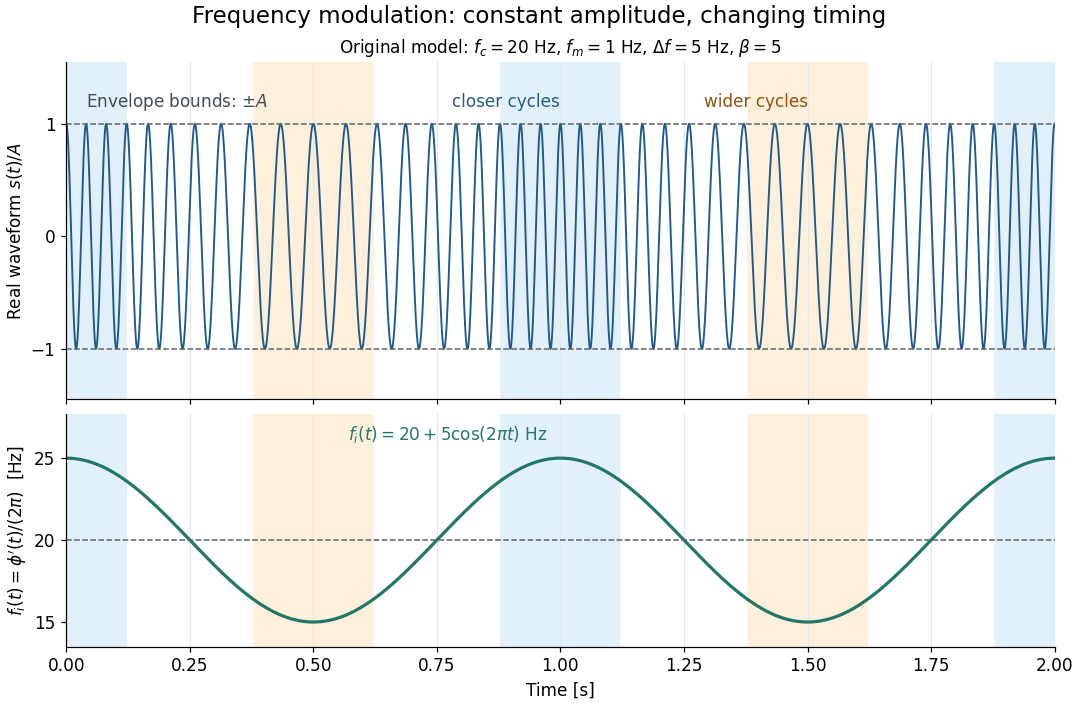

This separation is useful in a receiver: changing a positive multiplying wave amplitude does not change the zero crossings of , so their timing still carries the message. Noise that moves those crossings, a vanishing wave amplitude, and frequency response distortion can still damage it. The surprising beauty of FM is that a constant wave envelope can conceal a rich frequency spectrum: the components interfere to change timing instead of the envelope's height.
Voltage-controlled oscillator 2026-10-14
An oscillator whose frequency is adjusted by an input electric potential difference. An approximately linear control characteristic provides a model for frequency modulation.
Amplitude modulation 2026-10-14
Amplitude modulation encodes a message by varying the multiplying wave amplitude of a carrier wave. Conventional AM adds a positive constant before multiplication, allowing a simple envelope detector to recover the message within its limits. Multiplication translates the message's frequency spectrum into a band around the carrier, adapting a slow message to a faster channel. This is an application of the modulation property of the Fourier transform.[ref]
Continuous-Time Modulation by Alan V. Oppenheim. Signals and Systems, Lecture 13: Continuous-Time Modulation, printed pp. 13-1–13-2: channel matching, spectrum translation, carrier injection and demodulation
For an original single-message-frequency voltage model, chooseHere is time, is the peak voltage amplitude of the unmodulated carrier wave, is its angular frequency, is the message angular frequency, and is the dimensionless AM modulation index. The message shape is ; measures how deeply it changes the multiplying factor. Define the signed factor . The nonnegative wave envelope of the representation isThe instantaneous voltage crosses zero every carrier cycle, even when is large. Its value at one time, its wave envelope, and its carrier-component amplitude are three different quantities. The narrow-envelope intuition additionally needs ; the algebraic model only assumes .
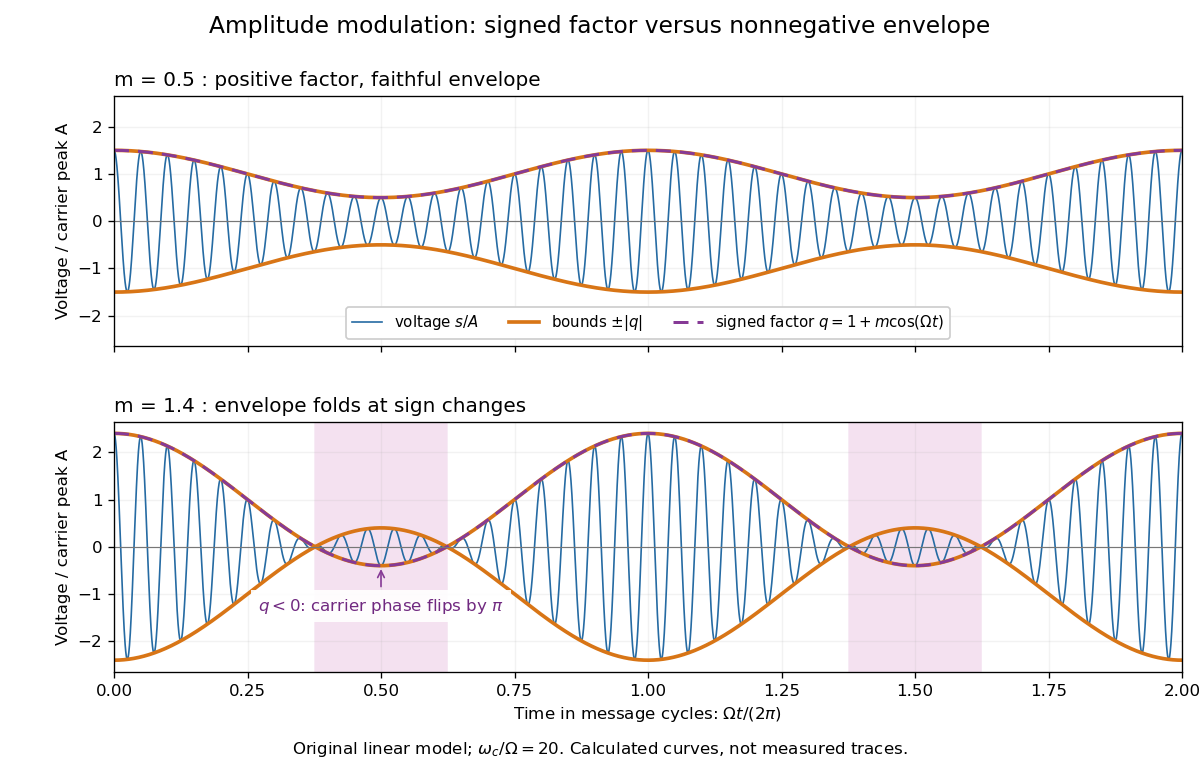
AM waveform, signed modulation factor and envelope before and after overmodulation
. Original voltage model with and or . Orange curves bound the waveform by ; the purple dashed curve is the signed . Shading marks negative , where the carrier phase reverses. These are calculated curves, not oscilloscope traces or detector measurements. Details.
The beauty is that two views reveal different parts of the same operation. In time, the message appears to ride on the oscillations. In the frequency spectrum, amplitude modulation sidebands show it as a pair of translated components. An envelope detector reads their combined shape without needing the carrier's wave phase; coherent demodulation instead uses a synchronized reference and preserves the signed factor.
Electrical engineer Created 2026-10-14 Updated 2026-11-05
An electrical engineer designs or analyzes systems involving electrical energy, electromagnetic fields and information-carrying signals. The work includes circuits, power conversion, communication, instrumentation and control. A sensor readout, for example, needs an amplifier that preserves the signal while accounting for noise, bandwidth, loading and supply limitations. The mathematical circuit model must be compared with component tolerances and measured behaviour, because an ideal amplifier equation does not capture every physical limit.
Antenna (radio) Created 2026-10-14 Updated 2026-10-18
An antenna couples electrical circuits to propagating electromagnetic radiation for transmission or reception.
Computer scientist Created 2026-10-14 Updated 2026-11-05
A computer scientist studies computation, information representation and algorithms. The work ranges from proving limits in computability theory and computational complexity theory to designing systems and evaluating them empirically. An analysis of binary search asks which ordering assumptions make elimination valid and how many comparisons are needed; a systems experiment asks how representation and hardware affect measured execution. Mathematics, formal models and reproducible measurement answer complementary questions.
Machine word 2026-10-14
A fixed-size unit of stored information in a computational cost model. Counting machine words separately from bits makes assumptions about identifier and value sizes explicit: for example, the storage bound for an adjacency list assumes each vertex identifier fits into a constant number of machine words.
Software 2026-10-14
Software consists of instructions and associated data used by a computer. A spreadsheet is software that stores spreadsheet cells and evaluates their spreadsheet formulas.
Computer Created 2026-10-14 Updated 2026-11-05
A computer is a physical system that represents information and carries out defined operations on it. In a stored-program design, instructions and data are held in computer memory, and a processor interprets instructions to update state. A simple program can read two represented numbers, add them and store the result; the represented bit patterns acquire meaning through the chosen encoding. Digital computers use discrete states, while analogue computers represent quantities through continuously varying physical variables. A mathematical model of computation abstracts these mechanisms to study capability and resource use.
Chromatography Created 2026-10-14 Updated 2026-10-18
Chromatography separates components of a mixture through different migration rates in contact with a chromatographic stationary phase while a chromatographic mobile phase transports them. Liquid chromatography describes the physical state of the transporting phase; size-exclusion chromatography describes a separation mechanism. Classification by phase and classification by mechanism answer different questions. In ideal size-exclusion chromatography, differential access to liquid-filled pores replaces binding as the source of differential migration.
In many other forms of chromatography, a solute repeatedly leaves the chromatographic mobile phase and returns to it. Reversible adsorption holds it at a surface; partition distributes it between the chromatographic mobile phase and an immobilized liquid chromatographic stationary phase. Spending more time stationary means less progress with the moving fluid. Two initially overlapping components can therefore emerge as separate bands without either being permanently trapped. Chromatography is useful both for comparing a sample with reference substances and for collecting separated components; a visible band need not contain just one substance.
Relative retention belongs to the sample together with the chosen chromatographic stationary phase, chromatographic mobile phase, eluent composition, and temperature. Changing these conditions can change the separation order. Chemical polarity helps explain interactions in some systems but is not a universal ranking rule. In thin-layer chromatography, a spot's TLC retardation factor is consequently conditional evidence about identity, rather than a fixed identifier intrinsic to a molecule.
There are unlisted articles, also show them or only show them.