
Lévy area 2026-10-14
Lévy area is the antisymmetric second-level integral of multidimensional Brownian motion. For distinct independent components the integrals are also Itô integrals. Combined with the symmetric tensor , it gives the second level of enhanced Brownian motion. It is not continuously determined by the uniform norm of the Brownian path.
Planar Brownian motion avoids a fixed point 2026-10-14
Planar Brownian motion started away from zero does not hit zero. Stopping the harmonic function on an annulus gives probability of reaching its inner circle before its outer circle. This tends to zero as . Exhausting the plane by outer circles proves point avoidance at finite times.
// Target: probability-and-statistics.bigb
Brownian moment recursion 2026-10-14
For standard one-dimensional Brownian motion, the Itô formula for gives this recursion. Stop at exits from to make the stochastic integral a true martingale. Gaussian tail integrability and the Doob Lp maximal inequality dominate all stopped powers on a fixed horizon, justifying the limit. Odd moments vanish and .
// Target: probability-and-statistics.bigb
Rotational invariance of Brownian motion 2026-10-14
For standard Brownian motion started at zero in , every fixed orthogonal transformation preserves the process law. Its transformed increments remain independent centred Gaussian random vectors with covariance , and its paths remain continuous. Consequently its exit law from any centred sphere is normalized surface measure. Translations give the same assertion for spheres centred at its starting point.
The process is a martingale in the filtration and has quadratic variation . The integral is well defined because its bracket is . The Lévy characterization of Brownian motion makes Brownian in this filtration, and stochastic-integral associativity gives the displayed representation. The resulting integrand is continuous at zero despite the singular inverse integrand.
Cylindrical Brownian motion 2026-10-14
On a real Hilbert space , this centered jointly Gaussian process is linear in its test vector and has the displayed covariance, with independent increments in time. Equivalently choose an orthonormal basis and independent real Brownian motions , and define stochastic integration by whenever . In infinite dimension it need not be an -valued random variable; the integral is the meaningful object.
Brownian sign transform 2026-10-14
The sign transform of standard Brownian motion is itself standard Brownian motion. The integrand is predictable because it is a Borel function of a continuous adapted process. Brownian motion spends zero Lebesgue time at a specified level: integrate over positive times. Consequently the transform's quadratic variation is , regardless of the chosen sign value at zero. The Lévy characterization of Brownian motion applies.
Strict comparison of one-sided and absolute Brownian maxima Created 2026-10-14 Updated 2026-10-18
For , let and . The Brownian reflection principle gives , hence . Also , with strict inequality on the positive-probability event : reflection gives its probability as . The Doob L2 maximal inequality bounds , so . At all quantities vanish and the lower inequality is equality.
// Target: probability-theory.bigb
Finite-sample maximum bias 2026-10-14
Here counts the observations replaced. This curve measures the largest change after at most arbitrary replacements. Under the first-unbounded convention, the replacement breakdown point is . The largest fraction still guaranteed bounded is one grid step smaller; those conventions must not be confused. A sample mean breaks after one replacement, while a scalar sample median with a fixed ordinary tie convention needs about half the sample replaced.
Multitype Poisson branching process Created 2026-10-14 Updated 2026-10-20
A particle of type has independently a Poisson distribution of type- offspring with mean . Different particles reproduce independently. If is the probability generation is nonempty from one type- ancestor, then and , where . This iteration decreases to the survival probability of a branching process, the greatest nonnegative fixed point of . The expected type-count row vector in generation is .
Branched surface action from two generators 2026-10-14
For a finite group generated by , take the regular covering of a thrice-punctured sphere with monodromy and fill each lifted puncture by a disk. Locally the projection is , where is the order of its monodromy. The result is a closed oriented topological surface with an orientation-preserving group action. The nontrivial stabiliser subgroups are the conjugates of , and at the three types of ramification points. Counting lifted cells gives the displayed Euler characteristic. A subgroup acts freely exactly when it meets every conjugate of these three cyclic groups trivially. Its quotient is then a regular covering of degree equal to the subgroup order, and quotient Euler characteristic is divided by that order.
Artin automorphism of a braid Created 2026-10-14 Updated 2026-11-05
A positive elementary braid acts on the free group of punctured-disk meridians by the displayed substitution, fixing other generators. The inverse sends to and to . Applying Seifert-van Kampen theorem at the crossings and closing the braid gives the knot-complement presentation .
Bowen ball 2026-10-14
Axis-aligned bounding box 2026-10-14
An axis-aligned bounding box is a Cartesian product of closed intervals aligned with a chosen Cartesian coordinate system:Only the two opposite corners and need to be stored. In two dimensions it is a rectangle. Changing the Cartesian coordinate system can change how tightly the axis-aligned bounding box fits the same object.[ref]
For a nonempty finite set of points , the smallest such axis-aligned bounding box hasThese minimum and maximum values also enclose the convex hull of : each coordinate of a convex combination lies between the smallest and largest input coordinates. In particular, three vertices of a polygon determine the axis-aligned bounding box of a filled triangle. For a general nonempty compact set, the same formulas use all its points; inspecting only an arbitrary finite sample is insufficient.
Given nonempty boxes and , the closed interval convention givesEquivalently, reject as soon as or in any coordinate. The surviving set intersection has endpoints and . This is an exact box test, while its conclusion about enclosed objects remains a conservative enclosure test.[ref]
3.7 Bounding Boxes. §3.7, Intersect() and Overlaps(): coordinate-wise intersection and inclusive comparisons
Equality counts as touching: and share an edge, so their set intersection is nonempty. Replacing every in the overlap formula by tests intersection of the interiors of full-dimensional boxes and excludes this contact. A zero-width closed interval can represent a point or a lower-dimensional enclosure, and must not automatically be discarded when touching counts. A box with some is empty; test emptiness before applying rules intended for nonempty boxes. The broad phase must retain touching candidates whenever the narrow phase counts touching as a hit.
For nonempty boxes, the smallest enclosing axis-aligned bounding box of their set union isThis operation supplies the parent boxes in a bounding volume hierarchy. It is an enclosure of the set union, rather than generally the set union itself. In floating-point arithmetic, comparisons are conclusive only for endpoints that still enclose the intended exact objects; use certified bounds such as interval arithmetic with outward rounding when that guarantee is required.
// Target: analysis.bigb
Bounding volume hierarchy 2026-10-14
A bounding volume hierarchy is a data structure arranged as a rooted tree: leaves store objects, and each internal node stores a bounding volume enclosing its children in a rooted tree. Consequently, every node encloses all objects in its subtree. A common choice is a binary tree of axis-aligned bounding boxes. The objects assigned to sibling subtrees can be different even when their bounding volumes overlap.[ref]
Here is an exact two-dimensional example. Use the triangles from bounding volume, together with having vertices of a polygon and having vertices of a polygon . Group under , and under . Their parent axis-aligned bounding boxes and the box at the root of a tree areThe diagram shows all seven nodes. Taking the coordinate-wise minimum and maximum of the two child boxes constructs each parent box; the resulting box contains the set union of the children, and can also contain empty space between them.
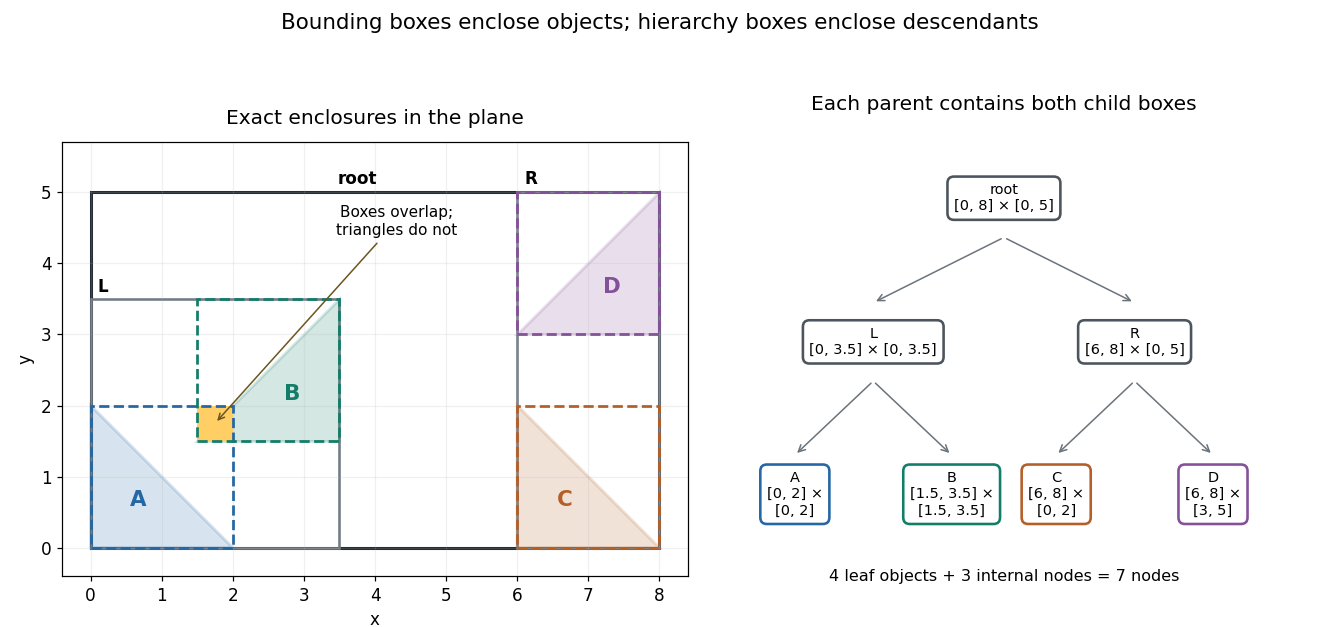
Four exact triangles, their enclosing boxes, and a seven-node bounding volume hierarchy arranged as a binary tree
. Details. 
A bounding volume hierarchy traversal starts at the root of a tree and discards a subtree when its bounding volume misses the query. Accepted internal nodes expose their children; accepted leaves supply candidates for actual shape tests. Box2D's official Collision: Dynamic Tree describes axis-aligned bounding box region queries that return overlapping leaf boxes. A query box that bounds a different query shape can produce additional false candidates.
For the closed query rectangleleft-first depth-first search tests the node boxes in order: root, , , , . The first four overlap ; does not, because its smallest -coordinate is . Pruning skips both and . Five box tests leave two broad phase candidates. The narrow phase rejects , since throughout , and accepts : the point belongs to both and . There are two detailed shape tests and one true hit.
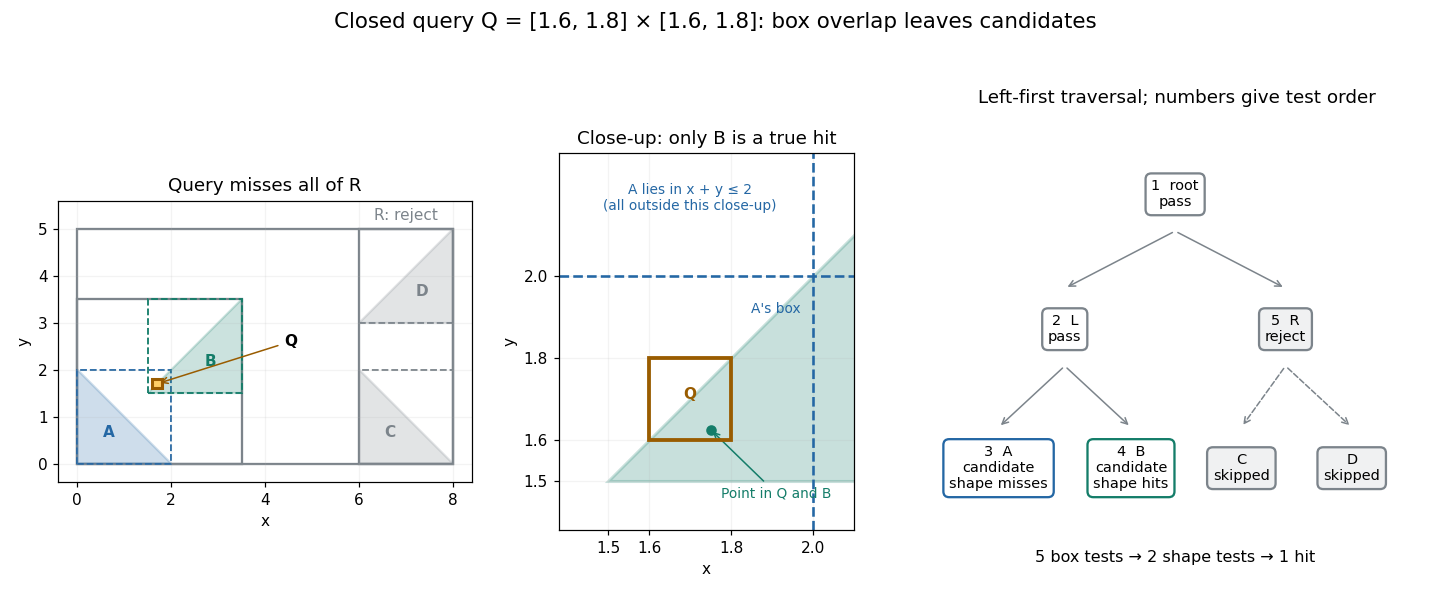
An exact rectangle query prunes the right subtree and leaves two box candidates but only one triangle hit
. Details. 
For a query asking for all intersections, time complexity depends on the number of visited nodes and the cost of each candidate shape test. With fixed dimension and constant bookkeeping cost per node, the work iswhere counts candidate objects and is Big O notation. A balanced binary tree has small height of a binary tree, but a query can enter both children at every level. In this example a query containing visits all seven nodes and tests all four triangles. More generally, a full binary tree with single-object leaves has nodes, so such a query takes work for constant-cost shape tests even when its height of a binary tree is . Listing hits itself requires outputs. Small height alone gives no unconditional logarithmic query bound.
For collision detection between two bounding volume hierarchies, traverse pairs of nodes: reject disjoint pairs of bounding volumes, expand a nonleaf member of an accepted pair, and apply the narrow phase at accepted leaf pairs. A single collection's self-query must exclude pairing an object with itself and avoid duplicate unordered pairs. If every object overlaps every other object, reporting all pairs already requires results. Construction quality, empty space in boxes and the queries determine how much pruning is useful.[ref]
For a short correctness outline, an object is enclosed by its leaf box, and each child box is enclosed by its parent box. Repeated subset relations carry this property to every ancestor. A true query intersection therefore prevents rejection at every ancestor of the object's leaf. Updating leaf boxes after motion also requires restoring all affected ancestor bounds before querying.
Collision detection 2026-10-14
Collision detection determines whether geometric objects meet, under a specified convention for touching. A bounding volume test can reject a pair before a more detailed shape test.
Conservative enclosure test 2026-10-14
A conservative enclosure test may retain disjoint objects as candidates, but must never reject a true set intersection. Increasing an enclosure can add candidates while preserving this implication.
For every fixed and , the sum is at most one. Pointwise convergence preserves this inequality. Taking the independent suprema over the pair and the point proves the assertion. Taking each bound separately would only give the weaker estimate two.
On a separable metric space, a sequence uniformly bounded in bounded Lipschitz norm has a pointwise convergent subsequence. Enumerate a countable dense subset and use the Bolzano-Weierstrass theorem and diagonal subsequence argument to obtain convergence there. Uniform control of the Lipschitz constant then makes the subsequence Cauchy at every point. The pointwise closure of the bounded Lipschitz unit ball preserves the original norm bound after rescaling.
Grothendieck inequality Created 2026-10-14 Updated 2026-11-05
For a finite real scalar matrix and unit vectors in a real Hilbert space, , with a universal constant. One valid bound is . Expand using odd tensor powers with coefficient magnitudes summing to , then apply the Gaussian sign identity . Taking converts the expectation back to the original inner product. Complex scalars admit a universal bound twice this real bound by separating real and imaginary parts.
There are unlisted articles, also show them or only show them.