
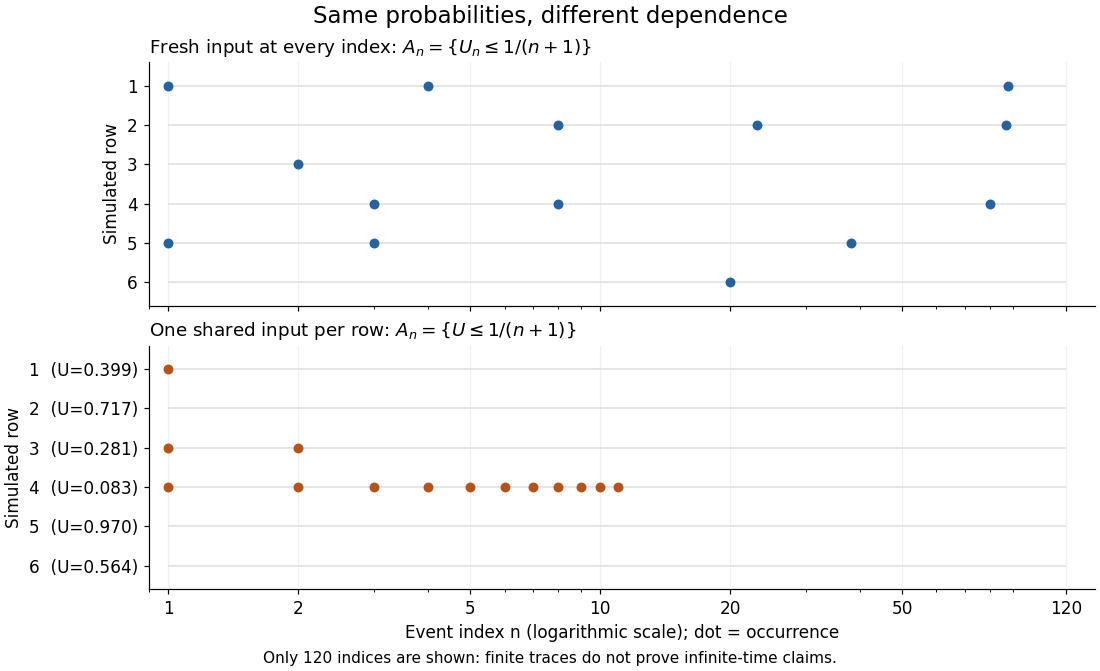

Bootstrap standard error 2026-10-14
Replace the unknown sampling distribution by the empirical distribution, generate independent bootstrap samples, and recompute the statistic. The sample standard deviation of those recomputed values estimates the conditional bootstrap standard deviation, which approximates the statistic's sampling standard error when the bootstrap is consistent. It is different from the Monte Carlo standard error of the estimated bootstrap mean.
Bootstrap failure for a uniform endpoint Created 2026-10-14 Updated 2026-10-18
For a continuous uniform distribution on , the scaled maximum gap tends to a unit-rate exponential distribution. An ordinary bootstrap sample includes the unique observed maximum with probability . The bootstrap maximum gap therefore retains an atom at zero, whereas the target limit is continuous. This proves failure of the ordinary empirical bootstrap for this endpoint functional; consistency of the endpoint estimate alone does not justify resampling its extreme-value limit.
Kleitman diametric theorem 2026-10-14
A family in the Boolean lattice whose pairwise Hamming distances are at most has size at most . Downward compression followed by elementary set shifts preserves the distance bound. In the resulting down-set, the section containing the last coordinate has diameter at most : two members leave a coordinate free, and shifting the last coordinate to it creates a pair with two additional disagreements. This gives the recurrence . The boundary case follows by pairing complementary sets. Hamming balls attain the even case; the union of two radius- balls with adjacent centers attains the odd case.
Tribes function 2026-10-14
A tribes function is an OR of AND blocks: partition coordinates into blocks of size , and let when at least one block consists entirely of ones. For independent random variables with each bit uniform, . The influence of a variable is , because every other bit in its block must be one and every other block must fail. Taking approximately keeps both output probabilities bounded away from zero and gives influences of order . This shows the order in the Kahn-Kalai-Linial theorem is sharp.
Random restriction of a Boolean function 2026-10-14
A -random restriction independently leaves each coordinate live with probability , otherwise fixing it to zero or one with probability each. Composing independent restrictions with live probabilities produces the same distribution with live probability . Fixed values stay unbiased.
Separated Boolean decomposition 2026-10-14
Every Boolean function of distributed inputs is an exclusive or of products of locally computable bits. The displayed identity follows because exactly one indicator is one. It uses at most terms, each a function of times a function of ; exchanging the two input roles gives at most terms. This elementary truth-table factorization is useful for distributed computation with PR boxes and does not depend on a probabilistic approximation.
Algebraic normal form 2026-10-14
The algebraic normal form is the unique multilinear polynomial representation of a Boolean function over the field with two elements, using exclusive or for addition and ordinary bit multiplication for products. The empty product is one. Existence and uniqueness follow by induction from : the first polynomial supplies all coefficients not containing , and the difference supplies exactly those that do. For split inputs , each monomial factors into one locally computed product of Alice's bits and one of Bob's bits, yielding a separated Boolean decomposition.
Quite fair Boolean function Created 2026-10-14 Updated 2026-10-25
Positive common intersection from pair-intersection probabilities Created 2026-10-14 Updated 2026-11-05
For , the intersection of all pairwise intersections is . Apply the union bound to the complements of the pairwise intersections and then take the complement to obtain the displayed lower bound. A sum exceeding therefore forces positive common probability without any independence assumption.
Failure-probability budget 2026-10-14
A failure-probability budget assigns nonnegative numbers to a finite or countable family of failure events in a common probability space, with verified bounds . The union bound guarantees that the probability of any failure is at most . By De Morgan's laws and the complement rule of probability, the probability that every requirement succeeds obeysThus guarantees simultaneous success with probability at least , even when all failure events depend on the same observations. The numbers are upper allowances; adding them is not a calculation of the exact failure probability.
For three requirements, give each a failure-probability budget . The total budget is , so simultaneous success has probability at least . On a sample space of twenty equally likely outcomes, let , , and . These disjoint events attain the budget and the success bound. If instead all three failure events equal , their individual probabilities are unchanged, but exact failure has probability and simultaneous success has probability . This second model shows how overlap can leave the guarantee conservative.
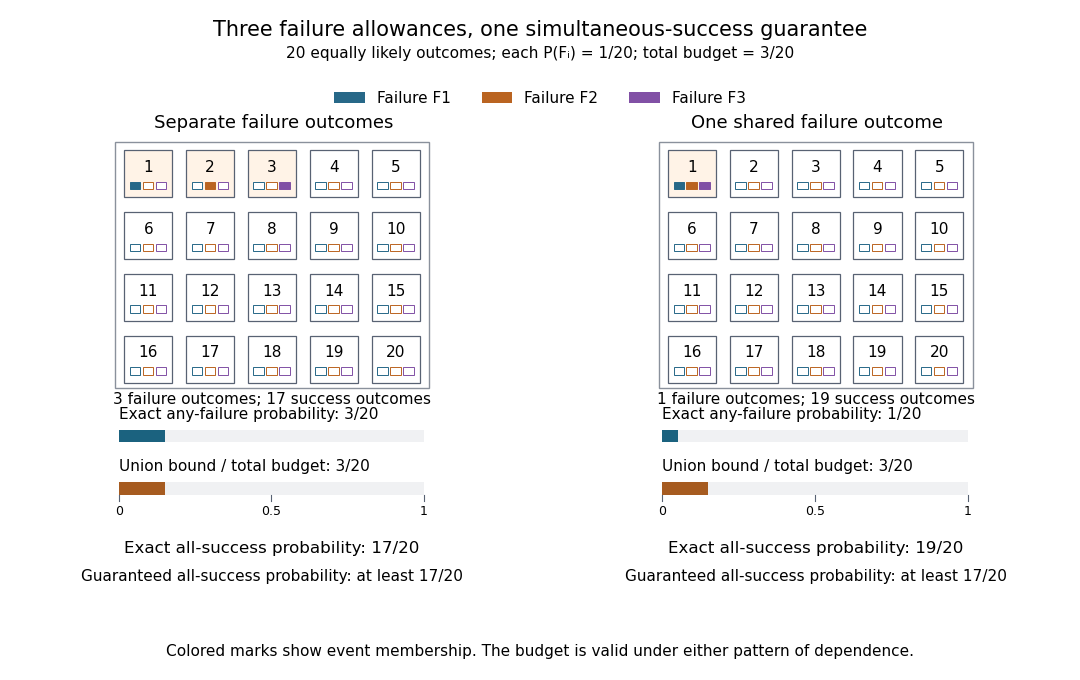
A shared failure-probability budget covers both separate failures and one common failure
. The two panels each have twenty equally likely numbered outcomes. The blue, orange, and purple marks identify membership in , , and , respectively. Their individual probabilities are in both panels. The union has three outcomes on the left and one on the right, while the union bound is in both. The event of simultaneous success is the complement of an event of any failure and contains seventeen or nineteen outcomes. These are illustrative probability models, not measured failure rates. Details.
For requirements, an equal allocation is convenient; unequal allocations also work when some requirements are harder to satisfy. For infinitely many requirements indexed by , the allocation uses total budget by the geometric series. A fixed positive allowance for every requirement instead gives an infinite sum and no positive simultaneous-success guarantee from the union bound. The individual probability bounds must cover all the failure events being combined: omitting possible failure modes leaves the resulting guarantee about the listed requirements only. The same addition of error allowances underlies the Bonferroni correction in simultaneous hypothesis tests.
Overlap in the union bound 2026-10-14
For a finite family, the random variable counts the events that occur. Linearity of expectation gives , while is the exact union probability. Their difference isAn outcome in exactly events contributes extra counts, weighted by its probability. This nonnegative difference vanishes exactly in equality in Boole's inequality. For two events it is , as the inclusion-exclusion principle for probabilities shows. For more events, the Bonferroni inequalities use pairwise and higher intersection information to bound the exact union probability; blindly subtracting pairwise intersections from the sum gives a lower bound, rather than a corrected upper bound.
Severe overlap can make the union bound arbitrarily pessimistic. Let all events be the same event with probability , where is an integer. A concrete model is the discrete uniform distribution on with . The exact union probability is , whereas the sum and capped bound are both one. The ratio is : adding more names for the same event does not create more ways to fail. The identity above describes the gap in the uncapped sum; capping at one can reduce that gap.
Equality in Boole's inequality Created 2026-10-14 Updated 2026-10-31
For finitely many events, or a countable family with finite sum of individual probabilities, equality in the uncapped union bound holds exactly when every pairwise intersection has probability zero. Equivalently, at most one event occurs almost surely. Pairwise disjoint events give equality, but literal disjointness is stronger than necessary: shared outcomes of probability zero do not change either side. For the capped bound, if the sum exceeds one, equality instead means that the union is an almost sure event; overlap can then have positive probability.
The cap and the disjoint case are both sharp. If the individual probabilities sum to at most one, put the events on separate pieces of a sample space to attain their sum. The twelve-outcome disjoint example does this with two events of probability . If the sum exceeds one, a covering union can attain the cap: on the same twelve-outcome sample space, and have sum and exact union probability one. These are sharpness examples, not an assertion that every overlapping family attains the bound. Positive-probability disjoint events are also not independent events, because their joint probability is zero while the product of their individual probabilities is positive.
Monatomic Bondi accretion Created 2026-10-14 Updated 2026-10-20
For isentropic spherical accretion with this adiabatic index, define and . The steady-flow equation is . The bracket has minimum two at Mach one. Reaching arbitrarily small positive radii therefore requires . For smaller rates the outer-rest branch remains subsonic; at the maximal rate it approaches Mach one only as , not at a finite sonic point. Supersonic outer branches fail the specified resting finite-density condition, and larger rates terminate at a positive minimum radius. An additional inner boundary prescription is needed to select a unique rate among the globally defined subsonic solutions.
Rectangle crossing in bond percolation Created 2026-10-14 Updated 2026-11-05
For the induced square lattice subgraph in , is the probability of an open graph path from its left boundary to its right boundary under independent bond percolation of density . Width and height count lattice spacings. Dual bond percolation exchanges failure with a top-to-bottom dual crossing of dimensions , with the usual exterior boundary vertices.
Extended real subsequence theorem Created 2026-10-14 Updated 2026-10-14
Every real sequence has a subsequence converging to an extended real number. A bounded sequence has a real convergent subsequence by the Bolzano-Weierstrass theorem. If it is unbounded above, every tail is unbounded above, so choose increasing indices with . These terms tend to positive infinity. If it is unbounded below, use .
Scope of Boltzmann's entropy formula 2026-10-14
The strings in Boltzmann entropy of a two-box occupancy are complete microstates only within the binary toy model. They retain a coarse-grained variable for each particle and omit its exact position within a box and its momentum. An actual classical gas instead occupies continuous phase space; obtaining a dimensionless count from a phase space volume requires a specified cell convention and the appropriate treatment of particle identity. A quantum state count must respect the allowed quantum states and quantum statistics. Thus is not a general count of microstates for a gas obeying quantum ideal-gas statistics. [ref]
https://ocw.mit.edu/courses/8-333-statistical-mechanics-i-statistical-mechanics-of-particles-fall-2013/0cdb670a825c6aaea7e229ac40776cbf_MIT8_333F13_Lec13.pdf. Kardar, MIT 8.333 (2013), lecture 13, §§IV.D–E: gas phase space and particle counting
For a discrete probability distribution with unequal weights, use the existing Gibbs entropy article; its equal-weight case gives Boltzmann's entropy formula. Shannon entropy uses the corresponding information measure, with the logarithm base setting its units. A count alone cannot replace the specified probability distribution, as the Boltzmann distribution examples demonstrate. [ref]
https://web.mit.edu/16.unified/www/FALL/thermodynamics/notes/node56.html. MIT, §7.3: statistical entropy for general microstate probabilities
Overwhelming multiplicity explains why thermodynamic equilibrium is overwhelmingly probable in macroscopic systems under the appropriate statistical assumptions. It does not make low-entropy thermal fluctuations logically impossible. Nor does counting alone derive irreversible macroscopic evolution: one also needs dynamics, an initial preparation, and a reason the system samples the allowed microstates on the timescale of interest. [ref]
https://ocw.mit.edu/courses/8-333-statistical-mechanics-i-statistical-mechanics-of-particles-fall-2013/0cb99318c2ed889316cdcff839759e8d_MIT8_333F13_Lec12.pdf. Kardar, lecture 12, §§IV.A–B: statistical equilibrium and the limits of counting arguments
Historically, Boltzmann's 1877 paper counted microscopic arrangements, called complexions, and related the natural logarithm of their number to entropy. The Sharp and Matschinsky translation appeared in Entropy 17 (2015), pages 1971–2009, DOI 10.3390/e17041971. Its notation differs from ours: Boltzmann's permutability measure is already logarithmic, whereas here is the count. [ref]
https://gilles.montambaux.com/files/histoire-physique/Boltzmann-1877-entropy.pdf. Boltzmann (1877), translated by Kim Sharp and Franz Matschinsky (2015), §III after equation 34 and §V
Josiah Willard Gibbs's Elementary Principles in Statistical Mechanics (1902) developed the statistical ensemble framework; Chapter XIV compares several statistical definitions of entropy with thermodynamics. [ref]https://en.wikisource.org/wiki/Elementary_Principles_in_Statistical_Mechanics. Gibbs (1902), title page and preface
[ref]https://en.wikisource.org/wiki/Elementary_Principles_in_Statistical_Mechanics/Chapter_XIV. Gibbs (1902), Chapter XIV: discussion of thermodynamic analogies
Additivity of Boltzmann entropy 2026-10-14
For two subsystems with independently specified macrostates, suppose every allowed microstate of can be paired with every allowed microstate of . Their allowed set is a Cartesian product. With equal probability for each pair, Boltzmann's entropy formula givesFor example, take two independent copies of the toy model, each with two labels choosing between its two boxes. Each copy has four configurations and Boltzmann entropy . Combining their independent labels gives sixteen configurations and Boltzmann entropy . This explains why entropy adds even though microscopic counts multiply. [ref]
https://web.mit.edu/16.unified/www/FALL/thermodynamics/notes/node57.html. MIT, §7.4, equation 7.17: independent state counts multiply
The product assumption matters. A constraint shared between the subsystems can forbid some pairs; for example, fixing only their combined energy generally requires summing over its possible divisions. See entropy maximization under thermal contact for how thermal equilibrium selects the dominant division. Statistical independence cannot be inferred merely from drawing a boundary between two parts.
In Boltzmann entropy of a two-box occupancy, impose an initial restriction that all labels are left. There is one allowed coarse microstate. Remove that restriction, allowing all occupancy values: the allowed set is now the union of every occupancy macrostate, containing strings. If the final description assigns equal probability to this whole set, its Boltzmann entropy change isThe counting identity is the binomial theorem. For twenty labels, . This final description fixes neither box occupancy; it is coarser than the particular macrostate , whose Boltzmann entropy is . The two counts answer different questions, so substituting the balanced macrostate for the full allowed set would change the calculation.
For four labels, the initial all-left string is
0000; removing the restriction makes all sixteen strings available. The column has only six strings. Accordingly, the whole allowed set has Boltzmann entropy , while the balanced macrostate has Boltzmann entropy .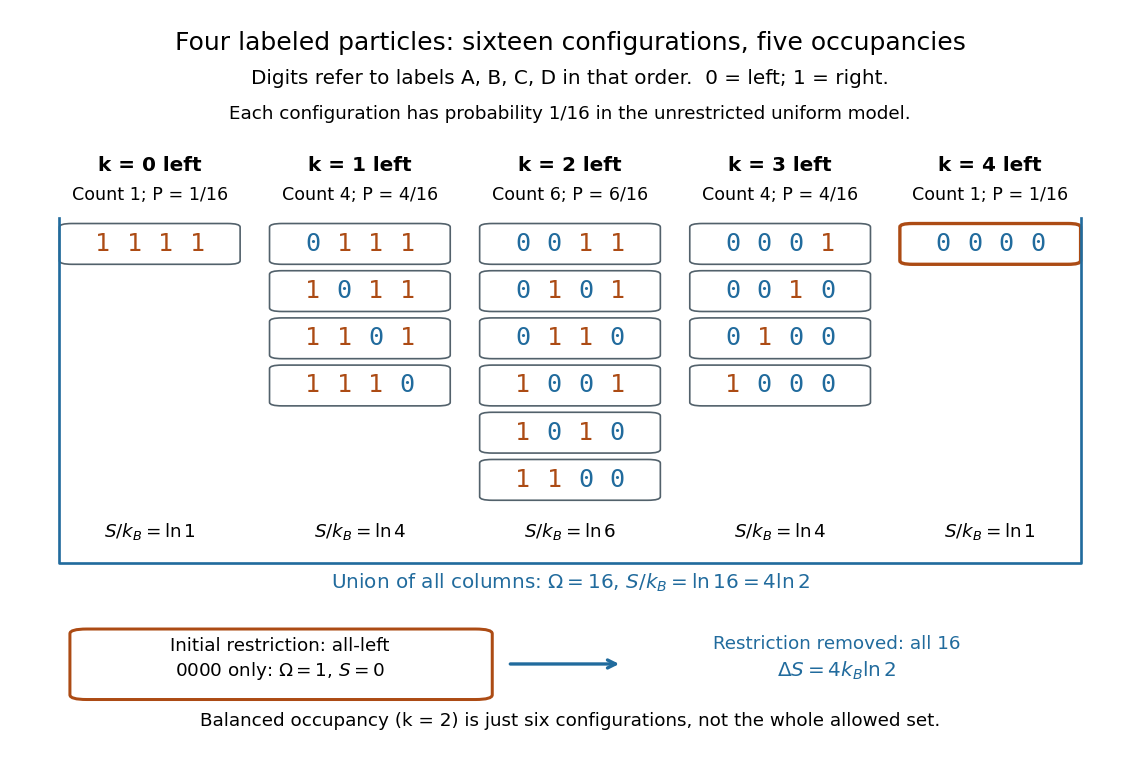
Sixteen configurations of four labeled particles grouped by left occupancy, compared with the all-left restriction
. Details. 
Removing a barrier changes the allowed set immediately, but it does not instantaneously randomize the actual probability distribution. Motion and equilibration must make those configurations accessible. The counting result illustrates the configurational contribution to free expansion; it does not describe the relaxation time or every contribution to the entropy of a real gas.
Boltzmann entropy of a two-box occupancy Created 2026-10-14 Updated 2026-10-18
Take distinguishable, labeled particles and two boxes of equal volume. Retain only whether each particle is in the left or right box: use a bit for left and for right. Each length-20 string is one coarse microstate of this toy model. Assume the labels make independent side choices with equal probability, so the strings are equiprobable. Equal volumes motivate these weights for noninteracting particles with no preference for either box; equal volumes alone would not establish them for an arbitrary interacting gas.
Now retain only the number in the left box as the macrostate. Choosing which labels are left gives a binomial coefficient, soThe factorials count assignments to labels; the probability of a macrostate sums the probabilities of its constituent microstates. This is the binomial distribution with parameters and . The same binomial coefficient appears in the counting of distinguishable two-level systems, although here the macrostate records occupancy rather than energy. [ref]
https://ocw.mit.edu/courses/8-333-statistical-mechanics-i-statistical-mechanics-of-particles-fall-2013/0cb99318c2ed889316cdcff839759e8d_MIT8_333F13_Lec12.pdf. Mehran Kardar, MIT 8.333 (2013), lecture 12, §IV.C, equations IV.17–18: binomial microstate counts
The largest binomial coefficient occurs at , the balanced macrostate. All-left means and supplies just one string. ThusThere are balanced strings for every all-left string, even though each individual string has the same probability. Exact balance has about of the total probability; equilibrium reasoning concerns the many macrostates near balance too, rather than certainty of exactly ten particles on each side. The diagram compares the counts with their natural logarithms.
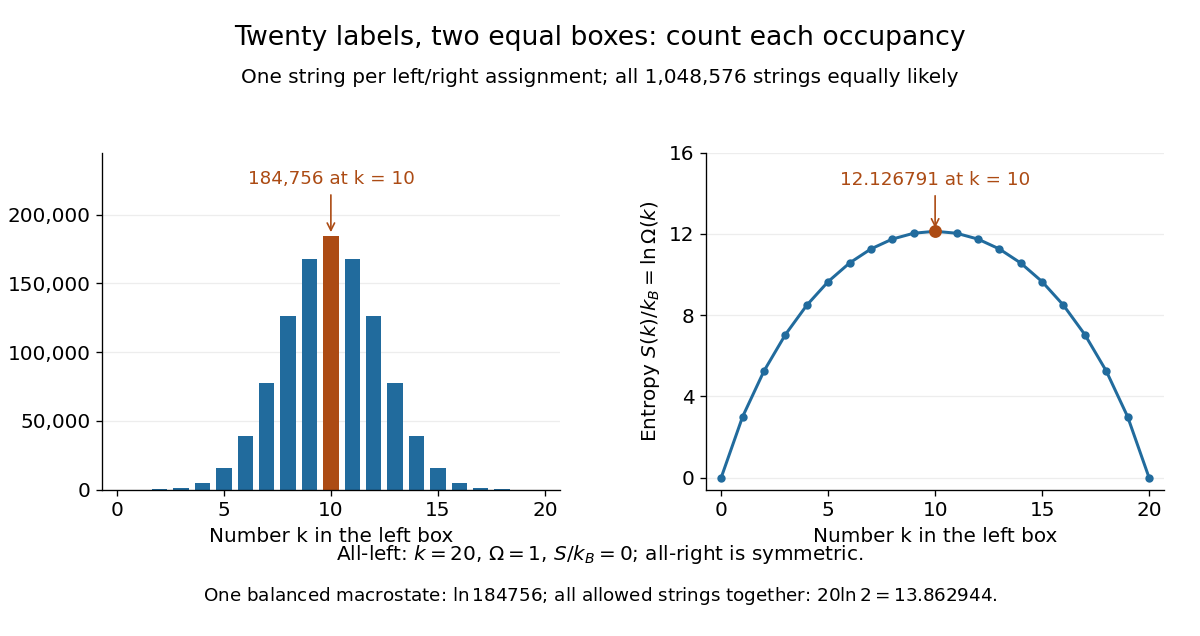
Counts and Boltzmann entropies of the occupancy macrostates of twenty labeled particles
. Details. 
Four fair, independent coins give a smaller worked example with the same binomial distribution. If is the number of heads, the five macrostates contain respectively microstates. Their probabilities are respectively . In particular, two heads is one macrostate containing six ordered coin sequences, with Boltzmann entropy in this counting analogy. A prescribed ordered sequence has one realization. The next diagram enumerates the same sixteen strings as left/right assignments.
There are unlisted articles, also show them or only show them.