
Independent-set bound for biregular graphs 2026-10-14
For a biregular graph with left vertices of degree and right vertices of degree , let be the indicator vector of a uniformly selected independent set. Use base-two information entropy. Shearer inequality gives . Conditional on , each right vertex with an empty selected neighbourhood is an independent fair binary choice, and the other right vertices are forbidden. Writing gives . For the neighbourhood patterns, assign weight to the zero pattern and weight one to all others. Jensen's inequality implies . Since , the bound follows from . If divides , the disjoint union of copies of the complete bipartite graph attains equality: each component has independent sets.
Circular orbit through an inverse-fifth-power singularity Created 2026-10-14 Updated 2026-10-25
For an attractive central force of magnitude , a circle of radius through the force center has polar equation . With specific angular momentum , substitution into the Binet equation gives . Consequently is inversely proportional to the magnitude of the angular momentum, and the angular-time integral gives . This is the finite travel time along the punctured circle from one approach to the singular center to the next; the force law alone does not specify continuation through the collision.
Binary symplectic space of Pauli labels 2026-10-14
Modulo scalar phases, the n-qubit Pauli group is the additive space , with label for . Multiplication adds labels, and commutation contributes the sign . The displayed alternating form is nondegenerate. An isotropic subspace satisfies , hence ; it labels commuting stabilizers.
Binary digit 2026-10-14
A binary digit is a zero or one in the base-two positional representation of an integer. The sum determines the Thue–Morse sequence and is the Hamming weight of the binary representation.
Single parity-check code 2026-10-14
The code consisting of all even-weight binary words. For its dimension is , and its weight enumerator is , by selecting the even terms of the binomial theorem. The length-one code contains only zero.
Self-orthogonal binary subspace 2026-10-14
A linear subspace is self-orthogonal if for every . The standard bilinear form is nondegenerate, whence and . The condition with means every vector has even Hamming weight. Such a binary linear code gives the linear algebra behind the Eventown theorem.
Doubly even code 2026-10-14
// Target: algebra.bigb
Even-weight subcode of a binary linear code Created 2026-10-14 Updated 2026-11-05
For a binary linear code , the linear functional records Hamming weight modulo two. Its kernel of a linear map is the even-weight subcode. If vanishes, this is all of ; otherwise rank-nullity theorem gives dimension . This also proves closure under addition without treating ordinary integer weight as a linear function.
A length-, dimension- binary linear code has full support when no coordinate vanishes on every codeword, equivalently when the union of the supports of a vector of all codewords covers every coordinate. Every coordinate is then a nonzero linear functional on the message vector space . Translation by a vector on which it is one pairs the zero and one fibers, so exactly codewords contribute one in that coordinate. Summing these contributions proves the formula. If there are nonzero columns in a full-rank generator matrix, the same argument gives instead.
For and vanishing solid-to-liquid diffusivity ratio, gives the interfacial liquid concentration. It increases from zero to as increases. Its derivative is , which decreases from to zero. For a direct proof, write . Then , so . Differentiation gives : the bracket increases with , and substitution of its lower bound gives only positive polynomial coefficients, including constant . Thus the concentration is strictly concave as a function of melting speed parameter . Combining this with a linearized thermal balance produces one fold on the melting branch and, with the freezing branch, an interval of three possible interface speeds.
For incident and reflected harmonic arterial pressure waves with real , the local pressure and flow phasors are proportional to and . Their maximum-time difference is the displayed phase lag, on the branch . Here is the round-trip phase to the reflector. Its derivative has the sign of . Raising the wave speed reduces the lag when , but increases it when . This conditional harmonic model does not establish an age trend for arbitrary vascular geometry or measurement stations beyond the sole reflector.
Bicyclic kernel classification 2026-10-14
The graph kernel of a bicyclic graph satisfies , with all degrees at least three. It therefore has either one degree-four vertex carrying two loops, a bouquet graph, or two degree-three vertices. In the latter case connectivity and degree counting give either three parallel edges, the three-edge Theta graph, or one edge between the vertices and one loop at each, a dumbbell graph. All bicyclic cores are subdivisions of these three kernels, subject to simplicity restrictions on loop lengths and parallel paths.
Labelled bicyclic graph count 2026-10-14
If counts labelled bicyclic cores on vertices, the bicyclic kernel classification gives . Three internally nonempty paths between two branching vertices give for . Attach a forest with those core vertices as roots to obtain . After division by the relevant sum is . Its upper bound follows from ; its lower bound uses , where this product stays bounded below. The sum is bounded above and below by positive constants. The restriction is necessary: .
Schur evaluation at all ones 2026-10-14
Put . In the bialternant formula, substitute with distinct and compare the first nonzero determinant coefficients as . They arise from the distinct degrees in the exponential expansions. The common factor in the and the factorials cancel, leaving the product of differences of the divided by the differences of . This proves the displayed integral specialization without dividing by a vanishing Vandermonde value.
Cobraided bialgebra 2026-10-14
A bialgebra equipped with a coquasitriangular structure, namely a convolution-invertible scalar form satisfying , and , with unit normalization. The induced right-comodule braiding is .
Stretch factor 2026-10-14
For an injective function that does not increase distances, one stretch-factor convention measures the largest compression that must be undone:If the sharp Lipschitz constant of is one, this equals bi-Lipschitz distortion. Fixing the scale matters: uniform compression has stretch factor two in this convention, but bi-Lipschitz distortion one. In a geometric spanner, the corresponding stretch factor is the largest graph-route distance divided by direct Euclidean distance; the graph-to-Euclidean identification does not increase distances. [ref]
https://people.scs.carleton.ca/~michiel/encyc_geometric_spanners.pdf. Gudmundsson, Narasimhan and Smid, Geometric Spanners, §1: the stretch-factor convention
. De Casteljau's algorithm 2026-10-14
De Casteljau's algorithm evaluates a Bézier curve by repeated linear interpolation between neighboring control points. Fix , start with , and computeEach new row has one fewer point. The final point is . Use the same at every stage: it describes the fraction of each line segment traversed from its first endpoint toward its second. A cubic Bézier curve needs three levels containing , , and linear interpolations, respectively.[ref]
https://graphics.stanford.edu/courses/cs164-10-spring/Handouts/handout19.pdf. Stanford CS348a, Handout 19, §2.3, pp. 10–11
For the Bézier curve with control points , , , , evaluation at takes the midpoint of every neighboring pair. The first level givesThe second level givesand the third level givesThe intermediate control polygons shrink toward the evaluated point. Each step is a convex combination, giving a geometric explanation of the convex hull property; every step also commutes with an affine map.
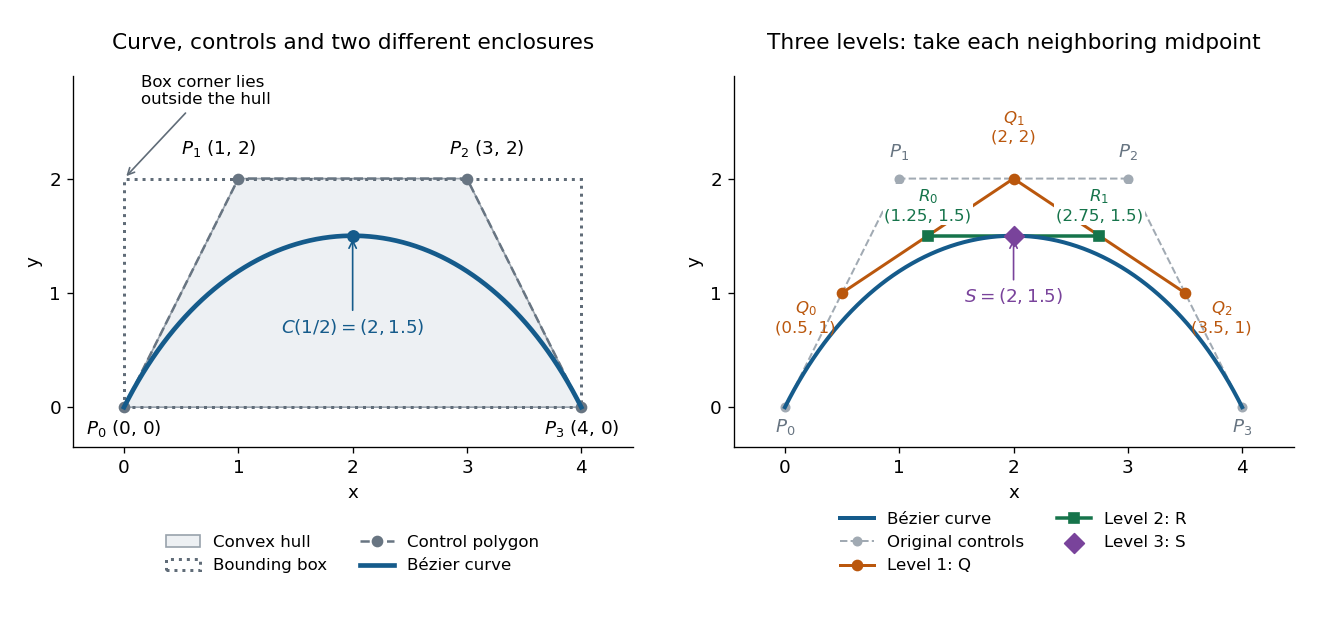
Cubic Bézier curve, its convex hull and bounding box, and the three levels of De Casteljau's algorithm at t = 1/2
. Details. 
The same construction splits the Bézier curve exactly, with no approximation. The outer edges of the triangular array give the new control points: for a cubic, specify the left piece and specify the right piece.[ref]
https://graphics.stanford.edu/courses/cs164-10-spring/Handouts/handout19.pdf. Stanford CS348a, Handout 19, §2.3, p. 11, subsegment control points
At these two lists areWrite and for the Bézier curves defined by these lists, each with its own parameter . ThenTheir images reproduce the original curve, while their derivatives account for the shorter parameter intervals. At the join,The chain rule gives ; in the original parameter, both pieces have derivative . This is the interval scaling in the parametric first-derivative join of Bézier curves.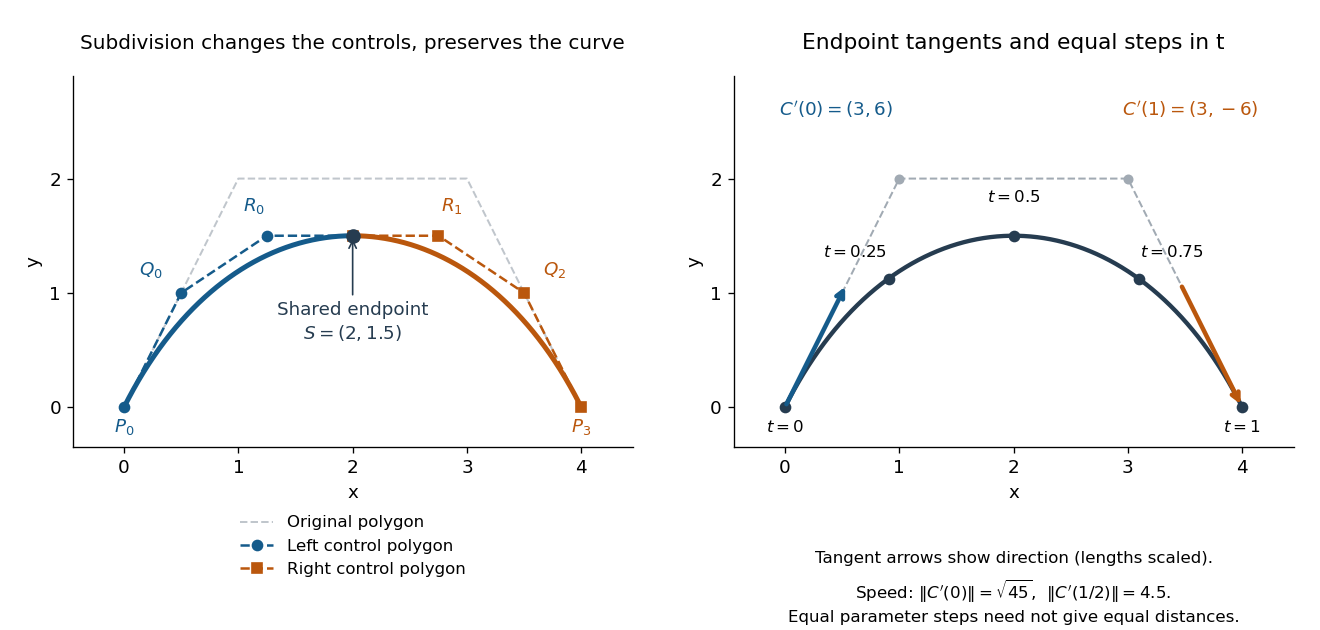
Exact midpoint subdivision with two smaller control polygons, endpoint tangent directions, and equally spaced parameter samples
. Details. 
Repeated midpoint splitting is useful for drawing vector graphics paths: each piece has a smaller control polygon and its own convex hull enclosure. A renderer can refine pieces until they are sufficiently close to line segments at the chosen display scale. Evaluating and splitting it are thus two results of the same short algorithm.
For a proof outline, expanding the recursion givesPascal's identity proves this by induction; at , it is precisely the Bernstein basis formula for the Bézier curve. The geometric construction remains useful even when expanding the polynomial by hand would be cumbersome.
// Target: analysis.bigb
Bézier derivative control polygon Created 2026-10-14 Updated 2026-10-31
For a degree- Bézier curve, the th derivative has degree at most and control points . The first derivative follows by differentiating the Bernstein basis and shifting one summation index; iteration proves the general formula. A parameter interval of length multiplies these derivative controls by .
Incomplete beta function Created 2026-10-14 Updated 2026-10-18
For real and , the displayed integral is the incomplete beta function. The regularized version is , the cumulative distribution function of the beta distribution. It has endpoint values zero and one and derivative . This is a useful explicit scale function of a one-dimensional diffusion when the scale density has two power-law endpoint singularities.
Beta sampling by gamma ratios Created 2026-10-14 Updated 2026-11-05
independent gamma distributions and with a common rate yield a Beta distribution . The change of variables , has Jacobian determinant , and factors the joint probability density function into a Beta distribution density in and a gamma distribution density in . In particular, independent chi-squared distributions with and degrees of freedom give the required ratio.
There are unlisted articles, also show them or only show them.