
Immigration-death worm-burden model 2026-10-14
Independent worm acquisition at rate and loss at rate produce a birth-death process for within-host parasite burden. Summing its forward equations against gives . At constant exposure, detailed balance yields a Poisson distribution with mean . Heterogeneous acquisition rates change the pooled burden distribution even when each individual host follows this model.
Aggregation of macroparasite burdens 2026-10-14
If host-specific equilibrium mean burden has a gamma distribution, conditional Poisson distributions produce a Poisson-gamma mixture, hence a negative binomial distribution. With mean and shape , its zero-burden probability is . Decreasing increases aggregation: a smaller infected-host prevalence can accompany the same mean burden and more heavily infected individuals.
Mating-limited macroparasite transmission 2026-10-14
For sexually reproducing worms, an infected host need not contain both sexes. Independent random sexes split a Poisson total burden of mean into independent male and female Poisson distributions of mean , giving the displayed probability of a fertile mixed-sex burden. For an arbitrary burden probability generating function , this probability is . Its low-burden behaviour can introduce an Allee effect in transmission, so an asexual mean-burden invasion calculation is not automatically valid.
Within-host parasite burden 2026-10-14
The within-host parasite burden is the number of parasites, or a specified parasite-load measure, carried by one host. A population's mean burden and its infected-host prevalence are different summaries of the burden distribution.
Volume-coupling relation for M-theory on K3 Created 2026-10-14 Updated 2026-11-05
A wrapped M5-brane fixes the heterotic string tension proportional to . Reduction of the gravitational coupling gives . Therefore , yielding the displayed dimensionless coupling relation. This derivation separates the K3 volume modulus from its shape Narain moduli space.
ADE gauge enhancement 2026-10-14
When appropriate negative-square two-cycles of a K3 surface collapse, wrapped M2-branes become massless. Their intersection pattern is an ADE root diagram, and the massless charged states enlarge the abelian gauge algebra to the corresponding simply laced Lie algebra.
// Target: supersymmetry.bigb
M-theory origin of type IIA D-branes Created 2026-10-14 Updated 2026-11-05
D0-branes are circle momentum states, D2-branes are unwrapped M2-branes, D4-branes are circle-wrapped M5-branes, and D6-branes arise from Kaluza-Klein monopoles with the M-circle as fibre. Wrapped M2-branes give fundamental strings, and unwrapped M5-branes give NS5-branes. The D8-brane is a source for Romans mass and is outside this ordinary massless-circle dictionary. Tension matching uses and .
M2-brane 2026-10-14
The M2-brane has two spatial dimensions and couples electrically to the supergravity three-form. Its supersymmetric worldvolume description is the supermembrane.
M5-brane Created 2026-10-14 Updated 2026-11-05
The M5-brane has five spatial dimensions and carries the magnetic charge dual to the M2-brane's electric three-form charge. Wrapping it on a compact cycle lowers its effective spatial dimension and multiplies its brane tension by the cycle volume.
Coronagraph pupil-stop observing experiment 2026-10-14
Schmid et al. tested the Lyot stop on sky using the close binary Hydri with SPHERE/ZIMPOL at the Very Large Telescope. They kept the CLC-S-WF coronagraphic focal plane mask, the NB730 filter and pupil-stabilized imaging mode, and compared observations without a pupil stop and with stopB1_2. Each configuration used ten 8-second exposures. One camera imaged the optical pupil while the other simultaneously imaged the focal plane, connecting the blocked pupil features to the image improvement. [ref]
https://doi.org/10.1051/0004-6361/201833620. Schmid et al., 2018, §4.2, figures 19–20 and table 10, test A
.Bright rings occurred at the inner and outer pupil boundaries; the stop covered them and other unwanted features. To compare point spread functions, the authors multiplied the no-stop image by , accounting for lost off-axis transmission. The companion's reported detection significance rose from to . This demonstrates a useful gain despite lost companion light. It measures the complete stop, including obstruction, support-vane and faulty-actuator blockers; it does not isolate outer-rim clipping alone or establish a universal suppression factor. The figures here are independent toys, not reproductions of those observations. [ref].
Fourier model of a Lyot coronagraph Created 2026-10-14 Updated 2026-10-20
Consider an ideal coherent monochromatic wave from an unresolved source on the optical axis, a uniform circular entrance pupil of diameter , and ideal relay optics without wavefront errors. In the scalar Fraunhofer diffraction approximation, a Fourier transform carries the pupil's complex amplitude into the image plane. Choose dimensionless pupil coordinates in units of and angular coordinates , where is the wavelength. DefineThe coronagraphic focal plane mask has transmission , with inside the occulting disk and outside. Thus the field immediately after the mask is . Outside the disk , so the local wave intensity is still : hiding the core has left those rings intact. Reimaging an unlimited pupil giveswhere is convolution, is the Lyot stop transmission, and the proportionality constant in the irradiance is omitted. Coordinate reversals from physical relay optics are absorbed into the coordinate choice. These equations use wave amplitudes throughout propagation; applying a Fourier transform to wave intensity would give a different and incorrect model. This is the pupil/image calculation described by Sivaramakrishnan et al.; the circular disk and numerical choices below are our illustrative specialization. [ref]
https://ao.jpl.nasa.gov/Publications/Technical/2001ApJ.sivaramakrishnan.AO.pdf. Sivaramakrishnan et al., 2001, §2.1, equations 2–6
.The subtraction explains the beauty of the arrangement: in much of the interior, the original pupil field and the convolution term nearly cancel. Near a boundary, that cancellation is incomplete. The Lyot stop can therefore block a region containing disproportionately much unwanted light. A hard-edged coronagraphic focal plane mask has a transform with extended tails, so the interior need not be perfectly dark. With an unlimited relay, gives exactly: no further ring suppression occurs. A stop covering the full original optical pupil instead uses and already clips field outside the optical pupil; an undersized Lyot stop clips more of the remaining rim.
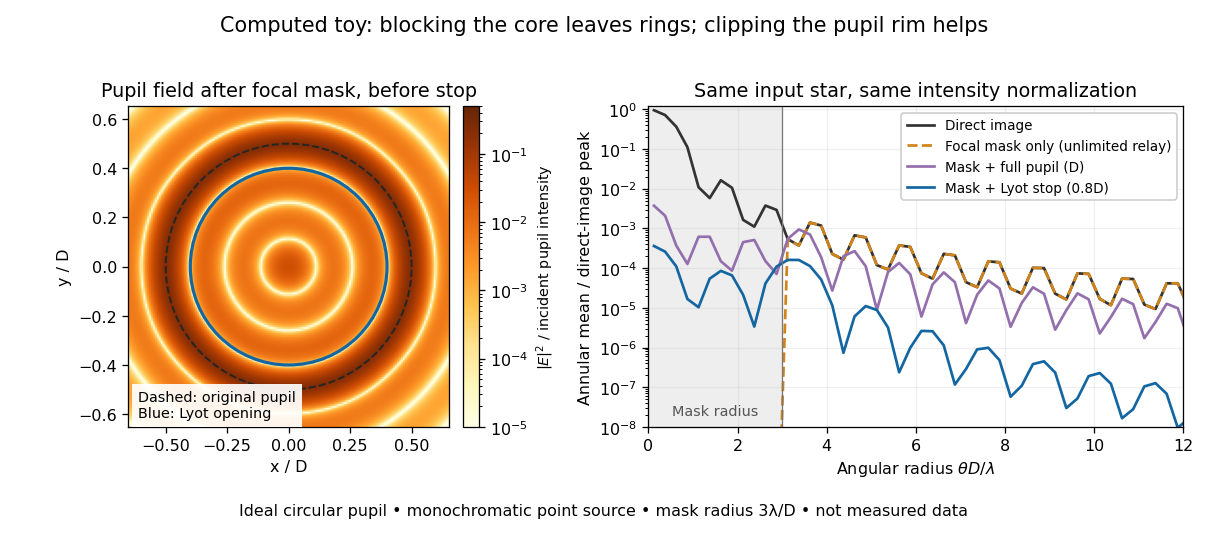

The toy uses a coronagraphic focal plane mask of angular radius and a Lyot stop of diameter . The discrete Fourier transform grid has samples, with 128 across and angular sampling ; it approximates the continuous equations on a finite periodic domain. The plot averages wave intensity in annuli of width . Over the annulus , the mean wave intensity divided by the direct stellar peak is approximately without a coronagraph, the same with only the focal mask and an unlimited relay, with the mask and full pupil, and with the mask and Lyot stop. Thus the undersized opening reduces this particular annular mean about 27-fold relative to the full-pupil comparison. It does not suppress every direction by that factor, and these values do not predict a real instrument's detection limit.
The ideal toy excludes a central obstruction, support vanes, scattering of light, wavefront errors, atmospheric effects, a spread of wavelengths, pointing drift and detector noise. It also contains only the star: no simulated planet or solar corona. For a far off-axis source whose image misses the coronagraphic focal plane mask, the continuous geometric coronagraph throughput of the opening tends to relative to the full disk. Rejecting stellar light therefore costs some desired light as well. Enlarging the coronagraphic focal plane mask narrows the characteristic scale of its pupil-plane transform by the scaling property of the Fourier transform, but also hides a larger neighborhood of the source.
Lyot stop 2026-10-14
A Lyot stop is a mask in the reimaged optical pupil after a coronagraphic focal plane mask. For an unobstructed circular entrance pupil, it usually transmits a smaller concentric disk. In a classical Lyot coronagraph, much of the residual stellar field lies near the optical pupil boundary; the Lyot stop rejects that field before the final image is formed. It also rejects useful off-axis light, so choosing its opening involves a coronagraph throughput tradeoff. [ref]
https://ao.jpl.nasa.gov/Publications/Technical/2001ApJ.sivaramakrishnan.AO.pdf. Sivaramakrishnan et al., 2001, §2.1
. Coronagraphic focal plane mask 2026-10-14
A coronagraphic focal plane mask modifies the wave amplitude or wave phase in an intermediate focal plane. Here it is a perfectly opaque circular disk centered on the bright source. A finite aperture produces an extended point spread function, so a finite disk blocks only part of the stellar light. Its sharp edge also changes the transmitted field and hence the later diffraction pattern. The exact model below makes both effects visible.
Proximity effect (astrophysics) 2026-10-14
The quasar proximity effect is a reduction of nearby Lyman-alpha forest absorption caused by extra photoionization from the quasar. At fixed density and temperature in photoionization equilibrium, an added rate changes the neutral fraction by the factor . A host environment with positive density contrast can mask this reduction, and a variable or anisotropic source complicates its interpretation.
Redshift evolution of the Lyman-alpha forest 2026-10-14
The Lyman-alpha forest becomes denser and more opaque towards higher cosmological redshift, for a fixed absorption selection over the ordinary post-reionization range. The incidence is often parametrized as , with the index depending on the column density threshold and epoch. The evolution flattens at low redshift as the declining cosmic ionizing background partly offsets dilution of the intergalactic medium. For optically thin gas at fixed overdensity, photoionization equilibrium gives approximately , illustrating why density, temperature and ionizing radiation all matter.
Lyman-alpha forest photoionization scaling 2026-10-14
In optically thin, almost fully ionized hydrogen in photoionization equilibrium, and . Thus the neutral fraction is approximately , while the neutral density is proportional to . At fixed overdensity, cosmic dilution gives , hence . Gas density, temperature, ionizing radiation and path length are all required to infer a baryon density from Lyman-alpha absorption.
Neutral-hydrogen column-density distribution 2026-10-14
The neutral-hydrogen column-density distribution counts Lyman-alpha absorption systems per unit column density and redshift. A count in logarithmic column bins is . At low forest columns an approximate power law with near is useful, but the slope and normalization depend on column range and epoch. Lyman limit systems are optically thick at the hydrogen photoionization edge; damped Lyman-alpha systems have strong radiative damping wings. A distribution per absorption distance instead removes the geometrical path factor.
Lyman limit system 2026-10-14
A Lyman limit system has approximately unit or greater optical depth at the neutral-hydrogen Lyman limit near . The threshold follows from with . Its strong continuum absorption distinguishes it from ordinary weak Lyman-alpha forest lines. Classification conventions often separate damped Lyman-alpha systems as the highest-column category.
Damped Lyman-alpha system 2026-10-14
A damped Lyman-alpha system has a sufficiently high neutral-hydrogen column density that the Lorentzian wings of its Voigt profile are conspicuous. These wings come from the finite lifetime of the excited atomic state, not from unusually high gas temperature. Damped systems usually trace substantial neutral reservoirs associated with galaxies.
Hilbert-Schmidt Lyapunov feedback identity 2026-10-14
For , with both states evolving under the same drift and only receiving , cyclicity of the trace cancels the drift terms and gives the displayed identity. The scalar is real because is Hermitian. Choosing , , makes . This is nonincrease, not by itself convergence to the target: additional invariant-set and reachability conditions are needed.
There are unlisted articles, also show them or only show them.