
Fatou's lemma 2026-10-14
For nonnegative measurable functions,
Field of sets 2026-10-14
A Boolean algebra of subsets contains the empty set and is closed under finite unions and complements. It is consequently closed under finite intersections, differences, and symmetric differences.
Linear noise of two species with joint removal Created 2026-10-14 Updated 2026-11-05
For and mean lifetime , the normalized restoring matrix is and the diffusion matrix is . Solving the normalized stationary fluctuation-dissipation relation for a reaction network gives the displayed covariance. The sum mode remains damped, but the difference mode's restoring rate is . Its noise grows without bound relative to that restoring rate as , giving strong negative correlations and invalidating small-fluctuation closure near exclusive joint removal.
// Target: mathematical-biology.bigb
Exclusive joint removal has a diffusing difference mode Created 2026-10-14 Updated 2026-11-05
If individual removal is absent, simultaneous removal of one molecule from each species leaves unchanged. Independent constant-rate births change it by plus or minus one, each at rate . The difference is therefore a symmetric continuous-time random walk on the integers with variance growing as displayed. It has no normalizable stationary law. This explains why a deterministic attracting line of equilibria does not provide a stationary stochastic distribution.
// Target: probability-and-statistics.bigb
Annual sea-ice thermodynamic equilibrium 2026-10-14
For annually repeated forcing, a thermodynamic equilibrium is a periodic temperature field and thickness cycle. The yearly integral of net ice growth is zero, although substantial winter growth and summer ablation can each occur. Equilibrium thickness must specify an annual mean or a phase of the cycle. A change in forcing can remove a perennial-ice solution without making every transient thickness decrease at the same rate.
Snow insulation and summer ice protection 2026-10-14
At fixed boundary temperatures, a snow cover decreases winter conductive heat loss through the resistance and inhibits sea ice growth. Its high albedo and persistence into summer reduce ablation. Therefore annual equilibrium thickness has competing snow sensitivities. The near cancellation at modest snow depth and thickening with persistent summer snow in the original Maykut-Untersteiner model are forcing-dependent responses, not a universal monotonically decreasing snow-thickness relation.
Attach two disks to a simply connected space along disjoint null-homotopic boundary circles, and additionally identify one interior point of each disk. Assume the attachments are CW complexes or admit compatible triangulations. The extra interior identification contributes a copy of to the first homology group, in addition to the two new second-homology classes. Indeed, after the first attachment , the intersection with has two components, . In the Mayer–Vietoris sequence, the map sends to , whose kernel is . If , exactness gives . The degree-two sequence is , which splits because is free. For , the integral homology groups are in degrees zero through three.
Identifying two distinct points of produces a space with homology groups and all higher groups zero. Cover the identified point by the image of two small disks, a contractible wedge of disks, and take as the other open set the complement of the point, a cylinder. Their intersection is two annuli. In the Mayer–Vietoris sequence, of this intersection maps onto of the cylinder with a rank-one kernel, producing . The kernel at has rank one and produces .
Hadamard three-circle theorem Created 2026-10-14 Updated 2026-10-31
For a holomorphic scalar function on a neighborhood of a closed annulus, is the maximum modulus on its radius- circle. The logarithm of its modulus is subharmonic; compare it with the harmonic function affine in which takes the logarithms of the two boundary maxima. The maximum principle for subharmonic functions proves the displayed bound. Zero boundary maxima are handled by adding a positive bound and taking its limit. The same bound holds for the norm of a Banach space-valued holomorphic function by applying scalar functionals and the Hahn-Banach theorem.
Solve the maximum-weight assignment problem forbidding fixed points, obtaining a cycle cover of a directed graph whose weight bounds every Hamiltonian cycle above. Remove a lightest edge from each graph cycle. Each graph cycle has at least two edges, so at least half its nonnegative weight survives. Connect the resulting disjoint graph paths cyclically; completeness supplies the connectors and their nonnegative weights cannot reduce the retained sum. The Hungarian algorithm and linear-time patching give a polynomial time approximation algorithm. Negative weights invalidate a universal multiplicative half guarantee: when every weight is , every tour has weight .
Harrison-Peebles-Zeldovich spectrum 2026-10-14
The Harrison-Peebles-Zeldovich spectrum is the scale-invariant primordial growing-mode spectrum: in a fixed conformal time slice before cosmological horizon crossing, the matter power spectrum is proportional to in the usual growing-mode density convention. At horizon entry , its dimensionless mass variance is independent of . This statement fixes a spectral shape, not its amplitude. Radiation domination subsequently suppresses small-scale density growth through the Mészáros effect, producing the asymptotic matter power spectrum after matter-radiation equality.
Scale-free density correlation transform 2026-10-14
For a statistically isotropic three-dimensional matter power spectrum , the Fourier transform gives . The improper integral converges at zero precisely when and at infinity when ; it is absolutely convergent only when . Within this range its positive coefficient is , interpreted continuously as at . Outside this range, cutoffs, smoothing or an explicitly stated distributional interpretation are necessary; dimensional scaling alone does not establish an ordinary positive power-law correlation function.
Band-limited linear density correlation 2026-10-14
For an isotropic matter power spectrum on and zero elsewhere, put . Angular integration of the Fourier transform gives , and two integrations by parts yield the displayed answer. Its apparent origin singularity is removable, with . The sharp cutoff creates oscillatory, including negative, correlations without violating positivity of the spectrum.
For , the cosmological Poisson equation gives . The contribution to variance per logarithmic wavenumber is , giving the displayed expression and rms scaling for a band around . The Harrison-Zeldovich spectrum has equal potential variance per logarithmic interval. An uncut power law over all scales has divergent total potential variance for every , so the scale-local amplitude must not be confused with a finite global rms.
The parameter is the present linear rms density contrast averaged in a spherical top-hat of comoving radius , with . Thus . It specifies an amplitude on a chosen scale rather than the complete matter power spectrum; converting cluster abundance into this parameter also requires a spectral shape and background cosmology.
Nilpotence from vanishing traces of powers Created 2026-10-14 Updated 2026-11-05
For a complex by matrix, triangularization gives . The zero power sums force a finite complex multiset to vanish criterion makes every diagonal eigenvalue zero. A strictly upper-triangular by matrix has zero th power: every nonzero product entry would require strictly increasing index steps. Similarity then gives .
Scalar square of a traceless two-by-two matrix Created 2026-10-14 Updated 2026-11-05
A two-by-two matrix with zero trace satisfies by the Cayley-Hamilton theorem. Over the complex numbers, either and its two distinct eigenvalues make it diagonalizable, or . A matrix commutator has zero trace, so this alternative applies to it. Diagonalization over the real numbers need not follow when .
Trace and local volume change Created 2026-10-14 Updated 2026-10-20
For any fixed real -by- matrix , as the real parameter tends to zero,The big O notation means the remainder is bounded in absolute value by for some constant near zero. The determinant stays positive for sufficiently small , so its oriented volume factor is also its ordinary volume factor. Thus the trace is the first-order fractional volume change, measured from the identity matrix.
A proof follows directly from multilinearity of the determinant. Each column of is . The constant term chooses all the standard basis columns and equals one. A term containing exactly one factor replaces just column by ; expanding that vector in the standard basis leaves only its component, , because every other choice repeats a column. Summing gives . Terms with two or more replacements have order or higher. This also proves the derivative of the determinant at the identity matrix.
This coefficient has a direct visual meaning. At the point , the linear map has component along direction . In a small step , these are the first-order changes of the square's or box's sides in their own directions. Summing them gives its fractional area or volume change; the off-diagonal entries initially change shape rather than contributing to this first-order total.
For the constant-coefficient linear system of differential equations , the exact linear flow is , using the matrix exponential. Its volume factor isThis is the matrix exponential determinant identity. One can derive it without diagonalization: set , whose matrix inverse is , and use in Jacobi's formula to get . The scalar differential equation with initial value one gives the displayed exponential function. Thus positive trace causes volume expansion, negative trace causes contraction, and zero trace preserves volume, even when individual directions behave differently.
In two dimensions, compare four generators at :The first and third diagonal matrices expand or contract both directions. The second expands horizontally and contracts vertically by reciprocal factors, making a rectangle of unchanged area. For the last nilpotent matrix, , so its matrix exponential is exactly ; it sends to , a shear mapping. Zero trace allows substantial shape change and does not mean the flow map is stationary.
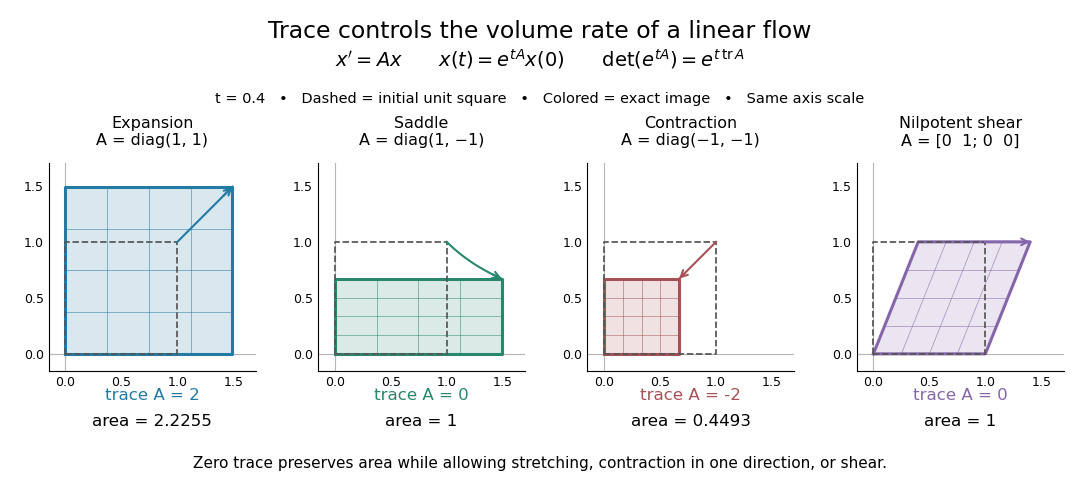
Four examples of a linear system of differential equations: trace controls area change while a saddle and a shear mapping preserve area
. Details. 
The first-order statement and the exact flow map should be distinguished. For , , whereas for all real . Zero trace eliminates the first-order change in the approximate step, and it preserves volume exactly in the matrix exponential flow. The examples use an abstract parameter and coordinate vectors; no physical units are assumed.
Left-right double cover of SO0(2,2) 2026-10-14
The action preserves the quadratic form on real two-by-two matrices. Its kernel consists of the simultaneous scalar pairs and . The differential is injective on the two traceless Lie algebras, and both source and target have dimension six. Its image is therefore open and, since the source is connected, equals the identity component of a Lie group . This gives a two-sheeted covering map onto the identity component, not onto the disconnected full special orthogonal group .
Induction hypothesis Created 2026-10-14 Updated 2026-10-31
There are unlisted articles, also show them or only show them.