
Metric epsilon-net 2026-10-14
An epsilon-net in a metric space is a set within distance of every point. A maximal -separated set is an epsilon-net: any uncovered point could be added. On the unit sphere of , disjoint Euclidean balls of radius around separated points lie in the ball of radius . Comparing Lebesgue measures gives a net of cardinality at most .
Maximum product metric 2026-10-14
The displayed metric on a product of two metric spaces satisfies its triangle inequality because for nonnegative coordinates. Its open balls are products of equal-radius balls, so it induces the product topology.
Ball (mathematics) 2026-10-14
In a metric space , an open ball of radius about is . A closed ball instead uses . The strict inequality matters: a point at distance exactly belongs to the closed ball and is excluded from the open ball. In particular, is excluded from all three open unit balls above, and included in all three closed unit balls.
The three closed unit balls centred at zero are , , and . Their shapes are a diamond (a rotated square), a disk with a circle as its boundary, and an axis-aligned square. A ball need not look round! The corresponding open balls are the interiors of these shapes. At , Manhattan distance from zero is and Euclidean distance is , whereas Chebyshev distance is : only the square's open unit ball contains this point.
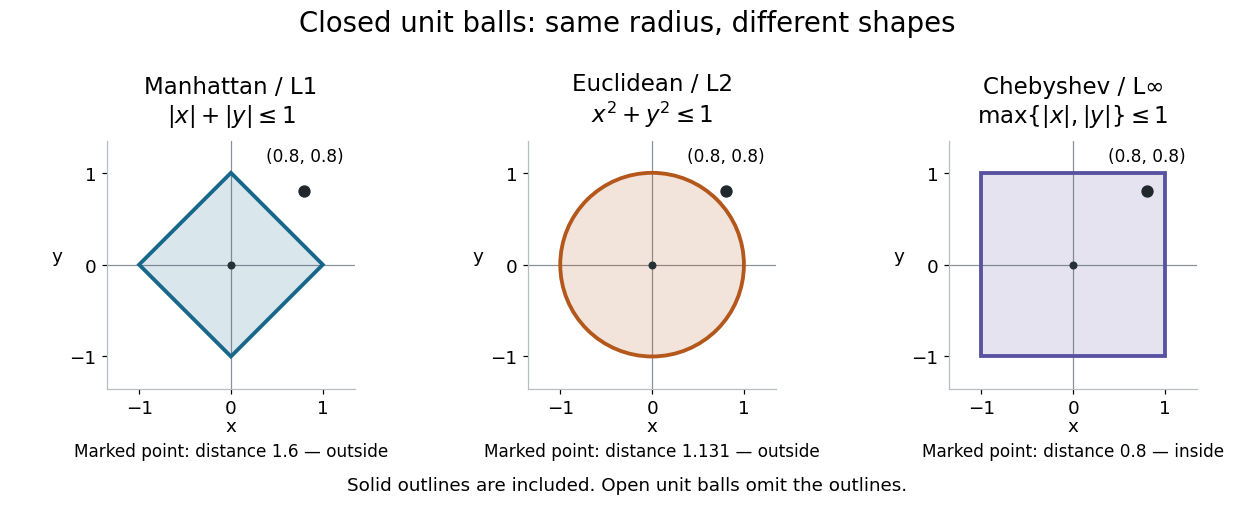
Three closed unit balls on the same coordinate scale
. Details. 
These shapes illustrate , with either the open ball or closed ball convention used consistently. Their outlines are included in the displayed closed balls. In an arbitrary metric space, however, points at distance exactly need not form the topological boundary; the discrete metric below shows why this distinction matters.
Distortion (mathematics) Created 2026-10-14 Updated 2026-10-25
Distortion measures how a mapping changes distances or geometric quantities relative to their original values. For an injective map between metric spaces, one multiplicative measure is the product of its Lipschitz constant and the Lipschitz constant of its inverse on the image. Subgroup distortion instead compares intrinsic and ambient word metrics through a growth function.
Rotating Mestel disk distribution function Created 2026-10-14 Updated 2026-11-05
In the midplane Mestel disk potential , take specific energy and . A prograde galactic distribution function for , with , has surface density proportional to . Matching gives andThe denominator is the product of the full radial Gaussian integral and the positive-azimuthal half-line moment. Here is a squared-velocity scale, not a velocity dispersion itself. Changing the potential's additive constant changes . With positive exponent , must instead be the negative of the specific total energy.
msync 2026-10-14
A mapping-range synchronization interface used by memory-mapped file synchronization. Its
MS_SYNC mode concerns completed updates to a backing file; it does not merge private file mapping changes into that file or coordinate competing readers and writers.// Target: computer-science.bigb
Carrier protein 2026-10-14
A membrane carrier protein binds a solute and changes its exposed binding site from one side of a cell membrane to the other. Depending on its mechanism and coupling, it can mediate passive transport or active transport.
GLUT4 Created 2026-10-14 Updated 2026-11-05
GLUT4 is an insulin-responsive glucose transporter expressed especially in skeletal muscle and adipose tissue. Insulin increases its abundance at the cell surface by regulating vesicle trafficking, thereby increasing transport capacity. GLUT4 facilitates transport down the glucose concentration difference; it does not directly pump glucose using ATP. Regulation by relocation illustrates how a cell can change transport rapidly without first synthesizing a new biological population of transporter proteins. [ref]
UniProtKB by the UniProt Consortium. P14672, Function, Catalytic activity and Subunit structure
Mellin inversion theorem 2026-10-14
Under standard decay and regularity hypotheses,If is smooth and compactly supported in , its Mellin transform is entire, decays faster than every power on vertical lines, and the formula holds for every real and every .
Imaginary-part regularization at a zero Mellin exponent Created 2026-10-14 Updated 2026-11-05
Let and . Near zero, the complex integral fails both absolute and ordinary convergence through its real part, which behaves as . Taking the imaginary part first givesThe regularized integrand is integrable at zero: setting changes its tail to a function comparable to . Exponential decay controls infinity, and prevents an interior singularity at .
A family with positive Mellin transform exponent can consequently have a finite imaginary-part boundary limit even when its full complex limit does not exist. Taking the limit of the full divergent expression and only then selecting its imaginary part is not justified. Endpoint-expansion coefficients can also change nonuniformly: a sine zero may cancel a gamma function pole and leave a nonzero constant term. This explains the regularization needed in the logarithmic expansion of Ramanujan's function.
Mellin transform in logarithmic coordinates 2026-10-14
The change of variables , using the exponential function, turns the Mellin transform intoThe factor changes to ; missing this factor would shift every exponent by one. With and the Fourier transform convention , the identity isChoosing inside the Mellin fundamental strip makes a Lebesgue integrable function. The minus sign in the Fourier transform argument follows from the stated convention. For the Mellin transform of an interval indicator with and , : the Fourier transform of an interval indicator is literally the same computation in a different coordinate.
Splitting the real line at also connects the Mellin transform to two unilateral Laplace transforms. If and for , thenwhere both integrals converge absolutely. Their Laplace convergence regions impose opposite endpoint conditions, explaining the two sides of the Mellin fundamental strip. Finally, shows that a change of scale is a translation in . Weighted Fourier transforms of this translation give exactly the factor in the scaling property of the Mellin transform. For a smooth function with compact support inside , the Mellin inversion theorem follows from Fourier inversion; the existing formula states the corresponding hypotheses.
Scaling property of the Mellin transform 2026-10-14
For , let . Whenever the Mellin transform of is absolutely convergent,The Mellin fundamental strip is unchanged: the corresponding integrals of absolute values differ by the finite positive factor . The change of variables gives , proving the rule. For , the transform's absolute value changes by , while the factor changes its phase. On the line , wherever absolute convergence holds, the transform's absolute value is preserved.
For the Mellin transform of an interval indicator, replacing by givesAt the removable singularity , both sides have value . Scaling leaves the width measured by the natural logarithm unchanged. Likewise, the exponential function has Mellin transform on .
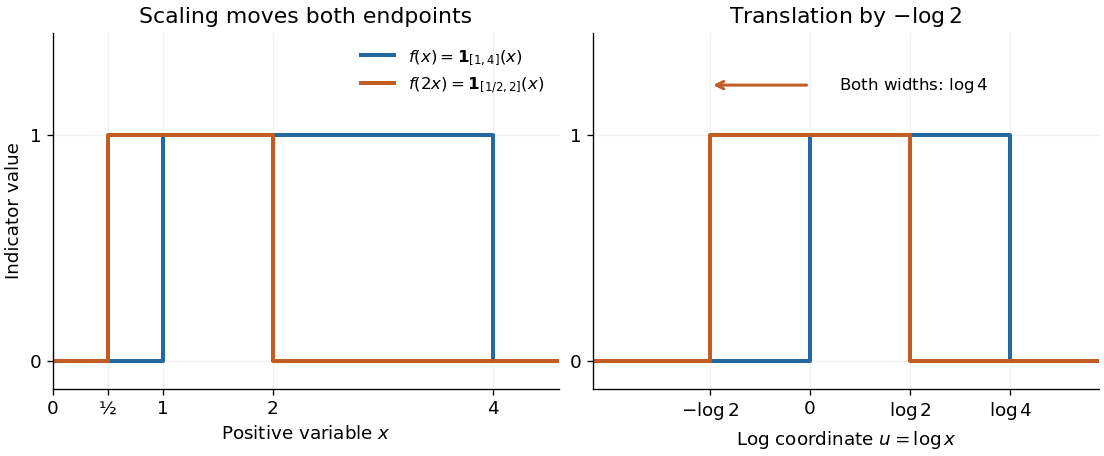
Scaling a positive variable translates its logarithmic coordinate
. Left: moves the support interval to . Right: turns the same change into a translation to the left by ; the interval width remains . The scaling property of the Mellin transform multiplies the transform by . Details.
Fundamental strip of a Mellin transform 2026-10-14
The fundamental strip of a Mellin transform is the interior of the set of real parts for whichViewed in the complex plane, it is a vertical strip ; either bound may be infinite, and the interior may be empty. Both endpoints of the improper integral must be checked. Convergence on a boundary line, whether absolute convergence or conditional convergence, requires a separate test. The Mellin transform is holomorphic throughout a nonempty fundamental strip.[ref]
NIST Digital Library of Mathematical Functions. Chapter 2, §2.5(i), equation 2.5.1 and the following description of the vertical domain of analyticity
A practical sufficient test uses Big O notation: if near zero and near infinity, with real , then comparison with elementary improper integrals givesThus guarantees absolute convergence. These upper bounds on need not locate the maximal Mellin fundamental strip; faster actual decay can widen it. The strip property itself follows by bounding the weight at any intermediate by the sum of two weights already known to be integrable. On a closed narrower strip, neighboring integrable weights also dominate the natural logarithm factors introduced by differentiation under the integral sign, making the transform a holomorphic function.
An exact two-endpoint example isHere both bounds are sharp: at the zero-end absolute convergence test contains , and at the infinity-end test contains . The displayed rational function continues meromorphically outside the Mellin fundamental strip and has simple poles at and . Its other finite continued values outside the strip are values of a meromorphic continuation, not of a convergent defining integral. More general endpoint information leads to meromorphic continuation of a Mellin transform from an asymptotic expansion.
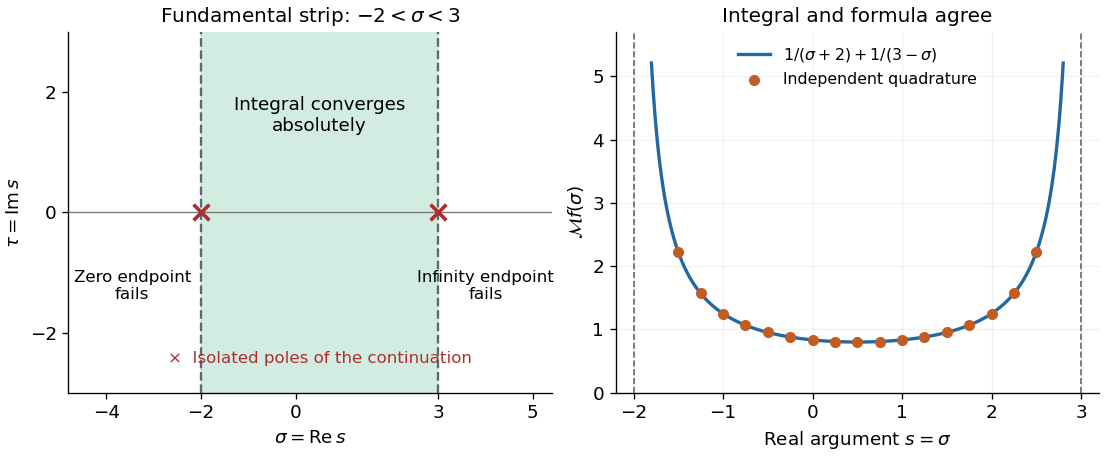
Two endpoint conditions define the Mellin fundamental strip
. Left: the Mellin fundamental strip for below one and above one is . Crosses mark the two poles of the continued rational function, not whole lines of isolated singularities. Right: the formula and independently computed integrals agree on the real slice inside the strip. The curve is drawn only where the defining integral converges. Details.
Mellin transform of an interval indicator Created 2026-10-14 Updated 2026-10-20
For , the indicator function has Mellin transformThe interval stays away from both zero and infinity, so the integral is absolutely convergent for every complex number . Its Mellin fundamental strip is the whole complex plane. Evaluating the antiderivative proves the formula for ; at , integrating gives the real natural logarithm . The apparent division by zero is a removable singularity, since by the Taylor series of the exponential function. The transform is an entire function.
For example, gives with value at zero. On , the Mellin transform sums oscillations over the width of the interval in natural logarithm coordinates; this is the same cancellation mechanism as in the Fourier transform of an interval indicator.
Posted price Created 2026-10-14 Updated 2026-11-05
A posted price is a fixed price announced by a seller, who sells if an eligible buyer accepts. Suppose two buyers have independent values with common cumulative distribution function , and a buyer accepts exactly when its value is at least the price . The no-sale probability is , where , so expected seller revenue isFor a continuous value distribution this becomes . With an atom at , using instead would exclude buyers who are indifferent and agree to buy. A convention that indifferent buyers decline has that strict-acceptance formula instead. Selecting among several accepting buyers does not affect revenue when each pays the same posted price.
Expected seller revenue Created 2026-10-14 Updated 2026-10-25
The expectation of the seller's total receipts over the buyers' valuation types and any randomization in the sales mechanism. In an auction it is the sum of the bidders' expected payments; with a posted price it is price times sale probability. It does not subtract selling costs or the seller's opportunity cost of retaining the item, so it is revenue rather than profit.
Conservation of mechanical energy 2026-10-14
For constant masses, a time-independent potential energy and forces with zero total extra power , Newton's second law gives . Thus mechanical energy is conserved. Smooth stationary constraint reactions and a purely magnetic Lorentz force supply zero power. This is more restrictive than conservation of energy in general, which may include thermal or other internal forms.
Qubit stabilization by measurement feedback 2026-10-14
An observed dissipative channel combined with direct feedback can create a modified Lindblad operator and a compensating Quantum Hamiltonian. Choosing those parameters can make a prescribed pure state stationary and globally attractive. At exceptional parameter values, the dissipator can instead leave an entire family of states stationary, so algebraic target stationarity does not establish stabilization. Checking the Affine Bloch equation and its transverse eigenvalues distinguishes these possibilities.
Three-vertex graph-state wire 2026-10-14
A path graph state on three qubits simulates two successive gates . Measure vertex one in the equatorial qubit measurement basis , then vertex two at angle , obtaining bits . Two one-bit teleportations and leave vertex three in , up to global phase. A computational output bit is corrected to ; the factor affects only phase. Adaptive sign choice is required for general angles, although the final bit correction is purely classical.
Lp space Created 2026-10-14 Updated 2026-11-05
For a measure space and , consists of equivalence classes of measurable functions satisfyingTwo representatives are identified when they agree almost everywhere. For , use the essential supremum norm, not an infinite power inside the integral. The quotient is essential: a function supported on a null set has zero integral norm even if it is not identically zero.[ref]
These are Banach spaces; L2 space also has the integral inner product making it a Hilbert space. On with Lebesgue measure, , , belongs to exactly when . This shows why membership depends on the exponent: a function can be integrable while its square is not. For , the same power expression defines a quasi-norm rather than a norm, as explained under Lq quasi-norm.
There are unlisted articles, also show them or only show them.