
For the conserved-mean convection amplitude equations before amplitude reduction, the functional generates a gradient flow with increasing . Periodic integration by parts identifies its variational gradient with the evolution equation. Completing the square gives . Hence along a globally smooth solution. Under compactness of the orbit, its limiting states are stationary; a nonstationary periodic orbit is impossible.
Every smooth real-valued function on a closed connected smooth manifold has at least its unnormalized Lusternik–Schnirelmann category many distinct critical points. No nondegeneracy hypothesis is required. If there are infinitely many critical points the bound is immediate; in the finite case, the sublevel-set deformation argument shows that category can increase only at critical levels, by at most the number of critical points on that level. In conjunction with cup length, this gives at least critical points whenever there is a nonzero -fold positive-degree cup product. This theorem is distinct from the antipodal covering theorem also sometimes named the Lusternik–Schnirelmann theorem. A primary account of the critical-point formulation is Conley pairs in geometry—Lusternik–Schnirelmann theory and more.
Candela 2026-10-14
At exactly , radiant intensity corresponds to luminous intensity . This convention specifies a direction, rather than the source's total luminous flux. [ref]
Lumen (unit) 2026-10-14
The lumen is the International System of Units unit of luminous flux: . A source with constant luminous intensity within a cone of solid angle supplies into that cone. A source with the same luminous intensity in every direction supplies over a full sphere. [ref]
Comoving spectral emissivity 2026-10-14
Comoving spectral emissivity is emitted spectral luminosity per comoving volume, measured using source-rest-frame time and frequency. For identical sources with comoving number density , it is . For a population with a luminosity function, integrate its rest-frame spectral luminosity over that distribution. Multiplying a proper-volume emissivity by gives this comoving convention for dimensionless scale factor .
Rotating roller under a nearly flat free surface Created 2026-10-14 Updated 2026-11-05
A rotating roller with top speed and gap drives a shear-free lubrication approximation flow. No slip below and zero shear above give and . The pressure recovery condition in lubrication flow then gives . With , the excess pressure is . Gravity supports it through the small surface displacement ; the flat leading geometry is consistent when .
Lubrication model of a crawling snail Created 2026-10-14 Updated 2026-11-05
For a periodic thin mucus gap translating as a backward wave relative to a force-free foot, put . In the wave frame, the plane and foot have horizontal velocities and . A Couette-Poiseuille flow with periodic pressure has flux . Zero net plane force gives the displayed crawling speed. The leading viscous dissipation per wavelength is .
Cusp flow between touching cylinders Created 2026-10-14 Updated 2026-11-05
Cylinder translating parallel to a wall in a thin gap Created 2026-10-14 Updated 2026-11-05
For a nonrotating cylinder of radius translating parallel to a stationary wall at minimum gap , the leading gap is . In the cylinder frame, the constant flux is and the pressure gradient is . The pressure is . Integrating the wall shear gives the displayed leading force per unit axial length. Full wetting and negligible inertia are assumed; cavitation would change the pressure boundary conditions.
Capillary instability of a thin film on a rigid cylinder Created 2026-10-14 Updated 2026-11-05
A thin axisymmetric coating of physical thickness on a rigid cylinder of radius has leading curvature . With constant surface tension , negligible Newtonian gravity, no-slip boundary condition at the wall and negligible exterior stress, lubrication theory gives . Set and to obtain the displayed thin-film equation. A perturbation of a uniform film proportional to hasThus the fastest Rayleigh–Plateau instability has , or physical wavelength .
Gravity-driven spreading of a planar viscous drop Created 2026-10-14 Updated 2026-11-05
A wide, shallow drop with cross-sectional area has the gravity-driven volume flux when substrate no-slip and zero surface shear are imposed. Mass conservation yields a porous medium equation, . Its symmetric source-type similarity solution has half-width in the display and height , where . Integrating the profile recovers . The contact-edge slope diverges, so the bulk lubrication approximation requires an inner edge regularization if contact-line microphysics or surface tension is retained.
Normal-stress smallness in lubrication Created 2026-10-14 Updated 2026-11-05
For gap and speed , shear stress scales as and viscoelastic normal stresses as . Their force contributions scale respectively as and . Thus the displayed criterion permits neglecting the normal-stress corrections in the leading lubrication approximation. It is weaker than requiring the normal stresses themselves to be smaller than the shear stress. Rapid time dependence can impose an additional material-time criterion.
Force-free pressure drop of an annular lubrication plug Created 2026-10-14 Updated 2026-11-05
The pressure force on a plug-and-film control volume is . Its opposing wall traction is , where . Equating them for a freely moving body proves the displayed formula. Writing , and converts it into , with and .
Asymptotic scalar field 2026-10-14
An asymptotic scalar field is a free field describing stable incoming or outgoing particles of an interacting scalar field theory. With a field that overlaps the stable one-particle state, the scattering asymptotic condition is in the remote past and in the remote future. These are scattering limits of suitably smeared matrix elements, not unrestricted strong pointwise limits of local fields. With covariant state normalization , the free-field vacuum-to-one-particle matrix element is one. Translation invariance and the asymptotic condition then give after choosing its phase positive. The wave-function renormalization residue measures that overlap.
L-infinity norm 2026-10-14
On a measure space of positive total measure, the L-infinity norm of an essentially bounded measurable function is . The absolute value matters: a constant function has L-infinity norm three, even though its essential supremum is . The norm belongs to the equivalence class in Lp space; different representatives equal almost everywhere give the same answer. [ref]
Lp spaces (Chapter 7 of Measure Theory). Hunter, Measure Theory, Definition 7.4: the L-infinity norm
.For the function in essential infimum and essential supremum, under Lebesgue measure, whereas its supremum norm is four. Replacing the exceptional values by the ordinary values leaves every finite Lp norm unchanged as well: . This tends to one as . That agreement explains why the endpoint with exponent uses an essential bound rather than a pointwise bound.
A finite probability space makes the distinction between zero and small measure explicit. Let , , and . Assign weights , , , where . For ,When , the singleton is a null set and . For every , however small, . For example, gives and , yet the large- Lp norms approach ten. The ordinary pointwise supremum norm is ten in both cases.
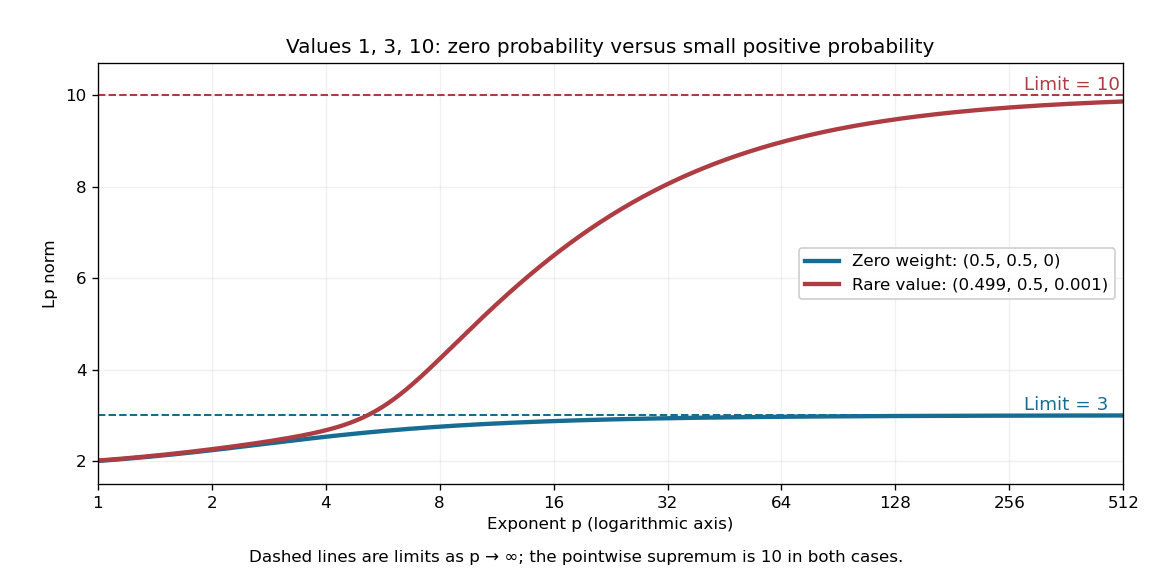
A zero-weight value disappears from every Lp norm, while a rare positive-weight value determines the limiting L-infinity norm
. The original three-point example has values . The curves use weights and , respectively. Dashed levels show the limiting norms three and ten; the plotted finite exponents do not themselves reach those limits. Details.
Why can a rare value dominate? For a bounded function on a probability space, an almost everywhere bound gives . If , the set has positive probability, so . As , the factor tends to one. These two bounds squeeze the limit to . The probability measure assumption keeps total measure finite; this explanation does not assert the same finite- integrability on arbitrary infinite-measure spaces.
Sorgenfrey plane 2026-10-14
The Sorgenfrey plane is the product topology on two copies of the Sorgenfrey line. It is separable because meets every nonempty basic rectangle . Its antidiagonal is an uncountable discrete subspace: meets it only at . In a discrete space every dense subset is the whole space, so this subspace is not separable. Thus separability need not pass to subspaces of nonmetrizable spaces.
// Target: analysis.bigb
Eckart-Young-Mirsky theorem Created 2026-10-14 Updated 2026-10-25
For a finite matrix with singular values in nonincreasing order, truncating its singular value decomposition after terms minimizes the Frobenius norm error, whose square is the sum of the discarded squared singular values. It also minimizes the operator norm error, which equals the next singular value, or zero if none remain. See Mazeika, Section 4.3: Low rank approximation.
The problem of replacing a matrix by one of lower matrix rank is explicit in Eckart and Young's 1936 paper, [ref]
https://www.cambridge.org/core/journals/psychometrika/article/approximation-of-one-matrix-by-another-of-lower-rank/B29672E1EDD0FA1B7611D4DFAFC321B3. The approximation of one matrix by another of lower rank, Psychometrika 1, 211-218
. The publication predates the modern image compression example, showing how a general matrix question can support later applications. Spacetime metric 2026-10-14
A spacetime metric is the Lorentzian metric on a spacetime. It determines proper time along timelike paths and the null directions that describe local light propagation.
Time-orientation-preserving Lorentz group in one spatial dimension Created 2026-10-14 Updated 2026-10-18
For , the matrices satisfying and form the time-orientation-preserving Lorentz group in one spatial dimension. They are exactly , where , and . Preservation of the Minkowski metric makes the first column a future-pointing unit timelike vector; Minkowski inner product orthogonality determines the second up to sign. The identity gives the multiplication law and inverse .
For a processed prefix , the minimum-tail table for increasing subsequences storesThere is no slot for an unattainable length. The table records minimum endings, rather than the terms of one longest increasing subsequence. Replacing the value comparisons by gives the corresponding table for strictly increasing subsequences, whose entries are strictly increasing.
There are unlisted articles, also show them or only show them.