
Mean-field electrodynamics Created 2026-10-14 Updated 2026-11-05
Mean-field electrodynamics applies averaging and a response closure to magnetic induction in a fluctuating conducting fluid. The mean equation contains the correlated mean-field electromotive force in the title. Scale separation permits a local expansion into alpha transport, turbulent diffusion and higher gradients; general anisotropic or finite-memory statistics require tensorial and nonlocal responses. A mean-field dynamo is a self-exciting application of this framework, not a consequence of averaging alone.
Magnetostrophic balance Created 2026-10-14 Updated 2026-11-05
The leading force balance in a rapidly rotating conducting fluid when inertial and viscous forces are small, while Coriolis force, pressure, buoyancy and Lorentz force density remain significant. The Rossby number and Ekman number measure the omitted inertia and bulk viscosity. Rotation does not balance an arbitrary magnetic torque: impenetrable axisymmetric boundaries impose the Taylor constraint. Magnetic diffusion can remain in the induction equation even when viscosity is neglected in momentum balance.
Magnetic flux concentration Created 2026-10-14 Updated 2026-11-05
Magnetic flux concentration redistributes existing magnetic flux into a smaller area. For a locally straight flux bundle with conserved flux, is constant, so decreasing area increases field strength. Converging convection, field-line stretching and flux expulsion can produce concentrations; finite magnetic diffusivity opposes them and Lorentz force feedback limits the kinematic approximation. Redistribution alone is not evidence of net dynamo action.
Alfvénic turbulence 2026-10-14
Alfvénic turbulence is the turbulent interaction of fluctuations polarized primarily as Alfvén waves. In Elsässer variables , each wave population is nonlinearly distorted by the oppositely propagating population. Equal populations give a balanced cascade; unequal populations give an imbalanced cascade. The absence of one population removes the leading nonlinear interaction in ideal reduced magnetohydrodynamics.
Critical balance 2026-10-14
Critical balance is a scale-dependent ordering in which the wave-propagation time and nonlinear interaction time are comparable. For strong Alfvénic turbulence, . For electron magnetohydrodynamics, the linear rate is and the nonlinear rate is , so critical balance instead gives . This assumption is an estimate of decorrelation dynamics, not an exact equality at every point.
Electron-magnetohydrodynamic cascade 2026-10-14
An electron-magnetohydrodynamic cascade transfers magnetic fluctuations through the nonlinear electron magnetohydrodynamics induction equation. Writing , its perpendicular nonlinear interaction time is . The anisotropic whistler wave time is . Scaling predictions depend on locality, phase decorrelation and the assumed balance of these times.
Dimensional freedom of an MHD spectrum 2026-10-14
In a local isotropic hydrodynamic inertial-range model with only and , dimensional analysis fixes the Kolmogorov 1941 theory spectrum. A mean magnetic field supplies the independent Alfvén speed, permitting the arbitrary dimensionless function in the displayed formula even before anisotropy adds parallel scales. Cascade-time assumptions such as weak decorrelated interactions or critical balance are therefore necessary to select an MHD spectrum.
Remanent magnetization Created 2026-10-14 Updated 2026-11-05
Remanent magnetization is magnetization retained after the applied magnetic field has been removed. Magnetic minerals cooling in an ambient field can preserve information about that field in a planetary crust. Such a record may outlive the planetary dynamo which originally produced it. Crustal remanence therefore differs from a present field maintained by conducting-fluid motion.
Curie temperature Created 2026-10-14 Updated 2026-11-05
The Curie temperature is the transition temperature above which a ferromagnetic material loses spontaneous magnetization. A hot conducting planetary core can generate a magnetic field through dynamo action without behaving as a permanent magnet. The blocking temperature at which a mineral records crustal remanence also depends on its relaxation timescale and need not equal its Curie temperature.
Paramagnetism Created 2026-10-14 Updated 2026-11-05
In a linear isotropic regime, a paramagnetic material has positive magnetic susceptibility: its induced magnetization is aligned with the applied magnetic field intensity. Molecular oxygen supplies an example discussed through molecular orbital theory in the covalent bond article.
Material transport of magnetic helicity density Created 2026-10-14 Updated 2026-11-05
For smooth ideal magnetohydrodynamics, write and . The continuity equation and induction equation give . The vector-potential equation becomes . Contracting these two equations cancels their velocity-gradient terms and provesConsequently the magnetic helicity in a material volume satisfies . It is conserved when the magnetic field is tangent to the boundary. A single-valued gauge transformation changes by , which also vanishes under that condition.
An open flux tube carries magnetic flux through its end caps. Its ordinary magnetic helicity can therefore change under a single-valued gauge transformation. For inside and zero outside, a regular family of magnetic vector potentials is , inside and , outside. Their tangential components agree at . Inside, , so the helicity per unit length is . Changing is the gauge transformation , and changes this result whenever . The convention outside gives and helicity per unit length , while gives zero. Without an end-cap or gauge convention the ordinary helicity is not unique.
Current helicity Created 2026-10-14 Updated 2026-11-05
Current helicity correlates a magnetic field with its curl, which is proportional to electric current density. It differs from magnetic helicity, which uses a magnetic vector potential. For a solenoidal monochromatic field of wavenumber in a periodic domain, choose . Then and .
Magnetic-energy lower bound from helicity Created 2026-10-14 Updated 2026-10-25
In a bounded regular domain, fix the global extension or circulation convention for the magnetic vector potential. A bounded inverse of curl on tangent solenoidal vector fields gives . The Cauchy-Schwarz inequality then gives . One construction extends the tangent field by zero outside the domain and uses the whole-space Biot-Savart law; its kernel of size is integrable over a bounded region, giving the required bound. Nonzero conserved magnetic helicity therefore prevents complete decay of magnetic energy.
Weber (unit) 2026-10-14
The weber is the SI unit of magnetic flux, with . A uniform magnetic field of crossing a flat surface of area along its chosen unit normal gives . [ref].
Localized steady-current moment identities Created 2026-10-14 Updated 2026-11-05
A localized steady electric current density satisfies . Integrate the divergences of and over a region enclosing its support; all boundary fluxes vanish. The first identity removes the monopole term from the magnetic vector potential expansion. The antisymmetric first moment is equivalent to the magnetic dipole moment .
Far-field approximation for a current loop 2026-10-14
Far outside a localized steady source of size , at distance , its multipole expansion starts with the magnetic dipole moment if that moment is nonzero. In vacuum, using SI units,where is the vacuum permeability, , and the magnetic field is the curl of the magnetic vector potential. The magnetic dipole field falls as , and the magnetic vector potential as . The localized steady-current moment identities remove the putative term in the magnetic vector potential. No magnetic monopole is needed. If different current loops cancel the total magnetic dipole moment, a higher term of the multipole expansion supplies the leading distant magnetic field. [ref].
The approximation is not valid at the center of a finite current loop. For a circular current loop of radius and electric current , the exact on-axis magnetic field of a circular current loop and the distant approximation areTheir ratio is : at , the approximate magnetic field exceeds the exact magnetic field by about relative to the exact value. Near the source, retain its geometry rather than replacing it with a point source specified only by its magnetic dipole moment.
Magnetic dipole torque 2026-10-14
An externally imposed magnetic field that is nearly uniform over a rigid current loop produces the torqueThe angle is measured between the magnetic dipole moment and the external magnetic field, not between the plane of the current loop and the magnetic field. The magnetic dipole potential energy uses a dot product, whereas the torque uses a cross product. The torque is largest when the magnetic dipole moment is perpendicular to the magnetic field; parallel alignment minimizes the potential energy.[ref]
11.5 Force and Torque on a Current Loop. §11.5, equations 11.22–11.23: vector torque and orientation energy
For the sign convention and , positive rotation increases andThus at the torque turns the magnetic dipole moment toward the external magnetic field. Both parallel and antiparallel alignment have zero torque, but they are respectively a stable equilibrium and an unstable equilibrium. With no damping, a freely released current loop can undergo oscillation around the stable equilibrium; settling requires damping.
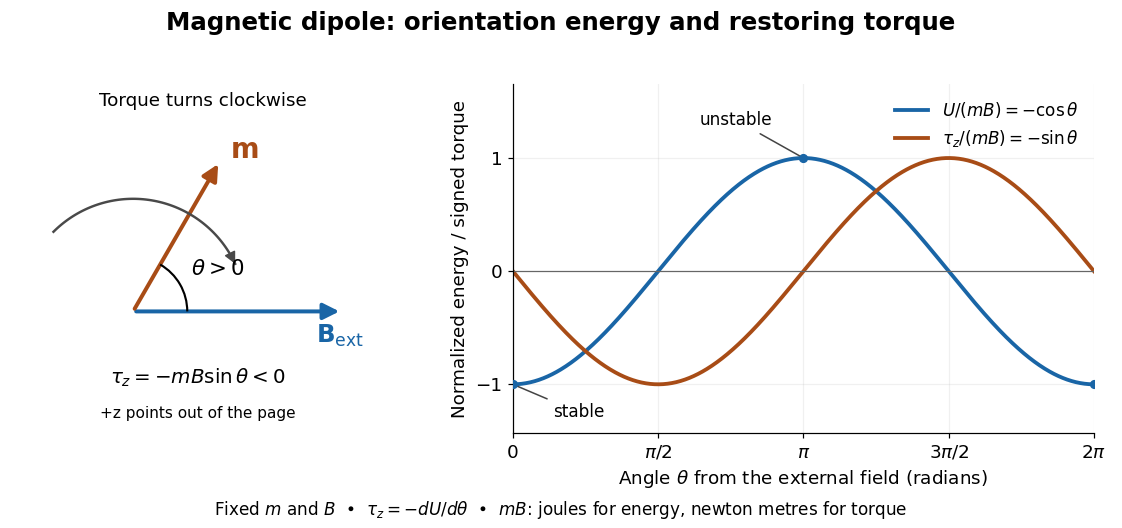

In the twelve-turn example, take and . The predicted torque is and the magnetic dipole potential energy is . The unit check is ; torque and energy have the same physical dimensions but different physical meanings.
A short derivation starts with the magnetic force on a current-carrying wire, . In an exactly uniform magnetic field, the net force is , but its torque need not vanish: opposite sides produce a turning couple. Integrating gives . Integrating at fixed and gives the orientation potential energy. This is the mechanical orientation potential energy for a maintained electric current, with the external source held fixed; the energy accounting for field and power supply is a separate problem. A varying external magnetic field requires corrections across a finite current loop, and can also give a net force.
Current loop Created 2026-10-14 Updated 2026-10-18
A current loop is a closed path carrying electric current. For a thin wire following a closed curve , the volume integral defining its magnetic dipole moment becomes a line integral:The vector area is for a planar current loop. For a nonplanar current loop, use the vector area, rather than the scalar area of an arbitrarily chosen spanning surface. Reversing the electric current reverses without changing the geometry. [ref].
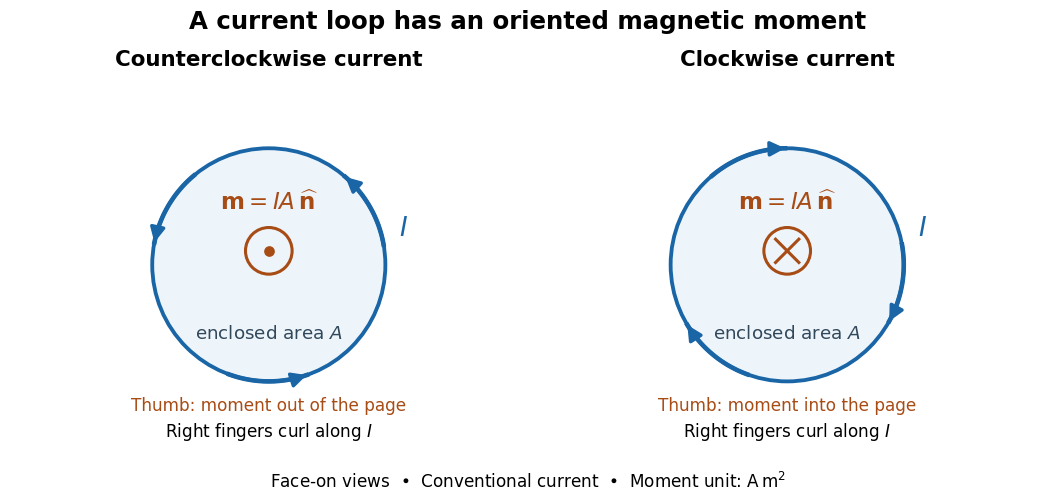

For closely spaced identical turns carrying the same electric current, the magnetic dipole moments add: . Each turn contributes its own vector area; unequal areas or differently oriented turns require a vector sum. As a calculated example, twelve circular turns of radius carrying give . This is an idealized example, not an experimental measurement.
There are unlisted articles, also show them or only show them.