
Nonconstant function 2026-10-14
A function is nonconstant when two inputs in its domain of a function have different outputs. For example, on the real line is nonconstant, whereas the same rule restricted to is a constant function.
Projection (mathematics) Created 2026-10-14 Updated 2026-11-05
A projection is an idempotent self-map : applying it twice has the same effect as applying it once, . Equivalently, it fixes every point of its image of a function. The map on the real plane is an example.
A coordinate projection map has different source and target, so it is not literally an idempotent self-map. After choosing and identifying with , its lifted form is a projection. A linear projection additionally respects vector addition and scalar multiplication.
Support Created 2026-10-14 Updated 2026-11-05
For a scalar-valued function on a topological space , its support isThe closure matters. On the real line, is nonzero exactly on , but its support is the closed interval . A point where vanishes can still belong to the support if nonzero values occur arbitrarily near it.
For the discrete topology, every subset is closed, so the support is simply the set of inputs with nonzero values. This is the convention used when representing a finitely supported count function. A function has compact support when the displayed closed set is compact.
Restriction (mathematics) 2026-10-14
For a function and a subset , its restriction keeps the same values but allows only inputs in . Restricting the domain of a function can remove collisions and permit an inverse function, as the nonnegative quadratic function example shows. This changes the allowed inputs; it is different from keeping the inputs and changing the codomain.
Commuting functions Created 2026-10-14 Updated 2026-11-05
Two self-maps are commuting functions when their function compositions satisfy . Order then makes no difference: the self-maps and on the real line both give when applied successively. By contrast, and give and , so they do not commute.
Mathematical induction gives for all nonnegative integers , where powers mean repeated function composition. Sharing a fixed point or an invariant set is insufficient to imply commutation. For rational maps of the Riemann sphere with degree of a rational map of the Riemann sphere at least two, commutation does imply equality of their Fatou sets and Julia sets, by the commuting rational maps of degree at least two have the same Julia set theorem.
Nonnegative function Created 2026-10-14 Updated 2026-11-05
A real-valued function is nonnegative when for every input . For example, and are nonnegative functions on the real line.
Products and nonnegative linear combinations preserve the property: if and , then and at every point. A partition of unity uses nonnegative functions whose values sum to one, so its weighted combinations lie in the convex hull of the values being combined.
Germ (mathematics) 2026-10-14
A germ at a point is an equivalence class of functions defined on a neighbourhood of the point: two representatives are equivalent if they agree on some smaller neighbourhood. A germ of a holomorphic function requires its representatives to be holomorphic functions; smooth and continuous germs use their corresponding classes of functions. The germ retains local behavior while forgetting the representative's values farther from the point.
Self-map 2026-10-14
A self-map is a function whose domain of a function and codomain are the same set. It need not be a bijection: a constant function on a two-element set is a self-map that merges its inputs. Self-maps can always be composed with one another, and all self-maps of a specified set form its full transformation monoid.
Codomain Created 2026-10-14 Updated 2026-10-14
The codomain of a function is its specified target set. The image of a function is a subset of the codomain, and equals it precisely for a surjective function. Changing a codomain can change whether the same input-output rule is surjective, as the quadratic function examples under function show.
Riemann's differential equation 2026-10-14
Riemann's differential equation is a second-order ordinary differential equation with three regular singular points, normalized to zero, one and infinity by a Möbius transformation. Its local characteristic exponents are encoded by the Papperitz symbol and constrained by the Fuchs relation.
Mesa solution 2026-10-14
A mesa is a localized broad plateau joined to its surrounding state by two separated fronts. Its leading spatial average equals the plateau fraction times the plateau value; the transition layers give corrections proportional to their width divided by the domain length. A conserved mean can determine the fraction occupied by the plateau, as in the coexistence fraction of a conserved-field amplitude mesa.
A stationary front solution of connecting equilibria and requires . Multiply the stationary equation by and integrate: the derivative term has zero endpoint contribution. This equal-potential condition is the Maxwell balance. For , a front from zero to a nonzero constant requires and .
Negative-vacuum Friedmann lifetime bound 2026-10-14
For a FRW metric with positive scale factor, nonnegative dust and radiation, and negative vacuum density, the Friedmann acceleration equation gives , with . At maximum expansion, and . The forced-oscillator integral formula gives until the first zero, since its forcing is nonpositive and its sine kernel is nonnegative for . Thus each half of the expansion-recollapse history lasts at most . Nonzero dust or radiation makes the endpoint a physical density singularity; the matter-free limit instead bounds the open anti-de Sitter coordinate patch.
Frictional heating 2026-10-14
In the ideal kinetic friction model, the loss of combined mechanical energy of the two contacting bodies becomes thermal internal energy at rateThis follows by adding the contact powers and from Newton's third law. It depends on contact slip, whereas the contact power received by either body separately depends on its velocity in the chosen inertial frame. Thus positive frictional heating is compatible with increasing kinetic energy of one body, as the moving-belt example in kinetic friction shows. Heating need not cause a temperature rise if thermal energy escapes by heat transfer.
Contact slip 2026-10-14
Contact slip is the tangential relative velocity between the two material points instantaneously in contact. For a nonrotating box on a belt it is ; for a rigid body, use the velocity of its contact point, including the contribution from angular velocity. Zero contact slip defines rolling without slipping at a rolling contact, even when the center of mass moves.
Kinetic friction Created 2026-10-14 Updated 2026-10-20
Kinetic friction is friction during nonzero contact slip. For one-dimensional motion along a surface, choose right as positive and write for the body's contact-point velocity and for the surface's contact-point velocity, both measured in the same inertial frame. The signed relative velocity is . The ideal Coulomb law for the tangential force on the body isHere is the magnitude of the normal force, is the coefficient of kinetic friction, and is the sign function. Thus kinetic friction opposes contact slip, which can differ from the body's direction of motion. In several tangential directions the same law reads for a nonzero tangential relative velocity . The magnitude law is documented in Ling, Sanny and Moebs, OpenStax University Physics 1, §6.2: static and kinetic friction.
For a stipulated toy model, take a nonrotating box with mass , normal force , coefficient of static friction , and coefficient of kinetic friction . These are assumed model parameters, rather than measured properties of any particular pair of materials; the prescribed normal force is consistent with horizontal support under and no other vertical forces. On stationary ground, a box already sliding right has . With an applied horizontal force to the right, Newton's second law gives , for as long as rightward contact slip persists.
Direction is clearer by comparing two instantaneous states of this same model. If the box has on stationary ground, and , so kinetic friction acts left with magnitude . If the box still has but a belt beneath it has , then : kinetic friction acts right with magnitude , even while the box moves right.
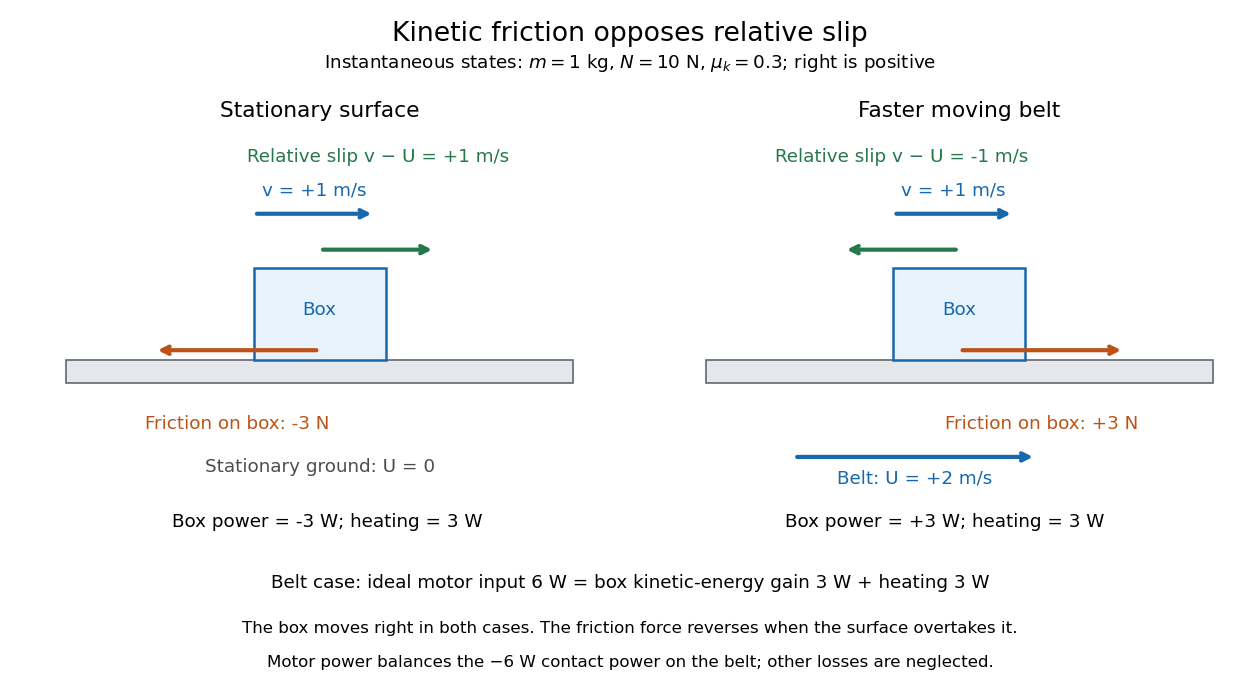
The same rightward box velocity gives opposite friction directions on stationary ground and a faster moving belt
. Details. 
In the belt case, the power delivered to the box is . With no other horizontal force, its kinetic energy therefore increases by the work-energy theorem. By Newton's third law, the box exerts on the belt, so the contact power delivered to the belt is . Their sum is : frictional heating produces thermal internal energy at . An ideal motor maintaining the prescribed belt velocity supplies against this contact load, neglecting other losses, so its input divides into of box kinetic energy and of frictional heating. These are instantaneous rates, since the box's velocity subsequently changes. This balance follows directly from power as force times velocity and conservation of energy; the power law is given in Ling, Sanny and Moebs, OpenStax University Physics 1, §7.4: power.
When contact slip vanishes, including a transition to rolling without slipping, the nonzero-slip law no longer applies. Determine the required static friction from the no-slip condition and the equations of motion, then test its bound. Substituting into the sliding law would incorrectly exclude a nonzero static friction.
Finite Fresnel integrals Created 2026-10-14 Updated 2026-10-18
In the unscaled convention, the finite Fresnel integrals are and . Their Taylor series follow by termwise integration. At infinity both tend to , and their oscillatory tails have asymptotic expansions obtained by integration by parts. This convention differs from the convention with phase .
Lebedev ice-growth law 2026-10-14
Freeness detected by a quotient 2026-10-14
Suppose a group homomorphism is injective on a subgroup freely generated by . If have , then the freely generate their subgroup: a relation among them projects to a relation among the free basis images, so the corresponding abstract reduced word must be empty. In particular, this applies to when the normal closure of intersects trivially.
If freely generate, then for any distinct integer indices freely generate their subgroup. Group a reduced word in these new generators into blocks with nonzero exponents and different successive indices. Expansion produces alternating nonzero powers of and interior powers , so it cannot freely reduce to the empty word. Consequently every finite-rank free group embeds in a rank-two free group; free rank is not monotone under subgroup inclusion.
There are unlisted articles, also show them or only show them.