
Affine rescaling of a null normal Created 2026-10-06 Updated 2026-10-14
If a null vector tangent satisfies , then is affine when . Choose on the initial transverse surface. The screen-space projector kills derivative terms proportional to , so the initial optical tensor and its null expansion agree with those of . In ingoing spherical coordinates, has .
Null convergence condition Created 2026-10-06 Updated 2026-10-07
The null convergence condition requires for every null vector. Through the Einstein field equations, it follows from the null energy condition, since all terms proportional to the metric tensor vanish on a null vector.
Sphere in a normed vector space 2026-10-06
In a normed vector space, this set consists of all points at a fixed positive norm distance from . It also makes sense in an infinite-dimensional Hilbert space, unlike a specifically Euclidean sphere. In a real Hilbert space, the sphere in a normed vector space has tangent variations satisfying ; this follows by differentiating the fixed squared norm. This is the geometric constraint used in fixed-energy initial-condition optimality.
Point-evaluation kernel is not closed in the integral norm Created 2026-10-06 Updated 2026-10-14
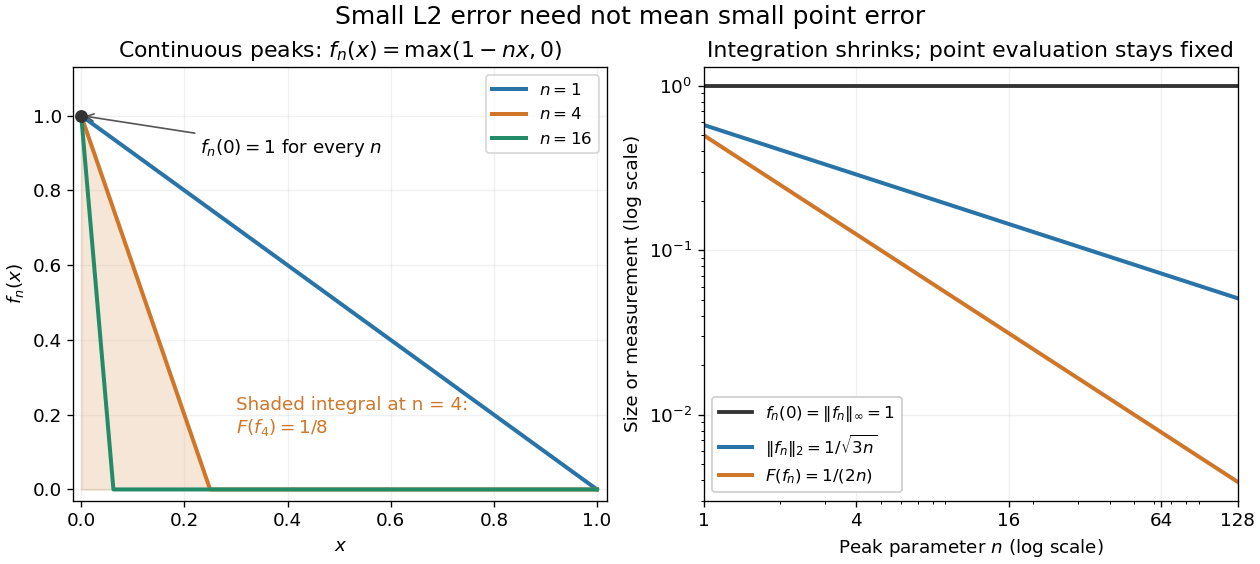
On continuous functions on a compact interval, evaluation at an interior point is not continuous in the integral norm. Narrow triangular peaks have fixed point value and integral tending to zero. Subtracting such a peak from the constant function one gives functions vanishing at the point and converging in the integral norm to one. Thus the evaluation kernel is not closed, although it is closed in the uniform norm.
Here is a fully computed endpoint version, now using the L2 norm on the actual continuous functions . For each integer , set . Its point evaluation at zero is , whileConsequently in the L2 norm but : point evaluation is discontinuous on this normed space. Quantitatively is unbounded. At , the L2 norm is approximately , the integral is , and the point value is still . In the supremum norm, and , so has operator norm one instead.
Set . Then and , although . Thus the kernel of fails to be a closed set. On the full L2 space, a further distinction is essential: its elements are equivalence classes under equality almost everywhere, and changing a representative at zero does not change its class. Arbitrary point evaluation is therefore not even well-defined there. Restricting first to continuous functions makes the discontinuity statement precise.[ref]
https://ocw.mit.edu/courses/18-102-introduction-to-functional-analysis-spring-2021/aad5fcf3b0f85788519a0324258dd296_MIT18_102s21_lec13.pdf. MIT 18.102, lecture 13: Lp spaces and almost-everywhere identification

For a scalar function on a finite abelian group, its coefficient at an additive character is the displayed uniform expectation. On , write . The coefficient at the constant character is the mean of , and the Parseval identity on a finite group becomes after relabelling characters to match the transform convention.
Fourth Fourier moment bound for an indicator function Created 2026-10-06 Updated 2026-10-14
For a subset of a finite abelian group of density of a finite subset , take normalized Fourier coefficients on a finite abelian group and an unnormalized sum over frequencies. The bound follows from and the Parseval identity on a finite group . It bounds the energy of the normalized convolution on a finite group .
Normal subgroup of order two is central Created 2026-10-06 Updated 2026-10-07
If is a normal subgroup of a group , conjugation by any element of preserves and fixes . It must therefore fix as well. Thus lies in the center of a group. This fact can turn a small normal subgroup into a commuting factor without assuming the whole group is abelian.
Moving-interface conservation jump identity Created 2026-10-06 Updated 2026-10-14
For a moving level surface, , , and the surface delta distribution is . Piecewise classical conservation laws acquire a distributional flux defect . Vanishing of this defect is the Rankine-Hugoniot condition.
Fréchet normal cone 2026-10-06
Limiting normal cone 2026-10-06
The limiting normal cone consists of limits of vectors from the Fréchet normal cone with in . It need not be convex. Including normals from nearby graph pieces is essential to the Mordukhovich criterion.
Fourier deconvolution Created 2026-10-06 Updated 2026-10-14
Independent additive noise multiplies characteristic functions: . When the noise characteristic function is nonzero, division recovers . A smoothing kernel limits the frequencies used, controlling the amplification of sampling error where is small.
Complex Ginzburg–Landau equation Created 2026-10-06 Updated 2026-10-14
The complex Ginzburg–Landau equation is a nonlinear complex-amplitude evolution equation with linear and cubic terms and generally complex coefficients. The driven-condensate form has gain/loss coefficients and conservative interaction/frequency coefficients . A uniform nonzero state has number density when .
A complex Ginzburg–Landau equation describes a complex number disturbance amplitude through linear amplification, advection, complex diffusion equation terms, and often cubic amplitude saturation. A constant-coefficient example is . Here real describe transport, linear growth rate and dispersive diffusion equation terms. Omitting the cubic term gives the linear complex Ginzburg-Landau equation.
Fourier analysis on a finite group 2026-10-06
For a finite group, choose one unitary irreducible representation of degree from each equivalence class. One consistent normalized Fourier transform on a finite group convention is . The Schur orthogonality relations giveThe normalized convolution on a finite group satisfies in this convention. Using in the transform instead reverses that product order for scalar functions with the same normalized convolution on a finite group convention. The Fourier transform on a finite group has matrix-valued components even when the original function is scalar-valued.
Quasirandom group 2026-10-06
A finite group is -quasirandom if every nontrivial irreducible representation over the complex numbers has degree at least . The trivial representation is excluded. Large suppresses correlations of products of arbitrary subsets, through product mixing in a quasirandom group.
Matrix-valued Gowers U2 quantity 2026-10-06
For on a finite group, use uniform expectation over the solutions of and the ordinary, unnormalized trace to define the displayed fourth-order quantity. If is its matrix Fourier block, this quantity equals , so it is real and nonnegative. For a scalar function on an abelian group, it reduces to the usual fourth power of the Gowers uniformity norm of order two. The unnormalized trace means a unitary matrix-valued function can have fourth-order quantity as large as .
Prime filtration Created 2026-10-06 Updated 2026-10-14
A prime filtration of a module over a commutative ring is a finite increasing chain from zero to the module with each nonzero successive quotient module isomorphic to for a prime ideal . Every finitely generated module over a Noetherian ring has one. In each nonzero quotient, a maximal annihilator of a module element is prime supplies a cyclic submodule ; lift it and repeat. The ascending chain condition for a Noetherian module makes the process terminate. This is not necessarily a composition series: the prime ideals need not be maximal.
Pressure compatibility at a no-slip wall 2026-10-06
For a smooth incompressible Navier-Stokes equation trajectory with zero velocity at a fixed flat wall, the normal momentum equation determines the normal pressure gradient. In a perturbation model with buoyancy term , it gives . An extra homogeneous pressure Neumann boundary condition is valid only when the right side vanishes; it does not follow from the no-slip boundary condition.
Newtonian connection from an exponential lapse Created 2026-10-06 Updated 2026-10-14
For smooth spatial and , the only nonzero Christoffel symbols are and . Consequently the Levi-Civita connection converges smoothly on compact sets as although the metric itself diverges in these coordinates. The limiting torsion-free connection has only and gives when is an affine parameter. With , its Ricci tensor is : quadratic connection terms vanish and . Thus zero Ricci tensor is the Laplace equation, while full flatness would require the entire Hessian to vanish.
Standard gravitational parameter Created 2026-10-06 Updated 2026-10-14
The product of the gravitational constant and a central mass sets the strength of the exterior Newtonian gravitational field. Its dimensions are length cubed divided by time squared. In the exact relative two-body problem, the parameter is ; using for one source assumes the test particle approximation.
The combination is useful because orbital and falling-body observations constrain directly. A gravitational circular orbit of radius has oscillation period , so measuring and gives . That measurement alone does not separately determine and . Similarly, radial free fall from rest has a natural time scale .
Other interactions require a different model. Inverse-square radiation pressure can reduce the effective attraction for a dust Kepler orbit; calling that effective coefficient a gravitational parameter must not hide the added force.
Self-gravity 2026-10-06
Self-gravity is the gravitational acceleration produced by a system's own mass density. It is obtained by solving the Poisson equation for Newtonian gravity for that density, rather than treating the Newtonian gravitational potential as an externally fixed field. It competes with pressure and rotational support in gravitational instability of an astrophysical disk.
There are unlisted articles, also show them or only show them.