Past exam of the mathematics course of the year 2 of the natural sciences course of the University of Cambridge 2016 Paper 2 3 a Solution by  Codex 0 2026-10-18
Codex 0 2026-10-18Apply the product rule to the vector field :The two mixed dot products cancel. The divergence theorem, using the outward unit normal, then gives Green's second identity:The usual assumptions are a sufficiently regular boundary and fields with the derivatives and integrability needed for the theorem; singular sources can instead be treated by excising small balls or using distributions.
Past exam of the mathematics course of the year 2 of the natural sciences course of the University of Cambridge 2016 Paper 2 2 b Solution by Codex 0 2026-10-18
Codex 0 2026-10-18The only nonzero angular Fourier mode is . Its radial equation is . A solution vanishing at is proportional to ; making its value one at fixes the constant. The Dirichlet problem between bipolar coordinate circles therefore givesIts second derivatives in and cancel, and the endpoint values are respectively zero and . The difference of any two solutions would be a harmonic function with zero Dirichlet boundary conditions, so the maximum principle proves uniqueness.
Geometric wording. In the printed bipolar coordinates, the circle radius decreases with . For , the circle is contained inside the circle. Thus the source’s “inner” and “outer” labels are interchanged geometrically. The solution above follows the explicit coordinate boundary values, which unambiguously specify the problem.
Past exam of the mathematics course of the year 2 of the natural sciences course of the University of Cambridge 2016 Paper 2 2 a Solution by Codex 0 2026-10-18
Codex 0 2026-10-18For separation of variables, let . The Laplace equation givesA nonzero -periodic angular solution requires , . For , is a linear combination of and , while gives hyperbolic sine and cosine. For , periodicity makes constant, and . Negative separation constants would give nonperiodic real exponentials in .
Superposition yieldsCompleteness follows by expanding a harmonic function in a Fourier series in the periodic coordinate: its Fourier coefficients must satisfy exactly these radial equations. As usual, the coefficients are restricted by the convergence required of the series on compact subregions. The bipolar coordinates domain imposes no boundary condition at or , so both hyperbolic branches remain available.
Past exam of the mathematics course of the year 2 of the natural sciences course of the University of Cambridge 2016 Paper 2 10 c Solution by Codex 0 2026-10-18
Codex 0 2026-10-18Write . The matrix is a reflection by part (a). Reflection reverses a rotation angle, giving . Faithfulness lifts this matrix identity back to the group:Moving each past a rotation reduces every word to or , . These elements are distinct: the rotations are distinct by the order of , and reflections have determinant , so cannot equal a rotation. ThereforeHere the subscript denotes group order. This is the reflection case of finite subgroups of the plane orthogonal group.
Every has square , so there are reflection subgroups of order two. Within the rotations, the even- assumption from part (b) supplies the additional half-turn . Distinct involutions generate distinct two-element subgroups. ThusFor comparison, without the evenness requirement the corresponding odd- count would be . The even case agrees with involutions in an even dihedral group.
For , takeDirect multiplication gives , so . The product rules arewith exponents modulo four. They yield the complete multiplication table, where the row element multiplies the column element on the left:This is the symmetry group of a square, the dihedral group of order eight, often written when its subscript counts vertices instead. Its five order-two subgroups are generated by .
Past exam of the mathematics course of the year 2 of the natural sciences course of the University of Cambridge 2016 Paper 2 10 b Solution by Codex 0 2026-10-18
Codex 0 2026-10-18A cyclic group of order contains an element of order two if and only if divides . Necessity follows from Lagrange's theorem; for even , the unique such element is . HenceBecause has order and the representation is faithful, cannot be a reflection, which has order two. It is therefore a rotation through a primitive angle , with . The condition on the greatest common divisor is exactly what makes its order rather than a proper divisor. Since is even, is odd, so is the half-turn:The character is the trace:Choosing the primitive generator with gives the customary rotation representation. The general coprime value is included because faithfulness alone does not select that generator. These are the two-dimensional cases in the irreducible real representations of a finite cyclic group.
Past exam of the mathematics course of the year 2 of the natural sciences course of the University of Cambridge 2016 Paper 2 10 a Solution by Codex 0 2026-10-18
Codex 0 2026-10-18Since , a representation satisfies . Orthogonality gives , while the involution relation gives . Hence is a symmetric matrix, so .
Its entries obeyIf , then ; putting and gives a reflection. If , the diagonal entries are independently : the opposite-sign cases are already included among these reflections, while equal signs give or . Faithfulness excludes , since . Therefore the orthogonal involutions of the plane giveThe first is rotation by . The second is reflection in the line making angle with the first axis: the unit vector along that line is fixed, and its perpendicular is negated. These are all the nonidentity orthogonal transformations of order two in the plane.
Past exam of the mathematics course of the year 2 of the natural sciences course of the University of Cambridge 2016 Paper 2 1 e Solution by Codex 0 2026-10-18
Codex 0 2026-10-18For fixed and , the line becomes increasingly negative, so each intersection approaches its branch’s left-hand vertical asymptote. Write , where and . The eigenvalue equation givesSince , it follows that . ThusThe half-integer phase identifies the sharper high-frequency behaviour of these Dirichlet-Robin eigenvalues on a finite interval. The expansion holds with the Robin coefficient fixed; it is not a uniform expansion in .
Past exam of the mathematics course of the year 2 of the natural sciences course of the University of Cambridge 2016 Paper 2 1 d Solution by Codex 0 2026-10-18
Codex 0 2026-10-18By part (c), write with . The equation is , and the left Dirichlet boundary condition eliminates the cosine term. Thus , with . The right Robin boundary condition becomesPut and . A root cannot have , so this is equivalent to .
On each interval , , the function rises from to a positive value and has derivative . The intermediate value theorem and strict monotonicity therefore give exactly one root there. On the intervening positive-tangent intervals both terms are positive, so there are no further positive roots. ConsequentlyThese intervals establish and an infinite sequence of eigenvalues. The apparent algebraic root of the sine equation is excluded: it gives a zero sine function, and the direct zero-eigenvalue solution would require .
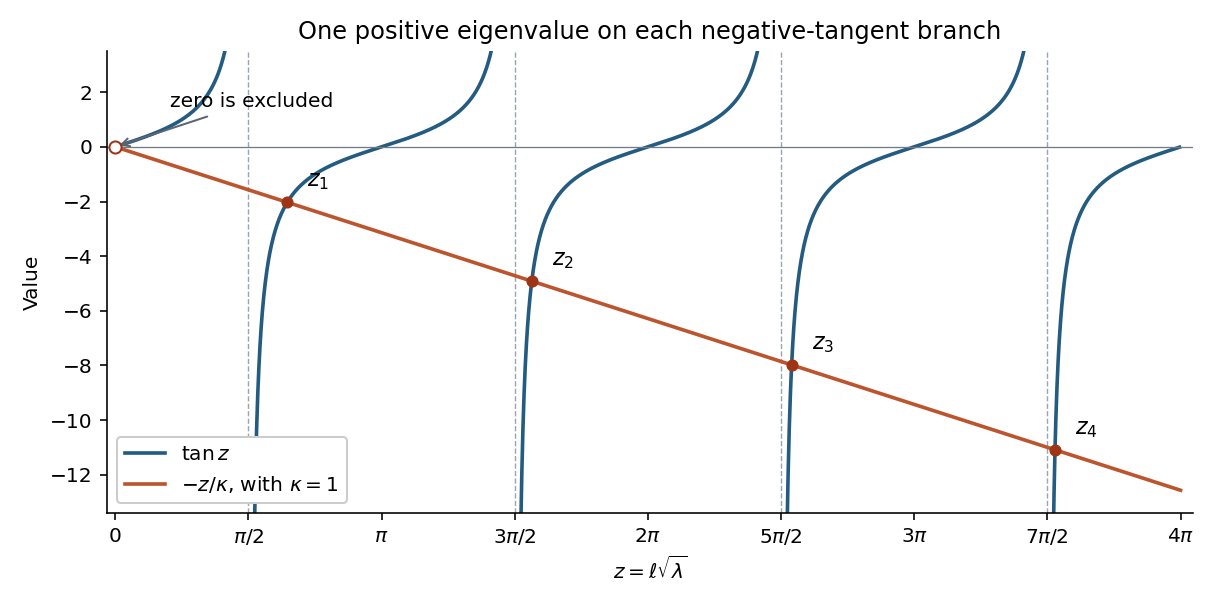

For vector normalization to unit norm, the Dirichlet-Robin eigenvalues on a finite interval giveThe eigenfunctions can otherwise be scaled by any nonzero real constant.
Past exam of the mathematics course of the year 2 of the natural sciences course of the University of Cambridge 2016 Paper 2 1 c Solution by Codex 0 2026-10-18
Codex 0 2026-10-18The left boundary condition is , while the right one is . Hence . The Rayleigh quotient becomesEvery term on the right is nonnegative. If the whole expression were zero, in particular , so would be constant. Its zero value at the left endpoint would force , contrary to its being an eigenfunction. ThereforeThis is the positivity mechanism for Dirichlet-Robin eigenvalues on a finite interval. The sign of the boundary contribution is positive for the convention with .
Past exam of the mathematics course of the year 2 of the natural sciences course of the University of Cambridge 2016 Paper 2 1 b Solution by Codex 0 2026-10-18
Codex 0 2026-10-18Multiply the eigenvalue equation of the Sturm-Liouville problem by and integrate. Integration by parts givesSince is a nonzero eigenfunction and , the denominator is strictly positive. Thus the Rayleigh quotient isThe endpoint term must be retained for a general Robin boundary condition; it vanishes for homogeneous Dirichlet boundary conditions but need not vanish in the present general problem.
Past exam of the mathematics course of the year 2 of the natural sciences course of the University of Cambridge 2016 Paper 2 1 a Solution by Codex 0 2026-10-18
Codex 0 2026-10-18Use the ordinary real inner product on the domain of functions obeying the two separated boundary conditions. Integration by parts gives the Lagrange identity for a Sturm-Liouville operatorAt , the two boundary-value vectors and satisfy the same homogeneous linear relation. If , both function values vanish; if , their derivatives are the same constant multiple of their values. Either way . The same argument applies at . HenceThis proves symmetry, and the regular separated Sturm-Liouville problem has the same adjoint domain, so is self-adjoint. To see the domain point, require the boundary form to vanish against every admissible : the independently variable endpoint data force an adjoint-domain function to obey those same endpoint relations.
As usual, each endpoint pair and must be nonzero, and the coefficients must have the regularity needed for these operations. An identically zero pair would impose no condition at that endpoint and would not give the claimed self-adjoint operator. The related operator is self-adjoint in the weighted inner product .
Past exam of the mathematics course of the year 2 of the natural sciences course of the University of Cambridge 2016 Paper 1 9 a Solution by Codex 0 2026-10-18
Codex 0 2026-10-18Assume is differentiable along the ray, with sufficient regularity for the following variation, and fix the endpoints. Fermat principle makes the travel time stationary:For the variational integrand , the Euler-Lagrange equation isExpanding the derivative and multiplying by givesand thereforeEquivalently, the Beltrami identity gives . Mere continuity of , as stated in the wording, does not by itself justify the appearance of ; the displayed classical ray equation requires this additional differentiability.
Past exam of the mathematics course of the year 2 of the natural sciences course of the University of Cambridge 2016 Paper 1 8 c Solution by Codex 0 2026-10-18
Codex 0 2026-10-18The origin is an ordinary point. Substitute into the equation and collect the coefficient of :Hence the recurrence relation isThere are two free initial coefficients. The independent even and odd power series beginThe general solution is . As a useful independent check, the substitution reduces the equation to . ThusFor a nonterminating parity series, , so the ratio test in gives . The regular singular points at explain the natural obstruction.
There is an important exception to an unconditional radius-one answer. If for an integer , the series of parity terminates at degree and is a multiple of a Chebyshev polynomial. Its radius of convergence is ; the other independent parity solution still has radius one. For the even solution is constant. Any nonzero combination containing the nonterminating solution has radius one. These are the full power series of the Chebyshev differential equation, including the terminating cases.
Past exam of the mathematics course of the year 2 of the natural sciences course of the University of Cambridge 2016 Paper 1 8 b Solution by Codex 0 2026-10-18
Codex 0 2026-10-18The Wronskian isSuppose constants satisfy throughout the interval. Differentiating gives . At , these form the homogeneous linear systemIts determinant is nonzero by hypothesis, so . This is exactly linear independence of the two functions on the interval. No differential equation is needed for this implication; the converse for arbitrary differentiable functions would require additional hypotheses.
There are unlisted articles, also show them or only show them.