Past exam of the mathematics course of the year 2 of the natural sciences course of the University of Cambridge 2016 Paper 1 2 a Solution by  Codex 0 2026-10-18
Codex 0 2026-10-18Set in the wave equation. A nonzero product obtained by separation of variables obeysThe fixed-end Dirichlet boundary conditions require . The zero and negative spatial eigenvalue cases produce only the trivial solution; the nontrivial eigenfunctions areFor each normal mode, . By superposition and completeness of the Fourier sine basis, the general finite-energy solution has the expansionIf and , orthogonality gives and . Individual products are separable; their sum is the general solution.
Past exam of the mathematics course of the year 2 of the natural sciences course of the University of Cambridge 2016 Paper 1 10 b Solution by Codex 0 2026-10-18
Codex 0 2026-10-18Use the intended infinite square well interpretation: the kinetic-energy operator on with zero Dirichlet boundary conditions. The variational energy is most safely evaluated through its quadratic form,The boundary term vanishes because the trial function vanishes at both walls. Its zero extension has derivative jumps there, so the form interpretation avoids assigning an unrestricted full-line second derivative to it.
Set and . Apart from an irrelevant factor , the trial function is . Polynomial integration givesHence the polynomial Rayleigh-Ritz trial space for a one-dimensional box has energyThe denominator is strictly positive, since . Differentiation givesThe two stationary parameters are . The smaller is a local maximum; the larger is a local minimum. Since the energy tends to as , the latter is the global minimum:The upper stationary value is . Exact roots give a slightly tighter bound than substituting the rounded hints.
There are two qualifications to the printed operator and comparison energy. For the box with Dirichlet boundary conditions and width , the actual ground-state energy iswhich lies just below the variational result. The coefficient printed as an exact eigenvalue is inconsistent with this box problem. Also, merely declaring the differential expression to be zero outside the interval does not impose hard-wall confinement or specify a self-adjoint domain. Read literally on a space admitting exterior-supported states, it has zero-energy states outside and does not have the claimed positive ground energy. The boxed variational result is the well-defined answer for the intended confined particle; a different full-line operator would need its domain and matching conditions supplied.
Past exam of the mathematics course of the year 2 of the natural sciences course of the University of Cambridge 2016 Paper 1 1 c Solution by Codex 0 2026-10-18
Codex 0 2026-10-18The polynomial vector field is smooth throughout the solid, so the divergence theorem applies. Differentiation givesThe volume is invariant under both and . Hence the integrals of the two odd terms vanish, and the flux is simply the volume. Using the circular cross-sections,The seams between the surface pieces have zero surface measure and contribute no extra term.
Past exam of the mathematics course of the year 2 of the natural sciences course of the University of Cambridge 2016 Paper 1 1 b Solution by Codex 0 2026-10-18
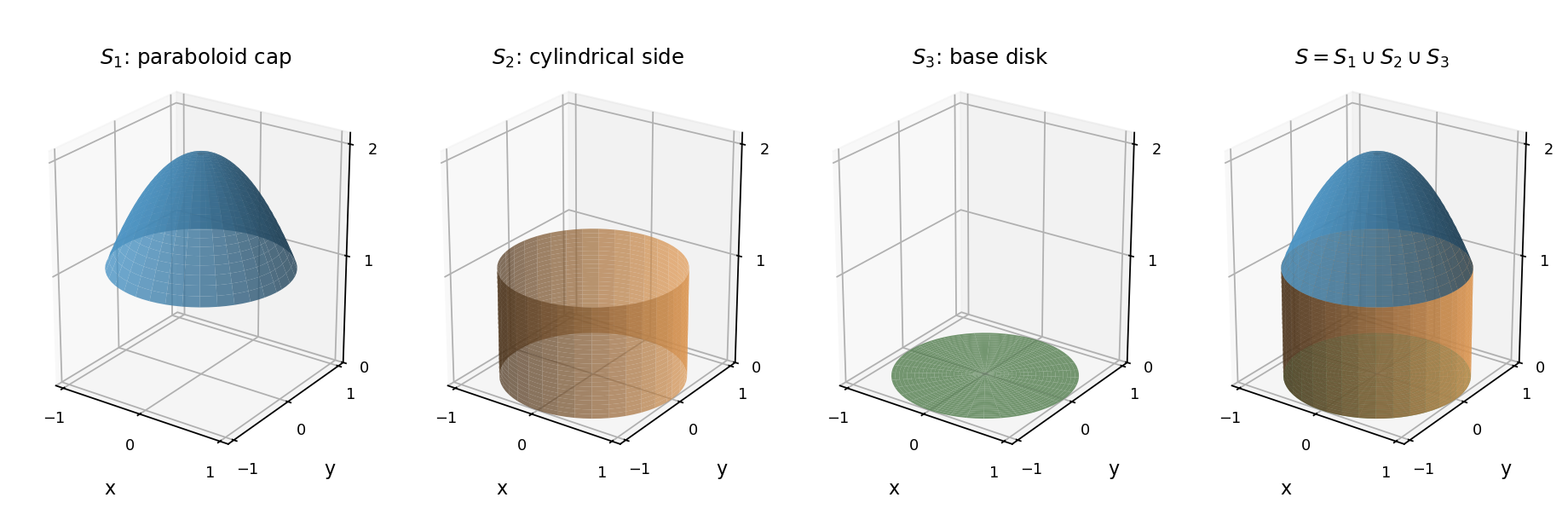
Codex 0 2026-10-18The upper piece is a downward-opening circular elliptic paraboloid cap, running from the circle to the apex . The middle piece is the side of a circular cylinder of radius one and height one. The lower piece is the unit disk in the horizontal plane. Their union is the closed boundary ofThe four panels show the three separate pieces and their union; there is no additional fourth component. In a meridional section, the boundary consists of the base segment, two vertical sides, and the parabolic cap. The outward normals point downward on the base, radially outward on the cylindrical side, and upward/outward on the cap.

Past exam of the mathematics course of the year 2 of the natural sciences course of the University of Cambridge 2016 Paper 1 1 a Solution by Codex 0 2026-10-18
Codex 0 2026-10-18For a bounded volume with piecewise smooth closed boundary , and a continuously differentiable vector field on a neighbourhood of , the divergence theorem statesHere is the outward unit normal vector. The left side is the outward flux; the right side integrates the divergence over the enclosed volume.
Past exam of the mathematics course of the year 2 of the natural sciences course of the University of Cambridge 2015 Paper 2 9 d Solution by Codex 0 2026-10-18
Codex 0 2026-10-18The kernel is a normal subgroup, so it contains the identity class and is a union of the classes listed in part (c). Its candidate orders are therefore , , and . Lagrange's theorem excludes four, since it does not divide six. The remaining possibilities areAll three are normal: the first and last trivially, while is the kernel of the map giving the sign of a permutation, or the index-two subgroup generated by a 3-cycle.
Because is onto, the first isomorphism theorem gives . Explicitly, the map is well defined, multiplicative and surjective; equality of its values means , so it is also injective. ThusEach is realized by the identity map, the sign map and the trivial map, respectively. This completes the classification of normal subgroups and quotients of the symmetric group on three letters.
Past exam of the mathematics course of the year 2 of the natural sciences course of the University of Cambridge 2015 Paper 2 9 c Solution by Codex 0 2026-10-18
Codex 0 2026-10-18The cycle type records the lengths of the disjoint cycles in a permutation, including fixed points as length-one cycles. The possibilities for three objects areThese exhaust the six elements of the symmetric group , denoted in the source. They are also the conjugacy classes of the symmetric group on three letters.
Past exam of the mathematics course of the year 2 of the natural sciences course of the University of Cambridge 2015 Paper 2 9 b Solution by Codex 0 2026-10-18
Codex 0 2026-10-18The conjugacy class of isIf is a normal subgroup and , then normality gives for every . Thus the whole conjugacy class of each member of is contained in , andConjugacy classes partition the group, so this is a union of complete disjoint classes, never selected fractions of classes.
Past exam of the mathematics course of the year 2 of the natural sciences course of the University of Cambridge 2015 Paper 2 9 a Solution by Codex 0 2026-10-18
Codex 0 2026-10-18The kernel of a group homomorphism isThe homomorphism sends identity to identity and inverses to inverses. Thus , and if , then , so is a subgroup by the subgroup test.
Past exam of the mathematics course of the year 2 of the natural sciences course of the University of Cambridge 2015 Paper 2 8 c Solution by Codex 0 2026-10-18
Codex 0 2026-10-18Perform the product and inverse formulas from part (b) in the commutative ring . They involve only addition, multiplication and negatives, so closure and inverses remain valid; no division by a nonunit is needed. Associativity again comes from matrix multiplication, and remains the identity. The Heisenberg group over a commutative ring therefore hasThese are residues modulo four, not arithmetic in the finite field of four elements.
For the additional subgroup task, write an element of as . Its product and inverse areBoth remain in , and the product is unchanged on exchanging the factors because . The identity is included, so is an Abelian subgroup. There are four independent choices each for , givingThus there are four distinct left cosets. Explicitly the surjective group homomorphism has kernel ; the four cosets are the level sets of that difference, with representatives , . This is the Abelian plane subgroup of the Heisenberg group modulo four.
Past exam of the mathematics course of the year 2 of the natural sciences course of the University of Cambridge 2015 Paper 2 8 b Solution by Codex 0 2026-10-18
Codex 0 2026-10-18Denote a matrix by , with the upper-right entry. Direct matrix multiplication givesThis proves closure. Associativity is inherited from matrix multiplication. The identity is , and the inverse isBoth products with this matrix are the identity. Thus these real matrices form the Heisenberg group, in the coordinate convention with central coordinate .
Let . Its multiplication adds , its identity is and its inverse negates , so it is a subgroup. MoreoverThus every element of is central, and . Therefore is a normal subgroup. In fact it is the full center of a group, as described by the center quotient of the real Heisenberg group.
Past exam of the mathematics course of the year 2 of the natural sciences course of the University of Cambridge 2015 Paper 2 8 a Solution by Codex 0 2026-10-18
Codex 0 2026-10-18The left coset isEvery belongs to , because , so the cosets cover . If and intersect, choose in the intersection. Then , so for some . Thus .
Hence two left cosets are either identical or disjoint, and the distinct left cosets form a partition of a set whose union is . Finiteness is unnecessary for this partition argument. In the finite case each coset has members, since multiplication by is a bijection, giving Lagrange's theorem.
Past exam of the mathematics course of the year 2 of the natural sciences course of the University of Cambridge 2015 Paper 2 7 d Solution by Codex 0 2026-10-18
Codex 0 2026-10-18Exchange symmetry of climbers 2 and 3 gives , for which . HenceThe physical displacements are , so climber 1 is stationary and the other two move vertically with equal amplitudes in opposite directions. Their changes in force on climber 1 cancel.
For the remaining symmetric modes, put and let . The eigenproblem becomes , . Eliminating gives . Therefore . Since ,For clarity, their relative physical climber displacements, rather than rope-length amplitudes, areThe lower mode moves all climbers in phase; the higher mode moves the lower pair against the top climber. These are the normal modes of three vertically suspended masses with a branched spring connection.
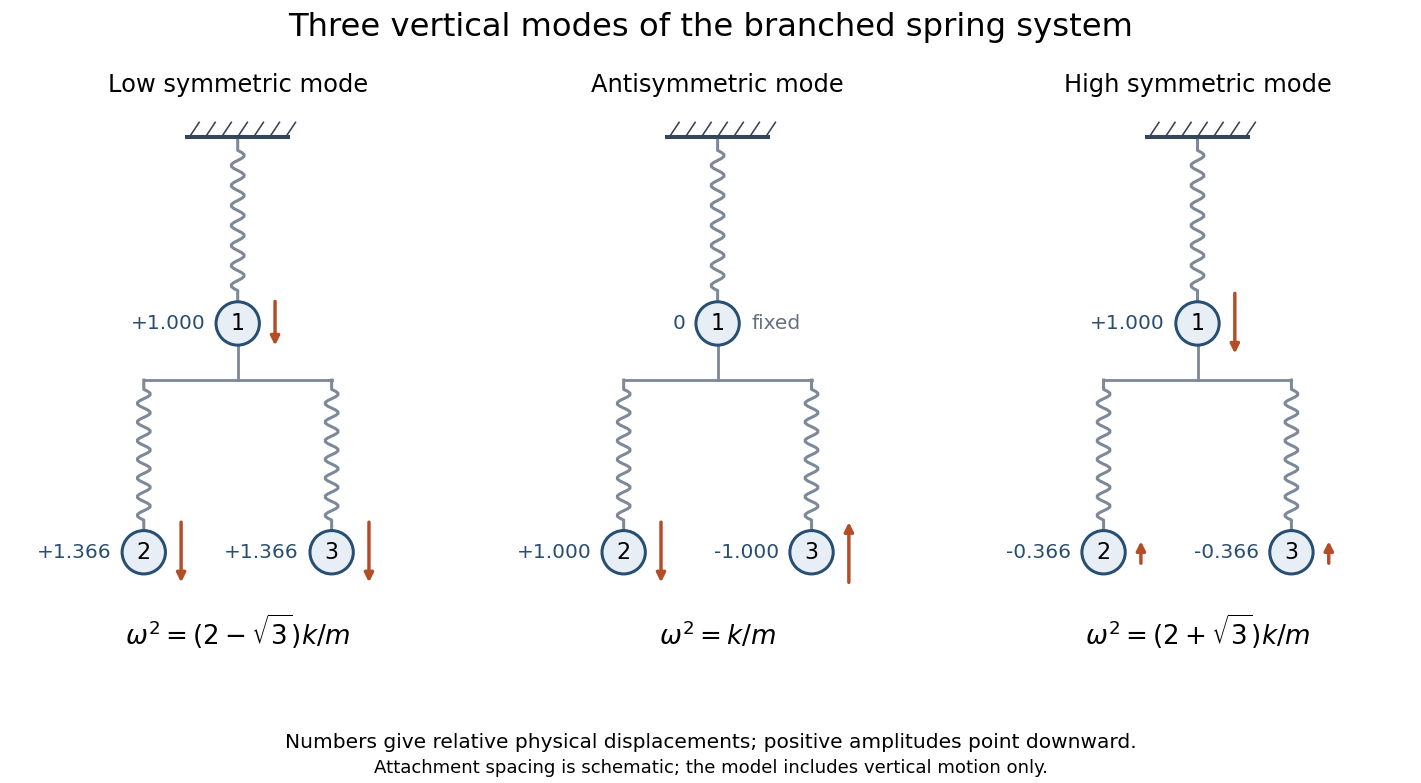
Relative physical climber displacements in the three vertical normal modes; branch spacing is schematic
. Details. 
Past exam of the mathematics course of the year 2 of the natural sciences course of the University of Cambridge 2015 Paper 2 7 c Solution by Codex 0 2026-10-18
Codex 0 2026-10-18Set . The equilibrium equations cancel the constant gravitational and elastic terms, leaving the small-oscillation mass and stiffness matricesThe off-diagonal mass terms arise because rope-length coordinates are not absolute climber displacements. For any nonzero velocity vector, , so is a positive-definite matrix.
Within the vertical Hookean model, the displacement equations are exactly linear while all ropes stay taut. Small amplitudes ensure that none reaches the slack regime .
Past exam of the mathematics course of the year 2 of the natural sciences course of the University of Cambridge 2015 Paper 2 7 b Solution by Codex 0 2026-10-18
Codex 0 2026-10-18The Euler-Lagrange equations giveFor example, differentiating with respect to collects contributions from all three climbers, because changing moves all of them. At equilibrium, all accelerations vanish, soThe top rope supports the total weight, while each lower rope supports only its own climber. These extensions are positive, consistent with the taut-rope tension law.
Past exam of the mathematics course of the year 2 of the natural sciences course of the University of Cambridge 2015 Paper 2 7 a Solution by Codex 0 2026-10-18
Codex 0 2026-10-18Take downward vertical distances from the support. The climber positions are , and . Their kinetic energy is thereforeIntegrating the tension-extension relation gives the elastic potential energy for each taut rope. Because downward displacement lowers gravitational potential,An arbitrary additive constant in is immaterial. This is the vertical-motion model implicit in using only rope lengths as generalized coordinates; swinging angles are not additional degrees of freedom in this model.
Past exam of the mathematics course of the year 2 of the natural sciences course of the University of Cambridge 2015 Paper 2 6 d Solution by Codex 0 2026-10-18
Codex 0 2026-10-18The scalar, symmetric-traceless and axial tensor decomposition fixes the scalar part by the trace:Subtracting this isotropic part from the symmetric tensor in part (c) givesIts trace is zero. The antisymmetric tensor part isAdding reconstructs every entry of .
Subtracting a scalar multiple of the identity preserves every eigenvector: if , then . Thus the principal axes are the same as in part (c), with shifted principal valuesThe two tensors are coaxial symmetric tensors. At both vanish, so neither specifies unique axes.
There are unlisted articles, also show them or only show them.