Past exam of the mathematics course of the year 2 of the natural sciences course of the University of Cambridge 2015 Paper 2 10 b Solution by  Codex 0 2026-10-18
Codex 0 2026-10-18All six reflections square to the identity, and the rotation is the half-turn. These exhaust the nonidentity involutions: has square one only when , giving apart from the identity. Thus the order-two subgroups areA reflection cannot have order three. The rotations of order three are and , and they generate the same subgroup:All these subgroups are cyclic, because a group of prime order is cyclic; the displayed nonidentity elements supply their generators. This gives seven subgroups of order two and one of order three, consistently with involutions in an even dihedral group and the classification of subgroups of a dihedral group.
Past exam of the mathematics course of the year 2 of the natural sciences course of the University of Cambridge 2015 Paper 2 10 a Solution by Codex 0 2026-10-18
Codex 0 2026-10-18The table describes the symmetry group of a regular hexagon. Choose as a counterclockwise rotation through and as reflection in one symmetry axis. With , the relations areThe rotation entries already are , and the table gives with indices modulo six. ThereforeThe source writes with the subscript counting polygon vertices; this dihedral group has order 12.
Past exam of the mathematics course of the year 2 of the natural sciences course of the University of Cambridge 2015 Paper 2 1 a Solution by Codex 0 2026-10-18
Codex 0 2026-10-18On its specified domain of admissible functions, a self-adjoint operator equals its adjoint, including the adjoint domain. Its integration identity on the interval isFor a differential operator, the boundary conditions must make the boundary form from integration by parts vanish. Formal symmetry of the differential expression alone does not specify a self-adjoint boundary-value problem.
Apply this identity to two eigenfunctions. Since the weight is real,First take : positivity of shows , so the eigenvalues are real. For distinct eigenvalues, subtraction therefore givesThis is orthogonality of Sturm-Liouville eigenfunctions in the weighted inner product, rather than necessarily in the unweighted inner product.
Past exam of the mathematics course of the year 2 of the natural sciences course of the University of Cambridge 2015 Paper 1 9 b Solution by Codex 0 2026-10-18
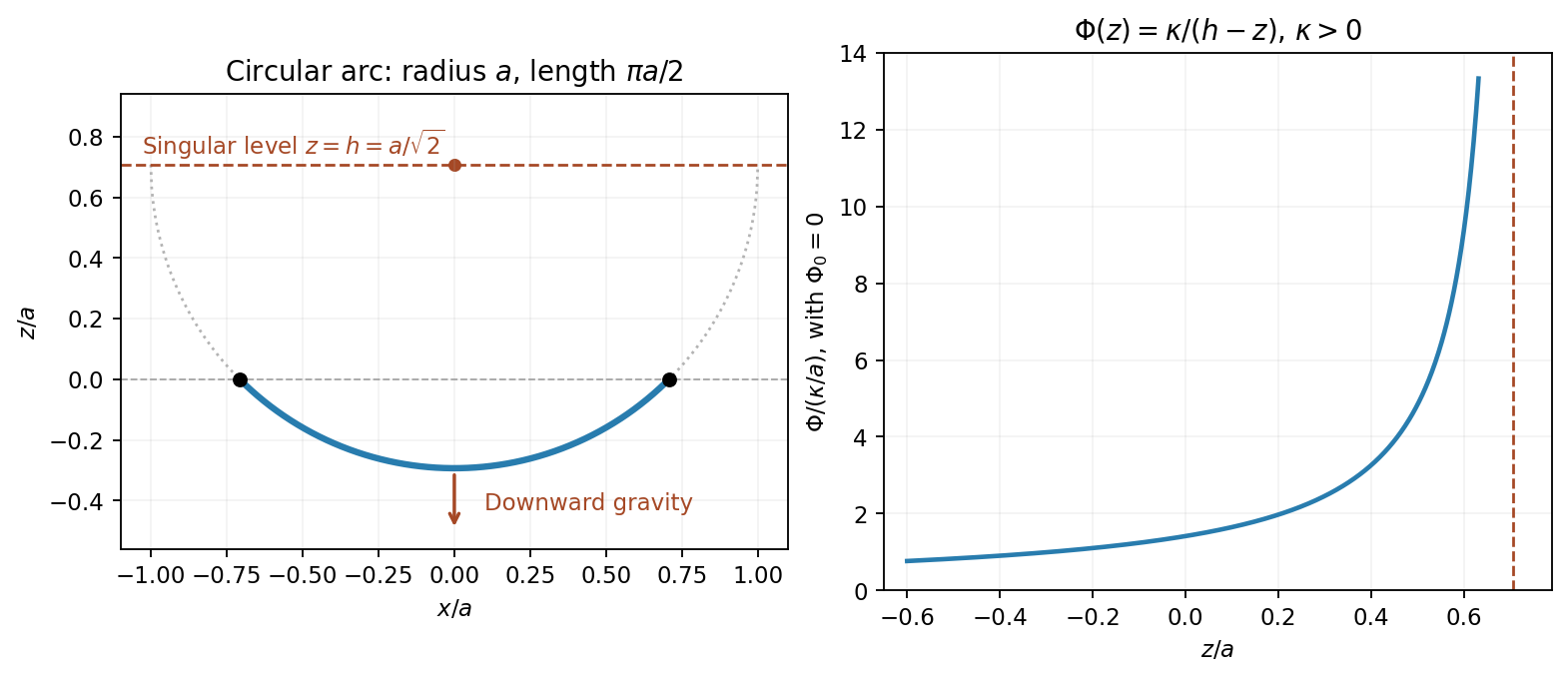
Codex 0 2026-10-18A curve element has arc length and mass . Adding its gravitational energies givesFor the fixed-length constraint, use the augmented integrand . It has no explicit dependence, so the Beltrami identity givesThe desired lower circular arc isIt joins the required endpoints, subtends angle , and has length . Its slope gives . Therefore a gravitational potential producing a circular hanging chain isChoosing makes the first integral constant, . Its gravitational acceleration is , which points downward. An arbitrary additive potential constant changes no force.
This construction really gives a minimum. With , the variable part of is ; the term is fixed by the length. The calibration for semicircular hyperbolic geodesics uses , whose gradient has norm . The Cauchy-Schwarz inequality gives , with equality on traversed left to right. Thus the circular arc minimizes the energy among competitors of the same length and endpoints in the stated potential domain, rather than merely satisfying a necessary stationarity condition.
Past exam of the mathematics course of the year 2 of the natural sciences course of the University of Cambridge 2015 Paper 1 9 a Solution by Codex 0 2026-10-18
Codex 0 2026-10-18For fixed endpoint values and smooth admissible variations, the Euler-Lagrange equation isThe first variation follows by integrating by parts and using at the endpoints.
For the claimed first integral, differentiate directly:Along an extremal the bracket vanishes. Thus when , the Beltrami identity isFor a further regular constraint , introduce a constant Lagrange multiplier and make stationary. Apply the Euler-Lagrange equation to the combined integrand, then impose the endpoints and to determine the integration constants and multiplier.
Past exam of the mathematics course of the year 2 of the natural sciences course of the University of Cambridge 2015 Paper 1 8 d Solution by Codex 0 2026-10-18
Codex 0 2026-10-18If is an integer, the recurrence has zero numerator at . Choosing the parity containing therefore makes all later coefficients vanish. Conversely, for a nonzero polynomial of degree , the coefficient of in the differential equation is , so is necessary.
Normalizing the terminating series by gives the first Chebyshev polynomials:Substitution verifies each differential equation and endpoint value. More generally, ; its recurrence also establishes polynomiality and the normalization.
Past exam of the mathematics course of the year 2 of the natural sciences course of the University of Cambridge 2015 Paper 1 8 c Solution by Codex 0 2026-10-18
Codex 0 2026-10-18For a nonterminating parity series, consecutive nonzero terms satisfyThe ratio test therefore gives for each nonterminating series. The nearest singular coefficient points are , both distance one from the expansion centre.
The polynomial exception is essential here. If is an integer, the series of the same parity as terminates and has ; the opposite-parity independent series remains nonterminating with radius one. For noninteger , both have radius one. A regular singular point can be removable for one particular solution, so its presence does not force every individual solution to have finite convergence radius.
Past exam of the mathematics course of the year 2 of the natural sciences course of the University of Cambridge 2015 Paper 1 8 b Solution by Codex 0 2026-10-18
Codex 0 2026-10-18Because zero is an ordinary point, substitute . Matching powers givesEven and odd coefficients evolve independently. Taking and constructs solutionsTheir initial values and derivatives give , so they are linearly independent. These power series of the Chebyshev differential equation span the local solution space. A useful check is and , with at .
Past exam of the mathematics course of the year 2 of the natural sciences course of the University of Cambridge 2015 Paper 1 8 a Solution by Codex 0 2026-10-18
Codex 0 2026-10-18At each of , has a simple pole and at most a simple pole. The products and are analytic, so both are regular singular points. More precisely their limiting values are and zero, giving indicial equation , with exponents .
Past exam of the mathematics course of the year 2 of the natural sciences course of the University of Cambridge 2015 Paper 1 7 d Solution by Codex 0 2026-10-18
Codex 0 2026-10-18Partial fraction decomposition give . Let . Each fraction has a geometric expansion, soEquivalently, its coefficient is . The first terms areThe linear and fifth-order coefficients vanish. Both geometric series converge for , and has genuine simple poles at , each distance from the centre. Thus the Taylor series has
Past exam of the mathematics course of the year 2 of the natural sciences course of the University of Cambridge 2015 Paper 1 7 c Solution by Codex 0 2026-10-18
Codex 0 2026-10-18Write and assume its domain is open and connected. If the constant modulus is zero then . Otherwise let . Differentiating this identity and using the Cauchy-Riemann equations givesThese are a linear system for with coefficient matrix , whose determinant is . Therefore , and the Cauchy-Riemann equations also give . It follows thatThis proves the constant-modulus holomorphic function result directly. On a disconnected domain the same conclusion holds separately on each connected component, but the constants can differ.
Past exam of the mathematics course of the year 2 of the natural sciences course of the University of Cambridge 2015 Paper 1 7 a Solution by Codex 0 2026-10-18
Codex 0 2026-10-18Complex differentiability requires the same limit for increments along the real and imaginary directions. Real increments give . Imaginary increments giveEquating real and imaginary parts yields the Cauchy-Riemann equationsThey hold throughout the open region where is holomorphic. Conversely, continuous first real partial derivatives satisfying these equations on an open set ensure holomorphy there.
Past exam of the mathematics course of the year 2 of the natural sciences course of the University of Cambridge 2015 Paper 1 6 c Solution by Codex 0 2026-10-18
Codex 0 2026-10-18Minimize or maximize subject to . A Lagrange multiplier givesThe constraint excludes and implies , so it is a regular constraint surface. Multiplying the stationarity equation by gives . Thus the distance extrema on a real quadratic surface satisfyEvery constrained extremum lies in a positive-eigenvalue eigenspace, with squared distance . If is positive definite, the global minimum is and the global maximum is . For an indefinite or singular form the surface need not be bounded; eigenvector directions give stationary candidates, which may be saddles and need not supply both global extrema. With a repeated positive eigenvalue, there can be an entire family of equally distant stationary points.
Past exam of the mathematics course of the year 2 of the natural sciences course of the University of Cambridge 2015 Paper 1 6 b Solution by Codex 0 2026-10-18
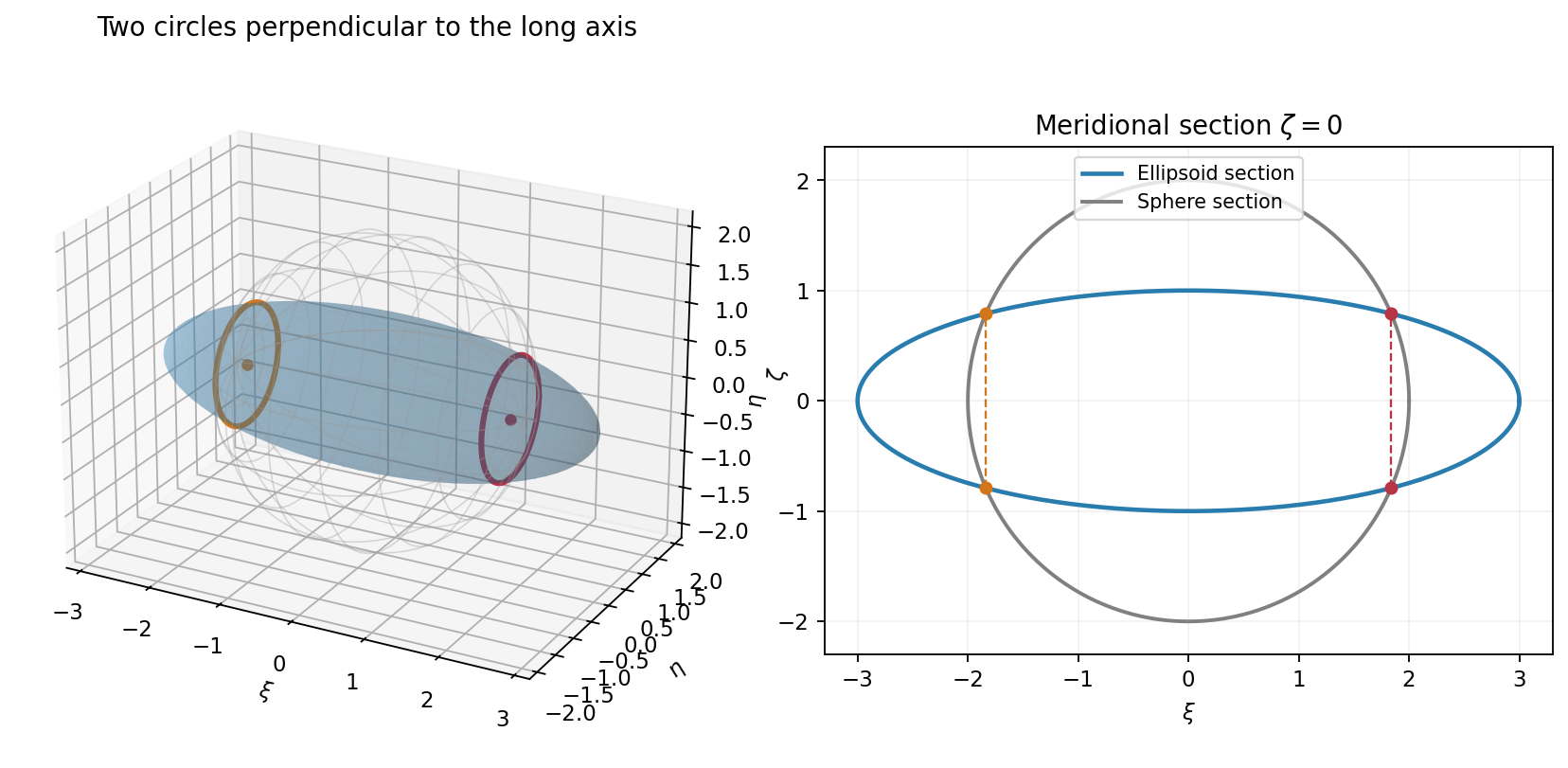
Codex 0 2026-10-18The quadratic-form matrix has eigenvectorswith eigenvalues . In the principal axes coordinates , and , the equation becomesIt is a prolate spheroid, centred at the origin, with semiaxis three along and one in every perpendicular direction. The displayed are one choice of short principal axes.
The sphere has equation . Combining it with the ellipsoid equation givesThe intersection of a prolate spheroid and a concentric sphere therefore consists of two circles in planes perpendicular to . Each has radius , and their centres areTheir plane equations in the original coordinates are .


Past exam of the mathematics course of the year 2 of the natural sciences course of the University of Cambridge 2015 Paper 1 6 a Solution by Codex 0 2026-10-18
Codex 0 2026-10-18The spectral theorem for a real symmetric matrix gives real eigenvalues and an orthonormal eigenbasis. Compute the roots of , find a basis for each eigenspace, and orthonormalize within any repeated-eigenvalue eigenspace. Eigenvectors belonging to distinct eigenvalues are already orthogonal: if and , symmetry gives .
Putting the normalized basis vectors in the columns of an orthogonal matrix yieldsFor repeated eigenvalues, the choice of axes inside their eigenspace is not unique.
Past exam of the mathematics course of the year 2 of the natural sciences course of the University of Cambridge 2015 Paper 1 5 c Solution by Codex 0 2026-10-18
Codex 0 2026-10-18Use the lower antisymmetric block shown in the original PDF. Write withPowers preserve the block structure. Splitting the matrix exponential series into even and odd powers gives . For the other block, the matrix exponential when the square is minus the identity gives . ThereforeThe upper block is hyperbolic and the lower block is a rotation. The transcription's altered last row and hyperbolic functions in the lower block would describe a different problem.
There are unlisted articles, also show them or only show them.