Past exam of the galois theory course of the University of Oxford 2023 2 c Solution by  Codex 0 2026-10-25
First assume . Set . If with , then in the field , so . For an automorphism inducing the root permutation ,Since fixes and in , every induced permutation has positive sign. The root action is faithful because the roots generate , givingThis is the discriminant criterion for an alternating Galois group.
As printed for arbitrary fields, the assertion is false in characteristic two. Over , the polynomial is irreducible and separable, with roots in . Their difference is one, so the discriminant is the square . Nevertheless its Galois group is , whereas is trivial. In characteristic two the permutation signs become indistinguishable as field elements; square discriminants in characteristic two therefore cannot detect the alternating subgroup in this way.
Past exam of the galois theory course of the University of Oxford 2023 2 b Solution by Codex 0 2026-10-25
Codex 0 2026-10-25For the root-discriminant convention in the requested identity, defineThe Vandermonde determinant is . Squaring removes the signs, provingIt is nonzero because the roots are distinct. It lies in , since its root expression is fixed by every Galois automorphism and .
If is not monic and has leading coefficient , the usual polynomial discriminant is . Thus the printed Vandermonde equality uses the discriminant of the monic normalization . The extra factor is itself a nonzero square in , so it does not alter the square-class criterion in the next part.
Past exam of the galois theory course of the University of Oxford 2023 2 a Solution by Codex 0 2026-10-25
Codex 0 2026-10-25The Galois group acts transitively on the roots because is irreducible and separable. The orbit-stabilizer theorem givesso divides . Equivalently, the tower law gives , while the finite Galois extension has group order .
Past exam of the galois theory course of the University of Oxford 2023 1 b Solution by Codex 0 2026-10-25
Codex 0 2026-10-25The element satisfies , so . Since is real, . A primitive root of order is nonreal: the only real roots of unity are , of orders at most two. Hence andEquivalently, nontrivial complex conjugation fixes precisely the maximal real subfield of a cyclotomic field in this degree-two extension.
Past exam of the galois theory course of the University of Oxford 2023 1 a Solution by Codex 0 2026-10-25
Codex 0 2026-10-25For , every Galois automorphism sends the primitive root to another primitive th root of unity, uniquely for . The Cyclotomic character of a finite cyclotomic extension isIf and , then , proving the group homomorphism property. Its kernel is trivial: an automorphism fixing fixes the field it generates. Thus the character is injective. Here its domain is the finite cyclotomic Galois group; the corresponding map from an absolute Galois group need not be injective.
Past exam of the further quantum theory course of the University of Oxford 2023 3 e Solution by Codex 0 2026-10-25
Codex 0 2026-10-25A tall, broad central potential barrier has . Let denote even parity and odd parity, and write , where . Since , the condition in part (d) givesThus the leading correction to the isolated-well Bohr-Sommerfeld quantization condition isThis is an implicit condition, with all action integrals evaluated at the corrected energy. To convert it into an explicit leading energy correction, let solve and define the full classical oscillation period in one well by . Differentiation of the action integral has no endpoint terms because , and givesConsequently, to leading exponentially small order within the WKB approximation,The even member lies below its odd partner. For an approximately harmonic oscillator well, , giving the familiar double-well tunneling splitting . The explicit energy formula retains only its leading exponential correction; varying and with the shifted energy also contributes at higher orders.
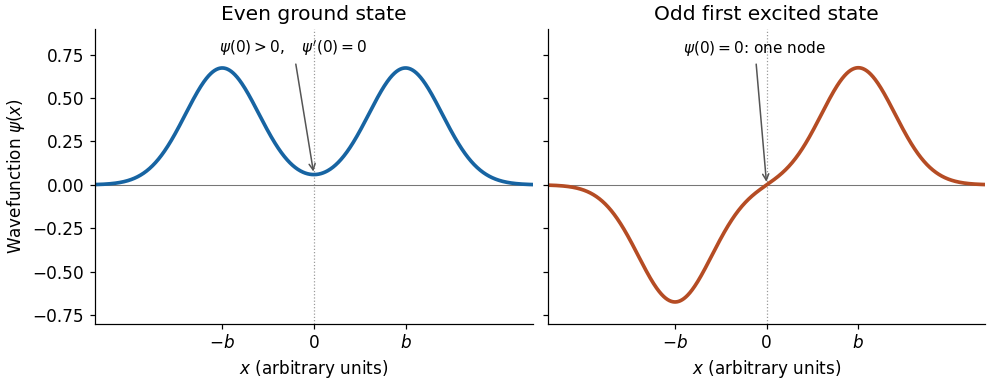
The ground state has an even, everywhere same-sign wavefunction with a peak in each well and a small nonzero value beneath the central potential barrier. Its derivative vanishes at zero. The first excited state is odd, has opposite-sign lobes in the two wells, and has exactly one interior node of a wavefunction, at zero. Both wavefunctions decay outside the wells. In terms of localized normalized wavefunctions , with overlap , their qualitative shapes are the lowest parity states of a symmetric double well:The overall sign of the odd wavefunction is arbitrary. The sketch uses localized Gaussian profiles to show the parity and the central node of a wavefunction, rather than claiming exact energy eigenfunctions for an unspecified potential energy.

Past exam of the further quantum theory course of the University of Oxford 2023 3 d Solution by Codex 0 2026-10-25
Codex 0 2026-10-25For , the parity operator commutes with the Hamiltonian operator. Also , so its eigenvalues are and the energy eigenspaces admit a basis of definite parity. More strongly, nondegeneracy of one-dimensional bound states says that each bound state energy here is nondegenerate: the Wronskian of two solutions at the same energy is constant by the Schrödinger equation, and decay at infinity makes it zero, forcing linear dependence. Thus each bound state itself is even or odd.
An even function obeys the Neumann boundary condition ; an odd function obeys the Dirichlet boundary condition . WriteSmooth reflection symmetry gives , while . Hence, for the central WKB approximation from part (c),The two boundary conditions consequently give the WKB quantization condition for a symmetric double well:The full wavefunction is in the even case and in the odd case, with the value at zero fixed continuously. The relevant boundary condition makes these extensions differentiable at zero. Both action integrals depend on through the integrands and the classical turning points.
Past exam of the further quantum theory course of the University of Oxford 2023 3 c Solution by Codex 0 2026-10-25
Codex 0 2026-10-25Use the amplitudes and positive action integrals of part (a), and define the right-well phaseMatching at the inner classical turning point gives , . Matching the exterior decaying wavefunction at the outer classical turning point givesThe trigonometric identitytherefore yieldsAll three pieces on are now fixed up to and :The Airy function descriptions replace the apparent singularities at the classical turning points. For the permitted energy eigenvalues, part (d) extends this right-hand wavefunction to the left by even or odd parity; is then determined by wavefunction normalization. At arbitrary , the decaying right-hand solution instead has a unique continuation by the Schrödinger equation, which need not decay at negative infinity.
Past exam of the further quantum theory course of the University of Oxford 2023 3 b Solution by Codex 0 2026-10-25
Codex 0 2026-10-25The WKB approximation fails at a simple classical turning point , because makes its amplitude singular and violates the WKB validity condition. Locally replace by . For a forbidden region on the right, and the rescaled coordinate changes the time-independent Schrödinger equation into the Airy ordinary differential equation . Reversing the coordinate handles a forbidden region on the left.
The two independent Airy functions have asymptotic forms, for ,Match these to the WKB approximation in an overlap region where the linearization of the potential energy and the large-argument asymptotic expansions both apply. If on the forbidden side and on the allowed side, the Airy turning-point connection formula isThus a decaying exponential acquires a factor two in its allowed-side amplitude, whereas a growing exponential does not. The phase convention uses positive integrals measured away from the classical turning point, so it applies at both ends of the well without an extra orientation sign. These are leading semiclassical matching rules for simple, separated classical turning points.
Past exam of the further quantum theory course of the University of Oxford 2023 2 e Solution by Codex 0 2026-10-25
Codex 0 2026-10-25For , the Hamiltonian operator is nonnegative: its quadratic form is . Thus it has no negative-energy bound states. A nonnegative-energy exterior wavefunction cannot be square integrable unless it vanishes identically, so there are no other bound states either.
For , set . The even equation is the zero of . Since , and , the intermediate value theorem and strict monotonicity give exactly one positive equation root.
The odd equation is the zero of . Here , , , and . If , strict concavity makes for every . If , initially increases, has exactly one maximum, and then decreases through zero exactly once. This proves the bound-state count of an attractive symmetric double-delta potential:At the threshold , the odd zero-energy solution is proportional to inside and to outside. It is bounded but not a square-integrable function, so it is a zero-energy scattering resonance rather than a second bound state. Each negative-energy bound state is either even or odd by nondegeneracy of one-dimensional bound states; the two branches above exhaust the count.
Past exam of the further quantum theory course of the University of Oxford 2023 2 d Solution by Codex 0 2026-10-25
Codex 0 2026-10-25Continue the transmission amplitude to complex wavenumber with , equivalently complex momentum . Then . In the left exterior region the term grows at negative infinity and the term decays; in the right exterior region the term grows and the term decays. A bound state thus requires , with nonzero . The transfer matrix relation gives . Equivalently, a zero of the incoming coefficient is a bound-state pole of , whose numerator is nonzero at .
The denominator found in part (c) givesFactorization produces two branches. To identify their parity, use an even interior wavefunction or an odd interior wavefunction for , joined to a decaying exterior wavefunction at . Continuity and the derivative jump give, respectively,Rearrangement gives the implicit energy eigenvalue equationsOnly strictly positive equation roots are retained. With , the even equation root lies above and the odd equation root, when it exists, lies below , so the even bound state has lower energy. The formal zero equation root in the odd equation does not itself establish a normalizable wavefunction.
Past exam of the further quantum theory course of the University of Oxford 2023 2 c Solution by Codex 0 2026-10-25
Codex 0 2026-10-25Assume and put , , and . At a delta potential located at , integration of the Schrödinger equation gives the matching conditionsWriting the adjacent plane wave coefficients as and givesSolving these two linear equations yields the transfer matrix of a delta potential:For the symmetric double-delta potential, use separate plane wave pairs in , , and . Successive matching gives between the two exterior pairs. For real , multiplication givesThe determinant identity reads . Left incidence means , whenceHere the first relation also follows from . Therefore the requested transmission probability and quantum reflection probability, as functions of the printed momentum , areThey obey . As checks, gives , and the coincident limit gives , the answer for a single delta potential of strength .
Past exam of the further quantum theory course of the University of Oxford 2023 2 b Solution by Codex 0 2026-10-25
Codex 0 2026-10-25For a real potential energy and a stationary state, the probability current isThe time-independent Schrödinger equation gives , so . In an exterior plane wave superposition, interference terms contribute no current andConsequently for every choice of incoming amplitudes. If , this says for every complex vector . Since is Hermitian, vanishing of its quadratic form implies that the matrix itself vanishes. ThereforeThe second identity follows by choosing . Since is a square matrix, the first also implies , proving unitarity. A real delta potential preserves this proof: continuity of and the real derivative jump make the current continuous across the interaction point.
Past exam of the further quantum theory course of the University of Oxford 2023 2 a Solution by Codex 0 2026-10-25
Codex 0 2026-10-25For , put and . Outside the support of the potential energy, a generalized eigenfunction of the Hamiltonian operator has the plane wave formHere denotes the support radius, to distinguish it from the quantum reflection probability . The momenta are and the velocities are . Thus describe incoming scattering channels from the left and right, and describe outgoing scattering channels towards the left and right. These energy eigenfunctions are not square-integrable functions; normalizable incoming wave packets are formed by superposition over energy, and their passage through the interaction region gives the physical quantum scattering experiment.
For incidence from the left, normalize and write . The quantum reflection amplitude is and the transmission amplitude is . The ratios of outgoing to incident probability currents defineNo extra velocity ratio occurs because both exterior regions have the same potential energy and mass. The scattering matrix, with a fixed choice of channel order, isIts first and second columns are the responses to unit incidence from the left and right, respectively. For a reflection-symmetric potential energy, these conventions give and .
Past exam of the further quantum theory course of the University of Oxford 2023 1 e Solution by Codex 0 2026-10-25
Codex 0 2026-10-25Let exchange the two equal-spin factors, so . For the unperturbed Hamiltonian operator, addition of angular momentum givesFor nonzero , different have distinct energy eigenvalues, while each eigenspace has the values of . The stated symmetry of the Clebsch-Gordan coefficients gives the exchange parity of two coupled identical spins:However, changes sign: . For any two basis vectors in the same eigenspace, insertion of therefore givesThus the entire projected perturbation is zero, including its off-diagonal matrix elements. Degenerate perturbation theory now proves that every first-order-in- energy correction vanishes. This is first-order cancellation for an exchange-odd perturbation; checking only the individual diagonal expectations would not by itself settle a degenerate problem.
There are unlisted articles, also show them or only show them.