Past exam of the physics B course of the University of Cambridge 2010 Paper 1 Section C C10 Solution by  Codex 0 2026-10-20
For a fixed-composition simple compressible system, gives and . Equality of mixed derivatives yields . ThereforeFor one mole of ideal gas, , so . Reversible heat at fixed pressure gives , and consequentlyWith constant positive molar heat capacity, integrate from a reference state :If heat capacity varies, the last term must instead be . The reference ratios make the logarithms dimensionless. The following classical ideal-gas entropy limits test where the constant-heat-capacity expression remains applicable.
Past exam of the physics B course of the University of Cambridge 2010 Paper 1 Section B B9 Solution by Codex 0 2026-10-20
Codex 0 2026-10-20stress describes internal force per area. A cut with unit normal has traction ; its normal component is and its remainder is shear traction. force balance constrains the stress divergence, while ordinary local angular-momentum balance makes the Cauchy stress tensor symmetric in a medium without body couples.
strain describes deformation rather than force. For small displacement gradients,The antisymmetric displacement-gradient part is a rigid rotation to first order and contributes no infinitesimal strain. Engineering shear strain is , so it must not be confused with the tensor component. stress has units of pressure; strain is dimensionless.
An isotropic linear elastic solid obeysTwo independent moduli are required. The shear modulus and bulk modulus must be positive for stability. Young's modulus and Poisson ratio satisfyFor a tensile specimen with free side faces, gives and . Pure shear gives ; hydrostatic loading gives . The incompressible limit has at finite shear stiffness, not vanishing shear resistance. Crystals can be anisotropic and need a fourth-rank elastic stiffness tensor instead of the isotropic two-constant law.
elastic deformation is recoverable on unloading; it need not remain linear at large strain. Beyond yield, irreversible rearrangements such as dislocation motion cause plastic strain, often followed by hardening. Ductile samples can neck before fracture; brittle failure has much less plastic deformation. Engineering stress uses initial area, while true stress uses the changing instantaneous area. A decreasing engineering stress during necking therefore need not mean that local true stress decreases. stress concentrations, flaws and loading geometry can determine failure before a uniform-material strength is reached. Viscoelastic materials also show rate dependence, creep and stress relaxation; their losses cannot be described by a static Hooke law alone.
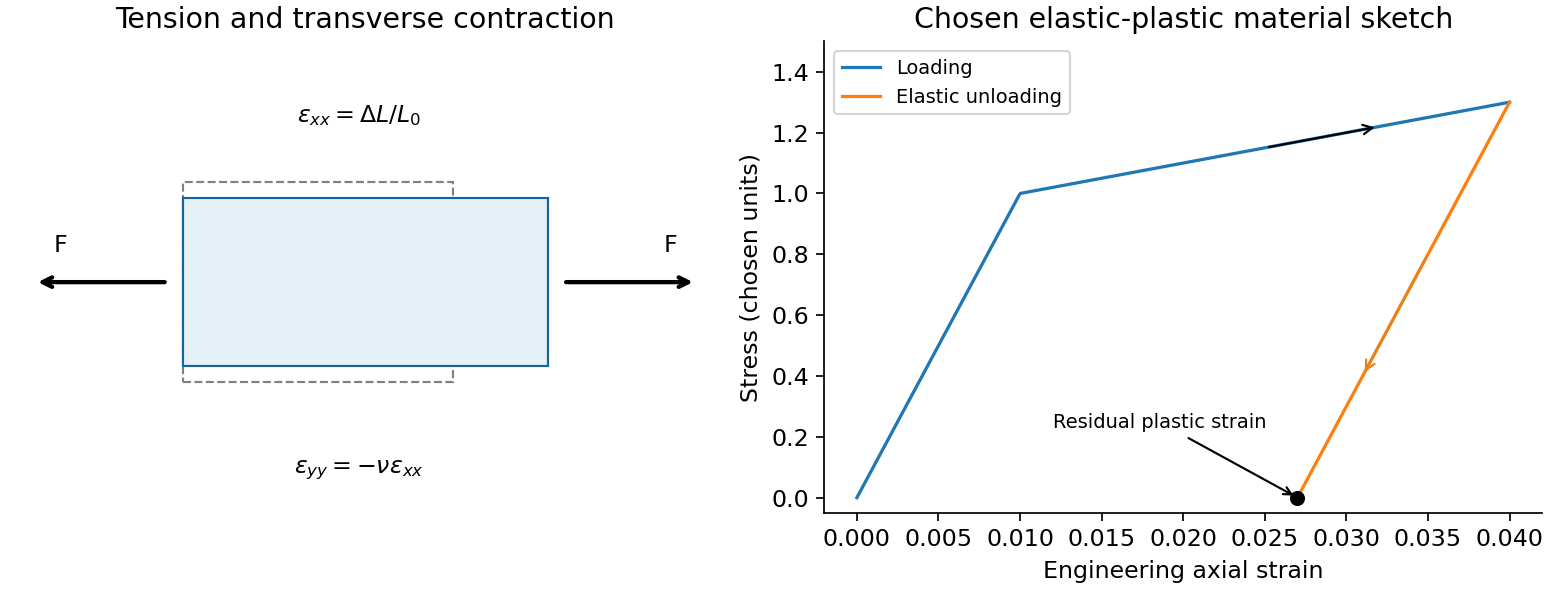
A tensile test should measure force and gauge-length extension independently, correct machine compliance, align the grips, and control strain rate and temperature. Unloading distinguishes recoverable strain from a residual plastic extension. Separate shear or hydrostatic tests determine moduli that one axial measurement does not fix. Compression specimens need friction and buckling checks. Work per volume is ; the recoverable part is elastic energy, while a dissipative cycle produces a loss rather than creating energy. The original loading/unloading curve below is a chosen constitutive sketch, not measured material data.

Past exam of the physics B course of the University of Cambridge 2010 Paper 1 Section B B7 Solution by Codex 0 2026-10-20
Codex 0 2026-10-20State a time convention before using complex response: take fields proportional to , with and for a passive wave entering the material. In a homogeneous Ohmic medium, Maxwell equations with giveThe ohmic-conductor complex wavenumber describes both phase advance and amplitude decay. Real constant conductivity is only a low-frequency approximation. In the Drude model, giveswith a fixed positive ionic background and no additional bound-electron contribution in this simple model. The plasma frequency marks the inertial electron-response scale. More elaborate band structure, interband transitions and nonlocal transport limit this scalar treatment.[ref]
Electromagnetism lecture notes by Richard Fitzpatrick. Dielectric constant of a collisional plasma, equations (1201)–(1205): electron inertia, collisions and dielectric response
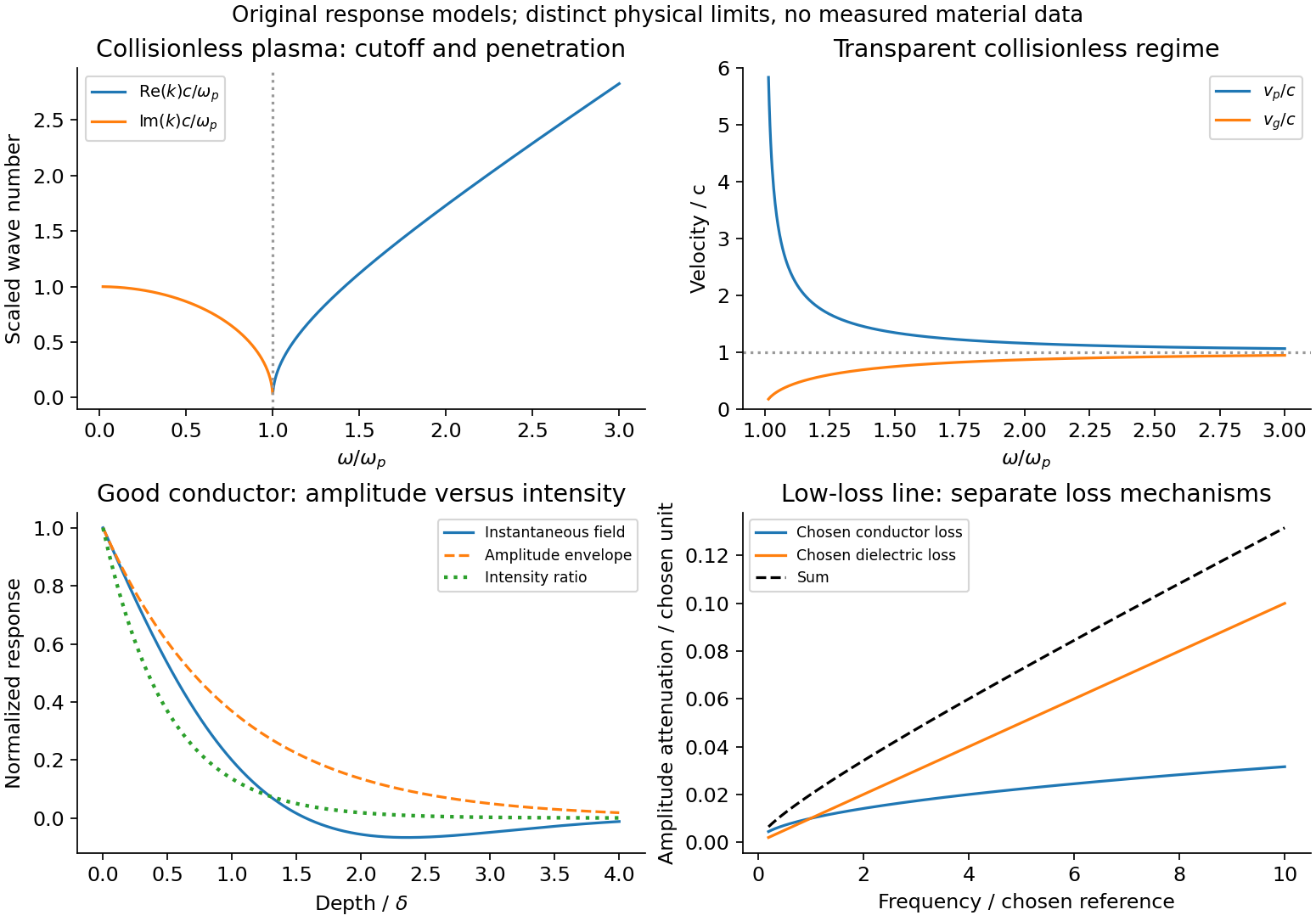
In the collisionless nonmagnetic limit, the dispersion relation is . For ,A crest can move faster than without carrying a new signal faster than light. Below cutoff the ideal wave is evanescent, with penetration length ; it does not propagate as an ordinary real- bulk wave. Evanescence in the lossless limit is not Joule dissipation. Nonzero collision rate gives a dissipative conductivity and smooths this ideal cutoff picture.
For a good conductor with approximately real , the spatial branch becomesA field amplitude falls as , while intensity falls as . The phase velocity is in this limit. Magnetic and electric amplitudes are not related by the vacuum ratio: with the chosen time convention. Its positive real part is the surface resistance. The local mean heating is , consistent with electromagnetic energy flowing into the metal. skin depth is an amplitude length; interpreting it as an intensity length gives a factor-of-two error.
A transmission-line mode propagates chiefly through the dielectric between conductors, even though finite metal conductivity causes loss at its boundaries. With per-length parameters , the telegrapher's equations give, for the same convention,Writing a forward wave as , , gives . In the low-loss regime and , set to obtainThis low-loss transmission-line attenuation separates series conductor loss from dielectric leakage loss. Average forward power falls as . In the normal skin-effect regime, reduced conducting area makes the AC conductor resistance increase roughly as ; dielectric loss can supply a separate frequency dependence. Reflection from a mismatched termination changes delivered power without being, by itself, dissipation in the line.[ref]
Electromagnetic Fields and Energy by Hermann A. Haus and James R. Melcher. Chapter14, §§14.7–14.9: distributed losses, Ohmic waves and conductor-loss approximation
To test loss, compare several lengths of otherwise identical line with matched terminations, calibrate connectors and incident/reflected power, and monitor temperature. Separate amplitude attenuation from phase delay and from standing-wave minima. Bulk penetration, line attenuation and dielectric propagation speed are related electromagnetic quantities but describe different experimental geometries.
Conducting-wave propagation
. Chosen dispersion and decay models. Details.
Past exam of the physics B course of the University of Cambridge 2010 Paper 1 Section A 5 Solution by Codex 0 2026-10-20
Codex 0 2026-10-20Use a circular Kepler orbit to eliminate the terrestrial gravitational parameter: is constant for both satellites. The reference orbital radius is , measured from Earth's centre. A geostationary orbit is circular, equatorial and prograde, with the sidereal rotation period, approximately . ThusIts altitude is about above the stated surface. The approximate low-orbit input sets the accuracy; replacing it by a modern measured gravitational parameter would answer a different numerical estimate. A -hour approximation changes the radius by less than . Matching the period alone would not make an inclined or eccentric orbit stationary above one point.
Past exam of the physics B course of the University of Cambridge 2010 Paper 1 Section A 4 Solution by Codex 0 2026-10-20
Codex 0 2026-10-20For a plane wave propagating along in vacuum, Maxwell equations give , with . HenceTaking , the period average of the squared cosine is . ThusThe fields are in phase, so the travelling-wave energy flux never reverses. The peak amplitude convention is essential; using a root-mean-square electric field would remove the factor .
Past exam of the physics B course of the University of Cambridge 2010 Paper 1 Section A 3 Solution by Codex 0 2026-10-20
Codex 0 2026-10-20Let be heat extracted from the cold reservoir, the heat delivered to the surroundings and the supplied work. The entropy inequality for a cyclic refrigerator isEquality is the reversible Carnot refrigerator limit. Thereforeenergy conservation gives . The requested rejected heat is 75 J, while 74 J is the minimum work; both have to be distinguished. Any entropy production increases the required rejection at these fixed reservoir temperatures.
Past exam of the physics B course of the University of Cambridge 2010 Paper 1 Section A 2 Solution by Codex 0 2026-10-20
Codex 0 2026-10-20Use local east, north and up axes. At latitude , and eastward velocity is . The Coriolis acceleration isIts horizontal part is southward, so the lift must acquire a northward component: bank left, with the north wing lower. For the requested local Coriolis correction, let the vertical lift balance . The Coriolis bank angle for eastward flight isUse and . Including the upward Coriolis term replaces by and changes the answer by only about . This is the horizontal Coriolis compensation, not a full calculation of a curved constant-latitude flight path. The rotation rate follows Earth's sidereal period.[ref]
Earth Fact Sheet by National Aeronautics and Space Administration. Orbital parameters: sidereal rotation period 23.9345 hours
Past exam of the physics B course of the University of Cambridge 2010 Paper 1 Section A 1 Solution by Codex 0 2026-10-20
Codex 0 2026-10-20For a fixed linear circuit, self-inductance relates the magnetic flux linkage produced by its own current to that current: , with . The self-induced electromotive force is when is constant. Its unit is the henry, .
mutual inductance relates the linkage in one circuit to current in another: and . For stationary reciprocal linear media, with consistently oriented turns, and . Orientation fixes the sign. The coupled magnetic energy is , so positivity requires . Moving coils or nonlinear cores require differentiation of the full linkage rather than treating the inductance as a constant.
There are unlisted articles, also show them or only show them.