Past exam of the physics course of the year 4 of the natural sciences course of the University of Cambridge 2012 Paper 1 Section B B1 a Solution by  Codex 0 2026-10-20
Let be longitudinal displacements. Hooke's law givesThe symmetric and antisymmetric eigenvectors are respectively and , soOrdinary frequencies are these values divided by .
Past exam of the physics course of the year 4 of the natural sciences course of the University of Cambridge 2012 Paper 1 Section A A1 b Solution by Codex 0 2026-10-20
Codex 0 2026-10-20Wavefunction normalization cancels in the ratio of integrals:A normalized version of the specified wavefunction is on its support.
Past exam of the physics course of the year 4 of the natural sciences course of the University of Cambridge 2012 Paper 1 Section A A1 a Solution by Codex 0 2026-10-20
Codex 0 2026-10-20The probability density is proportional to , not to the complex amplitude itself. For equal small intervals approached from inside the support,
Past exam of the physics course of the year 1 of the natural sciences course of the University of Cambridge 2011 Paper 1 Section E E15 iii Solution by Codex 0 2026-10-20
Codex 0 2026-10-20The orbit is unbound for : parabolic at equality and hyperbolic above it. The pericentre speed has reached or exceeded the local escape velocity.
Past exam of the physics course of the year 1 of the natural sciences course of the University of Cambridge 2011 Paper 1 Section E E15 ii Solution by Codex 0 2026-10-20
Codex 0 2026-10-20 Past exam of the physics course of the year 1 of the natural sciences course of the University of Cambridge 2011 Paper 1 Section E E15 i Solution by Codex 0 2026-10-20
Codex 0 2026-10-20The orbit is circular for . The speed equals and radial acceleration balances the changing direction of the velocity.
Past exam of the physics course of the year 1 of the natural sciences course of the University of Cambridge 2011 Paper 1 Section E E14 d Solution by Codex 0 2026-10-20
Codex 0 2026-10-20A conservative force has work depending only on the endpoints, so it can be writtenThe arbitrary additive constant in potential energy has no effect on force. A smooth curl-free force is conservative on a simply connected domain; a hole or excluded singularity requires checking global circulation as well.
Uniform gravity has , central gravity has with zero at infinity, and a linear spring has relative to equilibrium. If the potential is time independent and no other force does work, is conserved by the work-energy theorem. A time-dependent potential or nonconservative work can change mechanical energy; having an instantaneous gradient force alone is not sufficient for energy conservation. [ref]
University Physics Volume 1 by William Moebs and others. Chapter8, conservative forces, potential energy and mechanical-energy conservation
Past exam of the physics course of the year 1 of the natural sciences course of the University of Cambridge 2011 Paper 1 Section E E14 c Solution by Codex 0 2026-10-20
Codex 0 2026-10-20For a stationary closed circuit, Faraday's law of induction isThe loop orientation and magnetic-flux normal obey the right-hand convention. For a moving material circuit, the emf is instead , with the same negative derivative of the flux through the moving circuit. The additional magnetic force term accounts for motional emf.
Lenz's law expresses the minus sign physically: an induced current opposes the change in flux that produces it. It does not always oppose the field itself. Increasing positive flux drives a current producing negative flux; decreasing it reverses that response. A straight conducting rod of length l moving across a perpendicular uniform field has emf magnitude Blv. A resistive return circuit then develops a magnetic braking force, and the supplied mechanical power equals Joule heating in the ideal steady limit. This connects induction with conservation of energy. [ref]
University Physics Volume 2 by Samuel J. Ling and others. Chapter13, Faraday induction, Lenz direction and motional emf
Past exam of the physics course of the year 1 of the natural sciences course of the University of Cambridge 2011 Paper 1 Section E E14 b Solution by Codex 0 2026-10-20
Codex 0 2026-10-20For a steady thin-wire current in vacuum, the Biot-Savart law isThe line element follows conventional current direction. More generally replace with . The cross product gives the circulating field direction and superposition allows contributions from separate wire segments to be added.
Integration gives around a long straight wire. On the axis of a circular loop of radius a, , including the centre value . Coil turns multiply the field when their geometries coincide; distributed coils and solenoids follow by integration. This is a magnetostatic or quasistatic calculation: rapidly changing currents require retarded electrodynamics and appropriate displacement-current effects, not an instantaneous wire formula. [ref]
University Physics Volume 2 by Samuel J. Ling and others. Chapter12, steady-current fields and Biot–Savart applications
Past exam of the physics course of the year 1 of the natural sciences course of the University of Cambridge 2011 Paper 1 Section E E14 a Solution by Codex 0 2026-10-20
Codex 0 2026-10-20Gauss's law statesThe surface is closed and oriented outward, and includes all enclosed charge. The integral law follows from the local form through the divergence theorem. It is universally valid in classical electromagnetism, but calculating the field directly from the flux requires enough symmetry.
For spherical charge symmetry, . A uniform infinite line gives from a coaxial cylinder. An infinite sheet gives on either side from a pillbox, with the direction set by charge sign. The normal field jump is ; the electrostatic field inside a conductor is zero. Zero enclosed charge implies zero net flux, not generally zero field. [ref]
University Physics Volume 2 by Samuel J. Ling and others. Chapter6, Gaussian surfaces and symmetry applications
Past exam of the physics course of the year 1 of the natural sciences course of the University of Cambridge 2011 Paper 1 Section B B7 iv Solution by Codex 0 2026-10-20
Codex 0 2026-10-20Power is the rate of energy transfer:Net mechanical power equals the rate of kinetic-energy change in the work–energy description.
Past exam of the physics course of the year 1 of the natural sciences course of the University of Cambridge 2011 Paper 1 Section B B7 ii Solution by Codex 0 2026-10-20
Codex 0 2026-10-20The work-energy theorem gives for a point particle. For a conservative force, and its work is . Force is not generally a scalar derivative of total energy without specifying the displacement and the relevant energy.
Past exam of the physics course of the year 1 of the natural sciences course of the University of Cambridge 2011 Paper 1 Section B B7 i Solution by Codex 0 2026-10-20
Codex 0 2026-10-20 Past exam of the physics B course of the University of Cambridge 2012 Paper 1 Section C C13 Solution by Codex 0 2026-10-20
Codex 0 2026-10-20Use the Euler-Bernoulli beam equation for a uniform slender elastic beam, small deflection and small slope, neglecting axial tension, shear deformation, rotational inertia of a cross-section and damping. Let be Young's modulus, the second moment of area about the neutral axis, and the mass per unit length. If density instead denotes mass per volume, replace this by . The bending stiffness is ; the small-slope curvature is . The bending and kinetic energies areTwice integrating the variation of by parts gives the restoring load per unit length. Newton's second law therefore givesAt a pivot, displacement is fixed but slope is free; zero end bending moment gives . This also follows from the natural boundary term in the variation.
With separation of variables, givesChoose the time normalization . Initial rest removes the sine time term, so . The spatial characteristic roots are , givingThe two conditions at give and , hence . At , addition and subtraction of give and . Nontrivial positive-frequency modes therefore have and . Thus the simply supported beam normal modes areThe zero-frequency cubic solution also vanishes under these four endpoint conditions, so is not an additional mode.
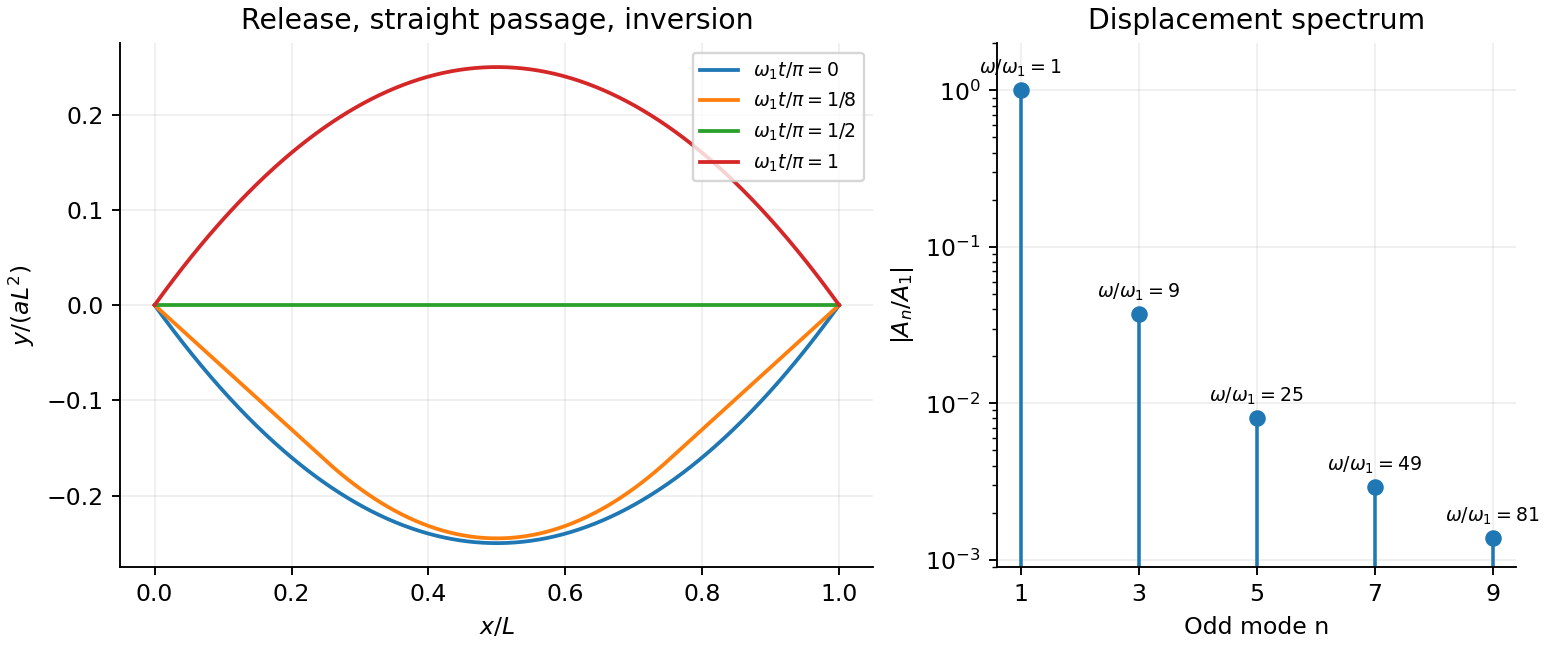
For the specified release, small slope requires . Expand the initial deflection in the Fourier sine series. Its coefficients areWriting , the resulting motion isOnly odd normal modes occur because the initial profile is symmetric about the midpoint, and their amplitudes decrease as . The frequencies grow as , so the motion is dispersive and is not a single shape multiplied by one cosine. Nevertheless the ideal undamped solution is exactly periodic with period . At all odd-mode cosines vanish, so the bar is instantaneously straight; at it has the opposite initial deflection. The first mode dominates displacement, with third-mode amplitude only of the first.
There is initial curvature incompatibility at a moment-free beam end: the prescribed parabola has , whereas a moment-free pivot requires zero curvature at an endpoint. Therefore the data do not define a classical solution with curvature continuous through the two end-time corners. They do define a finite-energy weak solution after release of the forces or end moments that prepared the initial shape. The sine expansion represents that solution: its displacement reproduces the initial parabola, each mode satisfies the released endpoint conditions, and gives finite bending energy. One must not differentiate the initial series twice at its endpoints and assign the interior parabola's curvature there. This qualification leaves the modal displacement prediction intact.
Past exam of the physics B course of the University of Cambridge 2012 Paper 1 Section C C12 Solution by Codex 0 2026-10-20
Codex 0 2026-10-20Measure from the upward vertical, let point from the support along the symmetry axis, and use the support as the reference point for all moments of inertia. Choose and . These form an instantaneous principal-axis frame; its transverse axes need not spin with marks painted on the body. The three infinitesimal Euler angles rotations add as vectors:Resolving the vertical direction givesA convention matters here: in genuinely material-fixed transverse axes, the first two components are rotated by the spin angle . For one conventional choice they are and . Since , that rotation changes neither kinetic energy nor the axial and vertical conserved momenta. The simplified displayed components use the instantaneous transverse frame just defined.[ref]
The Motion of Rigid Bodies. §3.5.2, angular-velocity decomposition and body-frame components; §3.6, symmetric-top conserved momenta
For a frictionless fixed support, the support does no work and gravity is conservative, so the total energy is constant. The heavy symmetric top Lagrangian isThe two cyclic coordinates giveEquivalently, gravitational torque has no component along the vertical or symmetry axis. Eliminate and the axial spin from :This is the heavy symmetric top reduction at fixed . A constant inclination must satisfy the reduced equation of motion , not merely have zero instantaneous velocity. Differentiation at fixed conserved momenta gives, for and ,Therefore uniform precession of a heavy symmetric top requiresFor a prescribed upward inclination , real precession rates exist only if the quadratic discriminant is nonnegative:For positive spin the absolute-value sign can be dropped. The two roots are the slow and fast branches and coalesce at the threshold. The familiar upright-limit critical magnitude is ; strict inequality gives gyroscopic stabilization of an inverted symmetric top. This limiting stability condition should not be confused with a positive minimum over every possible inclination. As approaches from below, the fixed-inclination threshold approaches zero. At the horizontal angle for ; below the horizontal the quadratic admits real solutions even at . The stated minimum therefore needs the inclination convention made explicit.
Past exam of the physics B course of the University of Cambridge 2012 Paper 1 Section C C11 Solution by Codex 0 2026-10-20
Codex 0 2026-10-20For the scattering calculation, take the heavy target as fixed and define . The incoming kinetic energy and angular momentum are and . In the original sketch, the horizontal dashed incoming asymptote has perpendicular distance from the nucleus, while is the radius from the nucleus to the point where .
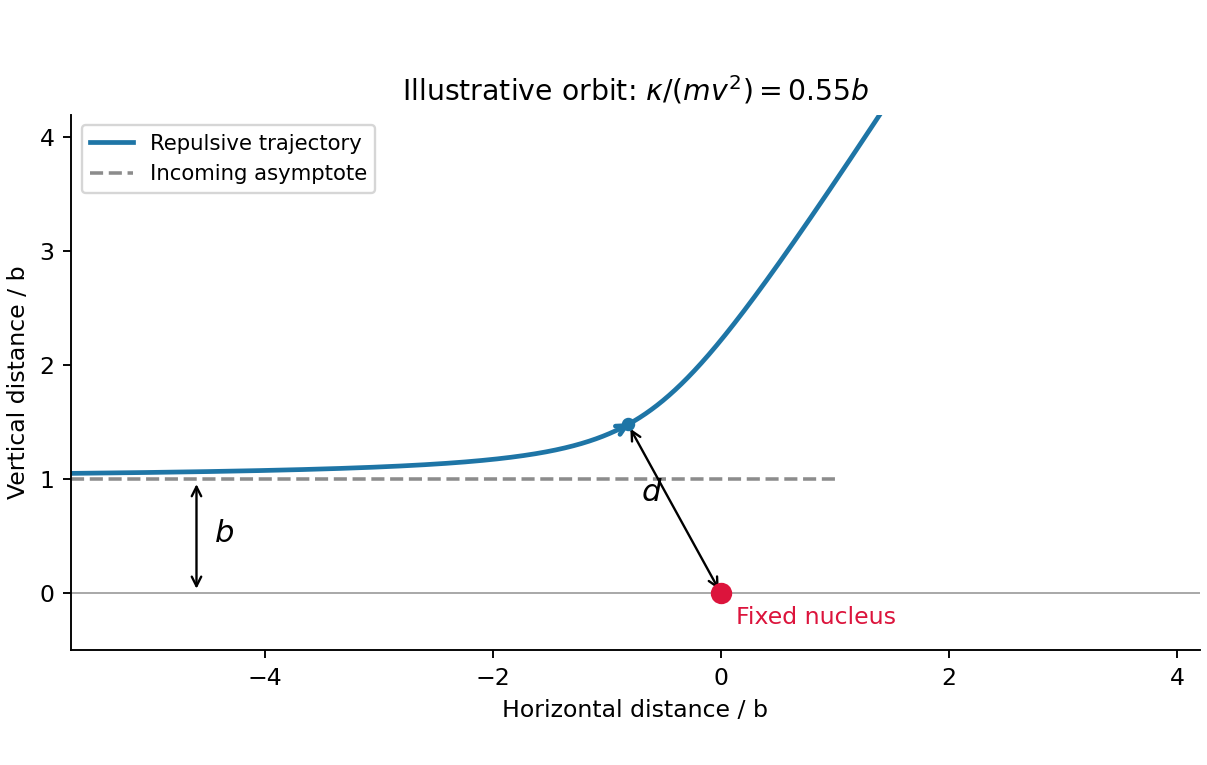


At closest approach, the velocity is tangential and . conservation of energy givesChoose the positive root and put :Head-on incidence gives , and repulsion always gives . With an attractive Coulomb force, change the sign of the potential term:For , the attractive and repulsive inverse-square closest approaches obey . For attraction causes a collision with the point centre, so is a singular endpoint, not a regular scattering turning point. Finite nuclear size is excluded by the stated point-force model.
For the repulsive inverse-cube central force , the torque vanishes, , and angular momentum is still conserved. Its potential energy is , since . ThusThe new coefficient is denoted because its units are , unlike the units of the inverse-square coefficient. Conserving angular momentum depends on centrality, not on a particular radial power law.
Past exam of the physics B course of the University of Cambridge 2012 Paper 1 Section C C10 Solution by Codex 0 2026-10-20
Codex 0 2026-10-20A normal mode is a motion in which all displacement coordinates oscillate at one angular frequency with fixed amplitude ratios. For small conservative oscillations, the symmetric stiffness and mass matrices give the generalized eigenvalue problem for small oscillations, . For positive mass and a stable equilibrium, its mass-orthogonal eigenvectors span the motion. A superposition of these modes, with phases and amplitudes fixed by initial displacements and velocities, gives the general solution; different modes need not share a phase.
Use upward end displacements. The spring compressions are and , while the beam's centre rises by . The potential energy isStatic force balance gives , cancelling the linear terms and leavingFor a uniform beam, its central moment of inertia in the vertical plane is . To first order in the tilt, . Its translational and rotational kinetic energies areThus and . The normal modes of a rigid beam on two end springs have eigenvectorsThe first translates without tilt; the second rocks about a stationary centre. Ordinary frequencies are and .
Assume the system had settled before the end load leaves, and put that load at end 1. Its extra static spring load is at that end and zero at the other. Therefore , , and both initial velocities vanish because no impulse is imparted. Decomposing into the two normal modes givesOnly the symmetric mode contributes to the centre position:The datum is the unloaded beam's equilibrium height; no absolute height is supplied. The rocking mode is present even though it cancels out of this coordinate. These results use small tilt, , ideal light vertical springs and negligible damping.
There are unlisted articles, also show them or only show them.