Past exam of the physics B course of the University of Cambridge 2012 Paper 1 Section B B9 Solution by  Codex 0 2026-10-20
Use peak-amplitude phasors with time factor and . Faraday's law of induction and the Ampere-Maxwell law giveIn the good-conductor limit , take the root with positive attenuation into the slab:The real physical field is . A thick slab excludes a returning wave from its rear face. The skin depth is the electric-field amplitude decay length; the intensity decay length is .
Faraday's law of induction fixes . The surface impedance of a good conductor and the complete transmitted magnetic field are consequentlyThe sign of the imaginary part belongs to the stated time convention. Average the Poynting vector using complex conjugation and the factor one half appropriate to peak phasors:As an independent energy check, , the mean Joule heating per unit volume.
Ohm's law gives and . Hence the averaged Lorentz force per unit volume isIntegrating through the illuminated half-space gives the positive inward radiation pressureFinally let be the vacuum wave impedance. Tangential-field boundary conditions at normal incidence give the electric-amplitude reflection coefficient . Since ,Here by surface energy balance. Combining the leading formulas gives , the nearly perfect-reflector limit. The displayed reflection expansion also assumes a good conductor relative to the incident vacuum wave, .
Past exam of the physics B course of the University of Cambridge 2012 Paper 1 Section B B8 Solution by Codex 0 2026-10-20
Codex 0 2026-10-20For a steady thin-wire electric current, the Biot-Savart law iswhere the source element follows positive current. For a circular loop, source points are and the observer is . Their cross product with has axial component ; transverse components integrate to zero. Thus the on-axis magnetic field of a circular current loop, multiplied by the number of coincident turns, isTake positive current counterclockwise as seen from . magnetic field lines pass upward through the loop and return around its exterior, closing rather than terminating. They fan outward above its centre and converge below it. The original numerical Biot-Savart law integration below illustrates these directions; the wire singularities are masked.
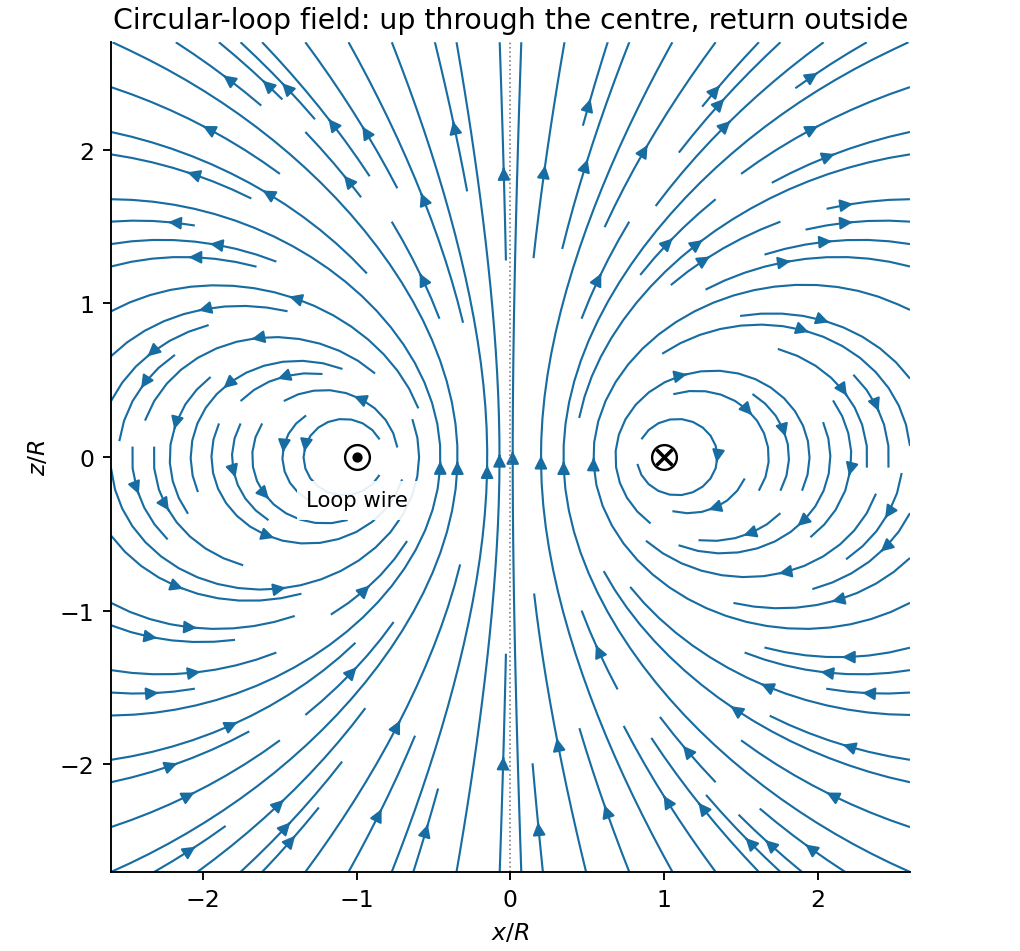
Original circular-loop magnetic field lines in a meridional cross-section
. Details. The axisymmetric magnetic field near a regular axis follows from Gauss's law for magnetism. In cylindrical coordinates, regularity gives , while symmetry gives . Integrate from the axis:A formal term is excluded by regularity. For the axial field decreases upward, so the radial component is outward, consistent with the sketch.
On the small receiving coil, . The Lorentz force has axial component . Contributions from the axial field cancel radially around the loop. ThereforeWith both currents giving magnetic dipole moments along and , this is attraction. Reversing one current reverses the force. The small coil has , so the result is exactly the leading magnetic dipole force . Equivalently . The approximation requires and negligible variation over the receiving coil; corrections begin at relative order .
Past exam of the physics B course of the University of Cambridge 2012 Paper 1 Section B B7 Solution by Codex 0 2026-10-20
Codex 0 2026-10-20For fixed, magnetically linear geometry, self-inductance relates a coil's own magnetic flux linkage to its electric current, . mutual inductance relates the linkage in one coil to the current in the other, . These coefficients enter the induced electromotive forces through ; reversing a chosen winding orientation reverses the sign assigned to .
In the ideal confined-field toroid, a circular magnetostatic Ampère law contour encloses , soWrite for the height of the square cross-section. The inductance of a rectangular-section toroid follows by integrating the magnetic flux density over that cross-section; it cannot be replaced by its value at an arbitrary mean radius:Consequently, for winding normals chosen consistently,The equality means complete shared magnetic flux linkage; with leakage one instead has .
For the crack, use the radial-path approximation for a cracked toroid, with an air length on each path and core length . Continuity of the normal magnetic flux density at a crack face gives . HenceIntegrating the radial paths yieldsHere and : about a 53% reduction. The small ratio does not justify expanding in , which is about ten. The crack's low magnetic permeability gives appreciable magnetic reluctance. This is an estimate within a confined-flux model; actual redistribution near the slit is outside its accuracy. Narrow-gap circuit models assume small gap width relative to transverse dimensions and approximately directed flux.[ref]
Magnetic Circuits. §9.7, Example 9.7.1 and the paragraph after it: air-gap circuit approximation and need for a more general field solution
For the intact ring, ideal poloidal winding currents and the no-leakage boundary condition admit with zero radial and vertical components. It is curl-free inside the current-free core, divergence-free for uniform magnetic permeability, tangent to the core boundary, and has the required circulation; uniqueness of the Neumann problem removes an additional homogeneous scalar-potential field. This explains zero non-azimuthal components in the stipulated intact-ring idealization. A literal slit breaks that rotational symmetry, so zero transverse components everywhere is not exact for the cracked ring: magnetic fringing and flux redistribution occur. In fact, extending the approximate unchanged around a current-free core would give . Thus that radial-path calculation and a claim of exact purely azimuthal field in the cracked geometry cannot both be exact. The numerical answer above retains the intended circuit approximation while making its limitation explicit.
Past exam of the physics B course of the University of Cambridge 2012 Paper 1 Section B B6 Solution by Codex 0 2026-10-20
Codex 0 2026-10-20In a charge-free region of homogeneous permittivity, Gauss's law and give Laplace's equation, . Prescribed surface electric potentials specify a Dirichlet problem. Its Uniqueness of the Dirichlet problem permits replacing conductors by fictitious charges outside the physical solution region: a harmonic candidate with the same boundary conditions is the physical solution. For an exterior problem its behaviour at infinity must also be prescribed. For a proof, subtract two candidate potentials to obtain with zero boundary values. Green's first identity gives , so is constant and its boundary value fixes it to zero. Conditions on a normal electric field instead determine a potential only up to an additive constant when the usual compatibility condition holds.
A cylindrical Gaussian surface around an infinite line charge gives . The electric potential difference is thereforeAn isolated infinite line charge has no finite potential zero at infinity. For the opposite pair, however, the logarithmic growth terms cancel and one can choose there. Define and . superposition givesOn ,Thus the circle, and its cylindrical extension, is an equipotential. This is an Apollonius circle: a constant ratio of distances gives a circle rather than a constant distance from either charge.
For the cylinder above the plane, call its centre height and set . The cylinder-plane image charges are at height and at height . Their distances are equal on the grounded plane, while their distance ratio is on the circular surface. The positive fictitious line lies inside the metal, so the exterior is charge-free and Uniqueness of the Dirichlet problem applies. A Gaussian surface enclosing the physical cylinder confirms that its charge per unit length is indeed . Its voltage isThe physical field energy per unit length at fixed cylinder charge is . Differentiate with respect to height, keeping and fixed:The electrostatic attraction per unit length of a cylinder above a plane is downward for either sign of charge. Placing the fictitious line at the cylinder centre would give the wrong answer at this separation. The long-cylinder approximation neglects the ends.
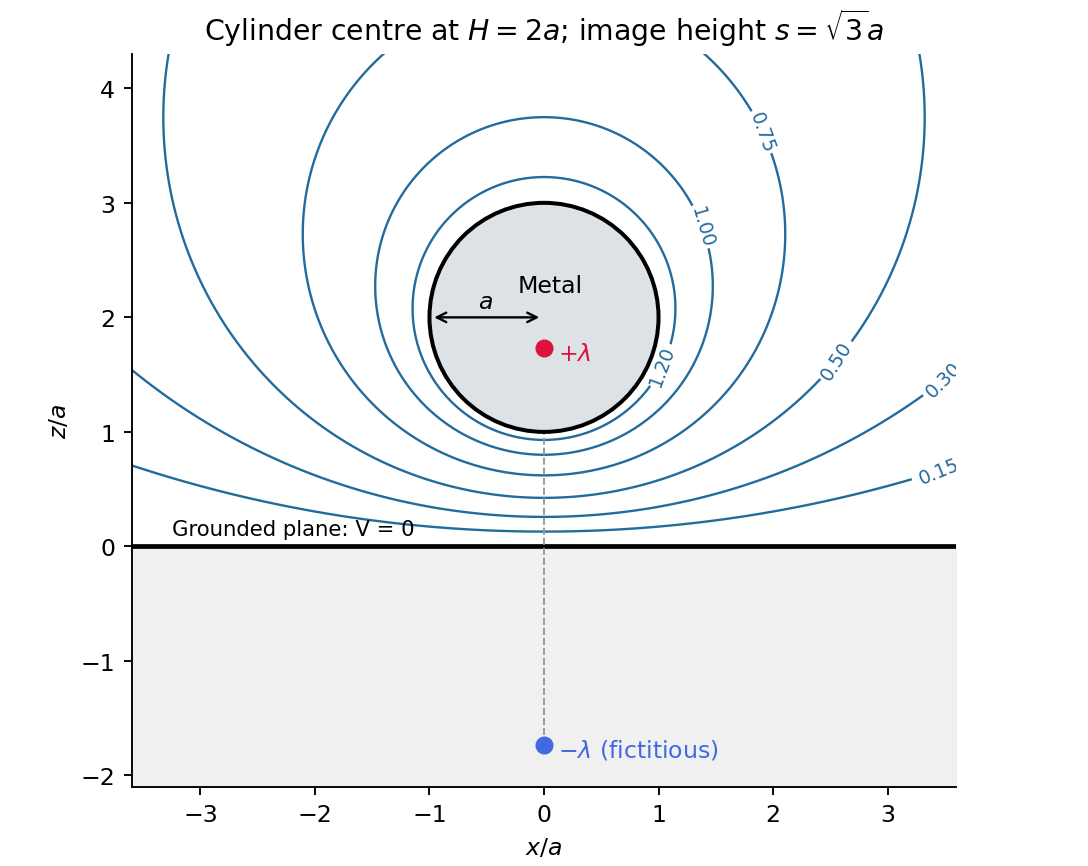
Original cylinder-plane image charges construction and exterior equipotentials
. Details. Past exam of the physics B course of the University of Cambridge 2012 Paper 1 Section A A5 Solution by Codex 0 2026-10-20
Codex 0 2026-10-20For the inertia tensor of a uniform cube, reflection symmetry makes every off-diagonal element of the central inertia tensor vanish. Permutation of the three axes makes its diagonal elements equal. Since and the mean of each squared coordinate in the cube is ,Every central axis is therefore a principal axis, including the body diagonal. The angular momentum is parallel to the angular velocity, and its magnitude is
Past exam of the physics B course of the University of Cambridge 2012 Paper 1 Section A A4 Solution by Codex 0 2026-10-20
Codex 0 2026-10-20The Stefan–Boltzmann law gives solar luminosity . At orbital distance , the incident irradiance is . A spherical absorber intercepts a disc of area but radiates over . Thus the uniform-temperature radiative equilibrium estimate isThe planetary radius cancels. This is a black-body radiation estimate with zero reflected fraction and complete redistribution of absorbed heat. More generally the balance fixes , rather than the arithmetic mean of a nonuniform surface temperature. It excludes atmospheric heating and thermal lag; no measured surface temperature is inferred.
Past exam of the physics B course of the University of Cambridge 2012 Paper 1 Section A A3 Solution by Codex 0 2026-10-20
Codex 0 2026-10-20For a hollow, air-filled rectangular electromagnetic waveguide with conducting walls, transverse confinement givesA transverse electric mode of a rectangular waveguide permits one zero index, but not two; a transverse magnetic mode of a rectangular waveguide requires both indices positive. Take and . The dominant mode is , withThe waveguide cutoff frequency is the limiting value: positive axial group velocity and propagating power require . There is no transverse electromagnetic mode in this single hollow conducting pipe; otherwise a zero cutoff would incorrectly follow.
Past exam of the physics B course of the University of Cambridge 2012 Paper 1 Section A A2 Solution by Codex 0 2026-10-20
Codex 0 2026-10-20Choose the plate polarity so that the gap electric field points along when . Away from the plate edges, the quasistatic electromagnetic approximation gives . A circular Ampere-Maxwell law contour of radius then givesIt is displacement current, rather than a conduction current across the air, that supplies the enclosed current term. The direction follows the right-hand rule for increasing positive electric flux; it reverses every half cycle. In the ideal extension that sets the gap electric field to zero outside the plate footprint, for . That extension is an edge approximation, not an exact exterior solution for finite plates. Neglect fringing field of a capacitor and retardation, requiring and .
Past exam of the physics B course of the University of Cambridge 2012 Paper 1 Section A A1 Solution by Codex 0 2026-10-20
Codex 0 2026-10-20Use absolute thermodynamic temperatures and assume a constant-parameter Arrhenius equation, with composition held fixed so that reaction rate is proportional to the rate constant. Write , where . two-temperature Arrhenius extrapolation eliminates the unknown Arrhenius prefactor and givesConsequentlyA tenfold increase for one interval does not imply another tenfold increase for the next interval: the Arrhenius plot is linear in inverse temperature. Two measured rates alone do not specify a unique extrapolation without a rate law for its temperature dependence; the result above states that modelling assumption explicitly.
Past exam of the physics B course of the University of Cambridge 2011 Paper 2 Section C C13 Solution by Codex 0 2026-10-20
Codex 0 2026-10-20A normal mode is a small-oscillation motion with every coordinate proportional to one common sinusoid, at a fixed amplitude ratio and relative phase. Expanding an arbitrary small motion in normal mode coordinates decouples its linear equations into independent oscillators. With mechanical mass matrix and mechanical stiffness matrix , the generalized eigenvalue equation is .
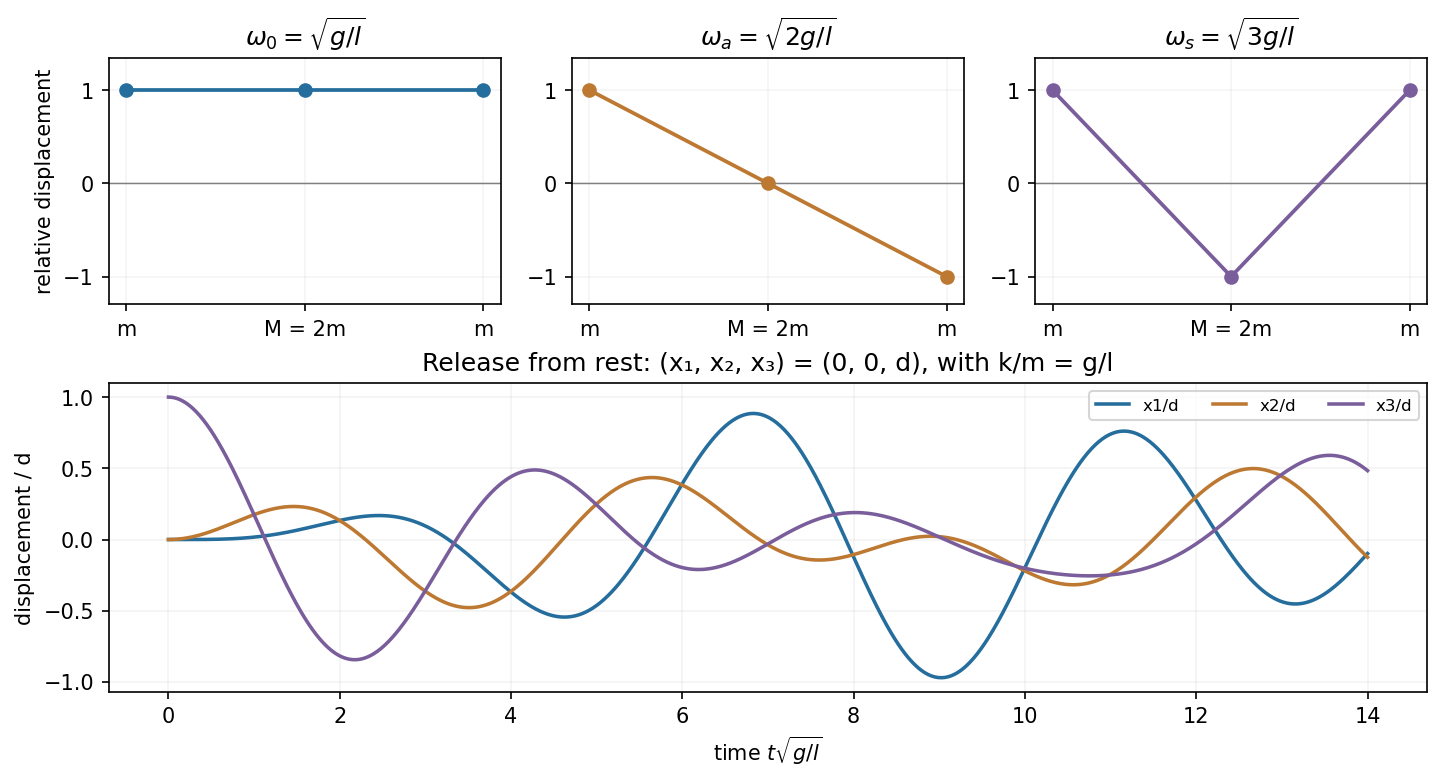
Horizontal gravitational restoring force on each bob is . The two springs add on the first bob, on the middle bob, and on the last. Dividing by the bob masses gives the stated equations withReflection symmetry separates an antisymmetric end motion from two symmetric motions. The three coupled pendulums with equal end masses have independent modesCall their positive frequencies respectively. The middle amplitude in the last mode ensures . The modes are orthogonal in the mass-weighted inner product, rather than generally in the unweighted coordinate dot product.
The initially stationary displacement decomposes asThere are no sine terms because every initial velocity is zero. ThereforeThese give at and solve all three coupled equations. The spring constant is assumed positive; for the frequencies become degenerate and the same superposition reduces to uncoupled pendulum motion.
Past exam of the physics B course of the University of Cambridge 2011 Paper 2 Section C C12 Solution by Codex 0 2026-10-20
Codex 0 2026-10-20Write and . For a circular orbit of radius , centripetal balance gives . Thus and . Since , , these agree with the general expressions.
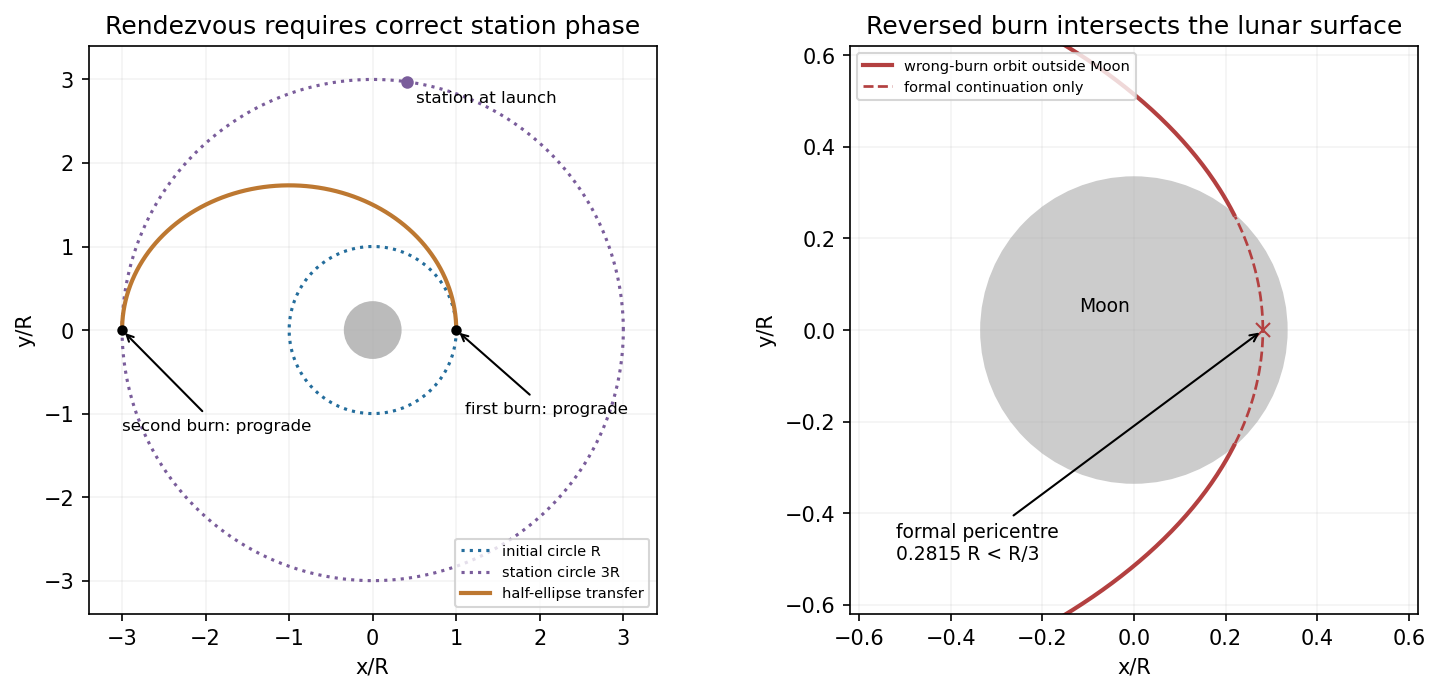
For an outward coplanar Hohmann transfer, burn prograde at the inner circle to put its radius at the ellipse's pericentre, then burn prograde at apocentre to circularize at the station's radius. The station must be phased to meet the spacecraft there. With , ,Energy at the first burn, with , givesAngular momentum is conserved along the transfer ellipse, so , while the outer circular speed is . For ,The correct second impulse adds . The reversed circularization burn in a Hohmann transfer, using the same impulse magnitude, instead leavesIts magnitude is below the circular speed at , so that point is the new apocentre. Define . For an ellipse at apocentre, , givingThe lunar radius is . Since , the osculating orbit intersects the Moon: the spacecraft crashes before reaching its formal pericentre. The calculation uses impulsive tangential burns and a spherical central gravitational field; it does not assume that a trajectory continues through the solid body.
Past exam of the physics B course of the University of Cambridge 2011 Paper 2 Section C C11 Solution by Codex 0 2026-10-20
Codex 0 2026-10-20Let denote distance from the neutral axis within a cross section. Bending to radius gives longitudinal strain , so Hooke's law gives stress . Its moment isHere is Young's modulus and is the second moment of area, not a mass moment of inertia. For the stated square orientation, .
For self-weight deflection of a square cantilever, the downward load per unit length is . A free-end segment from to has shear-force magnitude and bending-moment magnitude . Thus, with the given sign conventions,Using the small-slope curvature for downward deflection,The clamp fixes position and slope, and the unloaded free end has zero moment and shear:Four integrations yieldThe linear beam model requires small slopes and strains; the strong dependence eventually invalidates that approximation if other dimensions and material properties are fixed.
Past exam of the physics B course of the University of Cambridge 2011 Paper 2 Section C C10 Solution by Codex 0 2026-10-20
Codex 0 2026-10-20Relative to an origin, the inertia tensor is , with . Its orthogonal eigenvectors are principal axes, with eigenvalues the principal moments of inertia. Different components of are multiplied by different eigenvalues, so angular momentum need not point along angular velocity.
For a uniform thin disc, radial integration gives . The perpendicular axis theorem and symmetry then give , henceFor the elastic eccentric impact of a thin disc, neglect gravity's impulse and take the pole's impulse as vertical. Let point up and let the contact position relative to the centre be . An upward impulse givesFor an elastic impact with a fixed pole, the contact point reverses its normal velocity, so . ThereforeHere denotes upward motion; the centre can still move down if . Substitution givesThis also follows by combining conserved angular momentum about the fixed contact with conserved kinetic energy and selecting the separating, nonzero-impulse solution. At the disc simply rebounds without rotation; at its centre is instantaneously stationary. The rebound result concerns the contacting material point immediately after this ideal impact, not its subsequent contact history.
Past exam of the physics B course of the University of Cambridge 2011 Paper 2 Section B B9 Solution by Codex 0 2026-10-20
Codex 0 2026-10-20In a homogeneous, source-free, nonmagnetic dielectric the electric wave equation isSet and . Substitution gives . For the labelled field form (a), , so . For form (b), with , so . These give the two stated inequalities, with equality a zero-transverse-wavenumber limiting case.
Faraday's law gives the associated wave magnetic field, without an added static field,Thus in case (a), and . In case (b), and . In both cases .
For the planar dielectric waveguide the core is dielectric but the exterior is vacuum. Consequently the exterior decay constant has , while the interior oscillation has . Adding gives the relation labelled (c):For an even bound mode the complete profile can be writtenContinuity of tangential fixes the exterior amplitude; continuity of tangential makes continuous because both media have magnetic permeability . At ,which is the relation labelled (d). The same even profile also matches at ; continuity of follows from that of .
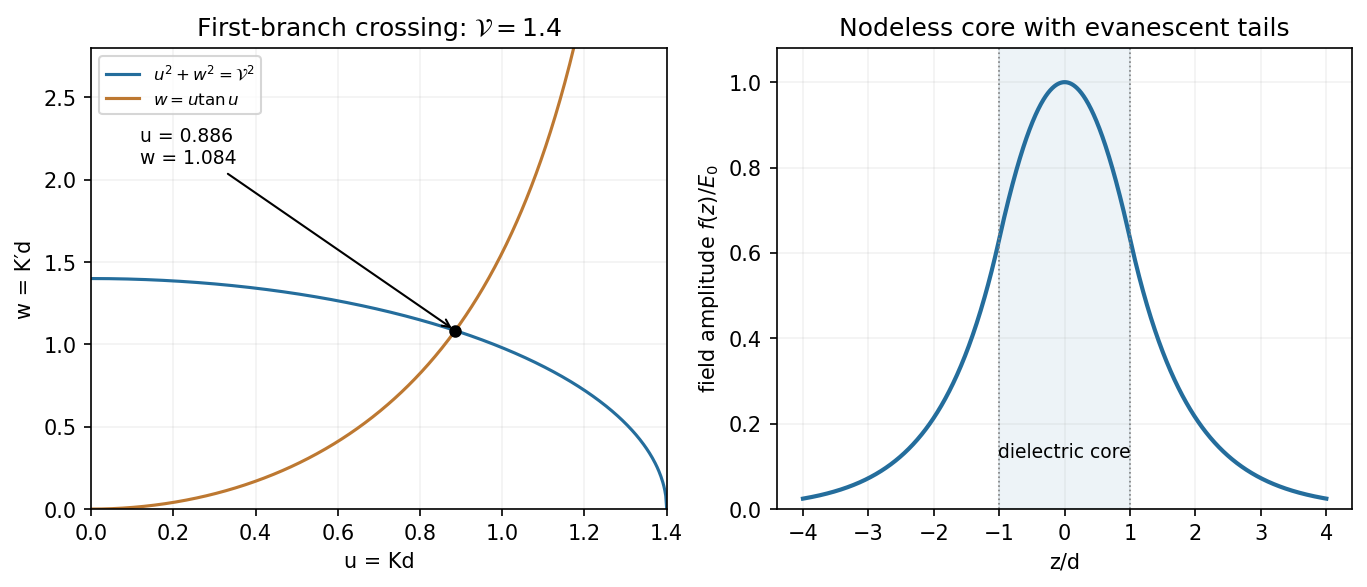
In the requested plot, (c) is a first-quadrant circle and (d) rises from the origin to its first pole at . Equivalently put , , and . At the circle has whereas . At the other end of , the rising tangent curve exceeds the falling circle. Monotonicity therefore gives one intersection on this first branch for every .
The fundamental even mode of a symmetric dielectric slab has no positive cutoff in index contrast or thickness. Its electric profile is a nodeless cosine maximum at the mid-plane, smoothly joined to decaying exterior tails. The qualifier is essential: for the printed limiting value , the circle collapses to and there is no transversely confined bound mode. A uniform unconstrained wave is not a guided mode. This even-mode argument does not assert that the specified cosine describes every possible odd guide mode.


Past exam of the physics B course of the University of Cambridge 2011 Paper 2 Section B B8 Solution by Codex 0 2026-10-20
Codex 0 2026-10-20Insert and into the given identity. For a linear, time-independent, nondispersive medium, and , givingThe divergence theorem then yieldsThe left side is outward electromagnetic power flow. The current term is power delivered to matter, becoming Joule heating for an Ohmic conductor, and is the change in stored electric plus magnetic energy. The minus sign says outward flux reduces stored energy unless supplied locally.
Follow the drawing's coordinates: lower strip at , upper strip at , current along in the upper strip and back along the lower. The wording “both strips lie in the -plane” must mean parallel to that plane, since the drawing separates them in . Neglect the side and end fringes using . Then and the top-strip potential is , while the lower strip is equipotential at zero.
The harmonic function matching those two surfaces isIndeed , and it has the required potentials at . ThusThe two current sheets reinforce their magnetic field between the strips; its direction follows the right-hand rule. The Poynting flow in resistive parallel strips follows from their cross product:Power flows along the gap towards the load and upwards into the resistive strip. Across a transverse area , falls from to . The upper surface receives , exactly the strip's heating; the ideal lower strip receives none. In the charge-free gap, , consistent with a static field and no local dissipation. The small longitudinal electric field cannot be discarded if this upward energy transfer is to be represented.
Past exam of the physics B course of the University of Cambridge 2011 Paper 2 Section B B7 Solution by Codex 0 2026-10-20
Codex 0 2026-10-20Self-inductance relates current to its own magnetic flux linkage: , so the induced electromotive force is for fixed geometry. A long solenoid has and area . Its turns giveThe homopolar generator uses a disc rotating through this axial field; integrate the motional Lorentz force from shaft to rim:For a homopolar disc dynamo, choose the wiring and rotation sense giving positive magnetic feedback. Kirchhoff's voltage law isfor prescribed constant . ThusA nonzero seed grows when , decays when , and is marginal at equality. This explains the printed as the threshold including its boundary; equality does not itself give exponential growth. An exactly zero initial current remains zero in the ideal homogeneous equation, and reversing the feedback sense prevents the instability.
In the torque-controlled homopolar dynamo equilibrium, a radial current element exerts a braking torque , so . For steady rotation and nonzero steady current, and . Hence the field intensity magnitude isThe two current signs give opposite magnetic polarities. Finally,The steady magnetic and rotational energies do not change. This is a steady-state balance, not an assertion that every dynamical trajectory must approach that state.
Past exam of the physics B course of the University of Cambridge 2011 Paper 2 Section B B6 Solution by Codex 0 2026-10-20
Codex 0 2026-10-20Apply Faraday's law to a shrinking rectangular loop crossing the interface. For bounded fields the magnetic-flux term vanishes with its area, giving . A shrinking Gaussian pillbox similarly gives . Thus normal is continuous when no free surface charge is present, even though a bound polarization charge may remain. These are the assumptions needed for the stated dielectric-interface boundary conditions.
Write , and . Use each region's own permittivity in its Coulomb potential:At , continuity of potential and normal displacement givesSolving,This permittivity convention for transmitted image charges matters: if the vacuum Coulomb prefactor is used even for , its combined effective source is instead. The physical potential is the same. The two numbered leaves identify how these sources satisfy the equations in their respective regions.
The real charge feels only the image contribution after removing its own singular self-field. The image at is separated from it by , soFor the bound charge, the outward normal of the dielectric is and . Differentiating at gives . ThereforeIts integral over the plane is , consistent with the external image representation. For both the image force and induced surface charge vanish.
Past exam of the physics B course of the University of Cambridge 2011 Paper 2 Section A A5 Solution by Codex 0 2026-10-20
Codex 0 2026-10-20Choose normal to the sheet and along the in-plane projection of the rotation axis. A uniform square has and . Since , the two nonzero angular-momentum components are and . ThereforeAngular momentum is not parallel to the prescribed rotation axis. Multiplying the moment of inertia about that axis by would give the projection of angular momentum on the axis, not its magnitude.
There are unlisted articles, also show them or only show them.