Past exam of the particle and nuclear physics course of the University of Cambridge 2012 Paper 1 1 c Solution by  Codex 0 2026-10-20
The nuclear quadrupole vibration has five one-phonon magnetic substates, . Bose-Einstein statistics restrict three identical phonons to the symmetric power , of dimension . Count occupation states with and . For nonnegative the counts areEach spin- irreducible representation contributes one state at every projection from to . magnetic-substate subtraction therefore gives multiplicity : one each at , and none at . Thus the three-quadrupole-phonon multiplet isThe dimension check is . The parity is positive because each constituent phonon has positive parity. Pairwise angular-momentum triangle rules alone would include states incompatible with complete boson symmetrization.
Past exam of the particle and nuclear physics course of the University of Cambridge 2012 Paper 1 1 b Solution by Codex 0 2026-10-20
Codex 0 2026-10-20Neglect atomic binding energy and take the target electron at rest. Use natural units temporarily. The final state contains three electrons and one Positron, so its threshold invariant mass is . For incident total energy ,The corresponding incident kinetic energy is . At threshold the products have no relative momentum in the centre-of-momentum frame; their common laboratory motion requires more energy than merely the pair's rest energy.
Past exam of the particle and nuclear physics course of the University of Cambridge 2012 Paper 1 1 a Solution by Codex 0 2026-10-20
Codex 0 2026-10-20The static one-pion exchange propagator gives a Yukawa potential proportional to . Its characteristic range is therefore the Reduced Compton wavelength,This is an exponential falloff scale, not a sharp interaction cutoff. The ordinary Compton wavelength would introduce an unwanted factor .
Past exam of the optics and electrodynamics course of the University of Cambridge 2012 Paper 1 4 d Solution by Codex 0 2026-10-20
Codex 0 2026-10-20An ideal current-carrying wire consists of opposite charge populations, one associated with the stationary lattice and one with drifting carriers. They may cancel in the lattice frame while carrying a net current, as in part (c), up to exchanging the charge signs and current direction. In a carrier-rest description their densities no longer cancel because the two populations undergo different length contractions. The wire then has both electric fields and magnetic fields.
A neutral steady current in one frame generally becomes a charged steady current in another. This illustrates how electric fields and magnetic fields are parts of one relativistic field rather than separately invariant forces. Real resistive wires also have a driving longitudinal electric field and geometry-dependent surface charges; the infinite uniform filament model isolates the transverse fields of a neutral current and does not describe every field of a complete circuit.
Past exam of the optics and electrodynamics course of the University of Cambridge 2012 Paper 1 4 c Solution by Codex 0 2026-10-20
Codex 0 2026-10-20In , adding the stationary opposite line cancels charge density and electric field but contributes no current. HenceThe neutral current filament in a boosted frame is not neutral. Transform its line-integrated four-current:The same result follows by adding the original resting line to the new negative line, whose primed density and current are . In particular because .
Transforming the total fields givesFor positive , points inward, explaining the electric-field sign. The primed Gauss and Ampère fields calculated from and reproduce these expressions. Both a moving charge distribution and a moving current must be transformed; boosting just one constituent would give an inconsistent total.
Past exam of the optics and electrodynamics course of the University of Cambridge 2012 Paper 1 4 b Solution by Codex 0 2026-10-20
Codex 0 2026-10-20A material segment of the line with rest length has laboratory length , while its charge is unchanged. ThusEquivalently the line-integrated four-current transforms from to . Gauss's and Ampère's laws in now give and , exactly the fields found in part (a). Charge density is frame-dependent even though the charge of the same set of particles is invariant.
Past exam of the optics and electrodynamics course of the University of Cambridge 2012 Paper 1 4 a Solution by Codex 0 2026-10-20
Codex 0 2026-10-20Let point transversely away from the line and define . Cylindrical Gauss's law in the line's rest frame givesThe transverse distance is unchanged by the axial boost: . Applying the inverse of the given field transformation to a boosted uniform line charge,Here and all longitudinal field components vanish. Substituting back verifies and . The sign of determines the radial and circulation directions.
Past exam of the optics and electrodynamics course of the University of Cambridge 2012 Paper 1 3 b Solution by Codex 0 2026-10-20
Codex 0 2026-10-20The longitudinal Faraday effect produces circular birefringence: right- and left-circular components have different phase velocities. Linear input contains equal amplitudes of both circular eigenpolarizations. A relative phase rotates its linear polarization through , preserving linearity in an ideal transparent sample. Conventionally the signed rotation is , with Verdet constant .
A pure Faraday rotator cannot serve as the required switchable quarter-wave plate. It rotates a line into another line rather than producing the required relative phase between fixed orthogonal linear components. Applying a field that gives a nominal quarter-cycle circular-eigenmode retardation simply rotates linear polarization by . Circular dichroism or a separate linear retarder would change the device, and is not the stated pure Faraday mechanism.
Past exam of the optics and electrodynamics course of the University of Cambridge 2012 Paper 1 3 a Solution by Codex 0 2026-10-20
Codex 0 2026-10-20A transverse static electric field can induce linear birefringence through the electro-optic Kerr effect. Define its coefficient by , with the principal axes parallel and perpendicular to the applied field. A length then gives .
For input polarized at to those axes, switching from zero retardation to switches linear to circular polarization. Other input angles generally become elliptical, and axis-aligned input stays linear. The required field magnitude for the lowest-order setting isA Kerr cell is suitable as a switchable quarter-wave plate. The field can be changed electronically without mechanically rotating the axes; actual switching time depends on the material response and driving circuit. This is induced linear birefringence, not polarization-selective absorption.[ref]
The Feynman Lectures on Physics, Volume I by Richard Feynman and others. §33–3, final paragraphs: an applied electric field produces birefringence and electrical light switching in a Kerr cell
Past exam of the optics and electrodynamics course of the University of Cambridge 2012 Paper 1 2 c Solution by Codex 0 2026-10-20
Codex 0 2026-10-20The electric potential and magnetic vector potential represent the fields through and . They are not unique: a differentiable function giveswithout changing either field. Gauge fixing restricts this freedom to suit the sources, boundaries or symmetry; it does not alter observables.
The Lorenz gauge is Lorentz covariant. Maxwell's equations then reduce to sourced wave equations,Retarded solutions implement causal radiation conditions. This gauge is useful for radiation and relativistic calculations; residual transformations obey the homogeneous wave equation.[ref]
The Feynman Lectures on Physics, Volume II by Richard Feynman and others. §18–6, Eqs. (18.23)–(18.25): gauge choice and potential wave equations
The Coulomb gauge instead gives . Its electric potential is an instantaneous Poisson solution, but the accompanying magnetic vector potential makes the full physical electric field causal. It is useful in separating longitudinal electric fields from transverse radiation. In a source-free vacuum region, suitable radiation boundary conditions permit radiation gauge , , leaving two transverse plane-wave polarizations. These extra conditions are not a gauge choice applicable unchanged to arbitrary nonzero charge distributions.
Different gauges redistribute information between potentials; the same boundary-value problem gives the same electric fields and magnetic fields.
Past exam of the optics and electrodynamics course of the University of Cambridge 2012 Paper 1 2 b Solution by Codex 0 2026-10-20
Codex 0 2026-10-20Temporal coherence measures correlation between an optical field and a delayed copy. For a stationary scalar complex field with carrier convention ,The power spectrum and the field autocorrelation form a Fourier transform pair, the Wiener-Khinchin theorem:A Michelson interferometer supplies delay . With equal arm intensities and matched polarization, its interferometric visibility is ; unequal intensities or mode mismatch lower visibility independently of temporal coherence. The relevant spectrum is the optical field spectrum, not the low-frequency spectrum of detector intensity fluctuations.
For a single Lorentzian optical line of angular-frequency full width at half maximum , use the narrow-line detuning modelSuch a model describes a phase-diffusing monochromatic source. An correlation time is , and its coherence length is . The Lorentzian extension over all detunings approximates a narrow optical line with .
For two equal, mutually incoherent ideal monochromatic spectral lines,Here and . Visibility has zeros and revivals, so the overall spectral span alone does not determine a unique decay time. Giving each line a common finite Lorentzian linewidth multiplies this beating correlation by the corresponding exponential envelope.
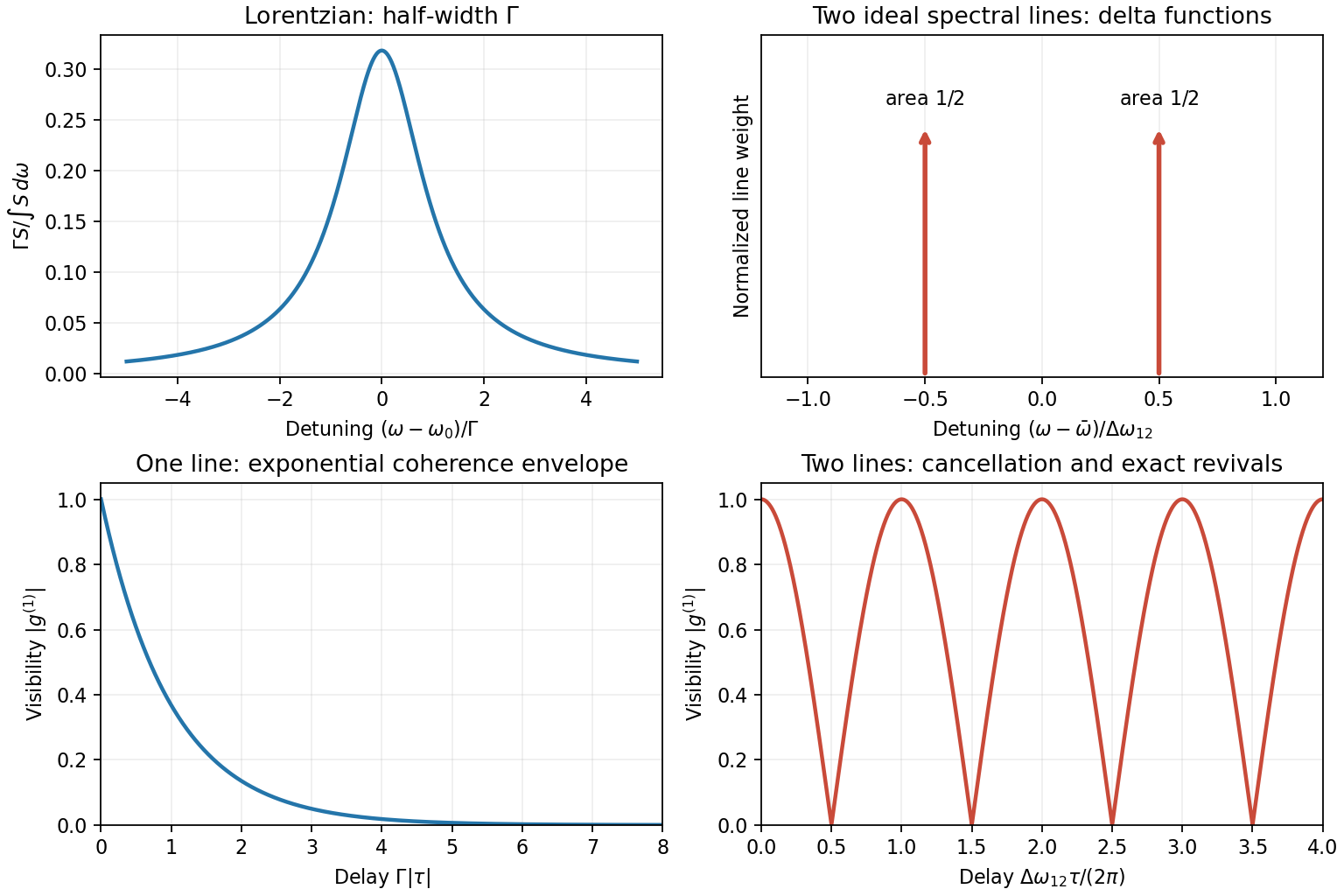
These two examples distinguish irreversible envelope decay from cancellation and revival of discrete spectral components. The line profiles are explicit models, not claimed measurements of a particular source.
Past exam of the optics and electrodynamics course of the University of Cambridge 2012 Paper 1 2 a Solution by Codex 0 2026-10-20
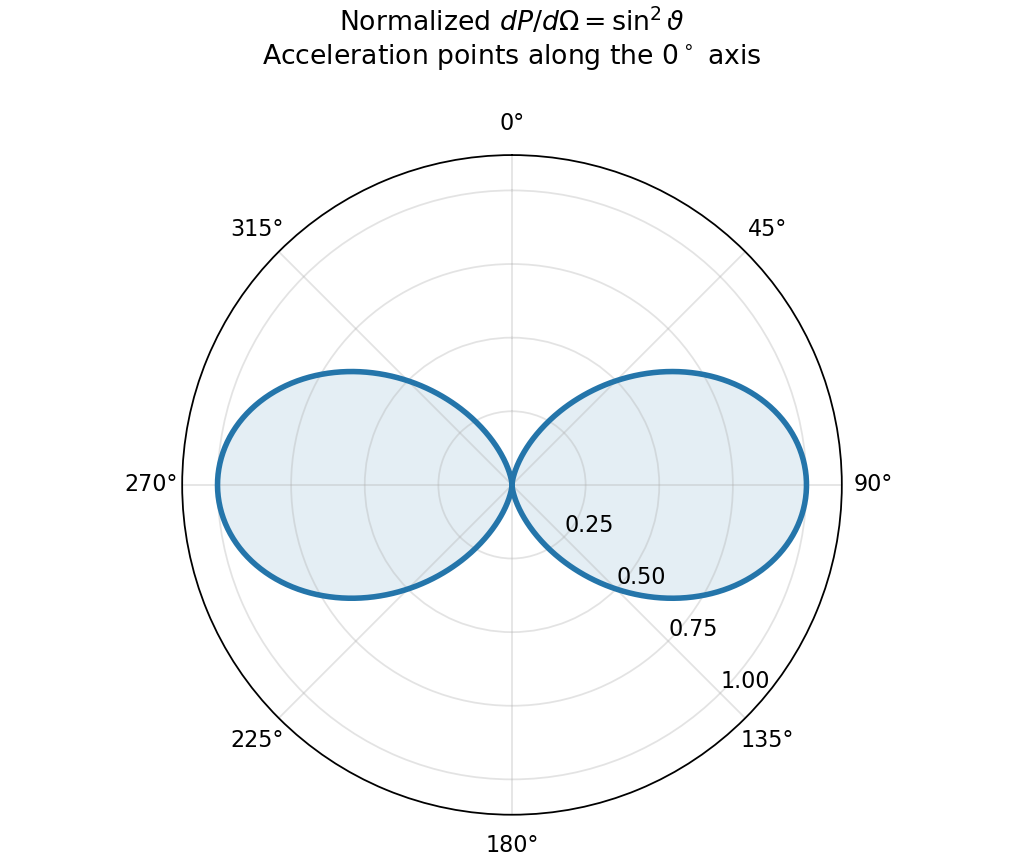
Codex 0 2026-10-20An accelerating point charge has a transverse radiation field in addition to its near field. At nonrelativistic speed and large distance ,The acceleration is evaluated at retarded time. Radiation fields decay as , so their outward energy flux integrated over a sphere is independent of radius; the near electric field instead decays as . The radiation vanishes along the acceleration and is strongest perpendicular to it.[ref]
The Feynman Lectures on Physics, Volume I by Richard Feynman and others. §28–2, Eqs. (28.5)–(28.6): transverse acceleration field and inverse-distance radiation
Using the Poynting vector givesThe integral uses . This is the Larmor formula. A harmonically accelerated charge with peak acceleration has mean power ; external work supplies this radiated energy in steady operation. Uniform inertial motion does not radiate.


Past exam of the optics and electrodynamics course of the University of Cambridge 2012 Paper 1 1 c Solution by Codex 0 2026-10-20
Codex 0 2026-10-20During the time light crosses a telescope of length , Earth moves sideways by approximately . The telescope must tilt towards Earth's motion so that both ends intercept the ray. Thus the annual stellar aberration amplitude at a transverse sightline is .
Taking one orbital year as days and treating the orbit as circular,This is the instantaneous shift relative to a stationary heliocentric observer, not the doubled peak-to-peak annual excursion. The exact Lorentz transformation for a ray transverse in that frame gives , with the same first-order result.
Past exam of the optics and electrodynamics course of the University of Cambridge 2012 Paper 1 1 b Solution by Codex 0 2026-10-20
Codex 0 2026-10-20For a Hertzian dipole of length driven at peak electric current , the electric dipole moment amplitude is . ConsequentlyThe Hertzian dipole fixed-current power scaling is thus , givingThe inverse-fourth-power wavelength scaling would hold at fixed electric dipole moment, not at the fixed electric current specified here.
Past exam of the optics and electrodynamics course of the University of Cambridge 2012 Paper 1 1 a Solution by Codex 0 2026-10-20
Codex 0 2026-10-20The electric field of the reflected beam is perpendicular to the vertical plane of incidence, hence parallel to the water surface. At Brewster's angle the reflected p-polarization amplitude vanishes; only the s-polarization component remains. For incidence from air, approximated by refractive index one,Incidence is measured from the surface normal, whereas solar elevation is measured from the horizontal. The Brewster solar elevation is thereforeThis assumes an ideally flat, transparent, nonmagnetic interface; ripples, absorption and diffuse light would spoil complete polarization.
Past exam of the nonlinear Optics and Quantum States of Light course of the University of Cambridge 2012 Paper 1 3 c Solution by Codex 0 2026-10-20
Codex 0 2026-10-20Frequency-resolved optical gating characterizes an ultrashort pulse using a nonlinear gate and a measured two-dimensional spectrogram. In second-harmonic frequency-resolved optical gating, split the pulse into two replicas, vary their relative delay, overlap them noncollinearly in a thin second-harmonic crystal, and spectrally resolve the cross-generated beam. Its propagation direction separates it from the individual beams' self-generated harmonics. For complex pulse envelope , the ideal trace iswhere denotes the output frequency offset in the envelope convention. An iterative phase retrieval algorithm seeks a pulse consistent with both this measured Fourier magnitude and the nonlinear product relation. The delay axis provides timing structure, while the resolved spectrum adds information missing from a plain intensity autocorrelation.[ref]
Characterization of arbitrary femtosecond pulses using frequency-resolved optical gating by Daniel J. Kane and Rick Trebino. 1993, nonlinear-gating spectrogram and pulse reconstruction
The measured trace does not fix absolute optical phase or absolute time origin. SHG FROG also has a conjugate time-reversal ambiguity: and produce the same trace. Extra information, such as a known dispersion change and a second measurement, can resolve that direction-of-time ambiguity. Finite phase-matching bandwidth, group-velocity mismatch, spatial chirp, spectrometer calibration, delay error, noise and instability over the scan must be controlled. A thin gate helps avoid temporal blurring, but trades against signal. FROG therefore reconstructs a pulse under an explicit instrument model rather than reading optical phase directly from a single intensity image.
Past exam of the nonlinear Optics and Quantum States of Light course of the University of Cambridge 2012 Paper 1 3 b Solution by Codex 0 2026-10-20
Codex 0 2026-10-20For a second-order response, , with the appropriate frequency conservation and negative-frequency convention for difference-frequency processes. Interchanging the two input field-frequency pairs gives intrinsic permutation symmetry of nonlinear susceptibility:For second-harmonic generation the input frequencies agree, so the last two Cartesian indices are symmetric and can be contracted into six input-pair labels. This reduces the unrestricted 27 Cartesian entries to at most 18 before crystal symmetries are imposed.
Crystal point-group transformations must leave the material tensor invariant and can force entries to vanish or become related. Under spatial inversion both electric field and polarization reverse, whereas the field product is even. A centrosymmetric bulk therefore has zero electric-dipole . Surfaces and interfaces can break inversion symmetry, and higher-multipole processes are outside that simple prohibition.
Kleinman symmetry is a stronger approximate permutation symmetry used sufficiently far from resonances when dispersion can be neglected over the participating frequencies. It is not justified merely because two input frequencies are equal; resonant or appreciably dispersive media need the full frequency-dependent relations. These distinctions determine which polarization and propagation geometries have nonzero effective coupling, in addition to whether they satisfy phase matching.[ref]
Nonlinear Dielectric Polarization in Optical Media by D. A. Kleinman. 1962, symmetry of the nonlinear dielectric response
Past exam of the nonlinear Optics and Quantum States of Light course of the University of Cambridge 2012 Paper 1 3 a Solution by Codex 0 2026-10-20
Codex 0 2026-10-20For stationary photodetection, the normalized correlation in second-order optical coherence is . Normal ordering expresses the absorption of two photons. In a single mode,A coherent state has . A single-mode thermal field has and bunches, while a number state with gives ; a single-photon state has zero ideal coincidence probability at zero delay. Antibunching, a zero-delay suppression relative to nearby delays, is distinct from simply reporting an intensity variance. Multimode averaging and finite detector response reduce observed contrast.
The Hanbury Brown and Twiss effect is measured by splitting the light onto two detectors and histogramming coincidences versus delay. Background counts, detector timing, dead time and afterpulsing need calibration. Two detectors avoid confusing the single detector's inability to register arbitrarily close counts with real antibunching. First-order interference and second-order correlations contain different information: weak first-order coherence does not imply an absence of intensity bunching.[ref]
Past exam of the medical physics course of the University of Cambridge 2012 Paper 1 3 d Solution by Codex 0 2026-10-20
Codex 0 2026-10-20TODO: Biology deferred at the user's request: biological tracer behavior and clinical PET applications.
The generic physics of positron emission tomography uses electron-positron annihilation. A slowly moving electron-positron pair predominantly produces two nearly opposite photons with energy close to each. A ring of detectors records approximately simultaneous interactions; a coincidence identifies a coincidence line of response along which an annihilation could have occurred. Finite Positron travel before annihilation and nonzero pair momentum limit how directly this line identifies the original emission location.
Many such measurements constrain an emission distribution through a tomography model. Attenuation, scattered coincidences, unrelated random coincidences, finite detector resolution and dead time alter the observed counts and require calibration or modeling. With useful time-of-flight information, the arrival-time difference further localizes position along the line: a timing uncertainty corresponds to a position scale . The coincidence data therefore provide spatial constraints, rather than each event directly supplying a complete three-dimensional image point.
Past exam of the medical physics course of the University of Cambridge 2012 Paper 1 3 c Solution by Codex 0 2026-10-20
Codex 0 2026-10-20In pulse-echo ultrasound, a transducer emits a pulse and records returning echoes. For a straight round-trip path in a medium of assumed sound speed , an echo delay gives depth . Reflections depend on acoustic-impedance changes, while attenuation, scattering and propagation geometry affect the received amplitude.
An A-mode ultrasound scan displays echo amplitude against inferred depth along one beam. A B-mode ultrasound scan maps received amplitude to brightness and assembles many beam directions or translated beam lines into a spatial image. An M-mode ultrasound scan repeats one beam line and displays its depth profile versus time, making motion along that line visible. Thus the display axes and acquisition pattern differ even when the pulse-echo principle is shared.
For a pulse lasting , a simple axial-separation estimate is . Lateral resolution depends on aperture, wavelength, focusing and depth. Shorter pulses and broader bandwidth can improve axial resolution; an assumed sound speed or a multiple-reflection path can instead misplace an echo. Brightness is not a direct universal map of composition.
Doppler ultrasound uses frequency or pulse-to-pulse phase changes from moving scatterers. In a simple backscatter geometry, . Inferring speed requires the beam-to-motion angle; pulsed sampling can alias frequencies, and an unknown angle leaves a velocity-projection ambiguity. This describes generic acoustic acquisition rather than a clinical diagnosis.
There are unlisted articles, also show them or only show them.