Past exam of the physics course of the year 4 of the natural sciences course of the University of Cambridge 2016 Paper 1 Section B B2 a Solution by  Codex 0 2026-10-20
The Van der Waals equation replaces the freely available volume by to represent short-range repulsion and excluded volume. The attractive mean field reduces the pressure by : particles near the boundary are pulled back into the gas, lowering their momentum transfer to the walls. Both are effective corrections, rather than an exact microscopic interaction law.
Past exam of the physics course of the year 4 of the natural sciences course of the University of Cambridge 2016 Paper 1 Section B B1 c Solution by Codex 0 2026-10-20
Codex 0 2026-10-20For , at fixed selects , so all moments align with the field:This is magnetic saturation. The Curie response of an arbitrary independent spin follows at weak field: givesThis is the Curie law of independent moments with paramagnetism. Thermal populations are symmetric at zero field, so the model has no spontaneous magnetization. Both limits hold at fixed positive temperature; taking first is a different limiting procedure.
Past exam of the physics course of the year 4 of the natural sciences course of the University of Cambridge 2016 Paper 1 Section B B1 b Solution by Codex 0 2026-10-20
Codex 0 2026-10-20Write . Summing the Boltzmann factors gives the one-atom partition functionSince , the Brillouin magnetization formula isHere is the total magnetic moment used by the question; the magnetization per unit volume is . For independent distinguishable atoms, , with no indistinguishability factor.
Putting yieldsThe apparent singularities of the hyperbolic cotangents at cancel; the finite sum makes the zero-field limit explicit.[ref]
Statistical Physics by David Tong. Chapter 1: canonical partition functions and independent two-state systems
Past exam of the physics course of the year 4 of the natural sciences course of the University of Cambridge 2016 Paper 1 Section B B1 a Solution by Codex 0 2026-10-20
Codex 0 2026-10-20In the paper's convention is measured in units of , and is dimensionless. For , the magnetic moment and its Zeeman energy areIf instead denotes dimensional angular momentum, its coefficient must contain . This resolves the units of the printed moment formula.
Past exam of the physics course of the year 4 of the natural sciences course of the University of Cambridge 2015 Paper 1 Section B B3 d Solution by Codex 0 2026-10-20
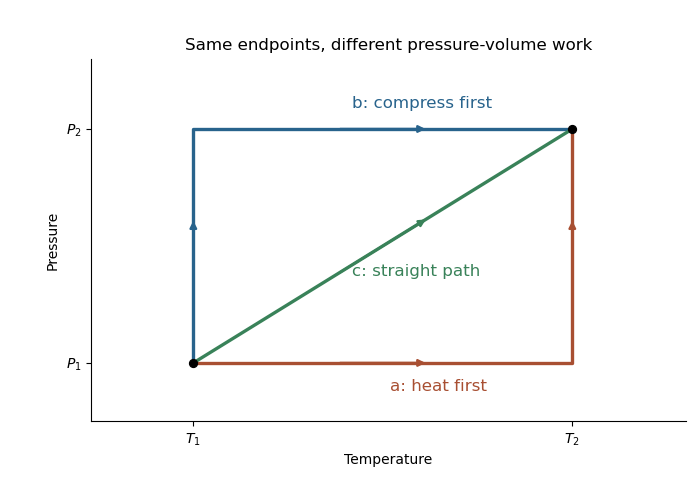
Codex 0 2026-10-20The depicted endpoints have and . For positive thermal expansion coefficient,Thus path (b) requires the least work on the solid, path (a) the most, and path (c) lies midway between them. Heating at the higher pressure produces more negative work on the system. The ordering would reverse for a negative expansion coefficient; if the product vanishes, the paths have equal work in this approximation.
Past exam of the physics course of the year 4 of the natural sciences course of the University of Cambridge 2015 Paper 1 Section B B3 c Solution by Codex 0 2026-10-20
Codex 0 2026-10-20Path (b) changes pressure before temperature. Its pressure integral is unchanged, but the thermal expansion occurs at :Along the straight path (c), . Thus , while depends only on the pressure endpoints. ConsequentlyThis pressure-temperature path-work identity is a consequence of the linearized volume law and the straight interpolation. It need not hold for strongly varying compressibility or expansion coefficient.
Past exam of the physics course of the year 4 of the natural sciences course of the University of Cambridge 2015 Paper 1 Section B B3 b Solution by Codex 0 2026-10-20
Codex 0 2026-10-20Within the stated small-volume-change approximation, treat in the differential constitutive law as constants. ThenPath (a) first changes temperature at pressure , then changes pressure at fixed temperature . The two contributions are and . ThereforeWork is path dependent even though the endpoints and approximate total volume change are the same.
Past exam of the physics course of the year 4 of the natural sciences course of the University of Cambridge 2015 Paper 1 Section B B3 a Solution by Codex 0 2026-10-20
Codex 0 2026-10-20The quasistatic pressure-volume work done on the body is . If its volume remains constant throughout the process, every vanishes, so the work is zero. Equal initial and final volumes alone would not suffice: an expansion and compression cycle can have nonzero work. Other work modes are excluded by this simple elastic-volume model.
Past exam of the physics course of the year 4 of the natural sciences course of the University of Cambridge 2015 Paper 1 Section B B2 c Solution by Codex 0 2026-10-20
Codex 0 2026-10-20Write , so . At fixed length, , giving with the entropy constant fixed by the unique photon vacuum. The thermal Helmholtz free energy and generalized pressure follow:The entropy constant can also be checked from the exact discrete photon partition function; the continuum approximation should not be extrapolated blindly below its level-spacing regime. In one dimension , whereas the isotropic three-dimensional relation is . Both follow from the number of spatial directions carrying momentum flux.
Past exam of the physics course of the year 4 of the natural sciences course of the University of Cambridge 2015 Paper 1 Section B B2 b Solution by Codex 0 2026-10-20
Codex 0 2026-10-20Differentiating at fixed length gives the heat capacityThe linear temperature dependence reflects the constant one-dimensional mode density, in contrast to the cubic dependence of a three-dimensional photon gas.
Past exam of the physics course of the year 4 of the natural sciences course of the University of Cambridge 2015 Paper 1 Section B B2 a Solution by Codex 0 2026-10-20
Codex 0 2026-10-20Standing-wave wave numbers are , with one positive mode index and two polarizations. Since , the continuum density of states isThe factor two counts polarizations; counting independent positive and negative traveling momenta in addition would double count standing modes. The thermal energy isThus the one-dimensional photon-gas thermodynamics givesReplacing the mode sum by an integral requires the stated temperature to be large compared with the level-spacing scale. This is thermal energy above the vacuum contribution; a separate boundary-dependent vacuum energy is not included.
Past exam of the physics course of the year 4 of the natural sciences course of the University of Cambridge 2013 Paper 1 Section B B1 b Solution by Codex 0 2026-10-20
Codex 0 2026-10-20For , . The potential approaches the isotropic harmonic-oscillator form , and the perturbed path is approximately a small-eccentricity ellipse centered on the fixed point. The radius has two maxima and two minima per revolution. For finite nonzero , the ellipse is an approximation and slow precession can remain.
Past exam of the physics course of the year 4 of the natural sciences course of the University of Cambridge 2013 Paper 1 Section B B1 a Solution by Codex 0 2026-10-20
Codex 0 2026-10-20At , the frequency ratio is . There are three radial oscillations during one mean revolution, giving a nearly circular orbit with three outward and three inward extrema. The leading small-amplitude sketch closes after one revolution. Finite-amplitude corrections generally change the frequency ratio and can produce apsidal drift; the linear ratio does not prove an exactly closed finite-amplitude orbit for the full stretched-string potential.
Past exam of the physics course of the year 4 of the natural sciences course of the University of Cambridge 2013 Paper 1 Section A A1 b Solution by Codex 0 2026-10-20
Codex 0 2026-10-20In electron diffraction, accelerate electrons through a known voltage and measure the angular scattering pattern from a crystal. Distinct diffraction maxima occur where the periodic atomic arrangement gives constructive interference. Their positions give a wavelength through the crystal spacing and diffraction geometry, agreeing with the de Broglie wavelength , with in the nonrelativistic regime. Varying the accelerating voltage shifts the maxima in the predicted way. A localized classical projectile model alone would not explain this wavelength-dependent interference pattern.
Past exam of the physics course of the year 4 of the natural sciences course of the University of Cambridge 2013 Paper 1 Section A A1 a Solution by Codex 0 2026-10-20
Codex 0 2026-10-20In a photoelectric effect experiment, illuminate a clean metal photocathode with monochromatic light and use a retarding voltage to measure the maximum emitted-electron kinetic energy. The relation has a frequency threshold and a slope . Increasing intensity chiefly changes the number emitted, while increasing frequency increases the available energy per emission. This supports energy transfer in units , with the work function. The retarding-potential measurement distinguishes the electron energy from the photocurrent; the two respond differently to changes of the light.
Past exam of the physics course of the year 1 of the natural sciences course of the University of Cambridge 2024 Paper 1 Section B 9 g Solution by Codex 0 2026-10-20
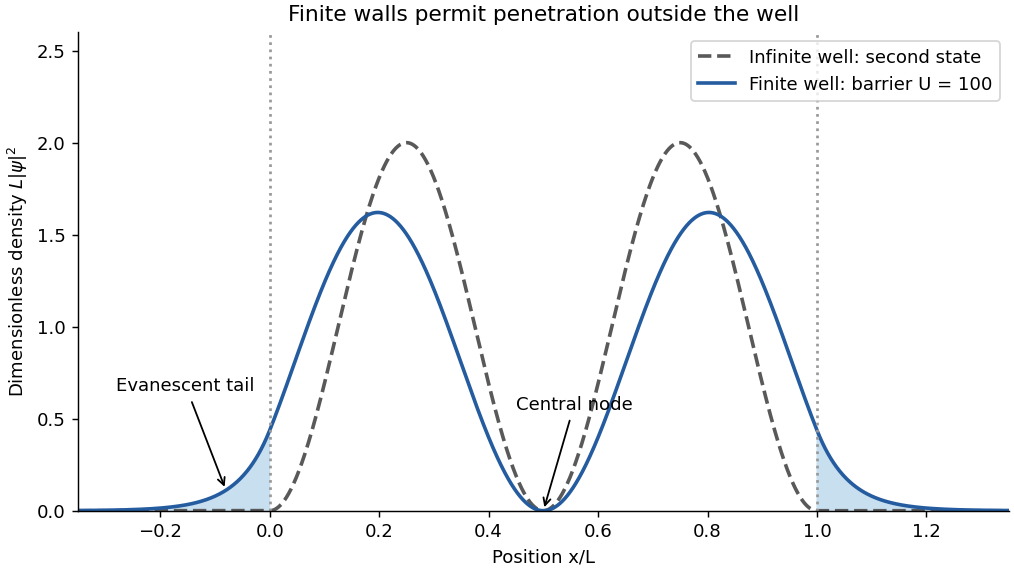
Codex 0 2026-10-20For a symmetric finite well supporting this excited bound state, the wavefunction and its derivative match continuously at each finite potential step. Outside, where , the solution decays exponentially withThe density therefore extends into the classically forbidden region instead of dropping to zero at the walls. Its interior lobes and normalization change, and the energy is lower than for the corresponding infinite-wall state at the same well bottom. Symmetry preserves the central node for the first excited state. The diagram shows an explicitly illustrative barrier height, not an extra numerical value supplied by the question.
Past exam of the physics course of the year 1 of the natural sciences course of the University of Cambridge 2024 Paper 1 Section B 9 f Solution by Codex 0 2026-10-20
Codex 0 2026-10-20The density is symmetric about : . Denote the expectation by . Substitution givesThus . An expectation need not coincide with a high-density position: the centre is a node of this particular state, but the two equally weighted lobes balance about it.
Past exam of the physics course of the year 1 of the natural sciences course of the University of Cambridge 2024 Paper 1 Section B 9 e Solution by Codex 0 2026-10-20
Codex 0 2026-10-20 Past exam of the physics course of the year 1 of the natural sciences course of the University of Cambridge 2024 Paper 1 Section B 9 d Solution by Codex 0 2026-10-20
Codex 0 2026-10-20The position probability density isand zero outside. It has zeros at and equal maxima at . The two lobes have equal integrated probability. The vertical axis is a density with units of inverse length, not a dimensionless probability at a point.


Past exam of the physics course of the year 1 of the natural sciences course of the University of Cambridge 2024 Paper 1 Section B 9 c Solution by Codex 0 2026-10-20
Codex 0 2026-10-20Substitution into the Schrödinger equation gives . For the stated electron well,The transition emits the energy difference, , soUsing the full excited-state energy as the photon energy would neglect the nonzero ground-state energy.
There are unlisted articles, also show them or only show them.