Past exam of the physics course of the year 1 of the natural sciences course of the University of Cambridge 2013 Paper 1 Section E E15 c Solution by  Codex 0 2026-10-20
In vacuum the electric and magnetic field energy densities areFor example, charging a capacitor requires . A parallel-plate capacitor with and then gives , identifying the electric field energy density. Similarly an inductor stores ; applying this to a long solenoid yields times its interior volume.
Electromagnetic energy is transported by the Poynting vector . Poynting's theorem,expresses local energy conservation and transfer to matter. In a vacuum plane wave , so the two energy densities are equal and the energy flux has magnitude . For nondispersive linear media the corresponding reversible expressions are and ; they must not be applied unchanged to arbitrary dispersive or hysteretic materials.
Past exam of the physics course of the year 1 of the natural sciences course of the University of Cambridge 2013 Paper 1 Section E E15 b Solution by Codex 0 2026-10-20
Codex 0 2026-10-20The Lorentz force determines the trajectory:Thus a magnetic field changes momentum direction but does no work; an electric field can change the particle's kinetic energy. In a uniform electric field with negligible magnetic field and nonrelativistic speed, is constant. A transverse initial velocity then gives a parabola.
In a uniform magnetic field, the parallel velocity is unchanged and the perpendicular motion is circular. Nonrelativistically,the combined trajectory is a helix, with circulation reversed when the charge sign reverses. Relativistically and the gyrofrequency is .
For perpendicular uniform fields in the magnetic-dominated case, the drift velocity is , which obeys . A particle at this velocity is undeflected: the crossed-field velocity selector selects speed in the appropriate direction, independent of mass and charge. Radiation reaction and collisions are neglected in these ideal trajectories.
Past exam of the physics course of the year 1 of the natural sciences course of the University of Cambridge 2013 Paper 1 Section E E15 a Solution by Codex 0 2026-10-20
Codex 0 2026-10-20A gravitational field is force per unit test mass, . Newton's law of universal gravitation gives the field of a point mass M:The potential is potential energy per unit mass, with zero at infinity for an isolated mass. Fields and potentials superpose. The potential difference fixes the work per unit mass, and a conservative gravitational field has zero circulation around a closed path.
For a continuous mass distribution, the gravitational Gauss law is . A spherical body therefore has the same exterior field as a point mass at its centre. Inside a uniform sphere of density ,The field is continuous at its surface and vanishes at its centre. An empty spherical shell has zero interior field but a nonzero constant interior potential. Near a small region of Earth's surface one may approximate as uniform and the potential change as . Farther away its spatial gradient produces tidal relative accelerations. Escape to infinity from radius R requires speed when rotation and other bodies are neglected.
Past exam of the physics course of the year 1 of the natural sciences course of the University of Cambridge 2013 Paper 1 Section D D12 c Solution by Codex 0 2026-10-20
Codex 0 2026-10-20Farther out, successive maxima and zeros occur at different angles for each wavelength. Many colour bands overlap, so the pattern becomes faint with increasingly washed-out colour contrast, rather than retaining a single sharp monochromatic fringe system. The overall single-slit intensity falls with an approximately inverse-square angular envelope.
Past exam of the physics course of the year 1 of the natural sciences course of the University of Cambridge 2013 Paper 1 Section D D12 b Solution by Codex 0 2026-10-20
Codex 0 2026-10-20The first zero of each colour is at . Blue therefore reaches its first zero closer to the axis than the reference green wavelength, and red reaches it farther away. At the reference colour is absent, while other wavelengths remain: there is no common black first minimum in white light. Adjacent regions change hue as different colour minima pass through them; wavelengths longer than the reference are still in their central maxima and tend to dominate near its first zero. The exact hue depends on the incident spectrum and spectral response.
Past exam of the physics course of the year 1 of the natural sciences course of the University of Cambridge 2013 Paper 1 Section D D12 a Solution by Codex 0 2026-10-20
Codex 0 2026-10-20At zero angle every slit element is in phase for every wavelength. Their central maxima coincide, so the centre is bright white. Shorter wavelengths have narrower central maxima; farther from the axis their contributions fade sooner, giving the central band reddish outer edges for a smooth white spectrum.
Past exam of the physics course of the year 1 of the natural sciences course of the University of Cambridge 2013 Paper 1 Section B B8 b Solution by Codex 0 2026-10-20
Codex 0 2026-10-20Between launch and interception, . The time-coordinate Lorentz transformation therefore givesThis is an elapsed coordinate time in B's inertial frame, not the travel time on A's clock. The latter would be .
Past exam of the physics course of the year 1 of the natural sciences course of the University of Cambridge 2013 Paper 1 Section B B8 a Solution by Codex 0 2026-10-20
Codex 0 2026-10-20 Past exam of the physics course of the year 1 of the natural sciences course of the University of Cambridge 2013 Paper 1 Section A 6 b Solution by Codex 0 2026-10-20
Codex 0 2026-10-20The laboratory mean lifetime is dilated to . Multiplying by the laboratory speed givesThis is the mean of the exponential decay-distance distribution, not a fixed distance travelled by every pion.
Past exam of the physics course of the year 1 of the natural sciences course of the University of Cambridge 2013 Paper 1 Section A 6 a Solution by Codex 0 2026-10-20
Codex 0 2026-10-20 Past exam of the physics course of the year 1 of the natural sciences course of the University of Cambridge 2013 Paper 1 Section A 1 b Solution by Codex 0 2026-10-20
Codex 0 2026-10-20The de Broglie wavelength fixes the same momentum , but the nonrelativistic electron has :Here , consistent with the stated nonrelativistic approximation. The photon energy and electron kinetic energy are not interchangeable.
Past exam of the physics course of the year 1 of the natural sciences course of the University of Cambridge 2013 Paper 1 Section A 1 a Solution by Codex 0 2026-10-20
Codex 0 2026-10-20 Past exam of the physics course of the year 1 of the natural sciences course of the University of Cambridge 2012 Paper 1 Section E E15 d Solution by Codex 0 2026-10-20
Codex 0 2026-10-20In vacuum, Maxwell's equations in SI units areThe displacement current term makes the last equation consistent with the charge continuity equation. In a source-free region, take the curl of Faraday's law and use . This givesA plane electromagnetic wave therefore propagates at . The divergence equations make both fields transverse; the curl equations giveThe electric fields and magnetic fields are in phase and perpendicular to one another and to the propagation direction. Their energy densities are equal:For electric-field peak amplitude , the time-averaged intensity is . Mutually coupled changing electric fields and magnetic fields transport energy through vacuum, even where no charges or conduction currents are present.
Past exam of the physics course of the year 1 of the natural sciences course of the University of Cambridge 2012 Paper 1 Section E E15 c Solution by Codex 0 2026-10-20
Codex 0 2026-10-20In electrostatic equilibrium a conductor has throughout its bulk and constant electric potential on each connected component. Otherwise free charge would continue moving. Gauss's law then excludes bulk excess charge; it resides on surfaces. Just outside a conductor the tangential field vanishes and the normal jump isfor a vacuum interface with outward normal . Surface charge rearranges in an external field to enforce these boundary conditions. Greater curvature often concentrates charge, but the actual distribution is a global boundary-value problem.
An empty closed cavity inside a conductor has constant potential and zero field, even in an external electrostatic field. If a charge is placed in the cavity, a Gaussian surface in the metal shows that the cavity wall carries total induced charge ; its detailed distribution depends on geometry. An initially neutral isolated conductor then has on its exterior surface. A grounded conductor can exchange charge with Earth, so this isolation condition no longer applies.
A useful example is a charge at height above an infinite grounded plane. In the physical half-space, the method of images replaces the induced charges by an image at height , giving the attractive force . The image is a mathematical construction, not an actual charge behind the conductor. Equipotential surfaces and charge conservation determine conductor fields together.
Past exam of the physics course of the year 1 of the natural sciences course of the University of Cambridge 2012 Paper 1 Section E E15 b Solution by Codex 0 2026-10-20
Codex 0 2026-10-20For two isolated point masses, introduce total mass , reduced mass and relative separation . The relative acceleration is . Conserved specific angular momentum fixes a plane and a constant areal velocity . The specific orbital energy isFor , the trajectory is a conic:Negative energy gives an ellipse, including the circular limit ; zero energy gives a parabola; positive energy gives a hyperbola. Bound ellipses obey andThus Kepler's laws of planetary motion follow from angular momentum conservation and the inverse-square force. For a circular orbit of radius , , while escape from that radius requires . Energy determines whether the orbit is bound; angular momentum also determines its shape. These ideal results neglect extended-body perturbations, drag and relativistic corrections.
Past exam of the physics course of the year 1 of the natural sciences course of the University of Cambridge 2012 Paper 1 Section E E15 a Solution by Codex 0 2026-10-20
Codex 0 2026-10-20An electric dipole consists of opposite charges separated by a small displacement, with electric dipole moment directed from negative to positive. At distances large compared with its size,The net charge term vanishes; the field decays faster than a monopole field. In an imposed slowly varying electric field,for a permanent fixed dipole. A uniform field produces a torque but no net force. For a linear induced dipole , the interaction energy is instead , because building the dipole also costs energy.
A small planar current loop has magnetic dipole moment , with the normal fixed by the right-hand rule. Outside the source,Magnetic field lines form closed loops; a current-loop dipole does not require magnetic monopoles. Dipole moments describe the leading directional field of a neutral localized source, and their torques explain alignment in external fields.
Past exam of the physics course of the year 1 of the natural sciences course of the University of Cambridge 2012 Paper 1 Section C C11 b Solution by Codex 0 2026-10-20
Codex 0 2026-10-20For free parallel RLC voltage decay, measure and branch currents from A to B. ThenThere is no external current, so Kirchhoff's current law gives . Differentiating yieldsFor the characteristic equation is . Its underdamped roots giveThe supplied inequality makes real. A real physical voltage has the general form , the real part of the printed complex expression. A general complex-valued solution uses both roots, . The inductor's initial current is fixed consistently by the undifferentiated current balance; it is not an arbitrary additional voltage-mode constant.
Past exam of the physics course of the year 1 of the natural sciences course of the University of Cambridge 2012 Paper 1 Section C C11 a Solution by Codex 0 2026-10-20
Codex 0 2026-10-20In sinusoidal steady state, complex impedance is the voltage phasor divided by the current phasor. Its modulus is the amplitude ratio and its argument is the voltage lead. With the convention, , so .
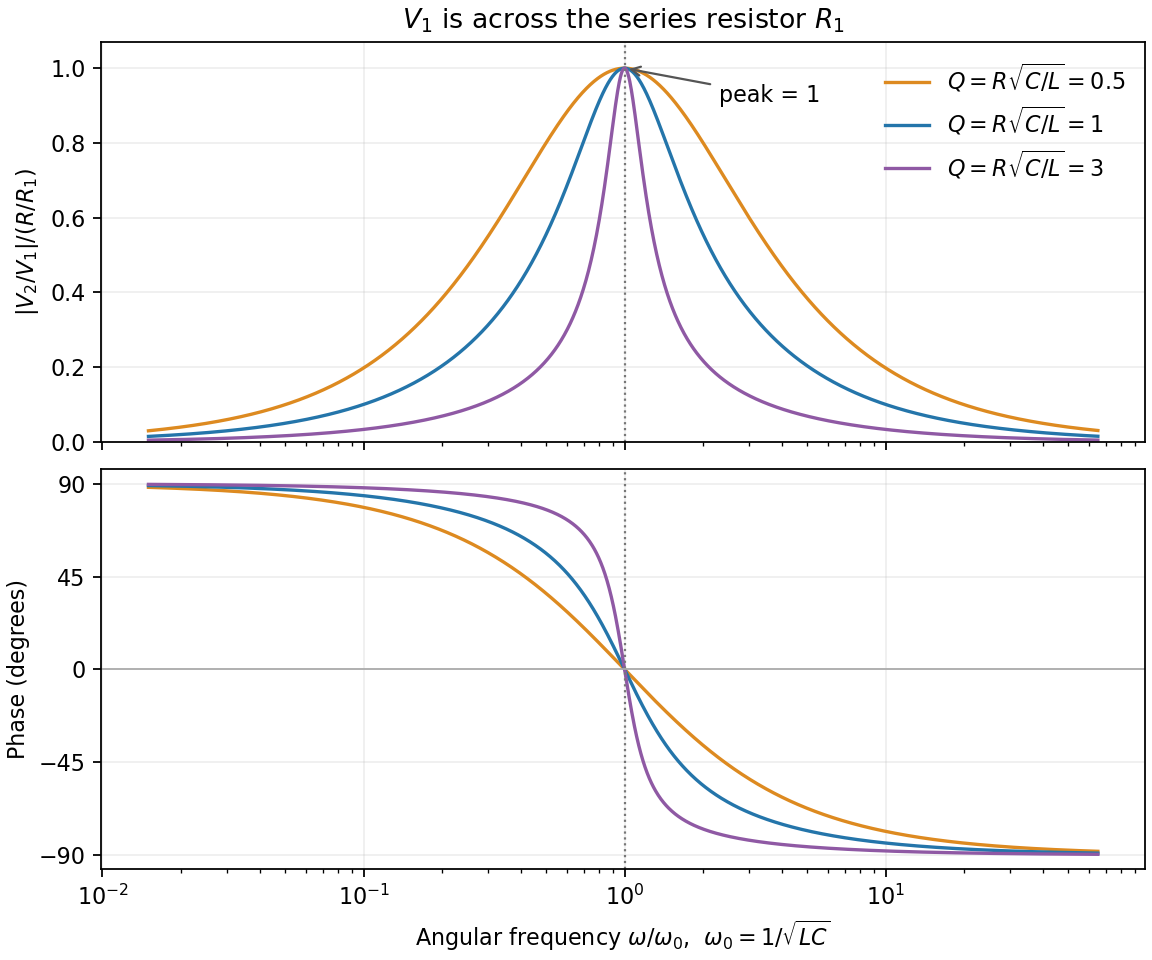
The PDF labels across , not across the complete driven network. If is the current through , then and , whereThe resistor-referenced parallel-resonator response isWriting ,The maximum occurs at , where and the phase is zero. Below resonance the phase is positive, tending to ; above it the phase is negative, tending to . The amplitude tends to zero at both extremes: the inductor shorts the parallel network at low frequency, and the capacitor does so at high frequency. At resonance their reactive currents cancel, leaving only the resistor current.
Past exam of the physics B course of the University of Cambridge 2016 Paper 2 Section C C13 Solution by Codex 0 2026-10-20
Codex 0 2026-10-20An equation of state relates thermodynamic variables within a material model; a phase diagram records which equilibrium phase or phases are stable under specified controls. For a pure substance at fixed temperature and pressure, stability means minimizing Gibbs free energy. Two phases coexist when their molar chemical potentials agree. The equation of state and the free-energy stability condition must therefore be used together: an algebraic relation between alone need not identify the stable branch.
A pressure-temperature phase diagram contains single-phase regions separated by phase coexistence curves. For a one-component system the Gibbs phase rule gives : a single phase has two independent controls, two-phase coexistence lies on a curve, and three phases coexist at a triple point. The liquid-gas coexistence curve ends at a liquid-gas critical point; beyond it a continuous path connects liquidlike and gaslike states without crossing a first-order coexistence boundary. A fixed point on a coexistence curve does not specify the proportions of the two phases: an additional extensive constraint, such as total volume, fixes the phase fraction.
At a first-order phase transition, first derivatives of Gibbs free energy, such as molar entropy or volume, are discontinuous. The conversion has latent heat . At a continuous transition the first derivatives match, while response functions associated with higher derivatives can be singular or discontinuous. At an ordinary liquid-gas critical endpoint, the two coexisting densities approach one another and the latent heat tends to zero; the material does not retain a sharp liquid-gas boundary above it.
The coexistence slope follows directly from equality of the two molar chemical potentials. Since , differentiating along the boundary givesThis is the exact Clapeyron equation, also commonly called the Clausius-Clapeyron relation. For vaporization, both and are positive, so the saturation pressure rises with temperature. For ordinary ice melting into liquid water, but the molar volume decreases, giving the familiar negative melting-curve slope. The sign follows from the volume change, not from a different law.
For a dilute ideal vapour with , . The ideal-vapor Clausius-Clapeyron approximation becomesIf molar latent heat is approximately constant over the interval,These approximations deteriorate close to the critical point, where liquid and gas volumes become comparable, or over a range in which latent heat changes appreciably.[ref]
Statistical Physics by David Tong. §5.1.2, coexistence slope and ideal-vapour approximation; surrounding discussion of the liquid-gas critical point and solid-liquid boundary
The ideal gas law is an equation of state for a dilute gas, but it has no liquid branch and cannot predict condensation. A simple model including repulsion and attraction is the Van der Waals molar equation,where represents excluded molar volume and represents attraction. At its critical point, , givingBelow , the homogeneous isotherm has an interval with . That would have negative isothermal compressibility and is mechanically unstable. Equilibrium liquid-gas coexistence replaces the loop by a constant-pressure segment. Equality of chemical potentials gives the Maxwell construction:The equal-area condition enforces the common tangent to the appropriate free energy; it is a stability construction rather than permission to follow the unstable loop physically. The average molar volume between and varies by changing the phase fraction.
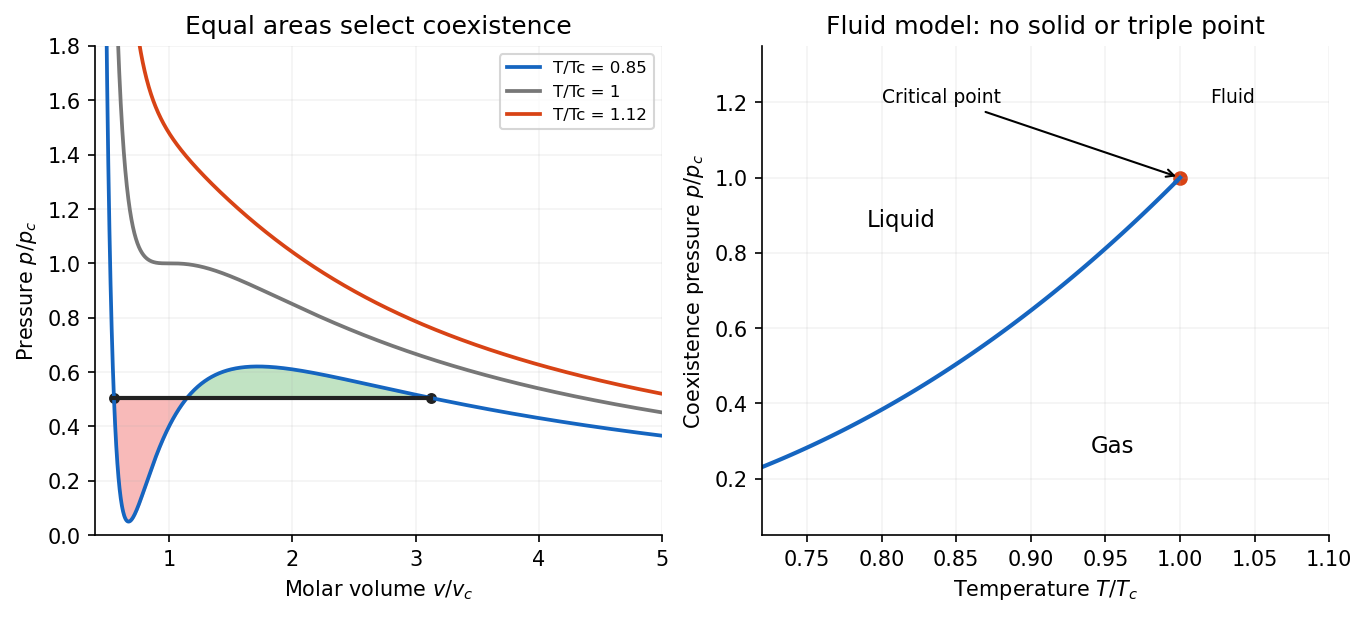


The model captures a liquid-gas critical point and qualitative coexistence, but its simple constants are not a complete quantitative description of real fluids and it has no solid phase. A full phase diagram needs additional solid free energies and can contain several crystal phases. Conversely, an experimentally determined coexistence curve and latent heat constrain equations of state through the Clapeyron equation. This is the useful connection: local thermodynamic response, global free-energy stability and the geometry of phase boundaries describe the same material at different levels.
There are unlisted articles, also show them or only show them.