Past exam of the physics B course of the University of Cambridge 2016 Paper 2 Section C C12 Solution by  Codex 0 2026-10-20
For the two unlabelled follow-up requests, distinguish re-equilibrating effusion from collisionless effusion. The calculations below show that escaping atoms carry mean kinetic energy , whereas a bulk atom has mean kinetic energy . If the aperture is small and interatomic collisions maintain near-equilibrium conditions, faster atoms escape preferentially, and the remaining gas relaxes toward a lower-temperature Maxwell-Boltzmann distribution. No heat supplied by the walls is available to replace the lost energy.
For a monatomic gas at fixed container volume, conservation of energy gives a quantitative check on this effusive cooling picture:Since , the temperature falls. Under these idealizations ; the gas is not left with a permanently truncated velocity tail when collisions rapidly restore equilibrium.
If interatomic collisions are absent, the individual surviving atoms do not rethermalize to a new common temperature. Their speed distribution becomes selectively depleted, generally favouring slower survivors, and their angular and spatial distribution can also develop structure determined by which trajectories reach the hole. A single lower temperature does not describe the full nonequilibrium distribution. With a direction-randomizing but energy-preserving wall model, an illustrative survival law is ; specular walls can give more detailed directional selection and even persistent nonescaping trajectories. The question supplies no wall-scattering or container-geometry model from which a unique collisionless loss law could be inferred.
Past exam of the physics B course of the University of Cambridge 2016 Paper 2 Section C C11 Solution by Codex 0 2026-10-20
Codex 0 2026-10-20The classical equipartition theorem assigns mean energy to each independent quadratic term in the Hamiltonian, provided the canonical distribution and its relevant boundary integrals exist. For a quadratic term , the Boltzmann distribution is proportional to , with . Integrating a total derivative givesAfter dividing by the normalization,The same argument applies to quadratic momentum terms. Other independent canonical coordinates factor out of the ratio. It is a classical statement: widely spaced quantum energy levels can freeze out a contribution at low temperature.
The confining quartic potential energy , with , is not quadratic, so the rule cannot be assigned to it. This does not invalidate the canonical Boltzmann distribution or its generalized integration-by-parts identity. Indeed,Hence equipartition for a homogeneous potential givesEquivalently, and . This is the potential contribution only; an additional standard kinetic term would contribute a further to energy and to heat capacity.
For an intact diatomic molecule, the classical degrees of freedom comprise three translational quadratic terms, two rotational quadratic terms, and two terms for its one bond-stretching vibration: one kinetic and one potential. Thus complete classical equipartition predictsThe heat capacity of a diatomic gas has lower-temperature regimes because rotational and vibrational levels are quantized. In a dilute molecular gas, the expected progression isThe rotational energy scale is normally much smaller than the vibrational scale, so these steps are separated. The high-temperature value treats the vibration as harmonic and excludes dissociation and electronic excitation; the lowest-temperature gas regime is meaningful only while the sample remains dilute and gaseous.[ref]
Statistical Physics by David Tong. §2.4, molecular rotation and vibration, and §3.4, quantum heat capacity of a diatomic gas
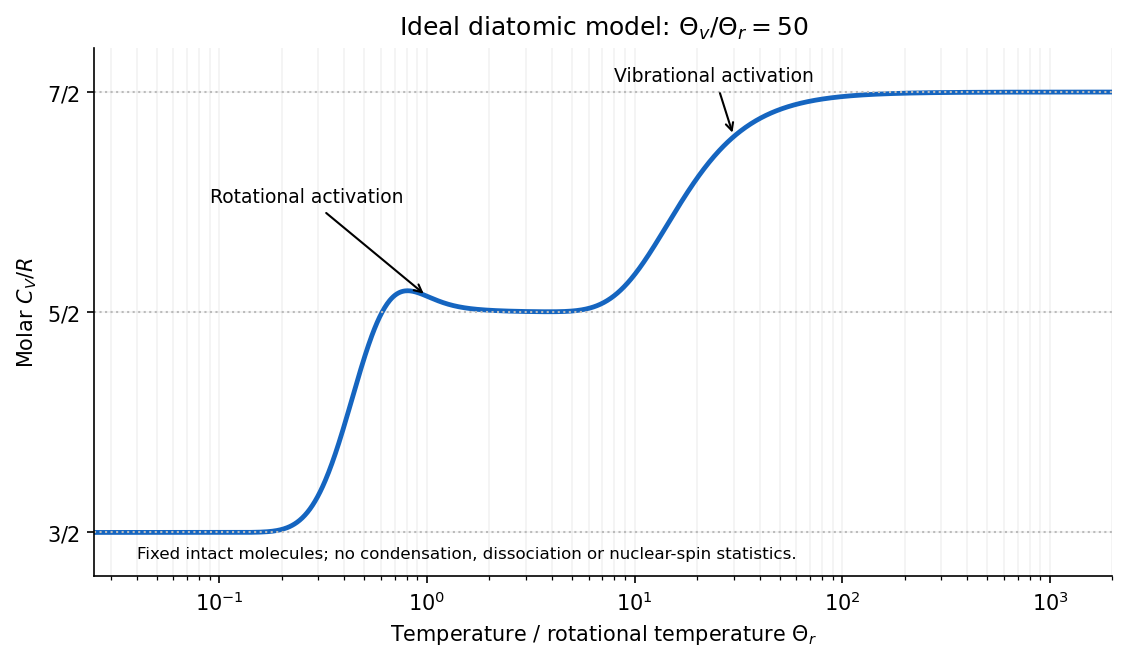
Original ideal diatomic heat-capacity model showing rotational and vibrational activation, without dissociation
. Details. The plotted example uses a quantum rigid rotor and harmonic vibration, with an illustrative ratio of characteristic temperatures. It is a model calculation, not measured data for a particular molecular species. For the vibrational part,which tends to zero on freezing out and to one when many vibrational levels are accessible. The classical equipartition theorem is recovered when the relevant level spacings are small compared with .
Past exam of the physics B course of the University of Cambridge 2016 Paper 2 Section C C10 Solution by Codex 0 2026-10-20
Codex 0 2026-10-20A Carnot cycle consists of two reversible isothermal branches joined by two reversible adiabatic branches. Let the hot isothermal expansion run from volume to , and the cold isothermal compression from to . For moles of an ideal gas, their absorbed and rejected heat magnitudes areOn a reversible ideal-gas adiabat, is constant. Applying this to the two joining branches gives . ThereforeThe result is independent of the gas's heat-capacity ratio. This derivation presumes the usual constant-heat-capacity ideal-gas model; more generally the equal entropy changes on the two isotherms give the same heat ratio without that restriction.
To establish the upper bound, suppose an engine were more efficient between these same two reservoirs. Use its output work to drive a reversed Carnot cycle, scaled so that the work magnitudes match. For fixed work , the hypothetical engine would take from the hot bath, whereas the reversed Carnot cycle would return to it. The combined device would transfer heat from the cold bath to the hot bath without any net external work. That contradicts the Clausius statement of the second law. Hence no such two-reservoir engine can exceed .
For the triangular cycle, call the three successive vertices , and measure energies in units of . For one mole of a monatomic ideal gas, , and positive work done by the gas is . The net values on the three complete branches areThus the net work is , equal to the triangle's enclosed area.
There is a small but important distinction between the net heat on a branch and its total positive heat input to a cycle. On the sloping branch put , so , with . ThenThere is a heat-flow reversal along a thermodynamic path at . The first part absorbs heat; the final part rejects it. Integrating the two signed contributions separately givesThe true total absorbed and rejected heats and thermal efficiency are thereforeFor clarity, the positive heat input on is , on it is , and on it is zero. Using just the positive net heats of the complete branches would give and ; that shortcut misses the short heat-rejection interval on .
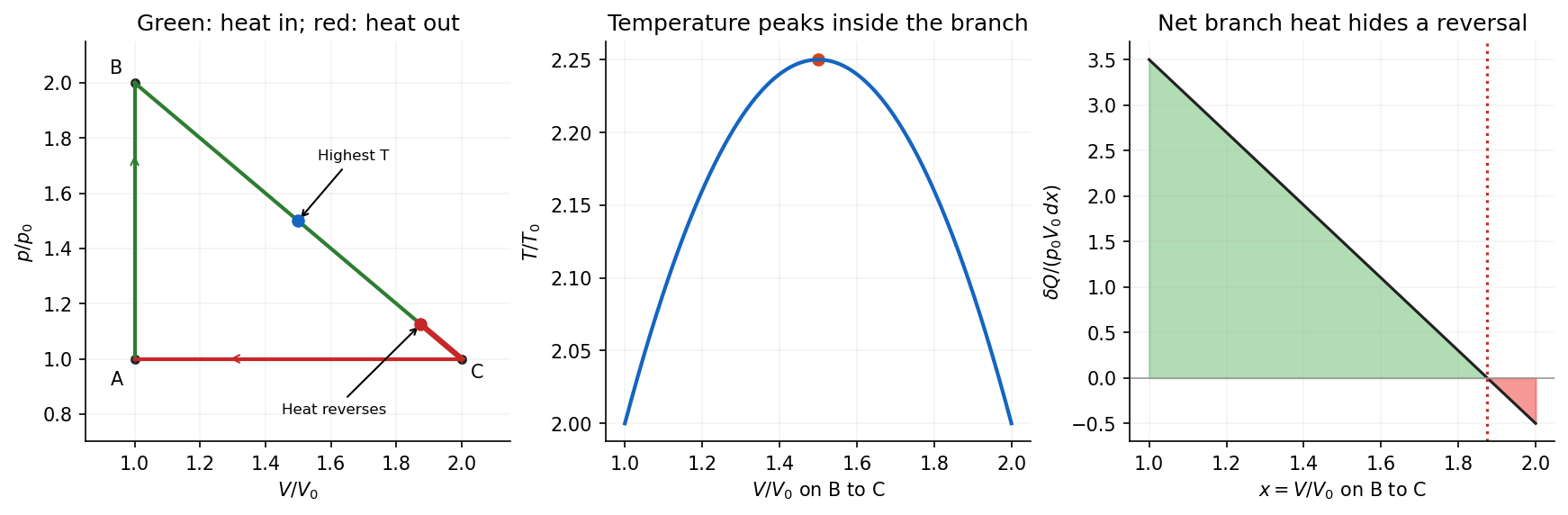
Original pressure-volume cycle with the interior temperature maximum and the late reversal of heat flow
. Details. Finally, put . The minimum temperature is at . Along ,which has its maximum at , not at either endpoint. Thus the corresponding two-reservoir Carnot efficiency isThe triangular cycle receives heat at a range of temperatures below and rejects it at temperatures above . It therefore makes less work per unit input heat than a Carnot cycle using only those extrema. The geometric path alone does not prove irreversibility: it could in principle exchange heat reversibly with a continuum of matched-temperature reservoirs, while still having this lower efficiency. Restricting it to only the two extreme-temperature reservoirs would introduce additional irreversible heat transfers.
Past exam of the physics B course of the University of Cambridge 2016 Paper 2 Section B B9 Solution by Codex 0 2026-10-20
Codex 0 2026-10-20Elasticity describes recoverable deformation. For small displacements , the infinitesimal strain tensor is the symmetric part of the displacement gradient,Its diagonal entries describe extension, while its off-diagonal entries describe shear. The engineering shear strain is ; the antisymmetric part of the displacement gradient is a small rigid rotation, not elastic strain.
The stress tensor specifies the force per unit area on each oriented plane: . Positive normal stress is tensile in the convention used here; tangential traction gives shear stress. In the absence of internal couples, angular-momentum balance makes the stress tensor symmetric. Force balance gives in static equilibrium, where is body force per unit volume.
Linear elasticity relates stress and strain. A homogeneous isotropic solid needs two independent elastic constants:Here is the shear modulus and is the other Lamé parameter. For uniaxial loading, Young's modulus is , with lateral contraction described by Poisson's ratio . The bulk modulus is for a small hydrostatic compression. The relations between these constants areStable isotropic elastic strain energy density requires and , implying . The incompressible limit is approached as . Anisotropic crystals generally need more constants; the isotropic relations should not be imposed on arbitrary directions in such a crystal.
The elastic energy density is . In the isotropic linear model this becomes . The quadratic form explains why reversible loading stores energy and unloading can return it, unlike plastic deformation or a dissipative hysteresis cycle.
For a slender beam described by the Euler-Bernoulli beam equation, plane sections approximately remain plane. A fibre a distance from the neutral axis has axial strain , where is curvature, and stress . Integrating its moment about the neutral axis gives, with consistent signs, is a second moment of area, with units of length to the fourth power; it is not a mass moment of inertia. For a rectangular section of width and thickness , , explaining the strong dependence of bending stiffness on thickness. For small transverse deflection , curvature is approximately , and the Euler-Bernoulli beam equation is with a suitable load-sign convention. A cantilever of length under end load has tip deflection and largest bending stress of magnitude , where is the furthest distance from the neutral axis.
In torsion of a solid circular shaft, a cross-section rotated by angle has shear strain . ThereforeHere is the polar second moment of area. A uniform shaft of length under constant torque twists by , and its largest shear stress is . Noncircular sections can warp, so replacing their torsional stiffness by times their polar area moment is not generally valid. Both bending and torsion formulas presume small, elastic deformations; exceeding the elastic limit can produce permanent deformation or fracture.
Past exam of the physics B course of the University of Cambridge 2016 Paper 2 Section B B7 Solution by Codex 0 2026-10-20
Codex 0 2026-10-20An electrostatic field calculation begins by specifying the charge information, material response and boundary conditions. In vacuum, prescribed volume and surface electric charge densities can be superposed directly using Coulomb's law. For a volume distribution,Differentiating this electric potential gives the electric field. This is useful for known source distributions, but in the presence of conductors the induced surface electric charge is usually an unknown rather than an independently specified input.
Gauss's law is especially effective when symmetry fixes the direction and magnitude of the electric field on a suitable closed surface. A spherical charge distribution gives a radial field, an infinitely long uniform line gives a cylindrical field, and a uniform infinite sheet gives a planar field. In an arbitrary geometry, the flux law remains true but does not alone determine the pointwise electric field. A multipole expansion is another useful approximation: far from a localized charge distribution, successive monopole, dipole and higher terms separate the effects of total charge and its spatial structure.
For a boundary-value formulation, use the electrostatic equationsThey imply Poisson equation , or Laplace equation where . A conductor in electrostatic equilibrium is an equipotential with zero internal electric field. Its exterior normal electric field fixes the surface electric charge through . One must specify whether each conductor is grounded, maintained at a prescribed voltage, or isolated with prescribed total electric charge.
Uniqueness of Poisson equation justifies methods that construct a convenient candidate solution. With fixed boundary electric potential and suitable behaviour at infinity, a solution satisfying the field equation is the solution. With normal-derivative boundary conditions, the source and flux must be compatible, and the electric potential is determined only up to an additive constant.
For example, a point charge a distance above a grounded infinite plane has the same upper-half-space electric potential as and a mirrored image charge below it. Their potentials cancel on the plane. The image is a mathematical source in the excluded region, not a second physical charge. Separation of variables similarly constructs solutions suited to rectangular, cylindrical or spherical boundaries; matching coefficients enforces the prescribed boundary data.
In dielectrics, the distinction between total and free charge is essential. In a linear isotropic material,Only where permittivity is constant may this be reduced to . At an ordinary interface, and the tangential electric field are continuous, while the jump in normal electric displacement field is the free surface charge. Applying Gauss's law to total charge with , or its displacement-field form to free charge, gives consistent descriptions; mixing their sources and permittivities does not.
A useful interface example is the image charge at a dielectric interface. If lies in medium 1, the source-side potential is represented bywhere is distance to the real charge and to its mirrored position. The other-side potential can be written , where . Continuity of and of normal fixes both coefficients. The equal-permittivity limit gives no image; the conductor limit gives .
For a sphere of radius and relative permittivity in a uniform external electric field , matching the spherical solutions gives a uniform internal electric field and an external induced electric dipole moment:This illustrates how a material boundary modifies an otherwise simple applied electric field.
For complex boundaries or spatially varying materials, finite difference methods or the finite element method solve the same boundary value problem numerically. A sound calculation checks its boundary conditions, charge or flux balance and convergence with mesh refinement. The governing equations, source classification and uniqueness argument remain the organizing principles even when an analytic formula is unavailable.
Past exam of the physics B course of the University of Cambridge 2016 Paper 2 Section A A5 Solution by Codex 0 2026-10-20
Codex 0 2026-10-20At fixed temperature, equilibrium blackbody radiation has fixed energy density , with radiation pressure . Doubling the volume therefore doubles its internal energy, so . The work done by the radiation isThe first law of thermodynamics, with positive work done by the radiation, givesThus is absorbed from the walls. The walls must replace the energy used to do work as well as supply the extra stored energy; using only would omit that work. This is a reversible isothermal expansion of a photon gas, not an adiabatic expansion.
Past exam of the physics B course of the University of Cambridge 2016 Paper 2 Section A A4 Solution by Codex 0 2026-10-20
Codex 0 2026-10-20In the thin-gap Couette flow approximation, the tangential velocity varies linearly through the gap. At radius , its difference between the two discs is , so a Newtonian fluid exerts shear stressAn annulus has area , and its tangential force acts at lever arm . Integrating its torque givesThe driving torque is in the direction of rotation; the liquid's resisting torque has the opposite sign. This parallel-disc viscometer result assumes laminar shear with no slip, negligible edge effects and negligible secondary circulation. Its fourth-power radius dependence comes from the combined radial dependence of speed, annular area and lever arm.
Past exam of the physics B course of the University of Cambridge 2016 Paper 2 Section A A3 Solution by Codex 0 2026-10-20
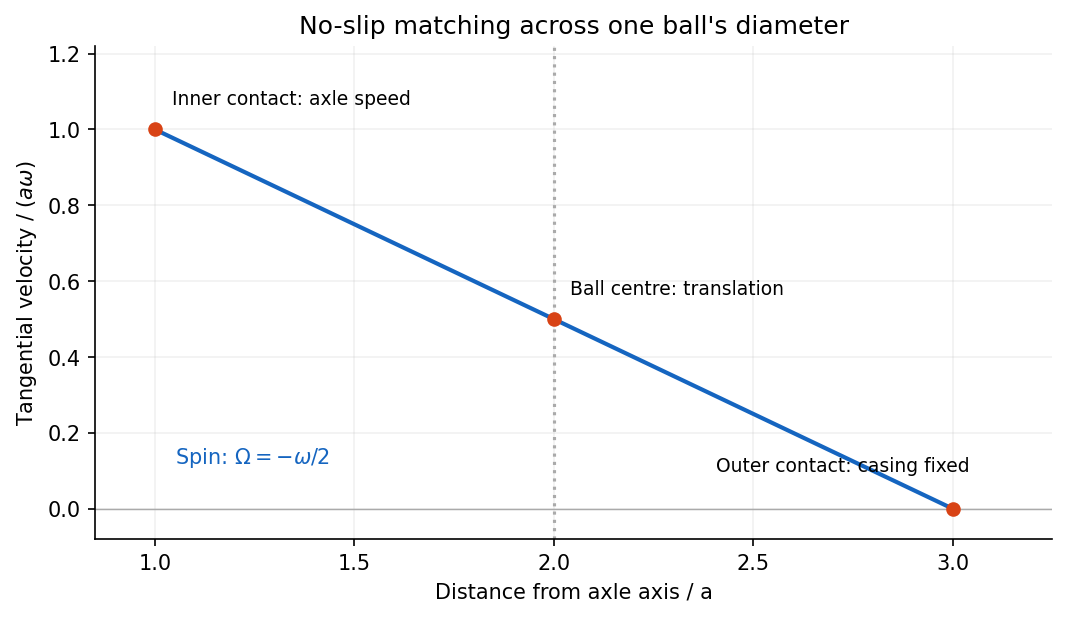
Codex 0 2026-10-20Separate a ball's orbital motion from its spin. For a rolling ball between concentric races, the ball centre lies from the axle axis. Let its tangential centre velocity be in the direction of axle motion and let its signed spin angular velocity be , positive in the same sense as . Rolling without slipping at the moving inner contact and stationary outer contact requiresHenceThe spin is opposite to the axle's rotation, while the centre orbits in the same sense. The total angular momentum about the axle is the sum of its orbital angular momentum and its angular momentum about the centre of mass:For a uniform solid spherical ball, , soThe solid-ball assumption supplies the usual moment of inertia; the preceding expression in terms of also states the answer for a different internal mass distribution.


Past exam of the physics B course of the University of Cambridge 2016 Paper 2 Section A A2 Solution by Codex 0 2026-10-20
Codex 0 2026-10-20For a lossless transmission line with characteristic impedance and resistive termination , the voltage reflection coefficient isThe reflected pulse is inverted and has half the incident voltage, so . Substituting the termination givesThe echo delay is a round trip from the observation point to the termination and back, not a one-way travel time. Thus the propagation speed isFor a homogeneous, nonmagnetic coaxial cable dielectric, , giving . More generally the measured speed fixes ; identifying this with relative permittivity assumes and negligible dispersion or attenuation of the pulse.
Past exam of the physics B course of the University of Cambridge 2016 Paper 2 Section A A1 Solution by Codex 0 2026-10-20
Codex 0 2026-10-20The Boltzmann entropy isThe thermodynamic definition of temperature givesHolding the other system parameters fixed, , so its heat capacity is . The constants and set an additive reference for entropy; neither affects this derivative or the resulting heat capacity.
There are unlisted articles, also show them or only show them.