Past exam of the atmospheric physics course of the University of Cambridge 2014 Paper 1 3 b Solution by  Codex 0 2026-10-20
In a simple northern-hemisphere layer with a fixed upper boundary, climbing a mountain compresses the column. Potential vorticity conservation, , then reduces absolute vorticity: at nearly fixed latitude the flow acquires anticyclonic relative vorticity. Descending the lee side stretches the column and restores or increases cyclonic vorticity. For an eastward streamline the idealized turning tendency is clockwise in the compressed region and counterclockwise on re-expansion; the resulting disturbance can launch a stationary downstream Rossby wave pattern.
Past exam of the atmospheric physics course of the University of Cambridge 2014 Paper 1 3 a Solution by Codex 0 2026-10-20
Codex 0 2026-10-20The isentropic potential vorticity is Ertel potential vorticity expressed on constant potential temperature surfaces:Here is the vertical curl of horizontal velocity differentiated on an isentropic surface, and is mass per unit area per unit potential-temperature interval. For smooth inviscid adiabatic motion, . Conserved anomalies are advected and deformed, explaining much balanced large-scale weather variability. Diagnosing velocity from PV additionally needs balance, stratification and boundary information. Strong latent/radiative heating, friction and irreversible mixing generate or modify PV, limiting a purely conservative explanation.[ref]
Past exam of the atmospheric physics course of the University of Cambridge 2014 Paper 1 2 d Solution by Codex 0 2026-10-20
Codex 0 2026-10-20Direct effect: nonabsorbing aerosol scatters sunlight, usually increasing reflected shortwave flux over dark surfaces. Absorbing aerosol also heats its atmospheric layer while reducing surface sunlight; the top-of-atmosphere sign depends on its altitude, optical properties and underlying albedo.
Cloud albedo effect: soluble, hygroscopic aerosol readily takes up water and can activate as cloud condensation nuclei. At fixed liquid-water path, more smaller droplets increase optical depth and cloud reflectivity: the Twomey effect. Suppressed collision-coalescence can delay rain and change cloud amount or lifetime, though dynamical adjustments prevent a universal sign.
Semi-direct effect: absorption can alter stability and evaporate clouds, or change entrainment and cloud cover. Insoluble dust may be a poor soluble-droplet nucleus but still scatters/absorbs radiation or nucleates ice; coatings can alter its activation. Solubility, absorptivity and ice-nucleating ability are distinct properties, not mutually equivalent categories.[ref]
Past exam of the atmospheric physics course of the University of Cambridge 2014 Paper 1 2 c Solution by Codex 0 2026-10-20
Codex 0 2026-10-20Droplets remain supercooled because creating an ice embryo costs interfacial free energy: freezing has a nucleation barrier even below the equilibrium melting point. Small droplets also have a low probability of containing an effective ice-nucleating inclusion.
Three heterogeneous routes are immersion freezing around a particle already inside the droplet, contact freezing following a collision with a suitable mineral particle, and deposition nucleation from ice-supersaturated vapour onto a suitable surface. At sufficiently low temperature, homogeneous ice nucleation occurs without a foreign surface. Its onset depends on volume and observation time rather than being a universal exact temperature. No biological ice-nucleating agents are needed for these mechanisms.
Past exam of the atmospheric physics course of the University of Cambridge 2014 Paper 1 2 b Solution by Codex 0 2026-10-20
Codex 0 2026-10-20Warm-rain pathway: condensation first grows activated droplets, but its relative size growth slows. A sufficiently broad size spectrum creates different fall speeds; large drops collect smaller ones by collision-coalescence. Collection efficiency, turbulence, liquid-water supply and residence time control the bottleneck. Rain reaching the ground also requires survival against subcloud evaporation.
Ice pathway: below freezing, saturation vapour pressure over ice is lower than over supercooled liquid. In mixed-phase air, ice can grow by deposition while droplets evaporate: the Wegener-Bergeron-Findeisen process. Ice also collects droplets by riming and combines by aggregation. Adequate ice nuclei, sustained supersaturation and residence time are critical; particles must become heavy enough to fall, with snow sometimes melting to rain. Condensation or deposition alone is not generally sufficient for rapid precipitation.
Past exam of the atmospheric physics course of the University of Cambridge 2014 Paper 1 2 a Solution by Codex 0 2026-10-20
Codex 0 2026-10-20A convex water surface has higher saturation vapour pressure than a flat one. Equality of chemical potentials with the Laplace pressure gives the Kelvin equationSmall pure droplets therefore need large supersaturation; many subcritical embryos evaporate, making homogeneous droplet formation inefficient under ordinary cloud conditions. Cloud condensation nuclei provide a surface and, when soluble, lower water activity. Köhler theory combines the curvature increase with this solute decrease, giving a critical supersaturation and size for activation.
Past exam of the atmospheric physics course of the University of Cambridge 2014 Paper 1 1 d Solution by Codex 0 2026-10-20
Codex 0 2026-10-20Thick low clouds usually reflect much sunlight and emit infrared at temperatures close to the surface, so their daytime shortwave cooling is strong and their longwave greenhouse contrast relatively small. Cold high clouds can strongly reduce outgoing longwave radiation; thin high clouds reflect less sunlight. Thickness and particle properties matter as well as height.
At night there is no solar term. Warm low-cloud tops commonly cool radiatively, promoting condensation and cloud-driven turbulence that can sustain the layer. A cold, optically thin high cloud can instead absorb more infrared from below than it emits, warming and sublimating and thus shortening its lifetime. A gray-layer diagnostic is absorption minus emission, . This is a tendency, not a universal lifetime ranking: thick cirrus can cool at its top, and ascent, entrainment, humidity and precipitation may dominate.
Past exam of the atmospheric physics course of the University of Cambridge 2014 Paper 1 1 c Solution by Codex 0 2026-10-20
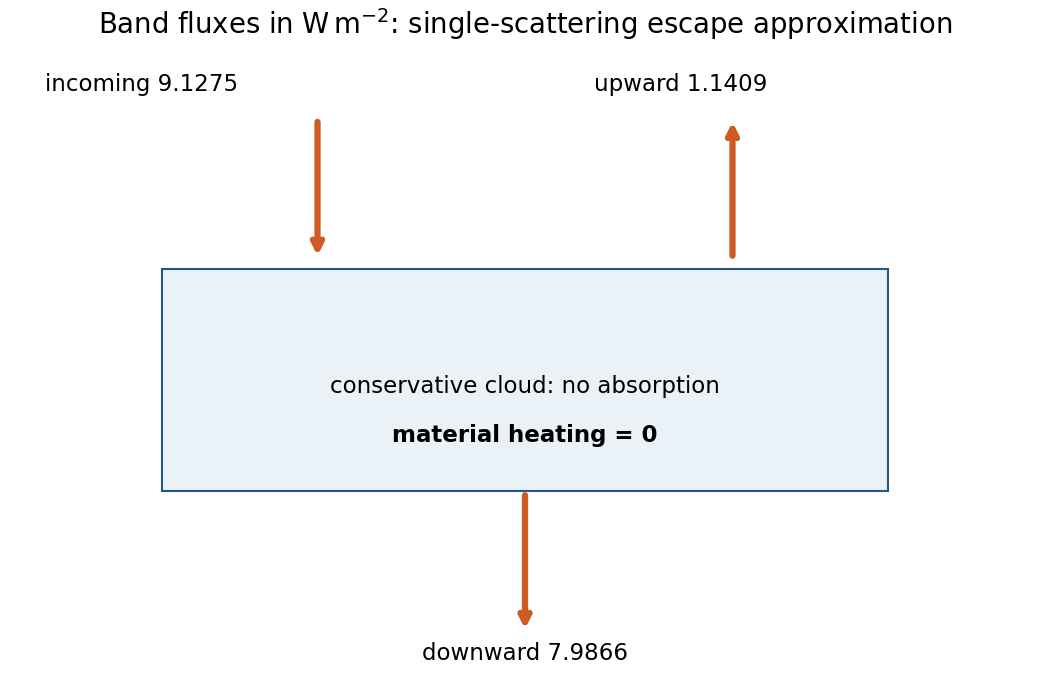
Codex 0 2026-10-20The cloud heating rate in this band is zero: conservative scattering changes photon directions but transfers no net energy to the cloud matter. Let enter its top and . In the stipulated single-scattering escape approximation, the downward and upward outgoing fractions areTheir fluxes are approximately and . With upward-positive net flux, both cloud boundaries have ; henceThe layer heat capacity is . Absorption outside the cloud heats those other layers. Dropping the upward flux would spuriously turn reflection into cloud heating. Neglecting multiple scattering is quantitatively poor at optical depth ten, but conservative multiple scattering still cannot create material heating in this band.
Past exam of the atmospheric physics course of the University of Cambridge 2014 Paper 1 1 b Solution by Codex 0 2026-10-20
Codex 0 2026-10-20The Beer-Lambert law solves the source-free attenuation term of the radiative transfer equation. Extinction includes absorption and scattering out of that ray. Missing terms are thermal emission and scattering into the ray from other directions, including repeated scattering and surface reflection.
A cloud can remove nearly all direct sunlight while still supplying substantial diffuse downward radiation. Consequently the total surface solar flux can greatly exceed the direct-beam answer, although reflection sends some energy back to space and absorption can heat matter. At ordinary atmospheric thermal emission is negligible. No unique total flux follows from extinction alone; the single-scattering albedo, angular redistribution and boundary conditions are needed.[ref]
Radiative transfer in the atmosphere by Met Office. Absorption, scattering and thermal-emission processes
Past exam of the atmospheric physics course of the University of Cambridge 2014 Paper 1 1 a Solution by Codex 0 2026-10-20
Codex 0 2026-10-20Treat the quoted solar spectrum as irradiance normal to the beam, approximately constant over the narrow band. The incident band irradiance is and the horizontal value is . The cloud's vertical optical depth is ; including the clear atmosphere gives . The slant optical depth is . Thus the Beer-Lambert law givesThe removed fraction is , almost the full incident horizontal . Beam-normal surface irradiance is twice the horizontal value. These are direct-beam quantities, not the total diffuse-plus-direct surface flux. If the supplied irradiance were already horizontal, the projection factor would instead be omitted.
Past exam of the atmospheric physics course of the University of Cambridge 2013 Paper 1 3 c Solution by Codex 0 2026-10-20
Codex 0 2026-10-20For dry atmospheric Ertel potential vorticity, use absolute vorticity and potential temperature :The conservation statement is Ertel's theorem for smooth, inviscid, adiabatic flow with conservative body forces and a thermodynamic equation of state . Stretching of cancels deformation of in their material derivative; the remaining baroclinic triple product vanishes because lies in the span of . The atmospheric form includes ; the commonly used Boussinesq approximation version has a different normalization.
In a predominantly vertical stratification, . Thus rotation and stratification jointly label air masses. Material conservation explains how parcels deform and stretch while preserving a useful scalar, supports Rossby waves, and helps diagnose sharp fronts, jets and stratospheric intrusions.
Under an appropriate balance model, potential-vorticity inversion recovers associated wind and temperature fields from a PV distribution together with stratification and boundary data. PV alone does not specify every component of an arbitrary atmospheric flow. Potential-vorticity generation by heating and friction limits conservative parcel reasoning near strong heating, surface stress or mixing.[ref]
Fundamentals of Atmosphere-Ocean Dynamics by Michael Edgeworth McIntyre. PartII§12, equationII.17, physical PDF pp.150–152: dry atmospheric PV and qualified invertibility
Past exam of the atmospheric physics course of the University of Cambridge 2013 Paper 1 3 b Solution by Codex 0 2026-10-20
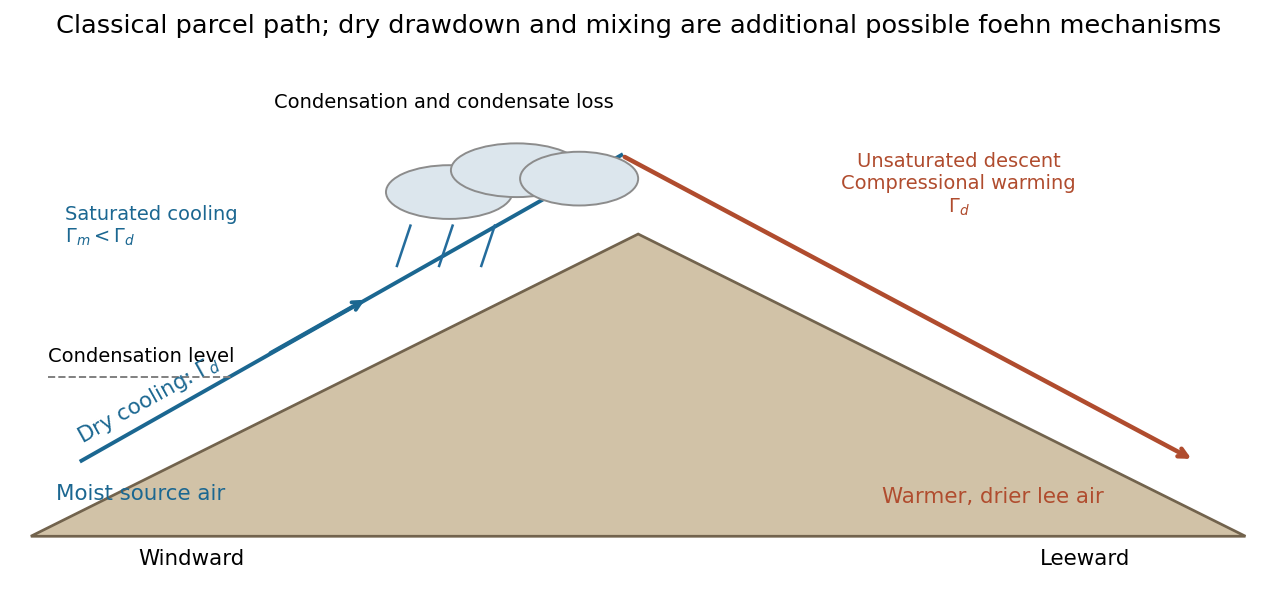
Codex 0 2026-10-20A foehn wind is relatively warm, dry downslope air on a mountain's lee side. In the classical condensation pathway, ascending windward air expands and cools at the dry adiabatic lapse rate until the lifting condensation level. Condensation then releases latent heat, reducing the cooling rate to the moist adiabatic lapse rate. Atmospheric precipitation removes condensate, and the descending parcel warms by compression at approximately the dry rate. Its relative humidity falls.
For equal starting and finishing heights, complete condensate removal and a constant moist lapse rate above condensation height , the precipitation-driven foehn warming isHere is the parcel's maximum height and . The warming is adiabatic compression during descent, not heating by friction. Without condensation or a difference in source air, a reversible dry parcel returning to its original height would regain its original temperature.
Precipitation is not essential to every foehn event. Isentropic foehn drawdown can bring air of higher potential temperature from aloft down the lee slope; turbulent mixing and extra solar heating beneath clear skies can also contribute. The sketch shows the classical rainout pathway rather than asserting a unique mechanism.[ref]
Foehn effect by Met Office. How does the foehn effect work? Condensation/rainout, drawdown, mixing and radiative warming
Past exam of the atmospheric physics course of the University of Cambridge 2013 Paper 1 3 a Solution by Codex 0 2026-10-20
Codex 0 2026-10-20A teleconnection is correlated atmospheric variability between separated regions. A principal dynamical pathway is a Rossby-wave teleconnection: a displaced air column conserves potential vorticity, so changing planetary vorticity must be balanced by changing relative vorticity. The background potential-vorticity gradient supplies the restoring mechanism.
In a uniform zonal current on a beta plane, a simple Barotropic Rossby wave hasThe intrinsic phase propagates westward for ; advection can leave a nearly stationary pattern in the terrestrial frame. Energy and information travel with the group velocity, not necessarily with individual crests or the same air parcels. A jet stream can guide wave packets and link distant ridges and troughs.
For example, persistent anomalous tropical heating can excite wave trains that alter remote pressure, temperature and storm tracks. Tropical Pacific ocean-temperature anomalies can modify that heating, yielding reproducible extratropical patterns. Their phase and strength depend on the background winds, potential-vorticity gradients, damping, season and eddy feedbacks. A correlation pattern is not by itself proof of a unique causal pathway, and not every teleconnection is a single stationary linear wave.[ref]
Teleconnections and stationary Rossby waves by Isaac Held. 9March2015: rotating-sphere response to localized equatorial heating and extratropical ENSO patterns
Past exam of the astrophysical fluid dynamics course of the University of Cambridge 2016 Paper 1 4 b Solution by Codex 0 2026-10-20
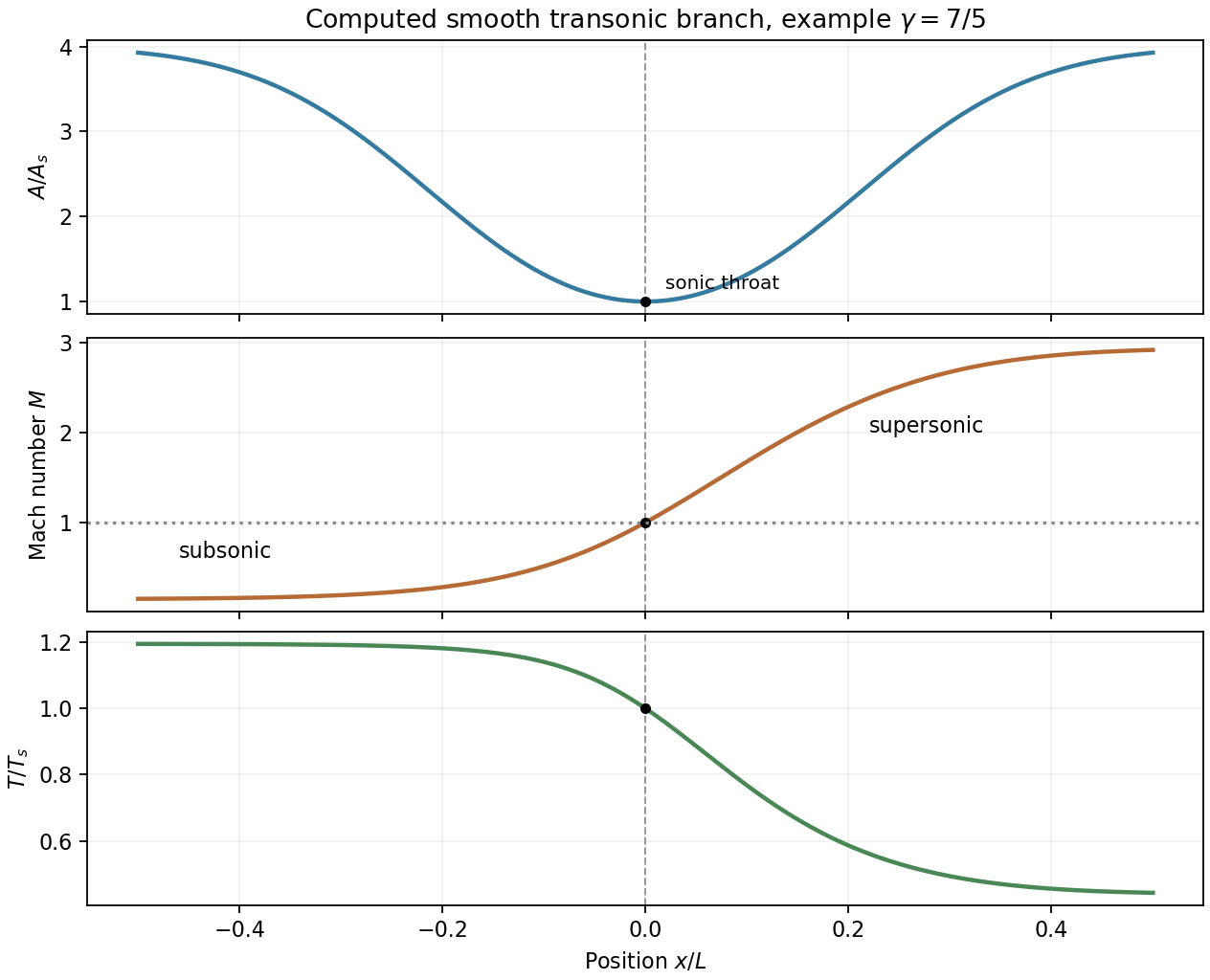
Codex 0 2026-10-20Treat the gas as a smooth quasi-one-dimensional flow through a rigid passage, neglecting axial body forces and heat input. It is the confining medium that is incompressible; the flowing gas must remain compressible. With area and axial speed , continuity and inviscid momentum balance giveCombining their logarithmic differentials yields the nozzle area-velocity relationA smooth crossing of requires an area extremum. The given radius is positive and has derivative , which vanishes only at within the slab and changes from negative to positive there. Thus this station is the unique throat, with and . The specified subsonic inlet and supersonic outlet select the smooth accelerating branch, soA throat by itself does not guarantee transonic flow for arbitrary reservoir and back pressures; that branch is specified here. Before the throat a converging section accelerates subsonic flow; beyond it a diverging section accelerates supersonic flow.[ref]
Nozzle Design by NASA Glenn Research Center. Supersonic and Subsonic Flow, continuity/momentum derivation of the area-velocity relation and choked throat
For the temperature task, evaluate the mass flux and sound speed at the throat using :The ideal-gas relation then givesThis expresses the sonic temperature in terms of the entropy constant, geometry, mass flux and composition; no numerical value of or is provided. Equivalently and . The slab length drops out because the sonic thermodynamic state depends on the minimum area, not on the axial distance over which a lossless smooth nozzle contracts. As a check, conserved stagnation enthalpy gives .[ref]
Mass Flow Choking by NASA Glenn Research Center. equations 1–10 and 19, sonic mass-flow maximum and temperature/Mach relation
The result assumes cross-sectional thermodynamic uniformity and negligible transverse kinetic energy. Exact multidimensional flow through a sharply varying passage can have a curved sonic surface; the radius profile alone does not solve that boundary-value problem. The original numerical plot below computes the standard quasi-one-dimensional branch, rather than reproducing the supplied passage sketch.
Past exam of the astrophysical fluid dynamics course of the University of Cambridge 2016 Paper 1 4 a Solution by Codex 0 2026-10-20
Codex 0 2026-10-20Write the polytropic law as , with constant and . Its pressure potential, or polytropic enthalpy relative to zero density, isHydrostatic balance is . If the surface has zero density and potential , integration gives . At the centre, . ThereforeInsert and into the spherical Poisson equation for Newtonian gravity:The central conditions are and ; the latter follows from a regular spherically symmetric centre. This reproduces the supplied coordinate and potential scaling rather than introducing an unrelated normalization.
For the sound-speed task, the adiabatic sound speed of a perfect polytropic gas isA diatomic gas with active rotational but frozen vibrational degrees of freedom has and . With the requested surface-potential gauge ,The interior potential is then negative. Choosing zero potential at the surface is legitimate; for a finite isolated sphere it is a different additive gauge from setting potential to zero at infinity. Both choices cannot generally be imposed simultaneously.
For the mass-radius task, let be the first zero of the regular Lane-Emden function and . A finite-radius polytrope hasThusAt fixed central temperature, fixed composition and fixed polytropic index, . These are homologous polytropes at fixed central temperature. They do not in general have constant ; imposing constant entropy instead gives a different polytropic mass-radius sequence. If or varies between stars, the displayed dimensionless structure factor and composition factor must be retained: equal alone is not a universal exact proportionality for arbitrary stellar models.
Past exam of the astrophysical fluid dynamics course of the University of Cambridge 2016 Paper 1 3 c Solution by Codex 0 2026-10-20
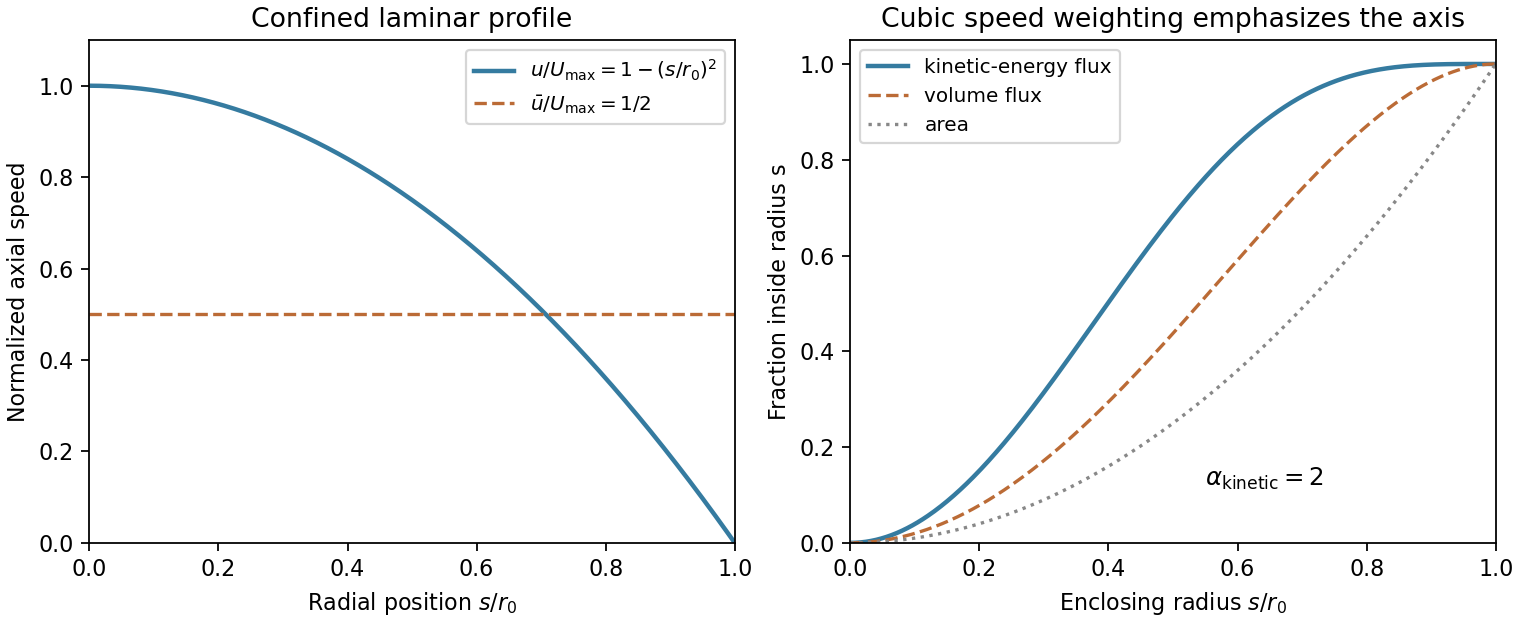
Codex 0 2026-10-20Use the idealized fully developed, laminar cylindrical-flow model implied by the fixed cross-section and zero velocity at its sides. Take the jet length to be , as for a central source reaching the cloud boundary; if the source is off-centre, the actual path length must replace . Let denote distance from the jet axis and write the axial velocity as . Then , the pressure gradient is , and the axial Navier-Stokes equation reduces toRegularity at excludes a logarithmic term. The imposed no-slip boundary condition gives the Hagen-Poiseuille flow profileThe kinetic energy crossing each area element per unit time is , so the velocity must be cubed before integration. ThusConsequentlyThe mean velocity is . Replacing the profile by in underestimates the flux by two; the kinetic energy correction factor is two for this profile. The radius dependence follows from and cross-sectional area .
The specified is outgoing bulk kinetic-energy flux, not the pressure-work rate , which scales as . In a fully developed section the profile is independent of and pressure work is dissipated as heat; entrance acceleration and energy supply establish the profile. A turbulent or freely entraining astrophysical jet need not have this no-slip parabolic structure. The model assumes a long enough, laminar confined region and neglects entrance losses and gravity.


Past exam of the astrophysical fluid dynamics course of the University of Cambridge 2016 Paper 1 3 b Solution by Codex 0 2026-10-20
Codex 0 2026-10-20Write and use the vector identity . Taking the curl of the momentum equation eliminates all pure gradients, including gravity and the viscous contribution. Before invoking barotropy, the pressure term givesThis is baroclinic vorticity generation. For a barotropic fluid, , so is parallel to and this source vanishes. Constant permits the curl and Laplacian to commute. The result isNo incompressibility assumption was used. Since , an equivalent form isThe terms represent vortex stretching/tilting, compression/dilatation and viscous diffusion. In particular, removing the baroclinic source does not make the vorticity of a three-dimensional parcel constant. A spatially varying entropy-dependent in need not define a single barotropic law; the common-pressure-law assumption matters.
Past exam of the astrophysical fluid dynamics course of the University of Cambridge 2016 Paper 1 3 a Solution by Codex 0 2026-10-20
Codex 0 2026-10-20Let be the specific internal energy of a calorically perfect gas and define its specific gas constant , so . A reversible adiabatic change has no heat input and obeysUsing and givesIntegration yields , or , with fixed on that isentrope. Equivalently , so specifies entropy as well as composition. In a smooth nondissipative flow this means along each parcel. A single common throughout the fluid additionally requires a homentropic flow. No heat transfer alone does not forbid entropy production: different sides of an adiabatic shock generally have different values. Constant composition and heat capacities are needed for the fixed exponent used here.
Past exam of the astrophysical fluid dynamics course of the University of Cambridge 2016 Paper 1 2 c Solution by Codex 0 2026-10-20
Codex 0 2026-10-20A small pressure disturbance propagates because compression raises the pressure, the pressure gradient accelerates nearby fluid, and the induced convergence compresses the next region. For a uniform fluid at rest, linearizing mass and momentum conservation and using the adiabatic pressure-density response givesEliminating and gives . A plane wave has and longitudinal velocity parallel to . In a perfect gas,The adiabatic response is appropriate when heat cannot diffuse appreciably out of each compressed region during a period; an isothermal response would give a different derivative. In a moving uniform medium, the acoustic characteristics travel at along the flow, rather than at in the laboratory.
For a progressive wave, ; pressure, density and longitudinal velocity are in phase. The acoustic energy density is the sum of kinetic and compression energies,Sound transports energy while fluid elements execute small oscillations about their mean positions. The ideal uniform-fluid acoustic mode is nondispersive. Spherical spreading reduces pressure amplitude as when total power is conserved; viscosity and heat conduction attenuate waves, while sufficiently large compressions can steepen into shocks. In a stratified astrophysical gas the uniform result is local: wavelengths short compared with background scale heights justify it, whereas long waves can couple to buoyancy and acoustic-cutoff behavior.
Past exam of the astrophysical fluid dynamics course of the University of Cambridge 2016 Paper 1 2 b Solution by Codex 0 2026-10-20
Codex 0 2026-10-20A finite-amplitude compression can steepen because different parts of the wave travel at different characteristic speeds. For a right-moving simple wave in a perfect gas, one may write in terms of the local velocity perturbation . Faster compressive characteristics catch slower ones. When the smooth inviscid description would become multivalued, a physical compression shock replaces it. A rarefaction normally spreads rather than forming an entropy-violating expansion shock.[ref]
Lecture notes: Astrophysical fluid dynamics by Gordon I. Ogilvie. §§6.1.3–6.2, simple-wave reduction and characteristic crossing
Across a locally planar shock, use velocities relative to its moving front. The Rankine-Hugoniot conditions for a perfect gas conserve mass, momentum and total energy flux:where is the specific enthalpy. For upstream normal Mach number ,Thus a normal compression shock increases pressure, density and temperature, reduces the normal velocity, and changes a supersonic upstream flow to subsonic downstream flow in the shock frame. In the strong-shock limit, compression approaches , which is four for a monatomic gas. A shock conserves total energy but generates entropy; an adiabatic shock is not an isentropic compression. For a calorically perfect gas, stagnation temperature is conserved while stagnation pressure falls.[ref]
Normal Shock Wave Equations by NASA Glenn Research Center. normal-shock property ratios, total-temperature conservation and total-pressure loss
Real dissipative processes resolve the narrow front; the jump conditions do not require its detailed internal profile. In a continuum-gas experiment a shock tube can produce a moving shock by releasing a pressure discontinuity. pressure probes separated along the tube measure arrival speed and the pressure jump; distinguishing the shock from the following contact surface is essential. A contact surface can have a density/entropy jump with continuous pressure and normal velocity, whereas a shock carries nonzero mass flux through its front.
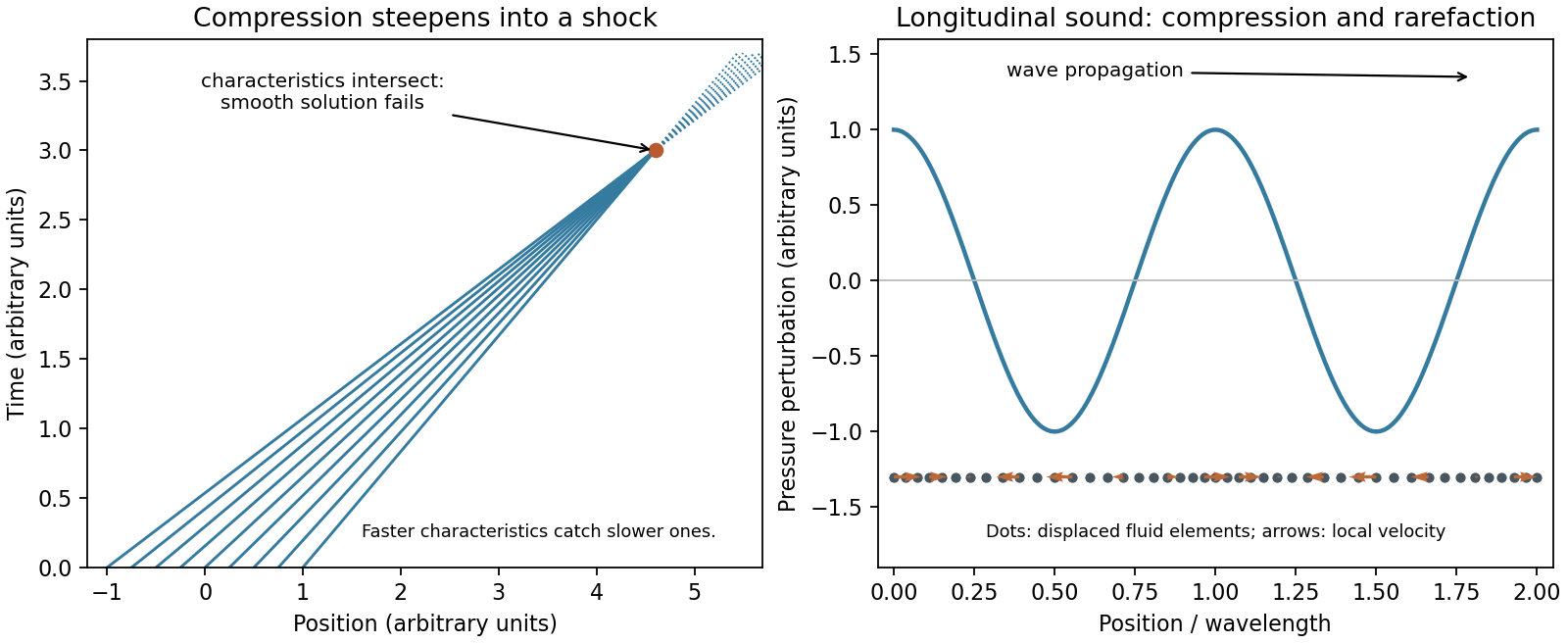
Original characteristic-crossing and longitudinal acoustic wave diagrams
. Details. 
There are unlisted articles, also show them or only show them.