Past exam of the advanced quantum physics course of the University of Cambridge 2015 Paper 1 4 iii Solution by  Codex 0 2026-10-20
For , use a resonant half-turn pulse,The up amplitude vanishes because , while the down amplitude has unit magnitude. Its phase is a common phase of the final state, so any RF phase givesThe final population inversion is insensitive to a free-precession phase, unlike the orientation of a transverse superposition. This is a Rabi pi pulse with the drive-amplitude convention specified above.
Past exam of the advanced quantum physics course of the University of Cambridge 2015 Paper 1 4 ii Solution by Codex 0 2026-10-20
Codex 0 2026-10-20The eigenstate is , with . Use the same duration but phaseThe relative amplitude is now , givingThe two transverse preparations differ by a quarter-cycle of RF phase, not by changing the pulse area. Reversing the desired transverse direction adds to the chosen phase.
Past exam of the advanced quantum physics course of the University of Cambridge 2015 Paper 1 4 i Solution by Codex 0 2026-10-20
Codex 0 2026-10-20The eigenstate is , since . Use a resonant quarter-turn pulse, , and choose its phase so thatThe laboratory-frame relative amplitude then is , givingIn rotating axes the equivalent target is obtained with ; the extra laboratory phase above compensates Larmor precession during the pulse. After switching the RF field off, the spin continues to precess in the static field, so this statement specifies the preparation instant rather than a state fixed along laboratory forever.
Past exam of the advanced quantum physics course of the University of Cambridge 2015 Paper 1 2 c Solution by Codex 0 2026-10-20
Codex 0 2026-10-20A helium atom has two electrons bound to nuclear charge . In the nonrelativistic fixed-nucleus approximation, using atomic units,The last term couples the electrons, so a product of independent hydrogenic orbitals is not an exact solution. The dominant ground configuration is . Its spatial wavefunction is symmetric, so Fermi antisymmetry requires the spin singletA triplet cannot put both electrons in the same spatial orbital. Correlation changes the exact spatial function, including its dependence on , while preserving this ground-state symmetry.
A useful helium variational effective charge takes normalized orbitals for both electrons and multiplies their product by . The energy in Hartree units isThe reduced effective charge expresses screening. Neglecting repulsion gives , while its expectation in the unscreened product gives ; optimizing the orbital improves that trial estimate. The exact ground energy is lower than the optimized product energy, since the product omits explicit electron correlation. This calculation keeps nuclear charge two in ; only the trial orbital parameter is varied.
For a singly excited helium state with distinct orthonormal orbitals and , the spatial combinations areThe symmetric pairs with the antisymmetric spin singlet, while antisymmetric pairs with the symmetric spin triplet. With the same orbitals, their leading energies areHere is the direct Coulomb integral and is the exchange integral. The latter is positive for the Coulomb interaction, so the triplet is lower for this fixed-orbital comparison. singlet-triplet exchange splitting in helium arises from antisymmetry and spatial correlation in the Coulomb interaction, not from inserting a separate classical spin-spin force. Spin-singlet helium states are parahelium; spin-triplet helium states are orthohelium. The two spectra approximately form separate families because the leading electric dipole operator does not change total spin.[ref]
The lowest terms are and , with the triplet lower. The configuration gives and , where the odd parity allows singlet to connect to the even-parity ground singlet by an electric dipole transition. Both levels lack an allowed direct electric dipole decay to : the triplet is spin forbidden, and singlet is forbidden by orbital angular momentum and parity. This explains helium metastability without implying an infinite lifetime once weaker radiative processes or collisions are allowed.
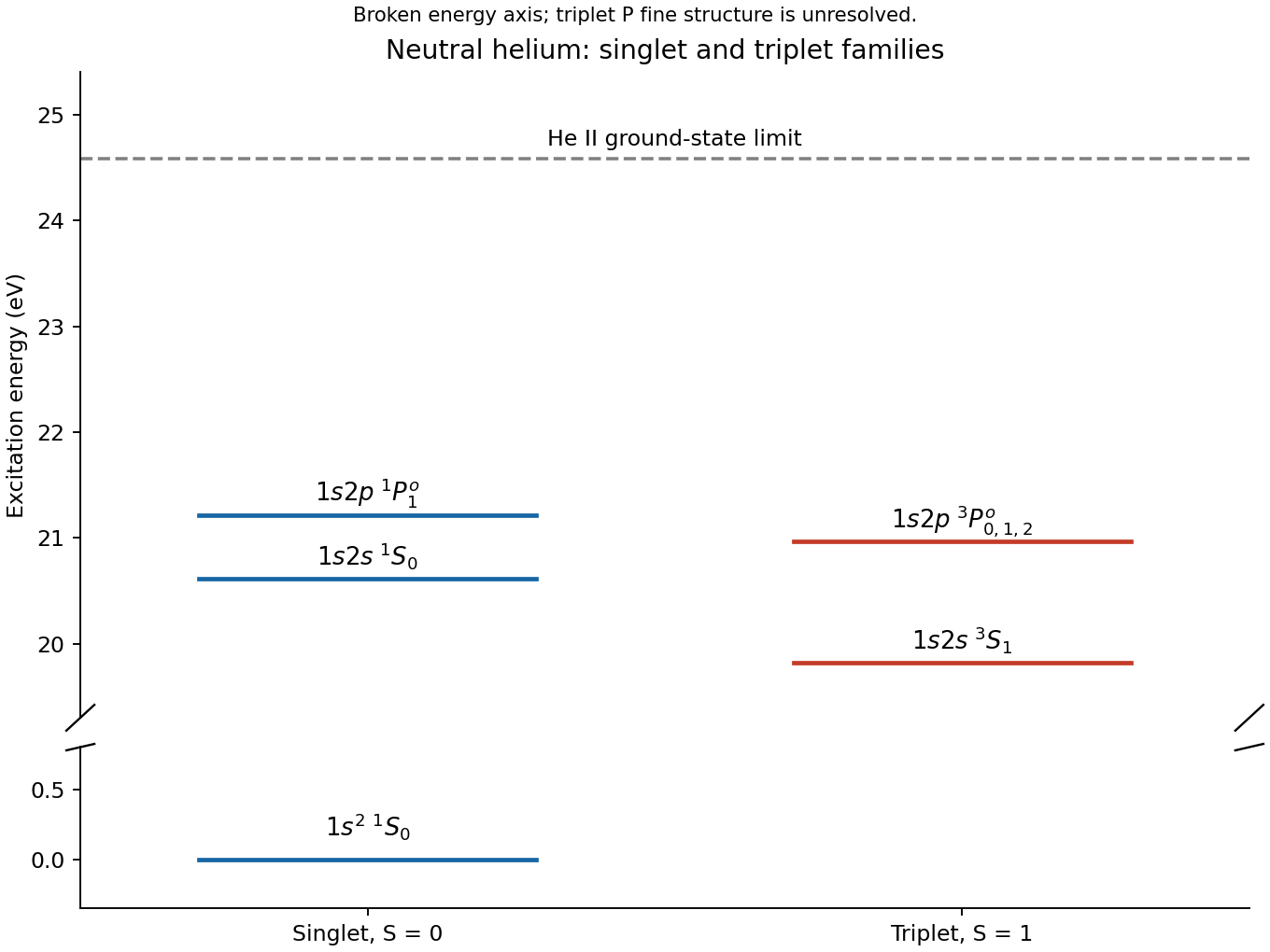
The observed first excitation energies are approximately and for the triplet and singlet, respectively. Higher singly excited Rydberg series approach the He II ground-state ionization threshold; doubly excited states above that threshold can autoionize and are not all stable bound excited levels.[ref]
Energy Levels of Neutral Helium by National Institute of Standards and Technology. 1s2s and 1s2p configuration rows; He II ground-state limit at 198310.6691 inverse centimetres
Past exam of the advanced quantum physics course of the University of Cambridge 2015 Paper 1 2 b Solution by Codex 0 2026-10-20
Codex 0 2026-10-20For a particle of charge and mass in a uniform magnetic field , minimal coupling replaces momentum by . Choose Landau gauge and first restrict motion to the plane. Since is conserved,These Landau levels quantize the classical cyclotron motion. The wavefunctions are harmonic-oscillator functions centred at , multiplied by . Changing shifts the guiding centre without changing the energy. Gauge-dependent labels such as are not themselves observables; the level spacing and degeneracy are gauge independent. The magnetic length is the transverse orbital scale.
For a large rectangle of sides , periodicity along gives . Requiring centres inside the sample gives, for each orbital level and each specified spin state,Thus each magnetic flux quantum supplies one guiding-centre state. The continuum bulk count neglects boundary corrections; magnetic periodic conditions on a torus require integer flux count. A finite confining edge lifts the simple flat guiding-centre spectrum near that edge.
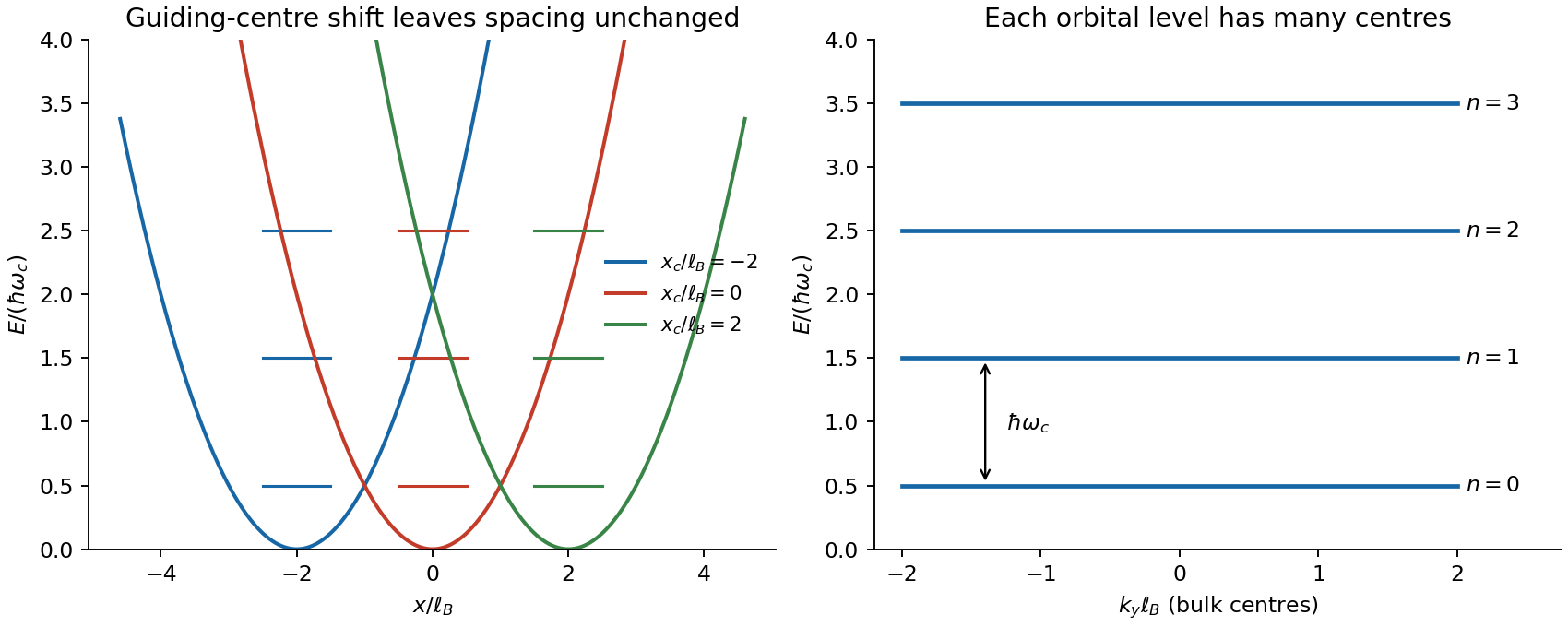
spin adds a Zeeman term. For electrons with gyromagnetic factor , its contribution is , with and . If and the orbital mass is , the branches become and : the lowest combined level has one spin branch, while positive levels coincide in pairs. In a material, effective mass and effective need not give that coincidence.
In three dimensions, free motion parallel to adds , so each orbital index labels a one-dimensional continuum rather than an isolated three-dimensional energy. Resolved magnetic quantization requires the spacing to exceed substantial thermal and disorder broadening. The changing occupation of these levels underlies magnetic quantum oscillations; in two dimensions their degeneracy and filling are central to the integer quantum Hall effect. These statements assume nonrelativistic, approximately independent particles, rather than arbitrary interacting or disordered spectra.
Past exam of the advanced quantum physics course of the University of Cambridge 2015 Paper 1 2 a Solution by Codex 0 2026-10-20
Codex 0 2026-10-20The quantum variational principle turns the ground-state problem into minimization of a Rayleigh quotient:The Hamiltonian must be a self-adjoint operator bounded below, and the nonzero trial state must have finite form energy. Expanding a normalized trial state in exact energy eigenstates gives , a weighted average no smaller than . Equality requires support only in the ground-state eigenspace. The spectral version also accommodates continuous spectrum; a lowest normalizable eigenstate is not required merely to bound the spectral infimum.
The variational method chooses a trial family with the correct boundary conditions, fermionic exchange symmetry and other required quantum numbers, evaluates its energy and minimizes over its parameters. It gives an upper bound on ground-state energy. Enlarging a nested trial family can only improve or preserve its optimal bound. A low energy does not by itself establish a highly accurate wavefunction, especially near degeneracy; energy errors are second order in small admixtures orthogonal to a nondegenerate exact ground state.
For example, a normalized Gaussian trial for a one-dimensional quantum harmonic oscillator is , with . Its energy isThe two terms balance kinetic localization cost against the potential cost of spreading out. This Gaussian variational energy for the harmonic oscillator happens to attain the exact answer because the family contains the exact ground state.
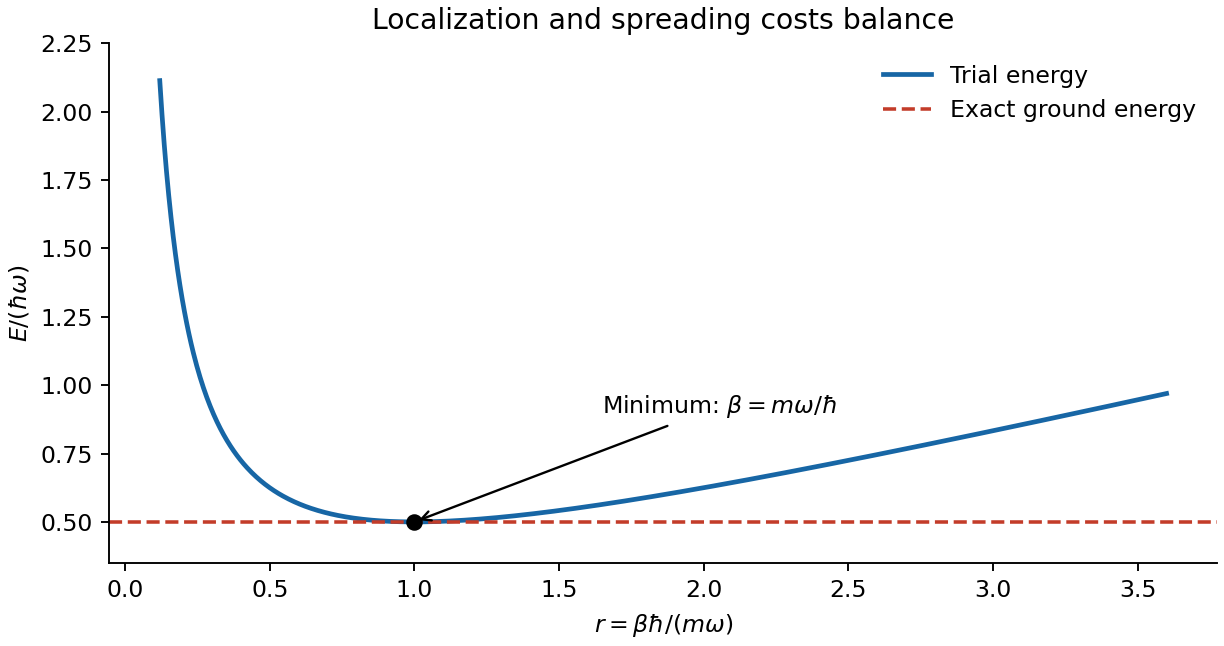
Gaussian variational energy and its exact harmonic-oscillator minimum
. Details. A trial expansion in a finite, possibly nonorthogonal basis gives the generalized eigenvalue problem , with and . Its lowest Ritz value minimizes the quotient in that subspace. For excited states, the excited-state variational constraint imposes exact orthogonality to the lower eigenstates to obtain a corresponding upper bound; the Courant–Fischer min-max principle yields upper bounds for ordered Ritz eigenvalues from a common subspace. orthogonality only to an independently approximate ground state does not automatically provide an excited-state bound: residual true-ground-state contamination can lower the trial energy below the desired excited energy. Symmetry can impose exact orthogonality when the relevant states have different symmetry sectors.
Past exam of the advanced quantum physics course of the University of Cambridge 2015 Paper 1 1 c Solution by Codex 0 2026-10-20
Codex 0 2026-10-20Closed and subshells have . In the open subshell, three electrons can have parallel spins in , and the fourth must have the opposite spin, giving maximum . Treating the shell as two holes gives the same allowed terms as ; at this spin, antisymmetry permits , rather than . One can also see by placing the fourth electron in .
Hund's rules therefore select the term. Since four electrons exceed half filling of the six-state subshell, its lowest atomic fine-structure level has the largest :Its zero-field magnetic degeneracy is . The experimentally tabulated neutral-oxygen ground level has precisely this term and .[ref]
Past exam of the advanced quantum physics course of the University of Cambridge 2015 Paper 1 1 b Solution by Codex 0 2026-10-20
Codex 0 2026-10-20At incident wave number , low kinetic energy means : the de Broglie wavelength is much larger than the scattering region. A generic finite-range scatterer can then be described to leading order without resolving its angular structure. In partial-wave scattering, this is leading S-wave scattering. The spherical harmonic is constant, whereas the centrifugal term impedes penetration to the potential for .
For a central potential with regular threshold behaviour, the finite-range partial-wave threshold law gives . Thuswhich is independent of scattering angle. For finite nonzero scattering length , and is isotropic. The potential range and scattering length are different quantities. The claim describes the generic leading S-wave scattering limit; tuned vanishing S-wave scattering amplitude or exceptional threshold resonances require separate analysis rather than a universal angular conclusion.
Past exam of the advanced quantum physics course of the University of Cambridge 2015 Paper 1 1 a Solution by Codex 0 2026-10-20
Codex 0 2026-10-20The Pauli exclusion principle allows each one-particle magnetic substate only once, since the fermions share the other quantum numbers. To maximize the total angular momentum projection, occupy , givingThe corresponding Slater determinant is a highest-weight vector: every attempted raising operation either tries to exceed or duplicates an occupied substate and vanishes. Therefore it belongs to a multiplet with , not the distinguishable-particle value . Equivalently, four particles in a six-state shell have two holes whose maximum angular momentum projection is . The general maximum total angular momentum of equivalent fermions is for .
Past exam of the advanced quantum physics course of the University of Cambridge 2014 Paper 1 3 b Solution by Codex 0 2026-10-20
Codex 0 2026-10-20For , the mixed states approach opposite-spin product states andThe omitted mixed-branch correction is of order . The four levels are generically nondegenerate, apart from special moment choices or crossings.
For equal-and-opposite signed moments, , and the parallel-spin level remains exactly twofold degenerate at ; the other two approach . Equal moment magnitudes are an extra assumption, not implied by opposite charges alone. If , the differential Zeeman term vanishes and the singlet/triplet-zero block stays unmixed by the field. This is the strong-field limit of a two-spin exchange spectrum.
Past exam of the advanced quantum physics course of the University of Cambridge 2014 Paper 1 3 a Solution by Codex 0 2026-10-20
Codex 0 2026-10-20At zero field, the spin-one-half triplet state has energy and degeneracy three; the spin-one-half singlet state has energy and degeneracy one:For the singlet is lower; for the triplet is lower. If , all four states coincide.
Past exam of the advanced quantum physics course of the University of Cambridge 2014 Paper 1 2 c Solution by Codex 0 2026-10-20
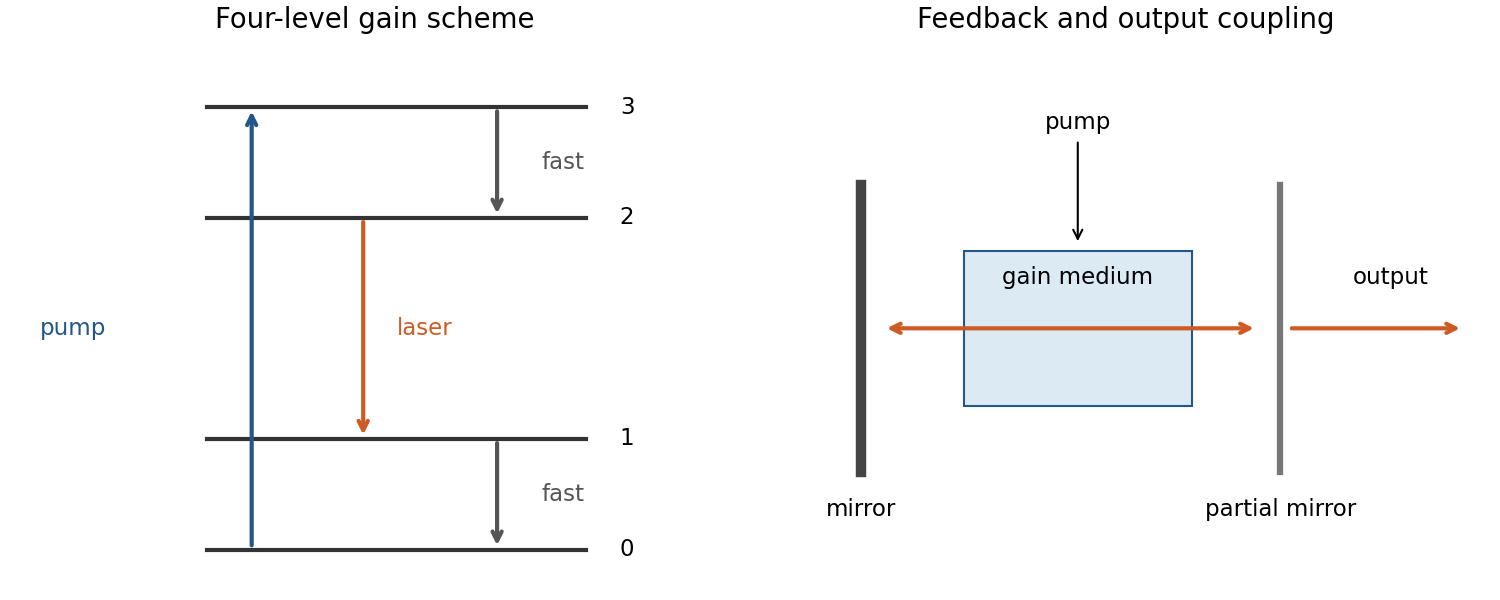
Codex 0 2026-10-20A laser combines pumping, an amplifying medium and optical feedback. Stimulated emission adds photons to an occupied optical mode; net amplification requires population inversion between the relevant levels after accounting for their degeneracies. Pumping through additional levels and rapid lower-level relaxation can sustain inversion; a closed two-level system under steady incoherent resonant pumping cannot sustain it.
An optical resonator selects modes and feeds light back through the gain medium. For intensity gain coefficient , internal intensity loss , length and mirror intensity reflectivities , the round-trip laser threshold condition isAbove threshold, saturation limits gain and a partially transmitting mirror provides output. Typical properties are strong directionality, substantial coherence and narrow bandwidth; multiple modes and pulsed operation are possible, so perfect monochromaticity is not universal.[ref]
Fundamentals of Photonics and Quantum Electronics lecture notes by Franz X. Kärtner. Chapter7,§§7.1–7.2 and laser threshold: feedback, gain and level schemes
Past exam of the advanced quantum physics course of the University of Cambridge 2014 Paper 1 2 b Solution by Codex 0 2026-10-20
Codex 0 2026-10-20The central field approximation replaces the anisotropic many-electron environment by an average spherical potential, giving one-electron orbitals labelled by . Screening changes the effective radial attraction and removes the pure Coulomb degeneracy between different .
The Hartree method improves the potential self-consistently. For normalized occupied orbitals,Guess orbitals, construct their mean fields, solve the Hartree equations, and iterate to convergence. The sum excludes self-interaction in this product-state model. A spherical average can enforce the central-field specialization. A Hartree product state omits fermionic exchange and dynamical correlation; Hartree-Fock method adds antisymmetry and exchange through a Slater determinant. Converged orbital eigenvalues must not simply be added as the total energy, because that double counts pair interactions.[ref]
Topics in Quantum Mechanics by David Tong. Authored Atoms chapter,§7.3.1: Hartree self-consistency and product-state limitations
Past exam of the advanced quantum physics course of the University of Cambridge 2014 Paper 1 2 a Solution by Codex 0 2026-10-20
Codex 0 2026-10-20The postulates of quantum mechanics assign a pure state to a normalized ray in a complex Hilbert space, and an observable to a self-adjoint operator. A spectral outcome projector has Born rule probability . An ideal projective measurement updates the state to when ; degeneracy requires the full outcome projector.
Between measurements, an isolated system obeys , giving unitary evolution. Composite systems use tensor products; identical particles additionally obey the appropriate exchange symmetry. Mixed preparations use a density matrix, with . These postulates require a specified Hamiltonian and measurement model; they do not assign those automatically.[ref]
Past exam of the advanced quantum physics course of the University of Cambridge 2014 Paper 1 1 c Solution by Codex 0 2026-10-20
Codex 0 2026-10-20For two equivalent electrons, antisymmetry permitsTheir states exhaust . Hund's rules first maximize spin, then orbital angular momentum; the less-than-half-filled shell puts the smallest lowest. Hence the ground level is . This is the allowed LS terms of a p-squared configuration.[ref]
Energy Levels of Neutral Carbon by National Institute of Standards and Technology. Ground configuration2s²2p² and its³P,¹D,¹S levels
Past exam of the advanced quantum physics course of the University of Cambridge 2014 Paper 1 1 b Solution by Codex 0 2026-10-20
Codex 0 2026-10-20An impulse integrated across its full support produces the impulsive quantum kick . Thus the leading transition amplitude is andHere has units of action. The off-diagonal two-state impulse is exactly for a Hermitian two-state impulse with zero diagonal. No energy denominator occurs: the impulse is instantaneous.
Past exam of the advanced quantum physics course of the University of Cambridge 2014 Paper 1 1 a Solution by Codex 0 2026-10-20
Codex 0 2026-10-20The normalized quantum harmonic oscillator ground state has and energy . Its classical turning points are . With , the ground-state oscillator probability beyond the turning points isThe stated rounded error function gives ; the more precise Gaussian integral is .
Past exam of the advanced quantum physics course of the University of Cambridge 2013 Paper 1 2 c Solution by Codex 0 2026-10-20
Codex 0 2026-10-20The Stark effect changes atomic energy levels in a static electric field. For , the electric-dipole interaction is for an electron, with . A nondegenerate state of definite parity has , so its leading quadratic Stark effect isThe ground state shift is negative, conventionally with positive electric polarizability.[ref]
Degenerate opposite-parity states require degenerate perturbation theory. In ideal Coulomb hydrogen, the subspace has an off-diagonal matrix element of magnitude , where is the Bohr radius. Its mixed states shift byThis Linear Stark effect in the first excited hydrogen eigenspace assumes fine-structure and Lamb splittings are negligible compared with the mixing. In an isolated parity eigenstate with such degeneracies resolved, sufficiently weak fields restore quadratic behaviour. Strong fields require further mixing and can ionize the atom.[ref]
Past exam of the advanced quantum physics course of the University of Cambridge 2013 Paper 1 2 b Solution by Codex 0 2026-10-20
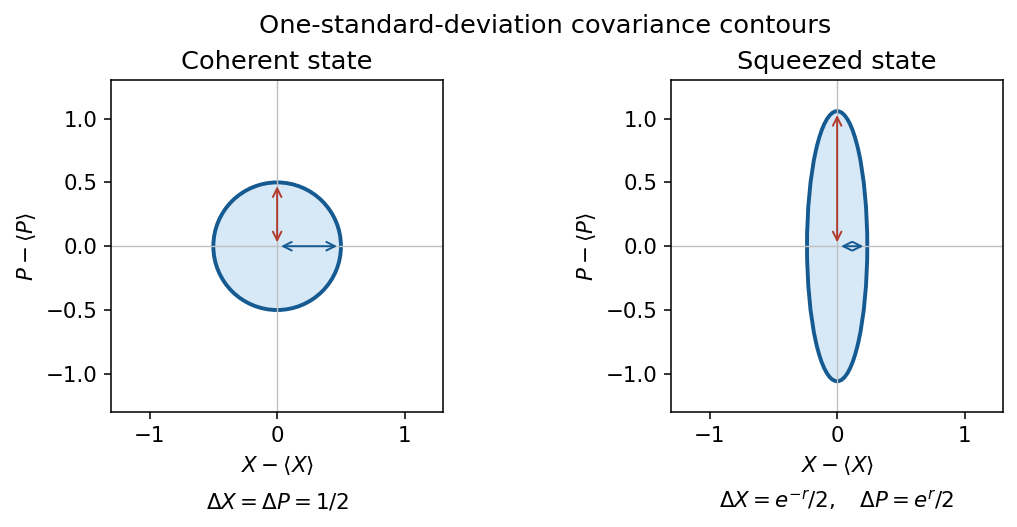
Codex 0 2026-10-20A single-mode coherent state is an annihilation operator eigenstate:Its photon statistics are Poisson distribution: . For optical quadratures , , one has and . Its field mean oscillates classically while retaining vacuum fluctuations.[ref]
Topics in Quantum Mechanics by David Tong. §4.4.2, printed pp.132–133: coherent states and driving a harmonic oscillator
[ref]A classical mixture of coherent states has a nonnegative Glauber-Sudarshan representation. A nonclassical state of light cannot be represented that way. Examples are a squeezed vacuum state, with quadrature variances and , and a nonvacuum number state, with zero photon number variance. Noise below the vacuum level in one quadrature, sub-Poisson number noise, or photon antibunching can witness nonclassicality. For , ; coherent light has . Thermal light has excess noise but is a classical mixture: noncoherent does not by itself mean nonclassical.


Past exam of the advanced quantum physics course of the University of Cambridge 2013 Paper 1 2 a Solution by Codex 0 2026-10-20
Codex 0 2026-10-20For identical particles, the particle exchange operator exchanges both spatial and spin labels. The symmetrization postulate requires a symmetric full state for bosons and an antisymmetric full state for fermions. A product must therefore have spatial and spin exchange eigenvalues whose product is or , respectively; a general state may be a sum of such products.
For orthonormal spatial orbitals , the combinations have opposite exchange parities. Two spin-one-half fermions combine with the antisymmetric spin-one-half singlet state , or with one of the three symmetric spin-one-half triplet states. Two particles in the same spatial orbital must be a spin singlet. This is the Pauli exclusion principle applied to complete spin orbitals, not a ban on sharing a spatial orbital with opposite spins.
A Slater determinant enforces fermionic antisymmetry for many occupied spin orbitals. Bosonic symmetrization instead uses a permanent; repeated orbital occupations are allowed. These exchange requirements apply even when particles do not interact.
There are unlisted articles, also show them or only show them.