Past exam of the particle and nuclear physics course of the University of Cambridge 2013 Paper 1 4 Solution by  Codex 0 2026-10-20
At energies far below the mass, replace its propagator by a constant. The modern V-A interaction form of Fermi's contact theory has, in units,Nucleons are treated nonrelativistically within nuclear states. To leading order in their velocity, the vector charge and axial spatial current give the two nuclear operatorswhere here means neutron-to-proton conversion. (i) The scalar Fermi operator permits , including , without parity change. The rank-one Gamow–Teller operator permits without parity change, excluding . Both terms can contribute when the same nuclear states permit them; their strengths contain nuclear matrix elements, not just phase space.
(ii) Expand the lepton waves across the nucleus in powers of their momenta times nuclear radius. When , the constant spatial term gives allowed transitions. If its matrix element vanishes by spin/parity selection, higher terms supply lepton orbital angular momentum: “forbidden” means suppressed, not impossible. First-forbidden terms change parity and can have ; the rank-two case is unique first-forbidden. Higher orders carry additional small spatial factors and different energy-dependent shape factors. The contact approximation alone does not imply the allowed approximation.
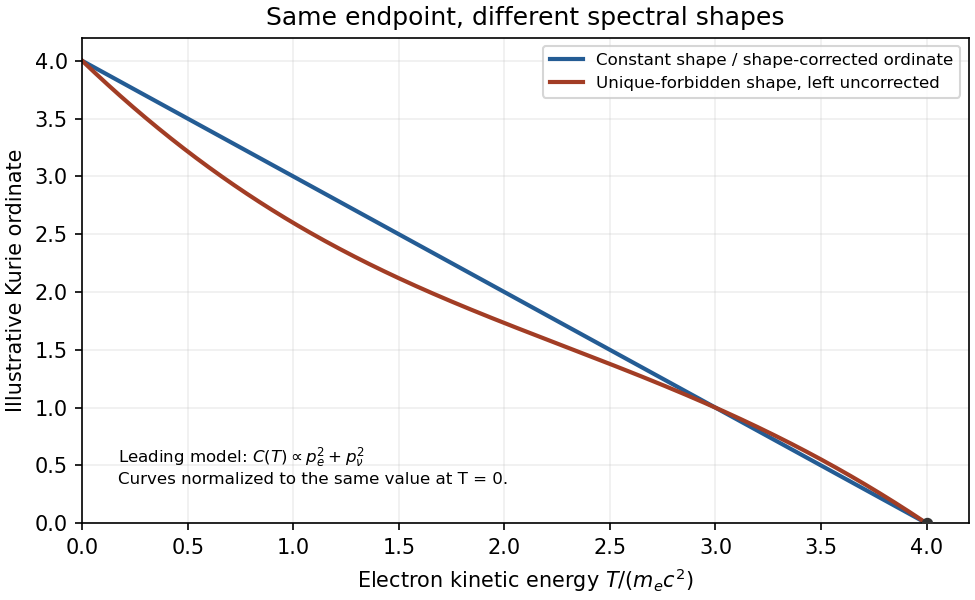
For a single branch, neglect recoil and neutrino mass and first assume an energy-independent nuclear shape factor. Fermi's golden rule integrates the neutrino phase space with , while the electron momentum volume is proportional to . Including Coulomb distortion,This momentum-bin Kurie ordinate is linear in kinetic energy and vanishes at its endpoint. If instead using counts per unit kinetic energy, in units; converting with recovers the supplied momentum-bin definition. No extra factor of should be left inside that definition of .
The graph's horizontal coordinate is , not in MeV. Its intercept is approximately –, soFor a ground-to-ground branch between bare nuclei, the emitted electron's rest energy must also be supplied:For neutral atomic masses the mass difference instead equals approximately , neglecting small electron-binding corrections. The graph supports this approximate precision, not a precise evaluated isotope mass. Interpreting a branch to an excited daughter would require adding its excitation energy; the ground-state comparison assumes the ground-state branch intended here.
The shell-model prediction for yttrium-91 beta decay follows from shell filling: the proton orbitals above 28 fill with four protons and with six, reaching 38. Yttrium has its 39th proton in , giving . Its 52 neutrons include the closed 50-neutron core and a pair in , coupled to zero in the simple paired ground state. Zirconium has 40 paired protons and 51 neutrons, leaving an unpaired neutron, so . ThereforeThe single-particle change is neutron to proton ; the parity change and rank two prevent an allowed Fermi or Gamow–Teller contribution.
The straight plotted line is a constant-shape idealization. For the shell-model transition just inferred, a leading unique-forbidden shape factor contains in units, with Coulomb/finite-size refinements. Consequently the uncorrected quantity specified in the paper is generally proportional to , not exactly linear. A consistent shape-corrected Kurie plot also divides its ordinate by . The source's exact straight-line construction and its forbidden-transition inference cannot both be exact with a Coulomb-only ; the approximate graphical endpoint can still be read as requested. Allowed and unique-forbidden spectral shapes are experimentally distinguishable.[ref]
Shapes of Allowed and Unique First-Forbidden β-Ray Spectra: 114In, 42K, 86Rb, 90Sr, and 90Y by H. Daniel and others. 1964 abstract; separate allowed and unique-forbidden spectrum measurements
Past exam of the particle and nuclear physics course of the University of Cambridge 2013 Paper 1 3 Solution by Codex 0 2026-10-20
Codex 0 2026-10-20For the lowest spatial state, orbital angular momentum is zero and the spatial wavefunction is symmetric. A three-quark colour singlet is antisymmetric, proportional to . The Pauli exclusion principle for quarks therefore requires a symmetric spin–flavour factor. Colour and flavour are different degrees of freedom even though both use three-dimensional group representations.
The tensor product flavour decomposition is . Three spin-one-half particles have a symmetric spin- quartet and mixed-symmetry spin- sectors. The symmetric spin quartet combines with symmetric flavour factors to give a baryon decuplet. Mixed spin and mixed flavour factors instead combine to a symmetric spin–flavour state, giving one physical ground-state baryon octet, not two independent ground-state octets. Equivalently the symmetric spin-flavour SU6 representation has dimension . The antisymmetric flavour singlet would require a fully antisymmetric three-spin state, which does not exist for only two single-quark spin components.
The spin-one-half baryon octet contains , , and . The spin-three-halves baryon decuplet contains the four charge states, three states, two states and . Both have positive parity in this approximation. Strange-quark mass breaks the approximate flavour symmetry and splits multiplets.
In the baryon hyperfine mass formula, the constituent-mass sum accounts phenomenologically for common confinement energy. A colour-magnetic spin–spin interaction contributes a contact-type term proportional to : each magnetic moment supplies one inverse mass. The common colour and spatial-overlap factors are absorbed into . These are effective constituent masses, not short-distance current-quark masses. Use dimensionless spin operators with , as implicit in the supplied formula and coefficient.
Label the identical up quarks 1 and 2. Their flavour and spatial factors are symmetric, and their colour pair is antisymmetric, so their spin is a triplet, . ThusCoupling the strange spin givesThe two up–strange denominators are identical. HenceWith the supplied masses expressed in GeV units, the common mass is . The predicted values areThey are about and below the stated measurements, respectively. The predicted splitting is , compared with . The agreement is useful for such a simple model, but a common overlap constant neglects flavour-dependent spatial structure and other residual interactions.
For the weak decay, one contribution is , . The two spectator up quarks combine with into the proton, and the new supplies the neutral pion's corresponding component. This changes strangeness. In the strong decay, a gluon creates ; rearrangement gives and without changing strangeness.
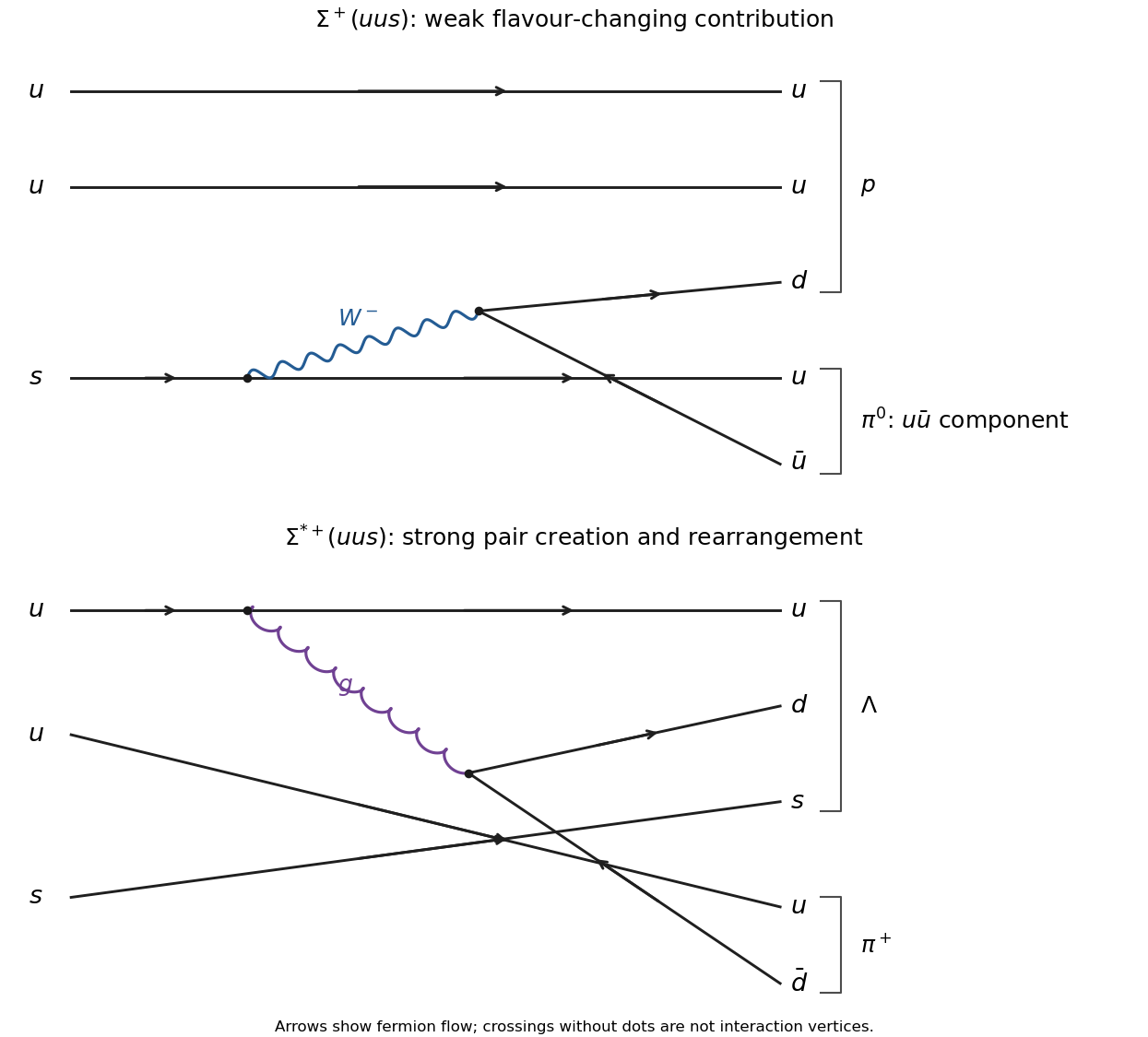
Original weak and strong quark-level contributions to the two charged Sigma-baryon decays; final groupings show the hadrons
. Details. The strong channel conserves parity: the positive-parity daughter baryon and negative-parity pion require odd relative orbital angular momentum, with a wave sufficient. The weak channel need not conserve parity. Using the mean lifetime relation ,The widths differ by about , principally because one is weak and flavour changing and the other is an open strong decay. They are not comparable transitions differing only by a small spin factor.
Past exam of the optics and electrodynamics course of the University of Cambridge 2016 Paper 1 4 Solution by Codex 0 2026-10-20
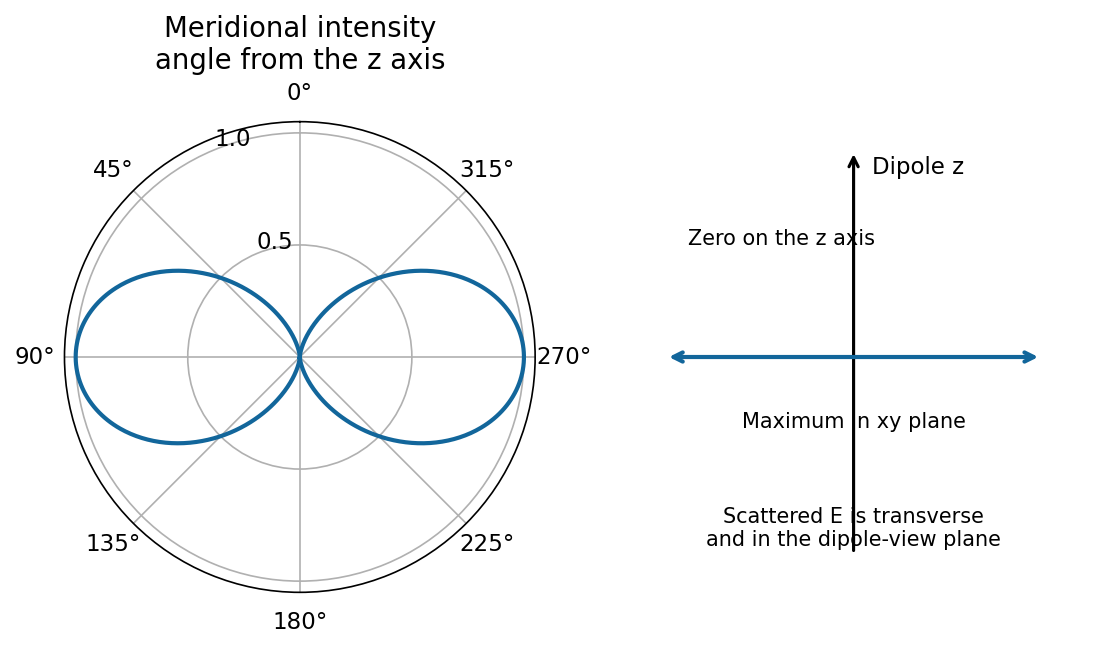
Codex 0 2026-10-20Spherical-particle frequency scaling. For a dielectric sphere of radius , the quasistatic electric polarizability isThe electric dipole radiation formula and giveThus Rayleigh scattering scales as , or , when the polarizability varies slowly with frequency. Material resonances and absorption can change this simple scaling. For the incident polarization, the dipole is along : intensity is proportional to , where is the angle from . There is no radiation on the dipole axis and a maximum in the plane. In a direction the scattered electric field is along , hence linearly polarized wherever nonzero.[ref]
Rayleigh Scattering by Richard Fitzpatrick. Small-particle dipole response and inverse-fourth-power wavelength dependence


Needle model used in parts (a)–(d). Let its axis be . A very slender, high-permittivity needle has dominant longitudinal response, so use the rank-one needle polarizability . Its transverse response is neglected at leading order. For observation along , define , andFor a unit incident Jones vector , the common far-field relation is , and . Here is irradiance at distance ; multiplying by gives power per solid angle. No absolute value of is given or needed for the requested relative intensities.
Diffuse random cloud, with the incident polarization of (a). The single-particle amplitudes through and analysers are proportional to and . The isotropic orientation fourth moment gives the needle-scattering analyzer momentsFor example, ; symmetry and give . Since the particles scatter mutually incoherently, intensities add. For illuminated particles,The cross correlation vanishes by reflection symmetry. The degree of linear polarization is : random anisotropic scatterers produce partially depolarized light, even though every individual needle produces a single linear polarization.
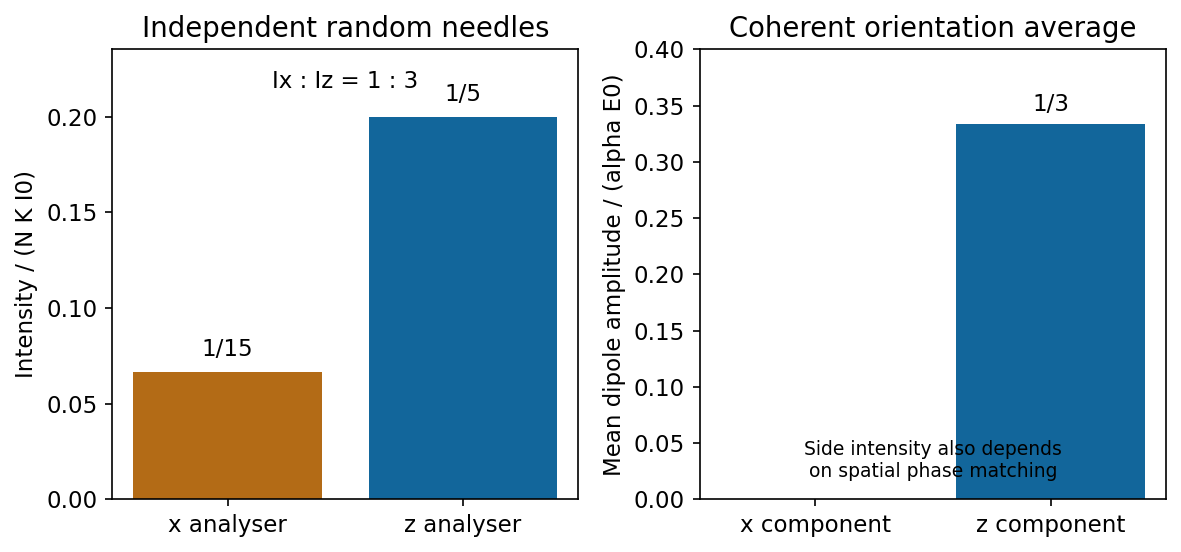
Independent isotropically oriented needles give the analyser ratio one to three, while coherent mean amplitudes have no x component
. Source. Details. 
Continuous homogeneous dielectric. One must sum amplitudes coherently and include their spatial phases, rather than retain the preceding sum of intensities. Random orientations give , so the averaged response is isotropic and its induced polarization is along . Its coherent radiation toward , when allowed by the sample geometry, is therefore purely polarized, with . The independent-needle prefactor is no longer a quantitative dense-medium model; local-field and collective effects determine the effective permittivity.
There is also coherent continuum phase matching: a uniform bulk driven by a plane wave has no arbitrary outgoing plane-wave component. In an ideal infinite homogeneous medium there is no diffuse side scattering at all; propagation, refraction and reflection are determined by the medium and its interfaces. A finite sample's coherent side signal depends on its shape and boundaries. Thus the old diffuse ratio is replaced by a coherent isotropic-medium response, not by a universal nonzero side-scattering intensity.
Past exam of the optics and electrodynamics course of the University of Cambridge 2016 Paper 1 3 Solution by Codex 0 2026-10-20
Codex 0 2026-10-20The magnetic vector potential is defined by . The gauge transformationleaves both and unchanged. In magnetostatics choose the Coulomb gauge . Then Ampère's law and the curl-of-curl identity giveThe free-space Green function identity therefore givesThe boundary condition selects the homogeneous solution; the usual decay condition assumes suitably localized sources. An infinitely long static wire needs a reference for its logarithmically divergent potential, although its magnetic field is finite away from the wire.
For time-dependent sources use the Lorenz gauge, , and the outgoing retarded potentialThe scalar potential has the analogous retarded charge-density integral. The two gauges should not be conflated for a general time-dependent source.[ref]
Retarded Potentials by Richard Fitzpatrick. Equations (73)–(76): Lorenz-gauge retarded scalar and vector potentials
For the prescribed uncharged wire, and is consistent. Translation invariance makes with , so this particular solution satisfies both gauge conditions. With ,It is zero for . For , set . The causal interval is , giving the switched infinite-wire retarded potentialDifferentiation gives the fields and Poynting vector, for , :Here and . All three fields vanish before arrival. For positive , opposes the imposed current and the radial energy flow after switching a line current points radially outward: .
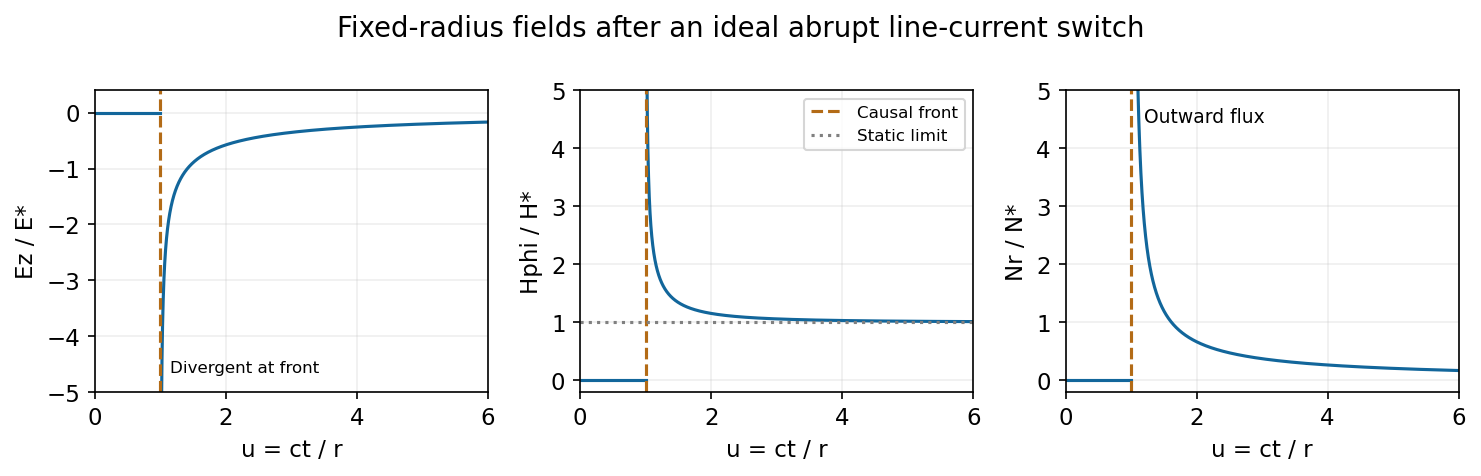
At fixed radius the causal fields start at t equals r over c and relax toward the magnetostatic limit
. Source. Details. 
For the graph, let . Normalized to , and , the curves areAt the wavefront, and diverge as and as . This abrupt line-current wavefront singularity reflects the ideal instantaneous turn-on of a line current; a finite rise time smooths the front. At late times,The vector potential grows logarithmically with time in this infinite-wire idealization even as the local magnetic field approaches its static limit. The divergent front should not be interpreted as a finite-energy pulse from a real instantaneous switching experiment.
There are unlisted articles, also show them or only show them.