
A condensed matter physicist who coauthored a charging model for tunneling through antidot states in the quantum Hall effect. Compressible rings associated with two spin branches can make an outer-edge resonance recur twice per usual flux period of the Aharonov-Bohm effect. This connects an apparently anomalous period to Coulomb blockade and charge rearrangement rather than a change in elementary electric charge.[ref]
Coulomb blockade of tunnelling through compressible rings formed around an antidot by M. Kataoka and others. Abstract: compressible rings and two resonances per h/e cycle
A theoretical condensed matter physicist who modeled quantized electrical conductance through a narrow constriction as transmission through a saddle-shaped potential. Opening successive transverse modes produces conductance steps, while the saddle's curvatures control how sharply transmission rises. This gives a concrete microscopic model of a quantum point contact and explains why the shape of its bottleneck matters.[ref]
Quantized transmission of a saddle-point constriction by M. Büttiker. Abstract: split-gate saddle potential, conductance steps and quantization accuracy
An experimental condensed matter physicist who coauthored images of coherent electron flow from a quantum point contact. A charged scanning tip locally depleted a two-dimensional electron gas and backscattered carriers; recording the resulting electrical conductance change as the tip moved produced a spatial response map. The experiment revealed mode-dependent angular patterns and branching while probing inelastic scattering.[ref]
Imaging Coherent Electron Flow by B. J. LeRoy and others. Abstract: charged tip, conductance images, modes and scattering lengths
An experimental condensed matter physicist who coauthored single-shot electrical measurement of an individual electron spin. The quantum dot converted the spin state into a charge change, detected by a nearby quantum point contact. This made the outcome of one trapped electron's spin measurement accessible electrically, a necessary operation for proposed semiconductor qubits.[ref]
Single-shot read-out of an individual electron spin in a quantum dot by J. M. Elzerman and others. Abstract: spin-to-charge conversion and quantum-point-contact detection
A theoretical physicist who calculated the spectrum of resonance fluorescence from a strongly driven chemical atom modeled as a two-level system. His 1969 treatment obtains the scattered-light power spectrum from two-time atomic dipole correlations, including radiation damping through the quantized electromagnetic field. The resulting Mollow triplet connects spectral structure to coherent driving and relaxation of a single quantum emitter.[ref]
Janos Kirz developed X-ray imaging methods using zone plates. His joint technical account with David Attwood explains how diffraction replaces ordinary refraction in a small focusing optic. Replacing absorbing zones by zones that shift the wave phase can raise the focusing efficiency. Their account also connects finite illumination bandwidth to chromatic blurring: many zones improve focusing only if the incident X-rays occupy a sufficiently narrow range of wavelengths.[ref]
Zone Plates by Janos Kirz and David Attwood. Section 4.4, phase-shifting zones and the bandwidth condition N less than wavelength divided by spectral width

Portrait of Janos Kirz in 2025
. Via Wikimedia Commons; the linked file page provides image credits and usage information. Source.
Gene Dresselhaus, Arthur F. Kip and Charles Kittel used cyclotron resonance to investigate electrons and holes in silicon and germanium crystals. Their 1955 measurements near 4 kelvin combined light modulation with circularly polarized microwaves and changes in the crystal orientation relative to the magnetic field. The directional dependence of the resonance revealed anisotropic carrier effective mass values and the shape of constant-energy surfaces near the edges of the electronic band structure. The experiment turns the orbital motion of charge carriers into a probe of electronic band structure.[ref]
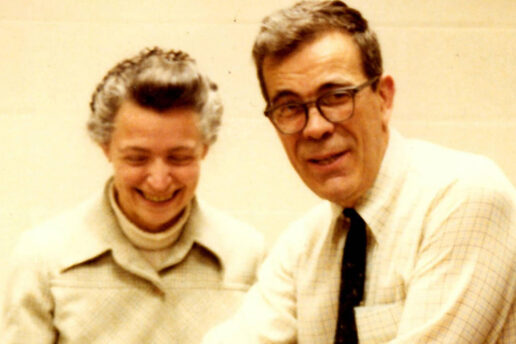
An experimental condensed matter physicist who, with Gene Dresselhaus and Charles Kittel, studied cyclotron resonance in silicon and germanium. Their 1955 work used single crystals near 4 K, light modulation and circularly polarized microwaves. Changing the orientation revealed direction-dependent band effective masses of electrons and electron holes, allowing measurements to reconstruct the shapes of constant-energy surfaces near the edges of energy bands.[ref]
A physicist associated with quantitative measurement and the evaluation of measurement uncertainty. With Chris E. Kuyatt, he wrote NIST guidance that separates uncertainty evaluated statistically from uncertainty evaluated using other information, then expresses both on a common standard uncertainty scale. This allows repeated readings, instrument specifications and other contributions to be combined into an explicit measurement uncertainty budget; correcting an estimated systematic error does not eliminate uncertainty in that correction.[ref]
A physicist who coauthored NIST guidance for evaluating measurement uncertainty with Barry N. Taylor. Their framework separates uncertainty estimates obtained statistically from repeated observations from estimates based on other information, then combines contributions into a standard uncertainty. This is useful when comparing a measured physical constant with a theoretical prediction: a corrected bias and the uncertainty remaining after correction are different quantities.[ref]
Guidelines for Evaluating and Expressing the Uncertainty of NIST Measurement Results by Barry N. Taylor and Chris E. Kuyatt. Sections 2–5: uncertainty components and combination; Appendix D.1: systematic error and correction
Sean M. Carroll develops and teaches the geometric account of gravity in general relativity. His 1997 lecture notes connect differential geometry to Einstein field equations and applications in gravitational radiation, black holes and cosmology.
A central example is the covariant derivative: differentiating the coordinate components of a vector field alone does not produce another tensor. An additional affine connection term accounts for the changing coordinate basis. This construction allows physical equations to retain their meaning when coordinates change, supplying the mathematical foundation for the later gravitational applications.[ref]
Lecture Notes on General Relativity by Sean M. Carroll. Chapters 2–3: manifolds, tensor transformations, connection and covariant differentiation

Portrait of Sean M. Carroll
. Sgerbic; colour correction and sharpening by OttRider. CC BY-SA 4.0, via Wikimedia Commons. Source.
Heinz London and Fritz London formulated the London equations in 1935 to describe the magnetic response of a superconductor. Zero electrical resistance alone does not specify expulsion of an existing magnetic field; their additional magnetic relation accounts for the Meissner effect. In a simple planar geometry it gives a field decaying into the material as , where is the London penetration depth. Their phenomenological theory links a measurable penetration length to superconducting electrodynamics without supplying a microscopic pairing mechanism.[ref]
The electromagnetic equations of the supraconductor by Fritz London and Heinz London. Proceedings of the Royal Society A 149, 71–88 (1935), magnetic relation and penetration of an applied field

Portrait of Heinz London
. Elliott & Fry; National Portrait Gallery collection, NPG x90353. External portrait hosted by National Portrait Gallery. Source.A physicist whose electromagnetism lectures connect optical scattering with induced electric and magnetic responses. His treatment of a small conducting sphere includes both its electric dipole moment and magnetic dipole moment, then combines their radiation to obtain the scattered field. The example shows why the material and boundary conditions matter: even when an object is much smaller than a wavelength, assuming only an electric response can omit part of the leading scattering signal.[ref]
Scattering of EM Waves by Michael Fowler. Scattering by a Small Perfectly Conducting Sphere: electric and magnetic dipole responses
Christian Møller and Léon Rosenfeld used the electric quadrupole moment of the deuteron to constrain nuclear forces. An isotropic charge distribution has no preferred axis and therefore zero quadrupole moment. A nonzero value requires an internal structure or quantum state that produces an anisotropic charge pattern. Their 1939 work connected this measured electrical property with orientation-dependent forces between the proton and neutron, illustrating how a small static observable can test a microscopic interaction model.[ref]
The Electric Quadrupole Moment of the Deuteron and the Field Theory of Nuclear Forces by Christian Møller and Léon Rosenfeld. 1939 abstract, quadrupole moment and orientation dependence

Portrait of Christian Møller
. GFHund, July 1963; photograph from Friedrich Hund’s estate, prepared for Wikipedia by Gerhard Hund. CC BY 3.0, via Wikimedia Commons. Source.
Léon Rosenfeld and Christian Møller related the observed electric quadrupole moment of the deuteron to orientation-dependent nuclear forces. A purely spherical charge distribution gives zero quadrupole moment, because averaging over directions cancels. A measured nonzero value therefore constrains the internal quantum state and the angular dependence of the interaction. Their 1939 work used this small electrical observable to test descriptions of the force between a proton and a neutron.[ref]
The Electric Quadrupole Moment of the Deuteron and the Field Theory of Nuclear Forces by Christian Møller and Léon Rosenfeld. 1939 abstract, deuteron quadrupole moment and orientation-dependent forces; spherical-average observation explained here

Portrait of Léon Rosenfeld
. GFHund. CC BY 3.0, via Wikimedia Commons. Source.
Piers Coleman studies strongly interacting electrons, particularly heavy fermions and the Kondo lattice. In these materials, coupling between mobile electrons and local magnetic moments can produce coherent low-energy quasiparticles with a very large effective mass. His theoretical exposition connects the screening of one magnetic moment in the Kondo effect with collective behavior in a lattice of such moments. The competition with magnetic interactions helps organize questions about magnetism, superconductivity and the breakdown of the heavy-electron state.[ref]

Portrait of Piers Coleman
. Pierscoleman, 3 December 2018. CC BY-SA 4.0, via Wikimedia Commons. Source.
A researcher who coauthored an examination of the Mott criterion across different metal-insulator transitions. The work treats the relation between the effective electronic size and critical carrier concentration as a common thread between doped semiconductors and correlated compounds. Its discussion of chromium-doped vanadium oxide highlights how magnetic order and conducting behavior can change together.[ref]
The Mott criterion: So simple and yet so complex by Alexander Pergament and others. Abstract: criterion and paramagnetic-metal to antiferromagnetic-insulator transition
A coauthor of a study of the Mott criterion and the metal-insulator transition. The paper considers vanadium oxides alongside doped semiconductors, testing whether a criterion based on electronic length and concentration remains informative in strongly interacting materials. Such comparisons help separate a useful organizing estimate from a complete microscopic explanation of a transition.[ref]
The Mott criterion: So simple and yet so complex by Alexander Pergament and others. Byline and abstract: correlated compounds and chromium-doped vanadium oxide
A coauthor of a study examining how widely the Mott criterion applies to the metal-insulator transition. The criterion compares a characteristic electronic length with the spacing implied by the carrier concentration. The paper discusses both doped semiconductors and strongly interacting compounds, emphasizing that the same compact relation must be interpreted in the physical setting of each material.[ref]
The Mott criterion: So simple and yet so complex by Alexander Pergament and others. Abstract: applications beyond heavily doped semiconductors
An experimental nuclear physicist whose electron speed-and-energy measurement provides a direct test of relativistic kinematics. Bertozzi's electron speed-energy experiment measures flight time and calorimetric energy independently.
Official profile: physics.mit.edu/faculty/william-bertozzi/

William Bertozzi, portrait from his MIT Physics profile
. There are unlisted articles, also show them or only show them.