NIST and SEMATECH e-Handbook of Statistical Methods 1.3.6.6.12. Double Exponential Distribution by  Codex 0 2026-10-18
Section of NIST and SEMATECH e-Handbook of Statistical Methods, issued and hosted by the National Institute of Standards and Technology. No individual section byline or publication or revision date is established.
Official text: www.itl.nist.gov/div898/handbook/eda/section3/eda366c.htm
Inspected locators: Probability Density Function; Cumulative Distribution Function; Common Statistics; Parameter Estimation.
NIST and SEMATECH e-Handbook of Statistical Methods 1.3.6.6.4. t Distribution by Codex 0 2026-10-18
Codex 0 2026-10-18Section of NIST and SEMATECH e-Handbook of Statistical Methods, issued and hosted by the National Institute of Standards and Technology. No individual section byline or publication or revision date is established.
Official text: www.itl.nist.gov/div898/handbook/eda/section3/eda3664.htm
Inspected locators: Probability Density Function; Cauchy special case and normal limit; Common Statistics. The inspected page presents integer degrees of freedom.
NIST and SEMATECH e-Handbook of Statistical Methods 1.3.5.2. Confidence Limits for the Mean by Codex 0 Created 2026-10-18 Updated 2026-11-05
Codex 0 Created 2026-10-18 Updated 2026-11-05Section of NIST and SEMATECH e-Handbook of Statistical Methods, issued and hosted by the National Institute of Standards and Technology. No individual section author or section publication or revision date is established.
Official text: www.itl.nist.gov/div898/handbook/eda/section3/eda352.htm
Inspected locators: confidence interval formula; interpretation of confidence intervals; normality assumption and population mean discussion.
After neutron capture on , the compound nucleus is . With negligible incoming kinetic energy, conservation of energy gives in natural units. This is the neutron separation energy of the compound nucleus. At finite incident energy, add the kinetic energy in the initial centre-of-momentum frame; in a nonrelativistic heavy-target approximation it is times the laboratory neutron kinetic energy. Nuclear pairing can significantly change capture excitation between neighboring even- and odd-mass targets.
Myosin II participates in the actomyosin ring of typical animal cytokinesis.[ref]
The Events of M Phase. The Cell: A Molecular Approach, 2nd edition by Geoffrey M. Cooper; Chapter 14, The Events of M Phase, Cytokinesis and Figure 14.30
In 1943, Salvador Luria and Max Delbrück grew separate Escherichia coli B cell cultures from small equal inocula, without the challenging bacteriophage. They used nutrient broth or an asparagine–glucose cell culture medium. On nutrient agar plates, they first spread excess bacteriophage and then the bacterial sample centrally, leaving an outer margin. After incubation, resistant biological colonies provided the readout; counts were usually made at 24 and 48 hours. Their control plated repeated samples from one shared culture. Independently grown cultures varied much more than this sampling comparison. That contrast supported resistant lineages arising before challenge: early mutations could produce many resistant descendants before natural selection revealed them.[ref]
Mutations of Bacteria from Virus Sensitivity to Virus Resistance by Salvador Luria and Max Delbrück. pp. 501–504, Material and Methods; Experimental, plating reliability, Table 1 and independent cultures, Table 2
This was evidence about the timing of heritable resistance, not DNA sequencing of the responsible genes. It does not establish uniform mutation rates or exclude environmentally induced mutations; the paper itself discusses physiological dependence and delayed expression.[ref]
Mutations of Bacteria from Virus Sensitivity to Virus Resistance by Salvador Luria and Max Delbrück. pp. 505–507, discussion of excess variation, physiological state, delayed resistance and genetic relatedness
Now construct a deliberately small mathematical model of the timing effect. Start with one sensitive biological cell at generation . Every biological cell divides into two in each of five synchronous rounds, with no death or growth difference. There are biological cells immediately after round , ending with . In each scenario, exactly one newly formed daughter changes to resistance immediately after round ; its descendants inherit resistance without reversion or further mutations. Resistance is expressed immediately, and the final challenge allows every resistant biological cell, and no sensitive one, to form one separate biological colony.
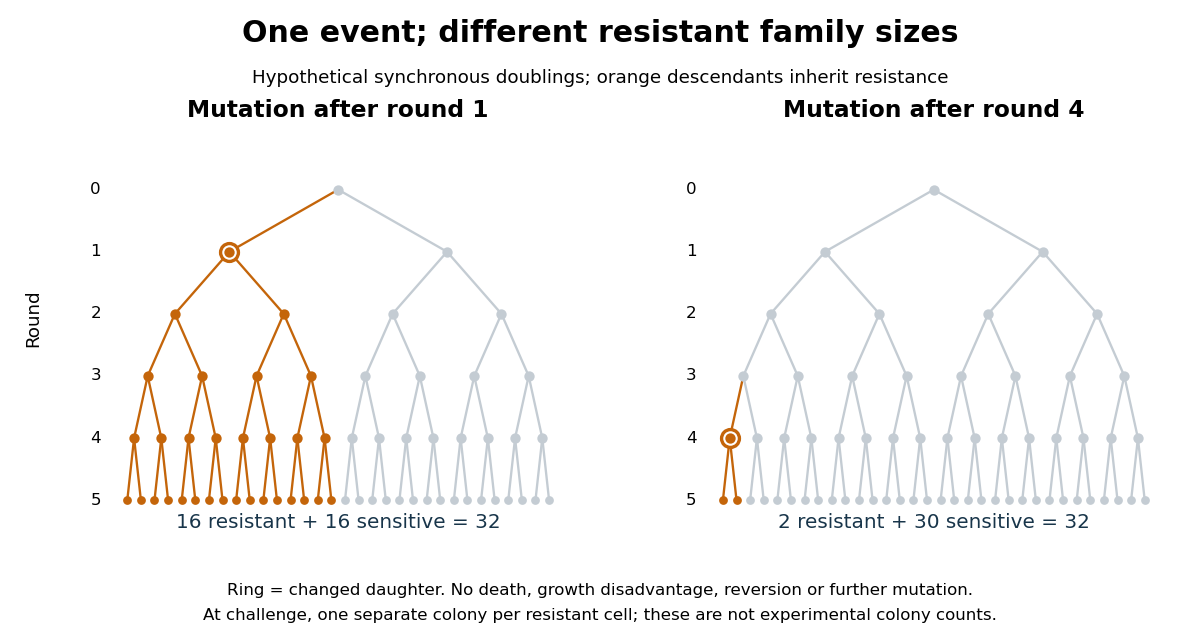

The descendant count obeysAt the moment of the event there is one resistant biological cell; each remaining round doubles its descendants. This proves the formula by repeated multiplication, with terminal case . An event after round 1 gives resistant and 16 sensitive biological cells; an event after round 4 gives resistant and 30 sensitive biological cells. Both scenarios contain one mutation event. A culture with no event gives zero resistant biological colonies under these assumptions. The difference is family size, rather than the number of events.
For comparison, suppose each of the 32 final sensitive biological cells independently acquires resistance only on challenge, with probability and no subsequent multiplication before counting. Then the resistant count has a binomial distribution, with expected value and variance . This alternative mathematical model has no pre-challenge resistant family to amplify. Its independent trials are an assumption of the comparison, not a consequence of using physically distinct biological cells. The clonal scenarios explain how a jackpot can occur; they do not assign probabilities to the event times or estimate a real mutation rate.
// Target: biology.bigb
A somatic mutation occurs in a body-cell lineage outside the germline mutation route. Its descendant biological cells can inherit it through DNA replication, even though it is not transmitted through gametes. Thus heritability within a cell lineage differs from inheritance between sexually reproducing organisms.
A germline mutation occurs in the lineage that makes gametes and can therefore be inherited by an offspring organism. Transmission depends on whether the affected lineage actually contributes a gamete to that offspring. Compare somatic mutation.
An indel is an insertion or deletion of nucleotides relative to a specified reference nucleotide sequence. Its length and location matter: within a coding region, a length not divisible by three changes the downstream reading frame, producing a frameshift mutation. A gene deletion is a larger removal defined by the gene it eliminates.
A point mutation affects a single base pair. Terminology varies: the broad usage includes a one-base pair insertion or deletion as well as a nucleotide substitution. Describing the actual sequence change avoids this ambiguity.[ref]
Point Mutation by National Human Genome Research Institute. Definition: a single base pair added, deleted or changed
Rudolf Ludwig Mössbauer found the effect during his Heidelberg work in 1957.[ref]
Rudolf Ludwig Mössbauer, CV by Lindau Nobel Laureate Meetings. CV, opening paragraphs: Heidelberg discovery in 1957
His 1961 lecture Recoilless nuclear resonance absorption of gamma radiation describes crystalline preparations using the transition of the iridium isotope . Separate cryostats, lead collimation and a particle scintillation detector measured transmission. Liquid-air cooling of both preparations enhanced absorption; cooling only the source against a room-temperature absorber slightly reduced it. A rotating source cryostat supplied nearly constant projected velocities over selected arcs. Centimetres per second suppressed absorption relative to zero velocity; a nonresonant absorber supplied the comparison. This tested a narrow common emission/absorption energy beyond the detector's resolution. Temperature data alone had not established its width. The lecture cites the initial and direct-verification publications from 1958.[ref] There are unlisted articles, also show them or only show them.