
An experimental optical physicist studying quantum-enhanced measurements. His research includes the generation and use of squeezed light for precision measurement, including magnetometry and gravitational-wave detection. Reducing fluctuations in a chosen optical quadrature connects the quantum state of the probe field to the sensitivity of an instrument.[ref]
https://physics.wm.edu/~evmik/. Research interests: squeezed states, quantum-enhanced measurements, magnetometry and gravitational-wave detectors
A computational physicist who coauthored simulated annealing as an approach to optimization. Random trial changes are accepted according to a temperature-like parameter, including some moves that worsen the objective; lowering that parameter gradually favors low-cost states. The analogy with thermal equilibration turns statistical physics into a practical search strategy for complicated optimization landscapes.[ref]
Optimization by Simulated Annealing by Scott Kirkpatrick and others. pp. 672–673 and 675: statistical-mechanical analogy, acceptance rule and optimization examples
Émile Verdet studied optics and magnetism, particularly the Faraday effect. A magnetic field along the propagation direction changes the orientation of linearly polarized light. In a uniform sample the measured optical rotation is written , where is the longitudinal magnetic flux density, the path length, and the Verdet constant at the specified wavelength and temperature. The coefficient links an angular optical measurement with the material's magneto-optical response.[ref]
Émile Verdet, ENS library record. Biographical description: research on optics, magnetism and Faraday rotation; named constant; modern uniform-sample notation
A physicist.[ref]
https://lucienne.ens.psl.eu/s/lucienne/item/264170. Independent biographical source: physics; optics and magnetism

Portrait of Émile Verdet
. Bibliothèque nationale de France; portrait reproduced in the 1872 collected works of Émile Verdet. Public domain artwork; faithful reproduction identified as public domain by Wikimedia Commons. Source usage terms, via Wikimedia Commons. Source.A physicist whose research joined waves, optics, acoustics and precise measurement. He maintained a laboratory at Terling and served as Cavendish professor of experimental physics from 1879 to 1884. At Cambridge he developed laboratory courses; later he donated his Nobel award proceeds toward a Cavendish laboratory extension.[ref]
John William Strutt (Lord Rayleigh) by John Joseph O'Connor and Edmund Frederick Robertson. O'Connor and Robertson, biography: Terling laboratory; Cavendish professorship and laboratory courses; donation of Nobel proceeds
The Rayleigh-Ramsay argon density experiment, pursued with William Ramsay, connects a small discrepancy in gas weighing to chemical separation. Its lesson is practical: agreement within one preparation method does not ensure that a second method produces the same chemical substance. The gas density model explains how composition and filling conditions both affect the readout.

Portrait of John William Strutt, 3rd Baron Rayleigh
. Nobel Foundation; Wellcome Images reproduction, as credited on the File; original photographer unspecified. Creative Commons Attribution 4.0 International; the File also carries an EU anonymous-work public-domain claim., via Wikimedia Commons. Source.Paul Peter Ewald developed a method for calculating long-range electrostatic lattice potentials. Ewald summation separates the interaction into rapidly converging real-space and reciprocal-space contributions through a Gaussian splitting. The artificial splitting parameter changes the work assigned to each sum, while the complete physical result is unchanged when electric charge and boundary conventions are fixed. This makes lattice electrostatics computationally tractable without simply discarding distant electric charges, and connects crystal calculations with Fourier methods.[ref]
Die Berechnung optischer und elektrostatischer Gitterpotentiale by Paul Peter Ewald. Annalen der Physik 369, 253–287 (1921), transformation of electrostatic lattice sums
A physicist who worked on crystallography and edited a participant-rich history of X-ray diffraction. The volume places experimental photographs, early theoretical arguments and personal recollections together, making it possible to trace how diffraction patterns became evidence for atomic arrangements in crystals. Its individual contributions have separate authors, while Ewald supplied the editorial framework.[ref]
Fifty Years of X-ray Diffraction, edited by Paul Peter Ewald. Volume title, editorial credit and contents
A physicist who studies networks using graph theory.[ref]
https://websites.umich.edu/~mejn/. University of Michigan homepage: physics affiliation, network research, and selected-publication bylines
Homepage: websites.umich.edu/~mejn/
A theoretical condensed matter physicist who coauthored analysis of Brownian motion of an ellipsoid. The study relates different diffusion rates along the particle's axes to rotational motion, explaining why laboratory-frame displacement statistics evolve with observation time. It connects microscopic anisotropy to the stochastic motion measured in a colloidal experiment.[ref]
Brownian Motion of an Ellipsoid by Yilong Han and others. Analysis of coupled rotational and translational diffusion
An experimental condensed matter physicist who coauthored measurements of anisotropic Brownian motion. An ellipsoidal probe couples translational observations to its changing orientation, so the measured diffusion depends on the time scale and reference frame. Following a single nonspherical particle makes this geometric effect experimentally visible.[ref]
Brownian Motion of an Ellipsoid by Yilong Han and others. Ellipsoid tracking and crossover of observed diffusion
An experimental physicist who coauthored direct measurements of Brownian motion of an ellipsoid. Tracking both position and orientation showed how diffusion along the particle's long and short axes differs, and how rotational diffusion changes what a laboratory-frame observer sees. The example exposes geometry hidden by the spherical-particle approximation.[ref]
Brownian Motion of an Ellipsoid by Yilong Han and others. Abstract and simultaneous translational/rotational tracking
An experimental atomic physicist who coauthored a measurement of degeneracy pressure in trapped lithium. Collisions with a cooled bosonic component lowered the fermionic component's temperature; its spatial extent then revealed the pressure caused by the Pauli exclusion principle. The experiment connected a microscopic occupancy rule to the visible size of an atomic cloud.[ref]
Institutional profile: physics.rice.edu/graduate-awards
Randall G. Hulet developed experiments with quantum-degenerate atomic gases, including the observation of Fermi pressure in trapped lithium. The comparison of bosonic and fermionic isotopes made their different population statistics experimentally accessible.
A degenerate fermionic cloud remains spread over many occupied one-particle states because of the Pauli exclusion principle. Its size and distribution therefore reflect quantum statistics as well as temperature and confinement. The experiment connected the same pressure mechanism important in dense astrophysical matter to a dilute laboratory gas.[ref]

Andrew G. Truscott measured Fermi pressure in a trapped dilute atomic gas. The experiment compared the spatial distributions of fermionic and bosonic lithium under conditions where their different quantum statistics become important.
Even at low temperature, the Pauli exclusion principle prevents identical fermions from all occupying the lowest one-particle state. Filling higher states gives the trapped cloud a finite extent beyond a classical thermal expectation. The distribution therefore probes degeneracy pressure through the size of a controllable atomic sample.[ref]
Observation of Fermi Pressure in a Gas of Trapped Atoms by Andrew G. Truscott and others. Abstract and cloud-distribution comparison: fermionic and bosonic lithium


William Henry Bragg developed experimental methods that turned crystal diffraction into X-ray spectroscopy. A crystal selects reflected radiation at particular angles, while a movable detector measures the reflected intensity. Relating these peaks to lattice-plane spacing connects an instrument reading with the wavelength of the incident radiation. His joint work with Lawrence Bragg established a quantitative relation between crystal geometry and X-ray reflection, helping make diffraction a practical probe of both radiation and structure.[ref]
The Reflection of X-rays by Crystals by William Henry Bragg and William Lawrence Bragg. Proceedings of the Royal Society A 88, 428–438 (1913), reflection measurements and crystal geometry

Portrait of William Henry Bragg
. Nobel Foundation; portrait dated 1915, published in Sweden in Les Prix Nobel 1915 (1916), page 101; individual photographer unspecified. Commons PD-Sweden-photo: Swedish public-domain status under its simple-photograph or anonymous-photograph provisions., via Wikimedia Commons. Source.
Arthur Holly Compton explained the angle-dependent change of X-ray wavelength by treating a photon as carrying both energy and momentum. For scattering from an initially stationary free electron, conservation gives . The Compton scattering shift therefore depends on angle and the electron mass, rather than on the illuminating wavelength alone. Comparing the measured scattered lines with this relation tested the particle-like energy–momentum account of radiation.[ref]
A Quantum Theory of the Scattering of X-rays by Light Elements by Arthur Holly Compton. 1923, quantum scattering derivation and experimental tests, especially pp. 494–495
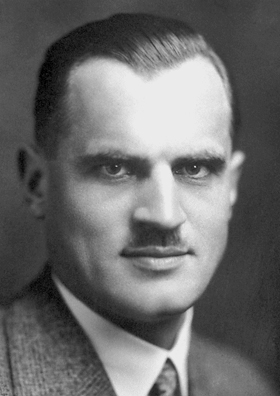
Portrait of Arthur Holly Compton
. Source. 
An optical physicist who coauthored a teaching text connecting electromagnetic wave descriptions with optical measurement. Its accounts of polarization and interference make the coherence assumptions behind an intensity prediction explicit, an essential step when applying ideal wave models to real sources.[ref]
An optical physicist who coauthored an interactive teaching text on wave optics. Its polarization and coherence chapters relate field components and correlations to measurable intensity, helping explain why combining beams does not always produce stable interference fringes.[ref]
Interactive Optics by Sander Konijnenberg, Aurèle J.L. Adam and H. Paul Urbach. Author record; polarization and interference/coherence chapters
A physicist who coauthored Interactive Optics by Sander Konijnenberg, Aurèle J.L. Adam and H. Paul Urbach. Its treatment connects wave polarization, interference and coherence to optical experiments. Writing those topics in a common wave framework helps readers move from a field equation to a prediction for the intensity measured by an instrument.[ref]
Interactive Optics by Sander Konijnenberg, Aurèle J.L. Adam and H. Paul Urbach. Author record and chapters on polarization, interference and coherence
There are unlisted articles, also show them or only show them.