Let be the source velocity towards the absorber, positive for approach along the photon direction. A first-order Lorentz transformation of the photon energy gives ; hence, for ,Moving the source shifts its emission line through the stationary absorption line. A minimum in transmitted photon counts marks their strongest overlap. The absorber is the narrow energy discriminator; the downstream particle detector only needs to count the transmitted gamma rays.
For a thin absorber with unsplit Lorentzian line shapes, the overlap is a convolution of the source and absorber profiles. The combined full width at half maximum is . A simple expected transmission model isHere is the off-resonance intensity, encodes a relative shift of the two transition energies, and includes the resonant absorber strength and . The convolution result can be checked by multiplying the Fourier transforms of two Cauchy distributions: their exponential decay constants add. The width of the absorption dip in velocity is , rather than the width of one individual spectral line converted to velocity.
For the teaching system with and , the dip's full width at half maximum is . Stipulate at zero temperature and expected off-resonance counts per equal-duration bin: the central bin then has expected counts, and the half-depth bins have . These are model expectations, without sampled counting noise. Holding all other parameters fixed while heating both lattices to multiplies by . This isolates how a falling recoil-free fraction weakens the dip.
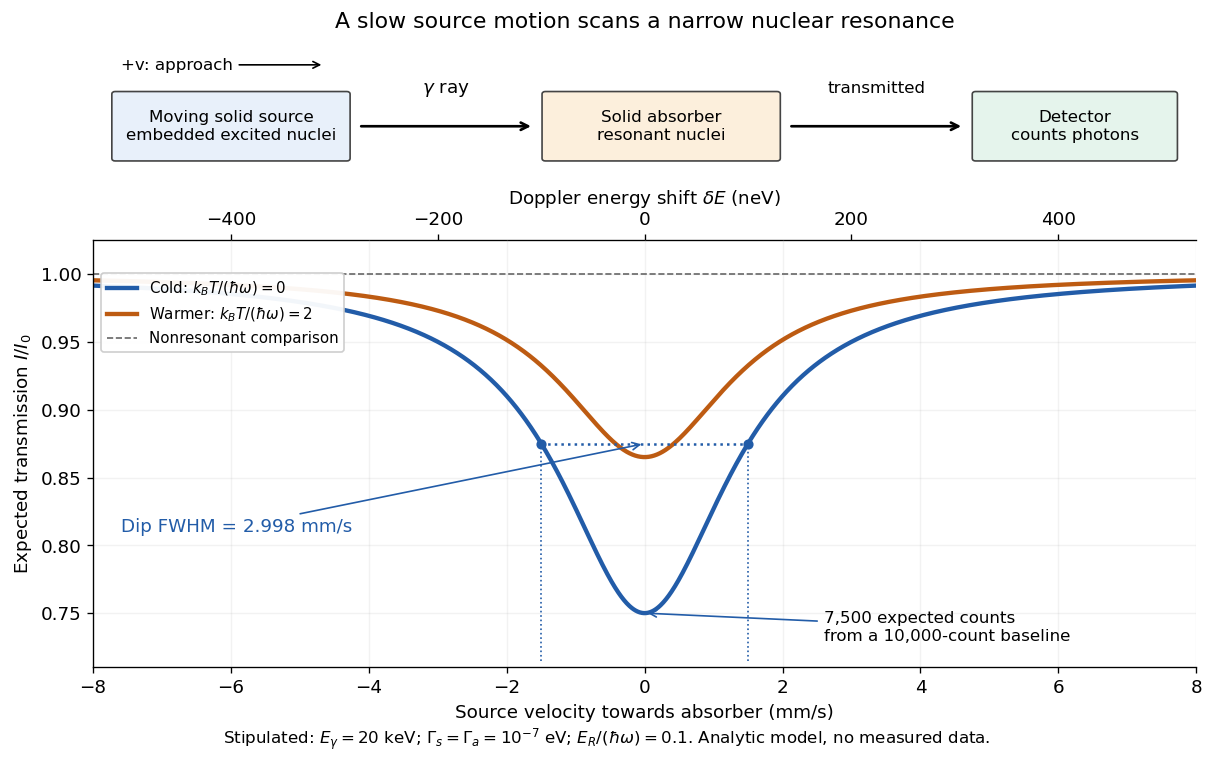
Mechanical velocity scans an absorption line much narrower than detector resolution
. Original ideal transmission model, with schematic source, absorber and counting detector. Both curves use the same stipulated energy widths; heating changes only . Dashed markers show the cold curve's half-depth positions. This is a new analytic teaching scan, not a historical measurement or a fit. The upper scale converts velocity to Doppler effect energy shift. Details.
The thin-absorber model is deliberately limited. A thick absorber can saturate and broaden the dip; unresolved hyperfine structure can create multiple components. Differences in chemical surroundings can shift the centers, and uncontrolled motion can smear them. These effects must be modeled before interpreting an observed width as a natural linewidth. Their sensitivity also makes the Mössbauer effect useful: a small displacement of a narrow dip can reveal a small change in the local nuclear environment.
A recoil-free nuclear transition emits or absorbs a gamma ray while leaving the internal vibrational state of the surrounding solid unchanged. It belongs to the elastic part of the process: no phonon is created or destroyed. The photon still carries momentum , where is the speed of light. The emitting solid takes momentum ; the absorbing solid takes . Conservation of momentum holds for each event.
Why does an isolated atomic nucleus pose a problem? Start with an excited state at rest and let be its transition energy, with nuclear mass and . Conservation of momentum gives a recoil momentum of magnitude ; its nonrelativistic kinetic energy is thereforeBy conservation of energy, emission spends part of on nuclear recoil, whereas absorption must supply both and the final kinetic energy. To leading order,Thus the relevant comparison is against the overlapping spectral line widths, rather than alone. If greatly exceeds the widths, the isolated-nucleus lines have negligible overlap. Finite Lorentzian line shape tails mean that this is suppression, rather than an absolute prohibition on absorption.
For a bound atomic nucleus, the recoil-free channel transfers momentum to the center of mass of the emitting or absorbing solid, with negligible kinetic energy . Other channels exchange phonons and carry substantial energy into or out of the internal vibrations. A large makes the elastic channel's energy cost small; the vibrational quantum state determines its probability. Merely replacing by a large mass in the free-particle formula does not calculate that probability.
Here is a deliberately stipulated teaching system, independent of historical isotope data: , , and a single-line natural linewidth measured as an energy full width at half maximum. These give and . A solid of such nuclear masses has elastic recoil energy , far below . In this article is an energy width; the corresponding lifetime is , with the Planck constant divided by .
In the independent harmonic approximation, each diatomic molecule has one bond-stretching quantum harmonic oscillator with energies . Write . Its canonical partition function is , and differentiating its logarithm givesFor , excitation is exponentially suppressed and the heat capacity tends to zero. At high temperature it tends to , one contribution from each quadratic kinetic and potential term. The zero-point energy does not contribute to the derivative with temperature. For a dilute gas whose rotations are already active, adding translation and rotation gives molar before vibration is activated and afterwards, provided dissociation and electronic excitations are negligible.
Molecular cloning propagates a chosen DNA fragment using a carrier such as a plasmid in suitable recipient biological cells.
DNA ligation joins DNA ends covalently through DNA ligase. Base pairing of complementary ends can align fragments before joining.
Auxotrophy is a phenotype in which growth requires an externally supplied substance that a comparison biological strain can make for itself. Growth on supplemented cell culture medium formulations can reveal the requirement without identifying the responsible gene.
Molecular Biology of the Cell, 4th edition by Bruce Alberts and others How Cells Obtain Energy from Food by  Codex 0 2026-10-18
Whole-book authorship and edition metadata apply; no separate chapter byline is established.
Online text: www.ncbi.nlm.nih.gov/books/NBK26882/
Molecular Biology of the Cell, 4th edition by Bruce Alberts and others Isolating, Cloning, and Sequencing DNA by Codex 0 2026-10-18
Codex 0 2026-10-18Section of Molecular Biology of the Cell, 4th edition by Bruce Alberts and others. The whole-book authors are Bruce Alberts, Alexander Johnson, Julian Lewis, Martin Raff, Keith Roberts and Peter Walter; no independent section-author byline is established. Garland Science published the fourth edition in 2002. NCBI Bookshelf hosts the online text.
Online text: www.ncbi.nlm.nih.gov/books/NBK26837/
Cited passages: Official indexed section text: dideoxy sequencing explanation and Figure 8-36 caption; Figure 8-36 A: normal deoxyribonucleoside triphosphates versus analogues lacking the 3′ hydroxyl group.
Molecular Biology of the Cell, 4th edition by Bruce Alberts and others Transport from the ER through the Golgi Apparatus by Codex 0 2026-10-18
Codex 0 2026-10-18Section of Molecular Biology of the Cell, 4th edition by Bruce Alberts and others. Whole-book authors: Bruce Alberts, Alexander Johnson, Julian Lewis, Martin Raff, Keith Roberts, Peter Walter. No separate chapter author is credited. The 2002 publication date belongs to the whole-book edition. Garland Science publishes the book; NCBI Bookshelf at the National Library of Medicine hosts the online text. No separate section publication or revision date is established.
Online text: www.ncbi.nlm.nih.gov/books/NBK26941/
Cited passages: Molecular Biology of the Cell, 4th edition by Bruce Alberts and others, Transport from the ER through the Golgi Apparatus: Indexed official text: section opening and whole-book citation metadata; Oligosaccharide Chains Are Processed in the Golgi Apparatus; The Golgi Cisternae Are Organized as a Series of Processing Compartments, Figure 13-28 and substrate-order explanation; Transport Through the Golgi Apparatus May Occur by Vesicular Transport or Cisternal Maturation, Figure 13-30 and comparison of nonexclusive models.
Molecular Biology of the Cell, 4th edition by Bruce Alberts and others Membrane Proteins by Codex 0 2026-10-18
Codex 0 2026-10-18Section of Molecular Biology of the Cell, 4th edition by Bruce Alberts and others. The 2002 publication date and author credits belong to the whole book; no separate chapter byline is established. Garland Science publishes the book; NCBI Bookshelf at the National Library of Medicine hosts the text.
Online text: www.ncbi.nlm.nih.gov/books/NBK26878/
Cited passages: Membrane Proteins Can Be Associated with the Lipid Bilayer in Various Ways; Figure 10-17 text and adjacent extraction distinction; cell-surface receptor domains on opposite sides.
Molecular Biology of the Cell, 4th edition by Bruce Alberts and others The Endoplasmic Reticulum by Codex 0 2026-10-18
Codex 0 2026-10-18Online text: www.ncbi.nlm.nih.gov/books/NBK26841/
Section of Molecular Biology of the Cell, 4th edition by Bruce Alberts and others. The 2002 date and personal author credits belong to the whole book; no separately credited chapter author is established. Garland Science publishes the book; NCBI Bookshelf at the National Library of Medicine hosts the text.
Cited passages: Membrane-bound Ribosomes Define the Rough ER, Figures 12-36 and 12-37; Smooth ER Is Abundant in Some Specialized Cells, Figures 12-38A and 12-38B and calcium-storage paragraphs; Translocation Across the ER Membrane Does Not Always Require Ongoing Polypeptide Chain Elongation; The ER Signal Sequence Is Removed from Most Soluble Proteins After Translocation; In Single-Pass Transmembrane Proteins, a Single Internal ER Signal Sequence Remains in the Lipid Bilayer as a Membrane-spanning α Helix.
Molecular Biology of the Cell, 4th edition by Bruce Alberts and others Transport from the Trans Golgi Network to Lysosomes by Codex 0 2026-10-18
Codex 0 2026-10-18Section of Molecular Biology of the Cell, 4th edition by Bruce Alberts and others. The six existing whole-book author credits apply; no separate section byline is established. Garland Science published the fourth edition in 2002; NCBI Bookshelf at the National Library of Medicine hosts the text. No separate section revision date is established.
Online text: www.ncbi.nlm.nih.gov/books/NBK26844/
Cited passages: Lysosomes Are the Principal Sites of Intracellular Digestion, Figure 13–31; Multiple Pathways Deliver Materials to Lysosomes, Figure 13–35 and autophagy paragraph. The inspected text was available through indexed section content; the host restricts direct browsing.
A directed stream of chemical atoms, such as the neutral silver stream in the Stern-Gerlach experiment.
Immanuel Estermann, O. C. Simpson and Otto Stern used gravitational deflection to measure atomic speeds. Stern describes scanning a hot-wire surface ionization detector through a cesium beam and recording ion electric current.[ref]
The Method of Molecular Rays by Otto Stern. The method of molecular rays, lecture 12 December 1946, pp. 9–11: collaborators, falling beam and ion-current readout
Their 1947 paper reports potassium and cesium beams; a deficit of slow arrivals increased with oven pressure, supporting a source-slit collision explanation.[ref]The Free Fall of Atoms and the Measurement of the Velocity Distribution in a Molecular Beam of Cesium Atoms by Immanuel Estermann, Oliver Cecil Simpson, and Otto Stern. Estermann, Simpson and Stern, Physical Review 71 (15 February 1947), p. 238, abstract: gravity deflection, modified Maxwellian distribution and pressure-dependent slow-atom deficit
First consider an original point-launch model, with horizontal speed , zero initial vertical velocity, flight distance , and uniform gravitational acceleration . Downward displacement follows from flight time :Slow particles fall farther. However, a detector scan counts arrivals per interval of height, not per interval of speed. Change of variables for probability densities supplies the Jacobian determinant:Here denotes the effusive beam speed distribution; the unadorned constant in denotes gravitational acceleration. The integral of is one: substituting reduces it to . Its mode is . Simply mapping the most probable arrival speed into a fall distance instead gives . The peaks differ because equal height bins cover unequal speed intervals.
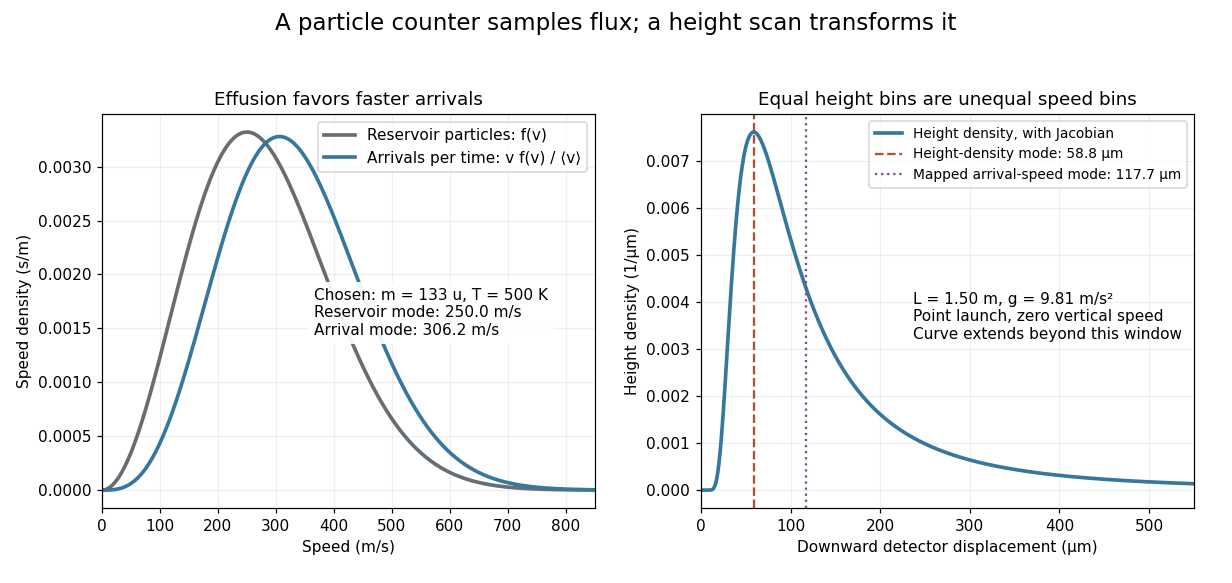
Effusion changes the arrival speed distribution, and a detector-height scan requires another Jacobian determinant
. Original calculated distributions with chosen , , and . These are not historical measurements. Details.
For those chosen parameters, , so the detector-height probability density peaks near . A detector covering only accepts the fractionAt this is about , even before allowing for imperfect detection. Discarding the remainder changes the observed normalization.
Real slits transmit a range of launch heights and vertical velocities. Their geometrical response must be combined with the gravitational deflection and detector width; the point-launch formula is not an exact reduction of the historical apparatus. In the point-launch model, an initial vertical velocity would add to . Source collisions, detector efficiency and alignment can also distort a profile. Varying oven pressure helps distinguish such source losses from an incorrect thermal distribution; inferring a source temperature from the peak alone ignores both selection and the detector's coordinate transformation.
Otto Stern's lecture describes two co-rotating toothed wheels: transit between them must match an advance between openings. He explicitly distinguishes this method from the first historical speed measurement.[ref]
The Method of Molecular Rays by Otto Stern. The method of molecular rays, lecture 12 December 1946, p. 9: rotating-wheel timing, transmission and limited accuracy
For an idealized example, let aligned wheels have equally spaced openings, separation , and rotation rate in revolutions per second. A particle with constant longitudinal speed takes between them. The second wheel advances through revolutions; transmission peaks when that advance is an integer number of opening pitches:With chosen , and , the first two orders select and . A second transmission maximum therefore need not represent a second source temperature. Finite opening widths admit speed intervals around each order, and an additional measurement is needed to distinguish orders. The ideal expression assumes negligible acceleration and constant rotation rate during a flight, with a fixed relative phase between the wheels.
Which speed distribution does an arrival counter measure? Suppose an equilibrium, nonrelativistic ideal gas escapes by effusion through a thin opening into vacuum. The opening is small compared with the mean free path; the reservoir remains at temperature . Let denote its normalized Maxwell speed distribution, with mass and :At a given direction toward the opening, the number crossing per unit time is proportional to the normal component . Integrating over a fixed accepted cone contributes an angular factor independent of . Thus the normalized probability density function for speeds among arriving particles isIts integral is one because . The reservoir mode is ; the arrival mode is . Faster particles get more opportunities to cross the opening. This is a selection effect, not heating after emission.
Specify the observable before applying the formula. An instantaneous count in a fixed segment of the beam weights the arrival flux by the time spent there, proportional to ; in this ideal model its normalized speed law returns to . A detector's speed-dependent efficiency, source collisions or a velocity selector changes the arriving law again. Counting arrivals and counting particles currently present are different measurements.
In 1911, Louis Dunoyer de Segonzac formed a sodium beam in vacuum and collected a deposit on a surface cooled with liquid air. Its shape agreed with straight paths through the slits.[ref]
The Method of Molecular Rays by Otto Stern. The method of molecular rays, lecture 12 December 1946, pp. 8–9: Dunoyer's sodium beam, collimation and cooled collector
A deposit tests the geometry of the surviving paths. A clock or a calibrated deflection is needed to turn their travel into a speed measurement.Contribution to MIRK 2003 proceedings by Vladimir Batagelj and Matjaž Zaveršnik, printed pp. 223–226. The English heading is NetLogo Workshop. Chapter authors are distinct from the proceedings editors and ARNES as web host.
Inspected text: www2.arnes.si/~sspmgiac/mirk2003/Zbornik.pdf
Inspected locators: printed p. 223, contribution title and byline; printed p. 226, English Authors biographies, PDF page index 216. The biographies establish professional specialization at that time, not current employment.
Introducing excess mobile charge carriers into a semiconductor, for example through a contact under biasing. Their subsequent motion and electron-hole recombination can change the electrical conductivity and an output electric current.
There are unlisted articles, also show them or only show them.