
Simon Foner developed a sensitive vibrating-sample magnetometer. A magnetized specimen oscillates relative to pickup coils, producing a periodic change of magnetic flux and hence an induced voltage. Calibration converts that signal into a magnetic moment. Moving the specimen makes its contribution oscillatory, allowing it to be separated from many static background fields. The apparatus turns the geometry and frequency of mechanical motion into a reproducible magnetic measurement.[ref]
Versatile and Sensitive Vibrating-Sample Magnetometer by Simon Foner. Review of Scientific Instruments 30 (1959), sample vibration, pickup coils and calibration

Portrait of Simon Foner
. Source. William Shockley developed the theory of semiconductor p-n junctions and junction transistors. Forward bias injects minority carriers across a junction; diffusion and recombination then determine how those carriers move through the neighboring material. In a transistor, a thin base allows much of the injected population to reach the collecting junction, making one electrical signal control another. The theory connects junction structure and carrier transport with quantitative current-voltage behavior.[ref]
The Theory of p-n Junctions in Semiconductors and p-n Junction Transistors by William Shockley. Bell System Technical Journal 28, 435–489 (1949), junction injection and transistor transport

Portrait of William Shockley
. Source. Ernst Ising solved the one-dimensional nearest-neighbor version of the spin model now called the Ising model. For ferromagnetic coupling and zero external field, its correlations decay with separation as . At every positive temperature the factor has magnitude below one, so correlations vanish at arbitrarily large distance and there is no finite-temperature long-range ferromagnetic order in this model. The result makes the role of dimensionality and fluctuations concrete, rather than assuming that an ordering interaction automatically creates macroscopic order.[ref]
Beitrag zur Theorie des Ferromagnetismus by Ernst Ising. 1925 paper, linear-chain calculation and absence of positive-temperature magnetic ordering
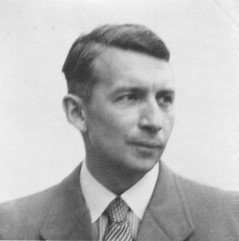
Portrait of Ernst Ising
. Michel H. Devoret coauthored a 1985 measurement of macroscopic quantum tunnelling in a current-biased Josephson junction. At higher temperatures, escape from the zero-voltage state characterized the junction in a thermal regime. At low temperatures, the escape rate stopped depending on temperature and agreed with the predicted quantum escape rate using those independently determined parameters. The comparison supplied quantitative evidence for tunnelling of the collective circuit coordinate, rather than merely observing an unexplained low-temperature switching rate.[ref]

Portrait of Michel H. Devoret
. Portrait identified on the cited institutional profile. Source.A condensed matter physicist who coauthored the quantronium circuit experiment. The superconducting device combined microwave state manipulation with a separate pulsed measurement circuit, allowing coherent evolution and readout of an electrical qubit. It supplied an experimental connection between circuit design and the dynamics of a controllable quantum state.[ref]
Manipulating the Quantum State of an Electrical Circuit by Denis Vion and others. Byline and abstract: controlled evolution and pulsed readout
An experimental condensed matter physicist who coauthored coherent control of a superconducting electrical circuit. Microwave pulses programmed evolution between two circuit states, while a pulsed readout circuit measured the result. The device behaved as an artificial two-level system, making a fabricated circuit a controllable carrier of quantum information.[ref]
Manipulating the Quantum State of an Electrical Circuit by Denis Vion and others. Abstract: quantronium, microwave control and projective readout
Daniel Esteve coauthored the quantronium demonstration of coherent superconducting-circuit control. Its combination of programmable microwave evolution and pulsed readout made an electrical circuit a candidate carrier of quantum information.[ref]
Identity source: iramis.cea.fr/en/spec/gq/membres-gq-en/

Portrait of Daniel Esteve
. Portrait identified on the cited institutional profile.Cristian Urbina coauthored manipulation and readout of a superconducting electrical qubit. Microwave pulse sequences programmed its quantum state, while a separate pulsed subcircuit measured the outcome.[ref]
Identity source: iramis.cea.fr/en/spec/gq/membres-gq-en/

Portrait of Cristian Urbina
. Portrait identified on the cited institutional profile.Hugues Pothier coauthored the quantronium experiment, in which a superconducting tunnel-junction circuit acted as an artificial two-level system with programmable microwave-driven evolution and pulsed quantum measurement.[ref]
Identity source: iramis.cea.fr/en/spec/gq/membres-gq-en/

Portrait of Hugues Pothier
. Portrait identified on the cited institutional profile.Philippe Joyez coauthored coherent control of the quantronium qubit. The circuit separated microwave state manipulation from pulsed measurement, connecting superconducting-device design with controlled two-state quantum dynamics.[ref]
Identity source: iramis.cea.fr/en/spec/gq/membres-gq-en/

Portrait of Philippe Joyez
. Portrait identified on the cited institutional profile.Denis Vion coauthored the quantronium experiment: microwave pulses controlled the quantum state of a superconducting circuit behaving as a two-level system, with separate pulsed readout.[ref]
Identity source: iramis.cea.fr/en/spec/gq/membres-gq-en/

Portrait of Denis Vion
. Portrait identified on the cited institutional profile.Evangelista Torricelli interpreted the support of a Mercury column in terms of external atmospheric pressure. His 11 June 1644 letter to Michelangelo Ricci describes equal column heights in vessels with different upper spaces, testing whether the support came from outside the vessel. In modern hydrostatic pressure notation, , where is the liquid's density and is gravitational acceleration. When the upper pressure is small, the column height measures atmospheric pressure, as in a barometer. Comparing liquids of different densities explains why water requires a much taller column than Mercury.[ref]
Letter to Michelangelo Ricci concerning the Barometer by Evangelista Torricelli. Letter of 11 June 1644, different-vessel comparison and mercury/water height argument; modern pressure notation
A physicist and mathematician associated here with Torricelli's law.[ref]
https://mathshistory.st-andrews.ac.uk/Biographies/Torricelli/. Biography: 15 October 1608 to 25 October 1647; mechanics and hydrodynamics

Portrait of Evangelista Torricelli
. Lorenzo Lippi (1606–1665), painting circa 1647; Galleria Silvano Lodi & Due / TEFAF. Reproduction credited in EXIF to Diego Brambilla / Studio Fotografico Perotti, 2011. PD-Art: Commons records origin-country/life-plus-100-or-shorter expiry, pre-1931 United States publication and its United States public-domain position for faithful two-dimensional reproductions., via Wikimedia Commons. Source.Meng Cui and Changhuei Yang demonstrated digital optical phase conjugation through a multiple scattering sample. A charge-coupled device measured a transmitted light field by wave interference with a reference. A calibrated spatial light modulator then imposed the opposite spatial wave phase on the returning beam. Comparing this return with a zero-phase control showed recovery of the original optical mode. The method separated field measurement from playback and made finite sampling and phase-only control explicit limits on reconstruction.[ref]
Implementation of a digital optical phase conjugation system and its application to study the robustness of turbidity suppression by phase conjugation by Meng Cui and Changhuei Yang. 2010 apparatus, phase-stepped measurement, modulator playback and zero-phase control
An optical physicist and coauthor of the digital optical phase conjugation experiment described there.[ref]
https://engineering.purdue.edu/ECE/People/ptProfile?resource_id=121778. Institutional biography: physics PhD in atomic, molecular and optical physics, and optical research
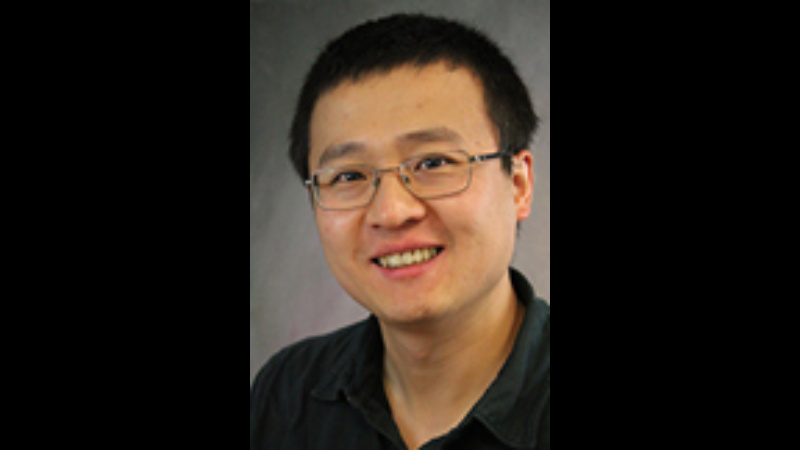
Portrait of Meng Cui
. Institutional portrait identified on the Purdue University biological sciences profile.An experimental physicist known for measurements of electron charge and the photoelectric effect. The Millikan photoelectric experiment describes the apparatus and stopping-voltage measurements behind his 1916 test.[ref]
Robert Andrews Millikan Collection by National Archives and Records Administration. Collection description: full name, 1868–1953 and experimental-physics work

Portrait of Robert Andrews Millikan
. Unknown photographer; Smithsonian Institution Libraries, Dibner Library, Scientific Identity collection, SIL14-M004-03. No known copyright restrictions, as supplied by Smithsonian through Flickr Commons and reviewed on Commons., via Wikimedia Commons. Source.Otto Robert Frisch and Lise Meitner interpreted the barium found after uranium bombardment as evidence that a heavy atomic nucleus could divide into two large fragments. Their 1939 paper related the available energy to nuclear mass differences and the electrical repulsion of the fragments. This supplied a physical account of nuclear fission, connecting a chemical identification of the products with a new type of nuclear transformation and its large energy release.[ref]
Disintegration of Uranium by Neutrons: a New Type of Nuclear Reaction by Lise Meitner and Otto Robert Frisch. 1939 Nature paper, interpretation of barium and energy estimate
A physicist who worked with Lise Meitner on the interpretation of nuclear fission.[ref]
Lise Meitner im Porträt. Treffpunkt der Nobelpreisträger. Das Harnack-Haus in Berlin-Dahlem by Susanne Kiewitz; Early-January 1939 discussion: Otto Robert Frisch identified as a physicist and Meitner's collaborator

Portrait of Otto Robert Frisch
. Photograph by Emilio Segrè, courtesy AIP Emilio Segrè Visual Archives, Segrè Collection. CC BY 4.0, via Wikimedia Commons. Source.A physicist who helped explain nuclear fission. Lise Meitner and Otto Robert Frisch interpreted the energy release associated with the chemical findings of Otto Hahn and Fritz Strassmann. Following these contributions together distinguishes the identification of reaction products from their physical explanation.[ref]
Lise Meitner im Porträt. Treffpunkt der Nobelpreisträger. Das Harnack-Haus in Berlin-Dahlem by Susanne Kiewitz; Susanne Kiewitz, final paragraphs: Hahn–Strassmann chemical findings, Meitner–Frisch interpretation and contributions to fission
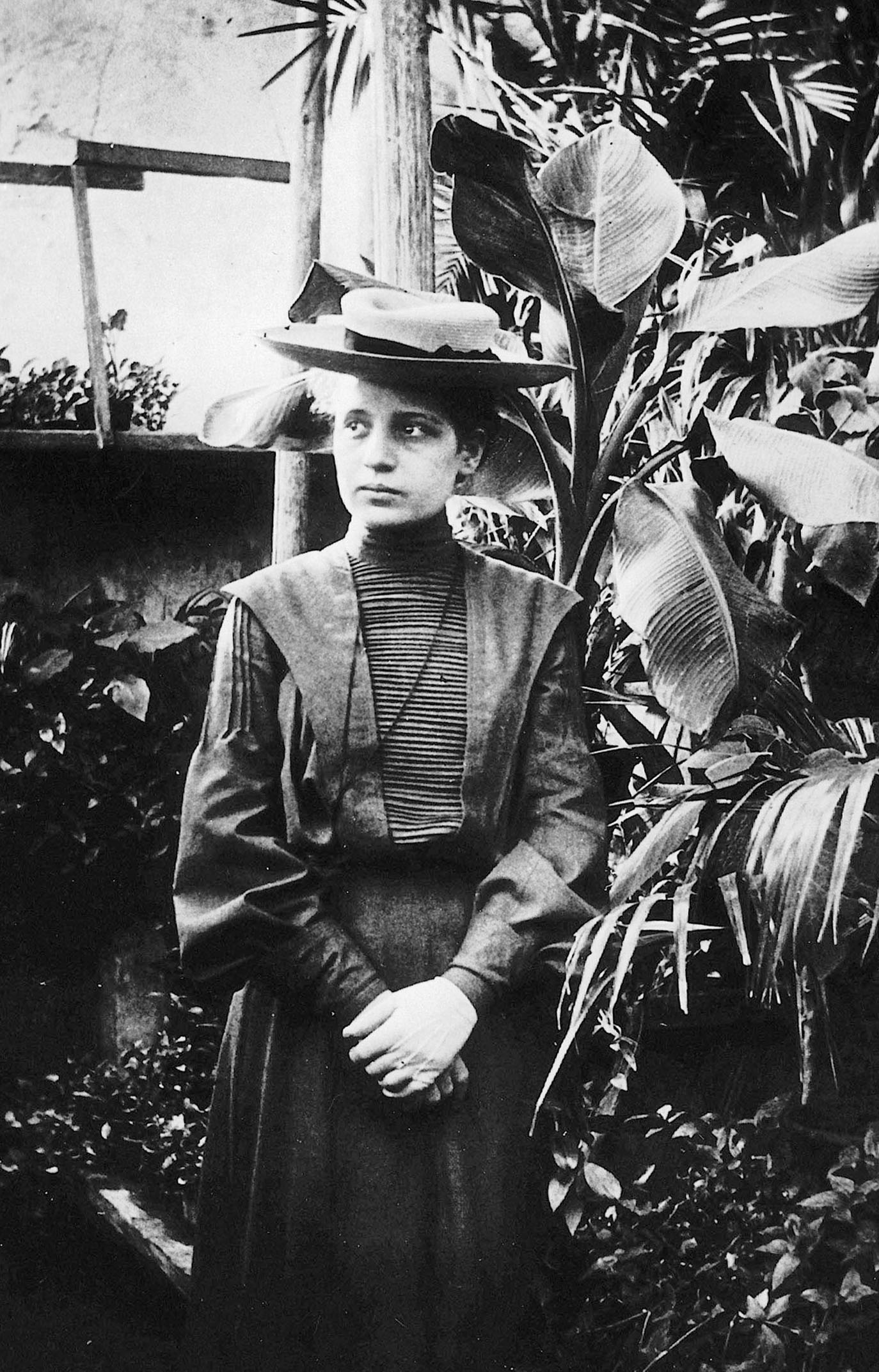


A physicist associated with the Bohr model of the chemical atom. His 1922 Nobel Prize in Physics concerned atomic structure and radiation.[ref]
The Nobel Prize (Niels Bohr) by Niels Bohr Institute. The Nobel Prize: atomic theory and the 1922 award
[ref]
Portrait of Niels Bohr
. Bain News Service, publisher; Library of Congress, George Grantham Bain Collection, ggbain.35303; restoration credited on the File to Bammesk. Library of Congress: no known copyright restrictions; Commons additionally records origin/life-plus-70-or-shorter and pre-1931 United States public-domain grounds., via Wikimedia Commons. Source.
Max Planck introduced energy elements proportional to frequency, , in his statistical treatment of thermal resonators. This led to a mean resonator energy and the corresponding black-body radiation spectrum, connecting entropy counting with measured radiation. For , expanding the exponential gives ; at high frequency the denominator suppresses the energy exponentially. The energy-element argument was a step toward quantum theory, without yet being the later light-quantum account of a free photon.[ref]
On the Law of Distribution of Energy in the Normal Spectrum by Max Planck. 1901 paper, section 10, equations (11)–(12); modern temperature notation
A physicist whose work on black-body radiation led to Planck's law and the use of the Planck constant. He received the 1918 Nobel Prize in Physics.[ref]
Max Planck by Lorenz Friedrich Beck. Biographical account: theoretical-physics appointments, radiation work, 1858 birth and 1947 death

Portrait of Max Planck
. Unknown photographer; Nationaal Archief / gahetna.nl source recorded on Commons. Public domain (anonymous historical photograph, as declared on Commons). Source and usage information on the linked Wikimedia file page. Source.
Paul Dirac sought a relativistic quantum mechanics whose evolution equation remained first order in both time and spatial derivatives. A free-particle Hamiltonian reproduces the relativistic relation when its coefficient matrices satisfy suitable anticommutator identities. The required multi-component wave function incorporates electron spin within the relativistic dynamics. His 1928 paper used this construction to address the doubling of atomic states that earlier theories had treated by adding spin separately.[ref]
The Quantum Theory of the Electron by Paul Dirac. Introduction and construction of four coefficient matrices; modern notation used here
A physicist who developed a relativistic theory of the electron. He shared the Nobel Prize in Physics in 1933 with Erwin Schrödinger.[ref]
Paul A.M. Dirac, Facts by Nobel Prize Outreach. Facts: life dates, joint prize and the 1928 relativistic electron theory

Portrait of Paul Dirac in 1933
. Nobel Foundation, 1933, via Wikimedia Commons. The linked file supplies the original Nobel source and marks the anonymous photograph public domain under its stated term of protection. Source.
A physicist who developed wave mechanics. In 1926, Erwin Schrödinger made the energies of chemical atoms an eigenvalue problem, rather than prescribing a separate quantization rule for each classical orbit. He shared the Nobel Prize in Physics in 1933 with Paul Dirac.[ref]
Erwin Schrödinger - Biographical. Nobel Lectures, Physics 1922–1941; Zurich period and 1926 wave-equation work; joint 1933 award; birth and death dates
The Schrödinger equation turns a proposed Hamiltonian operator into predictions for a wavefunction and its evolution. Boundary conditions can select discrete energy eigenvalues, while quantum superposition makes their relative quantum phases observable through interference. The infinite square well gives a transparent worked example; a hydrogen atom supplies a physical application with a different potential energy.
The Davisson–Germer experiment gives a complementary experimental route into matter waves: an accelerated electron beam scattered from a nickel crystal produces direction-dependent collected electric current. Its apparatus and angular scans make the wave prediction testable. Interpreting a wavefunction as a probability amplitude also requires the Born rule; that statistical interpretation deserves its own history alongside Erwin Schrödinger's dynamics.

Portrait of Erwin Schrödinger in 1933
. Nobel Foundation, 1933, via Wikimedia Commons. The linked file supplies the original Nobel biography source and marks the Swedish photograph public domain (PD-Sweden). Source.
There are unlisted articles, also show them or only show them.